Sunday, 20 March 2011

I WANT TO BE MISS UNIVERSE. FOR THAT I GET DEATH THREATS


Interesting piece from  today's Observer. A surprising topic, perhaps, but it didn't take long to see that I should post it here. This one really comes out of left field - but I really like it when that happens. See how many equality and diversity issues are involved in this one, faithful reader.
"I want to be Miss Universe. For that I get death threats"

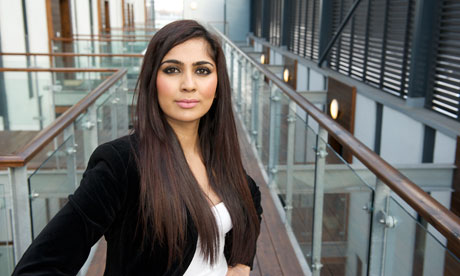
Shanna Bukhari was subjected to a tide of online hate after entering the British heats of the beauty contest. Now she fears her life could be in danger

By Mark Townsend

When Shanna Bukhari decided she wanted to be the first Muslim to represent Britain in a global beauty pageant, she suspected the road ahead might not be smooth, but nothing could have prepared her for the abuse she received.

"I have felt in fear for my life," said the 24-year-old Miss Universe contestant. The attacks escalated last week when Bukhari received her first death threat.

The censure has come from various quarters, ranging from Muslims who claim that she is denigrating the name of Islam, to white supremacists who say that an Asian cannot represent the UK, and to women who condemn beauty pageants as an affront to feminism.

Bukhari, born in Blackburn, grew up in Lancashire and is no stranger to intolerance. When she was nine, she ended up in hospital after a man screaming racist abuse had thrown a brick at her, causing so much damage to her stomach that she suffered a blood clot and had to undergo surgery.

But even she has been surprised by the furore that her participation in the British heats of Miss Universe has prompted. Rather than confirming her hopes that society had progressed since her childhood, the controversy has made her question the state of multiculturalism in modern Britain. "It has highlighted the divisions that exist, a lack of social integration, a lack of adhesion between white and coloured people, and this needs to be addressed," she said. "I thought my participation might be something that people did not agree with, but I never thought I'd get abused."

The attacks on the Manchester-based English literature graduate began after a local newspaper ran an article 10 days ago revealing her ambition to become the first Muslim to represent Great Britain at the beauty contest. Since then, she has received around 300 messages a day on her Facebook page, a handful of which are abusive. Most of the negative comments have come from a minority of Muslim men. "I get people saying, 'you're not a Muslim' and 'you're using religion to get attention'. I said they were the ones bringing religion into it. I'm not representing Islam; I just want to represent my country, and of that I am very proud. They are trying to control me, using religion as a tool to attack."

Bukhari accuses her abusers of having the same sort of mindset as those who support "honour" killings and beat women. Many of the comments are, she says, from individuals who want sharia law instead of a liberal democracy. "We simply live in a multicultural society where there are significant numbers of Muslims. Islam is about peace; abusing me is itself wrong in Islam."

Away from the religious-themed criticism, Bukhari detects a broader anti-female resentment from men who combine sleaze with slurs. "Maybe it's because I'm a woman saying to other women 'stand up for yourself, don't let anyone dictate what you can do or can't'. Some men don't like that," she said.

But not all the abuse is from men: Bukhari has also attracted opprobrium from feminists. "I've had a few girls saying 'shame on you' or 'rot in hell'. But I'd like to know what their real issues are, so we could have a constructive debate."

The abuse that truly shocked Bukhari arrived last Tuesday in the form of an online racist rant. Within hours she had shut down her Facebook fan page, but a friend was then sent a number of internet links to images of people murdered for standing up for their principles. "She rang up and said, 'Shanna, you need to be very careful because he's trying to make me aware that things will happen'. Not a direct death threat perhaps, but he was trying to say that something is going to happen to me."

Bukhari takes the threat of physical violence seriously. She makes sure she is never alone, both in her Manchester flat and on the city streets, and has contacted a private security firm for protection when attending charity events to raise money for the Joshua Foundation, a charity for terminally ill children. She fears that Britain's Miss Universe finals in Birmingham in May will also be a target: "It worries me that haters will turn up. I know what they are capable of."

One Facebook message calls her a "dirty Muslim" and asks why she is representing Britain "when you don't even fucking belong here". Bukhari said: "I actually replied to him in a very calm manner because I'm not one to retaliate, my family taught me to rationalise rather than react. Then I thought 'why can't I represent Britain?' I was born here and am proud to be British. My parents are from Pakistan but I am not going to represent Pakistan as this is my country."

Bukhari says the abuse has been disillusioning partly because she enjoyed a liberal upbringing; her parents sent her to a Catholic school in Blackburn where she was the only Muslim but was "completely accepted". It was only when she moved to Manchester in 2001, she said, that she became aware of segregation as an issue. She does not agree with David Cameron's speech last month in which he asserted that state multiculturalism in Britain had failed. She believes that more must be done to break down mistrust.

Bukhari cites the thousands who have offered their backing. Support has come from Spain, the Middle East, Pakistan, India and China. Most women supporters say she represents not just a role model for Muslim women, but all those who refuse to be cowed by bullies.

During last month's semi-final for Britain's Miss Universe candidate Bukhari received the most public votes. Britain has never won the title. It is increasingly possible that its first victor might also be its first Muslim representative.

Saturday, 19 March 2011

Church helping bring in visitors


There's a nice article in the Leicester Mercury today about St Martin's House - which recently opened for business - and its contribution to the creation of a new "Heritage Quarter" for Leicester. This is an attractive part of the city centre, built up around the old Grammar School which has since relocated to Great Glen. It's a part of town that is largely unknown and underused. I know it pretty well because I lived in the West End of Leicester for four years and used to walk through this area into the city centre.

The pictutre above is a computer generated image, produced to raise interest in St Martin's House while it was still in development. I couldn't find a good "real" image of the building online that I could post here. This is an accurate rendering of how it looks now though.

I'm sure that this new development will be good for this area. But I have one question: what happened to the possessive apostrophe in "St Martin's"? It's in this article from the Mercury alright, but it's nowhere to be seen on the new building!
Church helping bring in visitors

In the latest in his series on Leicester's regeneration, Ian Griffin looks at work to create a Heritage Quarter
One of the most historic parts of Leicester is undergoing a renaissance.

St Martin's House, in Peacock Lane, opened this year after the £7 million renovation of the former grammar school site.

The office and conference complex has helped attract hundreds more visitors to the area – including the 14th century Guildhall and 11th century cathedral – which has been dubbed "the heritage quarter".

Now, the site's owner, the Anglican Diocese of Leicester, is looking to spend an additional £2 million revamping the ground near to the building.

But, like other developers in the city, it is being forced to find alternative ways of raising the cash after Government spending cuts.

Half of the funding for the second phase of the project was due to have come from East Midlands Development Agency (EMDA). However, this was lost following the announcement that EMDA was to close.

Rev Pete Hobson, director of St Martin's House, said: "We see it as a flagship project which can kick-start regeneration of the heritage quarter.

"This is a project costing some £7 million, which has come from benefactors, not the public sector.

"In terms of regeneration, it's a good story, but it's early days."

About £3 million of the funding for St Martin's came from millionaire businessmen David Wilson and David Samworth, with the rest coming from the diocese and fund-raising schemes.

Office rent and conference rooms and grand hall bookings mean St Martin's House will generate income for the diocese within two years.

In the second phase of the development project, the diocese is also planning to make the school playground and cathedral precincts into Cathedral Square.

Mr Hobson said he was looking at ways of raising cash, including approaching other potential benefactors.

Businesses said the new venue was a valuable addition to the area.

Celine Issitt, corporate account manager at Hotel Maiyango, in nearby St Nicholas Place, which runs corporate and wedding events at St Martin's House, said couples could get married at the historic Guildhall, before moving on to the former school for the reception.

"I think the regeneration of St Martin's House has contributed hugely to putting the stamp of 'heritage quarter' on this part of the city," she said.

"Obviously, the Guildhall and the cathedral have always been here.

"However, the attraction of St Martin's House has really brought an increased footfall to the area.

"It's a beautiful backdrop. People come in and see the grand hall at St Martin's and their jaw drops."

Stuart Bailey, chairman of Leicester Civic Society, said: "There's a tremendous amount of historic buildings in that area.

"Anything that attracts people into it is only going to be good. It will boost the economy of the area. This, in turn, will help further development."

Read this article on the Leicester Mercury website, along with reader comments:
http://www.thisisleicestershire.co.uk/news/Church-helping-bring-visitors/article-3348822-detail/article.html

Find out more about St Martin's House and Cathedral Square:
http://cathedralsquare.dioceseofleicester.com/

QUEEN CONFIRMS NEW HIGH SHERIFF AT PALACE CEREMONY


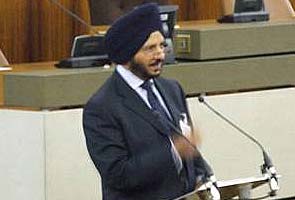
Today's Leicester Mercury carries an article about the official confirmation of Resham Singh Sandhu MBE (photo above)  in the post of High Sheriff of Leicestershire. Resham is a stalwart of Leicester Council of Faiths, having served for several years as its Chair. He continues to be one of the strongest supporters of its work and an influential figure in the city, the county and beyond on issues to do with community cohesion and  good relations. He is currently Chair of the Interfaith Forum for Leicestershrie and Chair of the Sikh Cultural and Welfare Society.

Queen confirms new High Sheriff at palace ceremony


Leicestershire's new High Sheriff has been officially confirmed by the Queen during an ancient ceremony at Buckingham Palace.


Last November, Resham Singh Sandhu, of Oadby, was nominated at London's High Court to take his place in history as one of the latest incumbents of the oldest secular office in Britain.


That nomination has now been officially confirmed by the Queen, when she used a silver bodkin to "prick" his name on a list of all new high sheriffs for England and Wales written on parchment.


Mr Singh Sandhu will take office in the next few weeks.

FEARS OVER CENSUS SECURITY FUEL BOYCOTT THREATS


Eight days to go before the Census on Sunday 27 March. Debate, discussion, dissension and protests continue. Here's a piece from today's Guardian.
Fears over census security fuel boycott threats

Backlash against £150m contract for US arms firm

Law professor dismisses worth of data safeguards

By Matthew Taylor

A growing number of people are planning to boycott this year's census amid increasing fears about data security and the involvement of arms manufacturer Lockheed Martin.

Many campaigners are angry that the £150m contract to run the census has been awarded to the American arms company while others claim the legal safeguards in place to prevent breaches in data security are "so flimsy as to be useless".

Chris Browne, from the Count Me Out campaign, said: "The more people who find out about the involvement of the world's largest arms producer in our census, the more civil dissent we will witness, and the bigger the campaign will get."

Protesters held a day of e-action today in which people were urged to swamp Lockheed Martin a "Twitter storm" and email messages detailing the minutiae of their day. Hundreds more are expected to take part in protests across the country on Saturday, with many saying they are willing to risk a criminal record and a £1,000 fine by refusing to fill in the 32-page questionnaire.

"I have no objection to the census itself because I recognise that it has served an important purpose historically," said Emma Draper, an anti-arms trade campaigner from London: "However, I think it is outrageous that the government can get away with paying a huge arms company millions of pounds in order to process data which is supposed to be of benefit to public services and people's welfare."

Lockheed Martin, which makes Trident nuclear missiles and F-16 fighter jets, won the £150m contract in 2008. A spokesman for the Office of National Statistics defended the company's involvement, stating it was "a major supplier of non-defence-related services for the public sector".

An ONS spokesman said: "The contract for census processing was awarded to Lockheed Martin UK – not Lockheed Martin US – in August 2008. Lockheed Martin UK offered best value for money in an open procurement under European law and the EU procurement directives were satisfied."

Symon Hill, writer and associate director of Christian thinktank Ekklesia, said many people remained unhappy about the decision and that he would be among those not be filling out the census. "Lockheed Martin is a company that has armed dictatorships around the world that has played a heavy role in the disastrous wars in Afghanistan and Iraq... I have reflected at great length. I have not taken this decision lightly but I feel that being asked to fill in the census is being asked to co-operate with an arms company and, as a Christian and as a pacifist, that is something that I feel I can not do in conscience."

Data from the census forms, which need to be completed by 27 March, is sent to a secure plant in Manchester and then to Titchfeld, Hampshire, for analysis. It is owned by ONS and a spokesman said it remains confidential for 100 years.

The government uses the information to award billions of pounds in grants and a boycott would cause widespread policy and funding difficulties. Councils would be hit hardest, potentially missing out on hundreds of millions of pounds if large numbers of people are not counted.

A spokesman for the ONS said: "The census ... is a unique snapshot of the population on a single day and is vital for your local community."

Lockheed Martin does more than 60% of its work for the US defence department and assists more than two dozen American government agencies. It is also reportedly involved in surveillance and data processing for the CIA and the FBI.

Campaigners fear that because it is a US company and therefore subject to the Patriot Act, which allows the US government access to any data in its possession, US authorities could have access to personal data on the UK's entire population.

The ONS has dismissed this claim, stating: "Under the contractual and operational arrangements we have put in place, no employees of Lockheed Martin UK or of its US parent or of any other US company will be able to access personal census data. The US Patriot Act could not therefore, be used to access such data." The spokesman added that a recent independent review had declared: "the public can be assured that the information they provide to the 2011 census will be well protected and securely managed".

Douwe Korff, professor of international law at London Metropolitan University, has questioned the security arrangements, warning that the "legal safeguards against breaches of confidentiality are so flimsy as to be useless".

"In a democracy under the rule of law, one should not have to rely on blind trust in the authorities; the law should guarantee restraint," he wrote in e recent paper. "However, the law that applies to the census data shortly to be collected does nothing of the sort. It does not stand in the way of the UK police, or intelligence services, or indeed foreign law enforcement agencies and secret services, seeking access – not just in exceptional cases but for general 'trawling' or 'fishing'."

Friday, 18 March 2011

This week's visitors

I intend to make it a weekly practice to share with you, faithful reader, information about the number of pageviews the blog has received from different parts of the world in the week just ending.
  1. United Kingdom 336
  2. United States 98
  3. Iran 55
  4. Turkey 36
  5. Russia 29
  6. Ukraine 29
  7. Denmark 24
  8. France 21
  9. Germany 17
  10. Brazil 16
This week's total: 671 (last week's: 715)  These are aggregates of the figures from the top ten countries only. The software doesn't give me access to numbers of pageviews from country number 11 downwards.
I didn't post nearly as much as usual this week, because I had a cataract operation in the middle of the week. that made it a wee bit harder than usual to stay up to speed. I'll be catching up over the weekend, thanks to my new HD eye!

If you're one of our readers from one of these countries, leave a comment and say hello. Tell me something about yourself - and what you think of what you've been reading here.

Thursday, 17 March 2011

Of Gods and Men - really, this time


A couple of months ago, I wrote a tongue-in-cheek piece about not being able to get into a screening of the movie, Of Gods and Men at Phoenix Square (see blog entry for 06 Jan 2011). We weren't the only ones who couldn't get in to see this film - it seemed that every showing was full. It's been brought back to Phoenix Square by popular demand for some extra screenings this week, so today we finally get in: and it's worth the wait. What a film. I can only urge you to see it for yourself, faithful reader.

Here's a review Of Gods and Men that was posted on Twitter some time ago and that I've kept squirrelled away for this occasion:

The monks in French director Xavier Beauvois' extraordinary Of Gods And Men have simple lives: They sell honey in the market, tend to the ailments of local peasants and mark the days with song and prayer. But simplicity can't prevent complications, especially in a country where some regard foreign faces and ideas as affronts.

It doesn't undermine this austere drama, which won the Grand Jury Prize at Cannes last year, to reveal that the story is loosely based on the case of seven French monks kidnapped and possibly killed by Islamist insurgents in Algeria in 1996. (The circumstances of their deaths are contested.) This is not a suspense film, but a meditation on how to live under the shadow of a violent end.

The Cistercian (or Trappist) monks attempt to reconcile their Christianity with their neighbors' Islam, rejecting martyrdom while fostering acceptance. A Buddhist might even call their outlook "non-attachment."
Algerian government officials order the gray-haired monks to return to France, and some of them welcome the command. But "wildflowers don't move to find the sun's rays," argues Christian (Lambert Wilson), the small cloister's Quran-reading abbot. Slowly, the more skeptical (or apprehensive) of the men come to agree.

The monks know they live in peril from extremists, who recently slit the throats of Croatian construction workers. The group's elderly physician, Luc (Michael Lonsdale), recalls a line from Pascal: "Men never do evil so completely and cheerfully as when they do it from a religious conviction."

With its stately tempo and its respect for the ascetic life, the movie recalls Into Great Silence, the 2005 documentary about a remote French monastery. Yet Beauvois' protagonists aren't really all that insulated from the world. They drive cars, attend local celebrations and, on special occasions, drink red wine and listen to Tchaikovsky on a battered cassette player. At one point, Luc even offers romantic advice to a woman who works at the cloister, sounding like any old man who remembers young love with pleasure.

Shot in widescreen format in Morocco, Of Gods And Men is beautifully composed by veteran cinematographer Caroline Champetier. The movie takes much of its power from its mountainous setting, which represents the closeness of both Earth and heaven. When Christian needs to contemplate the monastery's future, he doesn't go to the chapel but into the hills.

The other key to the film is music. Although the monks have divergent opinions and biographies, their unity is palpable whenever they come together in Gregorian chant. In one of the movie's most stirring moments, the men sing in response to the armed helicopter circling above their home.

It was during their singing lessons, Wilson recalls, that "the actors fused into a team and the community spirit began." That may give the music too much credit, but the ensemble cast's interplay does feel warm and unforced. Wilson himself (who's best known in the U.S. for the two Matrix sequels) seems far more serene than his usual cinematic self.

Although the monks don't seek death, Of Gods And Men can be seen as an ode to religiously motivated self-sacrifice. But Beauvois (who co-scripted the movie) deliberately leaves the story open-ended. The value of these men's lives, he's noting, is not defined by how they ended.

This review is taken from the website of National Public Radio in the USA. Read it in context here:
http://www.npr.org/2011/03/04/133959585/of-gods-and-men-faith-tested-faith-proved

Monday, 14 March 2011

MINDFULNESS & MORALITY 9: MUSLIM PERSPECTIVE


At Christchurch, Clarendon Park Road this evening for the ninth session of Mindfulness and Morality, a twelve-week course offered by Christians Aware as part of their Faith Awareness programme.

This time a Muslim perspective is presented by Dr Asaf Hussain, Chair of the Society for Intercultural Understanding in Leicester (in the photo above with his wife, Freda, a founding member of Women for Interfaith Understanding and former Head Teacher at Moat Community College).


He speaks about how Islam is both a religion and a civilization. Taking a societal approach, rather than the individual, Asaf shows us a process that doesn't focus on the well-known Five Pillars of Islam. He describes how faith (iman) leads to action (amal), the principal action being the establishment of community (ummah) which is built on the twin foundations of justice (adl) and knowledge (ilm). Moral standards and ethics emerge, Muslims work out how they should live together, as do individual values. Asaf discusses how these ethics have operated in commerce, politics and warfare. His thesis is that today's apparently all-consuming moral dilemmas for Muslims arise from the fact that they are alienated from Islam. Such  alienation takes two forms: estrangement and powerlessness, which characterise Islam until the worldwide Muslim community can reconnect with the source of their faith and the wellspring of their civilization. That would be the "mindfulness" dimension of this session, then.

There are 13 here tonight (including Asaf). We split into three groups of four for discussion, which takes a form different to the way we've done it in previous sessions. Asaf hasn't given us a dilemma, as our previous facilitators have done, so what we do is devise our own dilemmas based on what we've heard this evening. We come up with the questions this time rather than answers. three such dilemmas, originated by the groups are shown below:

Fatima is Head Teacher at a secondary school in England that has a large number of Muslim students on the roll. One day two parents bring their daughter, who is wearing the full veil, to an interview with a view to enrolling her in the school.  Fatima suspects that the “girl” is actually an adult and beyond the age range of the school. She wants to check this out by seeing the prospective student’s face but asking the girl to show herself could be seen as being disrespectful. What should Fatima do? Would it make a difference if the Head Teacher were male? Would it make a difference if she were not a Muslim herself?

Dr Hart is a practising Christian who went to live in a Muslim country to work as a general medical practitioner for the local community. This was working well until a local political change brought in a Muslim fundamentalist who told the doctor to convert to Islam or leave the area. If he continues to work as a doctor and a Christian his life may be in danger! What should he do?

Ali is a prolific writer on Islam, who focuses on teachings in the Koran that stress how religious faith should be accompanied by good actions aimed at building up harmony, not only between Muslims of different schools but also between Muslims and people of other faiths. He is nearing completion of his latest book challenging Islamic fundamentalist practices. He receives a letter telling him not to publish this new work or he will be killed. What should he do?

THE MULTICULTURALISM THAT THE EUROPEAN RIGHT FEARS SO MUCH IS A FICTION - IT NEVER EXISTED


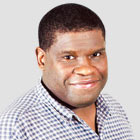
An excellent piece in today's edition of The Guardian by Gary Younge. Mind you, all Gary Younge's pieces in The Guardian are excellent, in my opinion.
The multiculturalism the European right fears so much is a fiction – it never existed

The state never backed cultural difference at the expense of cohesion. What is emerging is people's lived experience

On 12 March 1983 A Sivanandan, one of the sharpest minds on the British left, gave a talk at the Greater London Council Ethnic Minorities Unit Consultation on Challenging Racism. "I come as a heretic, as a disbeliever in the efficacy of ethnic policies and programmes to alter, by one iota, the monumental and endemic racism of this society. There is nothing wrong with multiracial or multicultural education as such … But [it] has become the vogue … Government monies for pluralist ploys – the development of a parallel power structure for black people, separate development, Bantustans – a strategy to keep race issues from contaminating class issues."

The left has long had a critique of multiculturalism. While Tories were still arguing for Nelson Mandela's imprisonment, there were progressive voices debating its inadequacies, limitations and potential. The notion that those who attack it today, in Britain or elsewhere, are slaughtering a holy cow is laughable.

But Sivanandan was contesting something definite, whereas the target of the more recent onslaught is vague. Over the last decade multiculturalism, like political correctness, has come to mean whatever its opponents want it to, so long as they don't like it. Usually, the policies and dilemmas referred to are difficult to fathom or entirely invented. Ill-defined, the term is much-maligned – a lightning rod for the majoritarian impulses, cultural anxieties, economic insecurities and nationalist mythologies of the 21st century. Its contemporary critics keep telling multiculturalism's supporters to admit it has failed, without identifying what "it" is and who ever supported the lampooned version they present.

In this debate there are two types of multiculturalism: one rooted in fact, the other in fiction. The multiculturalism of fact is the lived experience of most people in Europe and the world. Cultures are dynamic, and emerge organically from communities. None exist in isolation or remain static. So the presence of a range of cultures in Britain or anywhere else is not novel, but the norm.

This is not the product of our genius for tolerance as a nation but of constant negotiation. Take the Notting Hill carnival. It emerged as a response to racist attacks after teddy boys went on a "nigger hunting" spree in 1958. Today it is a mainstay of British culture, but it was once viewed as inimical to British culture. "Many observers warned from the outset that mass immigration from poor countries of substantially different culture would generate anomie, alienation, delinquency and worse," argued the Daily Telegraph in 1977.

Its survival has little to do with government policy. Governments can barely clear snow or make the trains run on time. They cannot single-handedly create or thwart culture, let alone multicultures. The French have staked their founding revolutionary creed against the notion of multiculturalism. They are losing. Like it or not – and the state doesn't – it's a multicultural country.

Germany insisted for two generations that it was not an "immigrant country": that didn't mean there were no immigrants there. Not recognising something does not mean that thing does not exist. It merely means you don't see it.

Moreover, these multicultural facts have nothing to do with race, religion or immigration. The Bretons in France, Basques in Spain, Bavarians in Germany and Sicilians in Italy are a few examples of cultural affiliations that thrive independently of the nations they inhabit.

This is the multiculturalism many of us on the left, including Sivanandan, are defending. The right to assert autonomy and cultural difference underpinned by an understanding that national identity is just one among many identities and may well not be the primary one: an affirmation of plurality against calls for assimilation that attempt to first invent and then enforce "British values" and other national orthodoxies.

Then there is the multiculturalism of fiction. This evokes a liberal, state-led policy of encouraging and supporting cultural difference at the expense of national cohesion. It champions practices, we are told, that have caused segregation, alienation and ghettoisation of racial and religious minorities. This, the argument continues, has laid the basis for an acceptance of abhorrent and barbaric practices, such as honour killings, forced marriages and female genital mutilation, that sacrifice the basic tenets of western, liberal civilisation and universalism at the altar cultural tolerance.

There are several problems with this framing but for now let us just deal with three. First, in most of Europe no such co-ordinated policies ever existed. In many places where "multiculturalism" is currently being read its last rites, it never actually lived in its professed form. "We never had a policy of multiculturalism," explains Mekonnen Mesghena, head of migration and intercultural management at the Heinrich Böll Foundation, responding to Angela Merkel's claim that the "multikulti" experiment had failed. "We had a policy of denial: denial of immigration and of diversity. Now it's like we are waking up from a long trance."

In Britain, it is similarly difficult to discern precisely what critics are referring to beyond the activities of some local councils. In his most recent speech on the subject, David Cameron did not offer one concrete example.

Second, the trend towards segregation is a myth. Asian Muslims, Sikhs and Hindus all marry outside of their own groups at the same rates as whites. For most ethnic minorities in Britain, roughly half or more of their friends are white while only 20% of those born in Britain have friends only from their own group. So even if the state were promoting separation, it clearly isn't working.

Finally, who, with any credibility, on the left has ever supported the crimes described? Like "on-street grooming", "black-on-black violence" or the "down-low", such practices are specifically ethnic, racial or religious terms employed to pathologise a specific community in which every transgression is refracted through an ethnic or religious lens. Imagine we invented a term "toff bonking" to describe the infidelities of the upper classes, and then decried the epidemic every time Boris Johnson was caught in an indiscretion.

That doesn't seek to understate these problems but to recast them. Forced marriages are kidnapping; honour killings are murder. We have laws for these that should be applied without fear or favour. I've yet to hear anyone on the left argue otherwise.

These ostensible liberal dilemmas seek to pit opposition to Islamophobia against support for liberalism as though they are mutually exclusive. But in reality they pose no challenge at all. You don't give antisemitism a pass if it comes from a Muslim any more than one would give Islamophobia a pass if it came from a Jew. If a state forces women to wear a burqa, we should oppose that. And if the state bans women from wearing a burqa, we should oppose that too. Because as feminists and progressives we believe the state has no right to tell women what to wear.

That does not mean there are no problems. But it distorts the reality and misstates the true nature of the threat to national cohesion, which comes not from a fictitious multiculturalism but from the very real economic vandalism wrought by this coalition government. The decimation of public services will reduce the common space – be it schools or community centres – that we all might share, while growing inequalities will provide greater opportunity for scapegoating minorities.

The multiculturalism of fact is rooted in considerable achievements of who we have become. The multiculturalism of fiction is rooted in the fear of what has never been.

Read this article on The Guardian website, along with reader comments:
http://www.guardian.co.uk/commentisfree/2011/mar/14/multiculturalism-fears-fiction-europe-state

RELIGION, BELIEF, DISCRIMINATION & EQUALITY PROJECT


A meeting in the Welcome Centre this morning with Dr Sariya Contractor (photo above), Project Researcher from the University of Derby on the Religion, Belief, Discrimination and Equality Project, which is being conducted there. She's focusing on Leicester for the next four weeks, at the start of this project. The project is explained in the text below, which is copied from a news release sent out by the university.
Religion, Belief, Discrimination & Equality in England and Wales: Theory, Policy and Practice (2000-2010)
The experiences and views of communities and individuals in Leicester about religion and belief, discrimination and equality are being sought as part of a national research project.
The University of Derby is leading a three-year academic study investigating how attitudes and experiences of different religious and belief groups in England and Wales have evolved since 2000 in the light of changes that have taken place during this period in the law, among religions and in society.
It is working with academics from the University of Oxford and the University of Manchester on the three-year study entitled: Religion and Belief, Discrimination and Equality in England and Wales, Theory, Policy and Practice, 2000-2010.
Paul Weller, Professor of Inter-Religious Relations at the University of Derby, is the Principal Investigator for the study. The study has been funded by the Arts and Humanities Research Council (AHRC) and the Economic and Social Research Council (ESRC) and is part of the joint Religion and Society research programme.
University of Derby researcher and colleague, Dr Sariya Contractor, is preparing to visit the neighbourhoods, streets and suburbs of Leicester this month (March). She seek to build up as detailed a picture as possible of local people's experiences and understanding of issues to do with equality and discrimination on the basis of religion or belief to feed into the overall study.
Leicester is the first location in a series of qualitative research studies to take place in key geographic areas. Later in the year, Sariya will visit Cardiff, Blackburn, Newham in London and Norwich.
Sariya said: "This is a major national research project and I will be looking to capture the experiences, views and feelings of a wide range of groups and individuals as part of the work. I will be involved within the community, gauging views and building as comprehensive a picture as is possible."
As well as talking with people from a wide range of religious traditions, communities and groups Sariya will, in each location, be organising a focus group with around a dozen participants who understand themselves to be 'non-religious'. She will also conduct interviews with participants from a variety of civil society, public, private and voluntary sector organisations.
Sariya will be identifying a range of organisations to seek out participants to take part in the research. She is also willing to hear from people living and/or working in Leicester who may themselves be interested in taking part. She can be contacted in Leicester during March, via her email which is S.Contractor@derby.ac.uk
Sariya joined the University of Derby having completed a PhD at the University of Gloucestershire, related to Muslim women being given the opportunity to tell their stories and how these could facilitate inter-community dialogue and social cohesion.
The latest study will build on previous Home Office commissioned research led by Derby (1999-2001) entitled Religious Discrimination in England and Wales which found evidence of unfair treatment especially in education, employment and media, particularly as reported by Muslims, Sikhs and Hindus.
The Religion and Society research programme has been supported by the two research councils (AHRC and ESRC) with a contribution over five years of £12.3m to fund research of the highest quality on the interrelationships between religion and society.
The Religion and Society Programme aims to foster collaborative research across the arts, humanities and social sciences; to build capacity in the study of religion; to engage interested parties in academia and beyond; to further understanding of religion in a complex world. The programme started in January 2007 and will end in December 2012.
AHRC Chief Executive Professor Rick Rylance said: "This is a great opportunity to embark on what promises to be a remarkable and illuminating project - and one that is very timely."
Other research approaches being used in the study include a postal questionnaire; a comprehensive review of relevant data from various sources such as the 2001 Census and the Home Office Citizenship Survey; and a series of national seminars to take place next year with key individuals from religion and belief organisations, the law, and the public, private and voluntary sectors.

Many believers are offended

Another response in the Leicester Mercury Mailbox to Leicester Secular Society's poster campaign about the Census. This makes an interesting companion piece to Allan Hayes's "First Person" column on the same subject (and on the same page of the paper).
Many believers are offended


Dr Emma Chung, of the Leicester Secular Society, says (Mercury, March 5) that there has been no complaints about their census campaign.


This is probably because God-fearing persons have, through their beliefs, learnt to be tolerant, forbearing and uncomplaining. It does not follow that there is no offence to many persons who hold to the commandments of God, one of the prime ones being "Thou shalt not take the name of the Lord thy God in vain".


The poster makes a mockery of an Eternal Being, known, revered and adored by millions of persons. The statement on the campaign is self conflicting as it invokes the name of a Being whose existence they deny.


It is also a pointless exercise as we understand there is provision on the census form for non-religious persons to indicate they have no religion.


It seems to me that the fact that persons feel the need for this campaign is because deep, deep down they are uncomfortable about their denial of the existence of God. May I suggest they seek the inner peace and blessing of coming to know that God.


Ian Benson
Leicester