Showing posts with label Census 2011. Show all posts

Friday, 5 July 2013

CITY WELCOMING REST OF THE WORLD

This article appears in today's Leicester Mercury:

City welcoming rest of the world
by David Owen
Nearly a quarter of all people living in the East Midlands who were born abroad reside in Leicester, according to new study.
Not only do 24.7 per cent of the region's foreign-born residents live in the city, but Leicester also has the highest number – 100,843.
The city also saw the largest numerical growth in the migrant population – 46,283 additional non-UK born residents – in a 10-year period.
It follows a study of the migrant population in England and Wales by Oxford University's Migration Observatory, based on its analysis of 2011 Census figures compared with the previous Census in 2001.
The research is the most comprehensive carried out on the city's migrant population.
It reveals that Leicester's migrant population has increased by 71.7 per cent – from 64,560 to 110,843 in 10 years.
The data reveals that of the 329,839 people living in Leicester – the East Midlands' largest city – in 2011, 33.6 per cent were not born in the UK, the highest proportion of any place in the region.
Dr Carlos Vargas-Silva, the senior researcher leading the Census project, said: "Reports produced by the Office for National Statistics often only provide information about broad immigration trends in the country.
"The purpose of our study was to give people a clearer idea of what is happening as far as immigration is concerned where they live."
Residents born in India represent the most numerous non-UK-born group in Leicester (37,224 residents, 34 per cent of Leicester's foreign-born), followed by residents born in Kenya (7,118; 3.3 per cent); Poland (6,417; 2.9 per cent); Pakistan (3,534; 1.6 per cent), and Zimbabwe (3,377; 1.5 per cent).
Of the proportional change in foreign-born residents since 2001, Poland represents the biggest increase (1,111 per cent; 530 to 6,417), followed by China (728 per cent; 290 to 2,401); Iran (508 per cent; 111 to 675); Zimbabwe (270 per cent; 913 to 3,377, and Nigeria (269 per cent; 307 to 1,133).
Dr Vargas-Silva said: "Leicester is interesting in many ways. We expected it to be an important destination for immigrants to the country, but what we found is it is also much more diverse than most other areas. People come to Leicester from all over the world."
He said the type of immigration was also interesting.
"You have networking migration, which is people who have family, friends and relatives already living in an area, and also areas with high student populations and people looking for work. But while some places like Vauxhall, in London, have high migrant populations due to students, and Boston, Lincolnshire, with a large migrant workforce, Leicester scores high on all counts."

Tuesday, 22 January 2013

JEDI SNOWMAN


A snow Yoda (or "Snowda", if you will) spotted in Leicester and tweeted by Dr Paul Abel, Astronomer at the University of Leicester and Co-Presenter of BBC's The Sky at Night.

In the 2011 Census, 176,632 people in England and Wales identified themselves as Jedi under the "Other Religion" section (out of more than 240,000 respondents who selected "Other").

I know it's meant to be Yoda; however I can't help but be reminded of Batfink! 

Thursday, 27 December 2012

A TRIBUTE TO THE POWER OF SHARED VALUES

Riaz Ravat's First Person column appears in today's Leicester Mercury (but not on the website):
A tribute to the power of shared values
Riaz Ravat looks back over an eventful year that has brought faith communities closer together
This year will surely go down as one of the most remarkable in the history of the UK. On a spring day in March , Leicester paid a colourful and vibrant tribute to the Queen on the first stop of her Diamond Jubilee tour. The royal party was treated to a show that will live long in the memory.
The Church of England is interwoven into the fabric of this country and the leadership shown by the Diocese of Leicester, with Leicester Cathedral as the centrepiece, enabled a mosaic of faith communities to join in the celebrations to show they too are firmly rooted in the identity of this country.
2012 as also marked as the Year of Service. Launched in January, the initiative encouraged faith communities to work collectively to deliver charity efforts to needy causes.
"Confirm us in service to the world of humanity so that we may become the servants of Thy servants, that we may love all they creatures and become compassionate to all thy people."
These words of 'Abdu'l-Bahá, the eldest son and successor of Bahá'u'lláh, the founder of the Bahá'í Faith, were delivered in 1912 and it was fitting the Bahá'í community was instrumental in launching a year of service.
One of the many points to note from the release of the 2011 Census is how the definition of "minority" is being redrawn locally.
The presence of smaller groups, such as the Bahá'í and Jewish communities, poses challenges to larger communities and defines the true meaning of a decent and progressive society. The challenge is how we enable these minorities to express their confidence and to contribute their fullest, to the life of the city, county and country.
Throughout the year, we witnessed Bahá'ís, Buddhists, Christians, Hindus, Jains, Jews, Muslims, Sikhs and those of no professed religions belief coming together for the selfless service of others.
Whether this motivation is inspired by God, political doctrine or human concern, we must begin to address what wee mean by  shared values, purposes and the nature of "good", not only for today's world, but for tomorrow's.
As we reflect on service, let us not forget the dedication and decency of the outgoing Archbishop of Canterbury, Dr Rowan Williams.
The impact of the General Synod voting against female Bishops is not restricted to the Church of England. Far from observing these developments, those from other persuasions must now take stock and ask, how much longer will we accept the gap between the principle and practice of equality?
The spiritual richness of service and compassion which faith communities possess, undergirded by their respective "golden rules", is all too often tainted by humanity's thirst for selective salvation.
Riaz Ravat is deputy director at St Philip's Centre, Leicester

Thursday, 13 December 2012

CENSUS SHOWS THE TIMES THEY ARE A-CHANGIN'

Harry Perry's First Person column appears in today's Leicester Mercury (but not on the website):

Census shows the times they are a-changin'
Harry Perry, president of the Leicester Secular Society, gives his view on lessons from the census
As the new President of Leicester Secular Society, my particular interest in the 2011 Census has been data relating to religion and belief in Leicester. These stats are quite different from the national averages, revealing a city that is more diverse than most other places and, notably, where the four main belief categories (Christian; Non-religious; Muslim and Hind) are relatively evenly balanced, with a sizeable number of Sikhs too.
The new figures show that the number of Christians (of ALL denominations) is now down to only 32% of Leicester's population. Those without religion (atheists) are the second largest group with almost 23%, while Muslims check in at nearly 19% and Hindus at just over 15%, Sikhs are at about 4.5%. In other words, no single belief group is anywhere near dominant.
I believe this means that no spokesman for any single religion can be seen as a moral spokesman for the city. Each belief community has something to offer in this respect.
The key objective of Leicester Secular Society is to achieve a "separation of religion from the state". We have no desire to ban religion, worship of gods or religious rituals. These are matters of personal conscience and we will do as much as anybody to protect those fundamental rights.
Indeed in a world where religion often seeks to impose its dogmas on to society as a whole it is increasingly obvious that only a secular state can guarantee freedom of religion and belief for all.
We believe strongly that religion can divide people against each other, especially when national or local government gives favoured status to one belief over the rest.
This is why we have campaigned against the creation of ever-more publicly funded "faith" schools and have called for the ending of religious rituals in public bodies, like prayers in council meetings and the religious ceremony to welcome a new lord mayor.
This is why we believe that national and local celebrations of events like Remembrance Day for those killed in war should not be based on a specific religious ritual but on secular respect, reflecting that those who died had many different beliefs.
This is why we must question the financial privileges given to religious bodies, such as publicly funded chaplains in hospitals, prisons and armed forces. If the religious want them, then it is obvious who should pay.
In terms of policy making it is time that those who live good lives without religion were given proper respect with consultation alongside religious bodies.
We must stand by "one law for all". The new Census statistics must give all the city's policy-makers and opinion formers pause for thought.
Harry Perry, Leicester Secular Society

CLARIFICATION

This article appears in today's Leicester Mercury:

Clarification
In an article in Wednesday's paper, on the Census results, the Mercury quoted Canon Barry Naylor as saying: "We seem to be at a time when the Church seems to be doing its best to alienate people."
Canon Naylor has asked us to point out that what he meant was the Church was unintentionally alienating people on several issues, such as women bishops, and not that it was intentionally doing so.
He added: "On several issues, we have shot ourselves in the foot."We are happy to make this clear.

Wednesday, 12 December 2012

CENSUS 2011: LEICESTER & LEICESTERSHIRE BY NUMBERS

This article appears in today's Leicester Mercury:
Leicester and Leicestershire by numbers
Census 2011: Survey shows changing faces of the population, with details of births, marital status, backgrounds and our religions.
The latest information from the Census revealed all sorts of interesting facts about the city and county.
Here is your at-a-glance guide to the main ones.
Whenever a statistic is given for “Leicestershire”, that means “excluding the city”.
Marital status
There are 996 people in same-sex civil partnerships in Leicestershire, and 457 in the city.
Just over half – 52 per cent – of the population of Leicestershire is married or in a same-sex civil partnership. In the city, the figure is 43 per cent.
In the county, 12 per cent of people cohabit. The figure is slightly less in the city, at nine per cent.
The East Midlands has the highest proportion of cohabiting couple households in England and Wales, at 11 per cent.
Ethnicity
In Leicestershire, 89 per cent of the population is white British. That is higher than the national figure, which is 80 per cent.
In the city, 45 per cent of people are white British.
The second biggest group in the city, at 28.3 per cent, is Asian or British Asian Indians. This is the highest proportion in England and Wales.
The national figure for this group of people is 2.5 per cent.
Two per cent of city is Asian or British Asian Pakistani, which matches the national figure.
Oadby and Wigston has the fifth highest Asian or Asian British Indian population in England and Wales – 10,000, or 18 per cent.
This is a six per cent increase on 2001.
National identity
Some 40.7 per cent of people in Leicester, and 68 per cent of people in the county, class themselves as English. Nationally, the figure is 60 per cent.
Country of birth
In the city, 214,403 people were born in England, which is 65 per cent of the population – compared with 84 per cent nationally. Some 15,927 people who live in Leicester were born in EU countries, which is five per cent of the population – compared to four per cent nationally.
In the city, 92,983 people were born in other countries.
This is 28 per cent of the population, compared to just nine nationally.
Some 66 per cent of people in Leicester were born in UK, 10 per cent in Africa, 17 per cent in the Middle East and Asia.
The city has the highest percentage, in England and Wales, of population of people who were born in India and Zimbabwe, and the seventh highest in England and Wales for people born in Africa.
Living in the East Midlands are equal amounts of people who were born in Scotland as India – it is 1.5 per cent for both.
Household language
In Leicester, 18 per cent of households have nobody who speaks English as a main language, compared with four per cent nationally, making Leicester the eighth highest in English and Wales.
In 70 per cent of households in the city, every occupant speaks English as their main language, compared with 91 per cent nationally.
Religion
In the city, 32 per cent of people are Christian. Almost a quarter – 23 per cent – said they were of no religion, 19 per cent said they were Muslim, 15 per cent Hindu, four per cent Sikh, 0.4 per cent Buddhist, and 0.1 per cent Jewish.
Leicester has the third highest population percentage of Hindus in England and Wales, and the 11th highest Muslim and 12th highest Sikh percentage of population.
In the county, 60 per cent of people are Christian. Just over a quarter – 27 per cent – said they were of no religion, 3 per cent are Hindu, one per cent are Muslim, one per cent are Sikh and 0.1 are Jewish.
The highest percentage of Christians in the county is in Melton – 68 per cent.
In the county, Oadby and Wigston has the highest percentage of Sikhs, Hindu and Muslims – seven, nine and six per cent respectively.
Oadby and Wigston has the sixth highest population in England and Wales for Hindus, and the eighth highest for Sikhs.
The highest percentage of people who said they had no religion can be found in Charnwood, where 29 per cent said that was the case.
In Leicester, there are also 31 Druids, 22 Heathens, three members of the Occult, 320 Pagans, 20 Satanists, 10 Scientologists, 62 Wiccans, 30 Heavy Metalists and 778 Jedi Knights.

DIVER-CITY

This article appears in today's Leicester Mercury:
Diver-city
White British people now form less than half of the population of Leicester.
Figures released yesterday revealed 45 per cent of the city's residents are white British – compared with 61 per cent in 2001.
About 49 per cent of the population is made up of people from Asian, African or Caribbean or mixed race backgrounds and about 5 per cent are white but not British.
The numbers were the latest to be released by the Office of National Statistics from the 2011 Census.
The city's 93,335 Asian or British Asian Indians make up the next biggest ethnic group in Leicester, accounting for 28 per cent of the population – an increase of two per cent since 2001.
Leicester now has the highest proportion of people of that ethnic group in England and Wales, where three per cent of the total population is Asian or British Asian Indian.
Meanwhile, two per cent of people in Leicester are Asian or British Asian Pakistani, equalling the average for England and Wales.
City mayor Sir Peter Soulsby said: "It has always been recognised we have a diverse community in Leicester, and I think that is a great strength. It is quite interesting these figures should come in the year the Queen chose to start here jubilee tour here – obviously it is a strength that she recognised, too.
"These statistics are so useful as they help remind us of the people in the city.
"I think you will find a large proportion of people who, for instance, might say they are Asian will actually be Leicester born and bred."
Sir Peter said the figures would be analysed to make sure the council was providing services suited to the whole population.
The statistics, which are made up of information provided by residents, also revealed 65 per cent of the city's population was born in England.
This is lower than the average for England and Wales, which is 84 per cent.
The religious make-up of the city's population has changed drastically since the last census in 2001.
The most common religion is still Christianity. However, it is now the religion of 33 per cent of city residents, compared with 45 per cent in 2001. The next biggest group is people who said they had no religion. This accounted for nearly a quarter – 23 per cent – of people in the city, and is up six per cent since the last census.
Canon Barry Naylor, the Bishop of Leicester's adviser on urban issues, said he thought the change was down to people feeling like they could be "more honest" about their religious beliefs.
"I think in the old days people would just say 'put me down as C of E,' because they felt they should," he said.
"I think when people are more honest, it helps to show where we are.
"Also, we seem to be at a time when the church seems to be doing its best to alienate people, and that means we are not very effective at communicating what the Christian gospel is about.
"That could be a factor here."
The city has the third highest percentage of Hindu people in England and Wales – 15 per cent.
Leicester has the 11th highest percentage in England and Wales of Muslims, who account for 19 per cent of the population, an increase of eight per cent since 2001.
Overall in Leicester, 51 per cent of residents class themselves as white, regardless of where in the world they are from originally, and 49 per cent as not white.
Suleman Nagdi, chairman of the Federation of Muslim Organisations, said: "I think we are seeing what makes Leicester so unique – there is no such thing as a majority.
"I think it shows we need to keep working hard to keep our relationships going."
The figures released yesterday were the second set of statistics released from the 2011 census.
Population figures were revealed in July, when the Mercury reported the city has 329,900 residents – 16 per cent more than in 2001 when the figure was about 282,800 – the fastest growth of any city in the region.
More than a quarter of Leicester's population – 27 per cent – is aged 20 or under, making it the youngest population in the East Midlands.

Wednesday, 4 May 2011

May the fourth be with you


From time to time, this blog mentions special days in the calendars of the various religions, or notes particular occasions throughout the year when something special brings different faiths together – World Religion Day, Earth Day etc.

Today has become known as Star Wars day, for obvious reasons. You can check it out on Wookieepedia: http://starwars.wikia.com/wiki/Star_Wars_Day

Those who entered "Jedi Knight" in the religion section of the 2001 Census were consigned en masse to the "No religion" category. Back then, an internet campaign encouraged people to write in “Jedi” as their religion. An email supporting the campaign urged people to declare themselves as Jedi knights, “because you love Star Wars ... or just to annoy people.” This was included in a feature on the BBC national news, the night before the 2001 Census. That probably bumped up the number a bit: 390,000 people in England and Wales did so (0.7% of population). That’s greater than national figures for these recognised faiths:

·         Baha’i 5,000 (>0.01% of population)
·         Buddhist 144,453 (0.3% of population)
·         Jain 15,000 (0.03% of population)
·         Jewish 259,927 (0.5% of population)
·         Sikh 329,358 (0.6% of population)

In Leicester 2,371 people wrote in “Jedi” as their religion in the 2001 Census. that was 0.8% of the city's population.

Now: whenever I meet someone who states proudly that they’re one of those who put their religion as “Jedi” in the 2001 Census, I tell them that if they can show me a Jedi trick, I’ll convert to it – in fact, I’ll do better than that, I’ll become their Padawan learner. Hasn’t happened – yet.

Mind you, I don’t see the point in giving people the right to declare their religious affiliation, even giving them the freedom to write in the religion of their choice, but then the government gets to say, “No, we’re not having that.”

It will be interesting to see how many people identifed themselves as Jedi in the 2011 Census. I'd predict that the number will have dropped considerably but we'll have to wait and see to what extent it was a jok or a fad - and how many have stuck with it.

There's a myth that if enough people write in something (just about anything) in the "other" section of that religion question, then the government would be compelled to classify it as a religion. There was a fiarly low key campaign this time to get Manchester United fans to put that as their religion.

Here’s a link to one of the first widespread stories about the Jedi as a religion in this country, published in the free daily paper. I searched it out on the Metro website, where the date isn’t displayed, but I recall it being some time in the summer of 2008. I’m unable to copy the text from the website but here’s the link: http://www.metro.co.uk/news/84822-brothers-build-jedi-church-in-wales

It’s not so much the article itself that I liked, so much as a reader’s response in the letters page a couple of days later. The text of that letter isn’t available online and I didn’t keep a copy. But it said something along the following lines: the writer was sorry to see the disparaging attitude that the paper appeared to be taking toward the establishment of the first Jedi church, objecting that it was male dominated, hierarchical, celebrated violence and based on a work of fiction. The writer asked, “Aren’t they all?”

Here’s an article I did manage to keep though, which was published in The Guardian, Saturday 19 September 2009.

Jedi religion founder accuses Tesco of discrimination over rules on hoods

Daniel Jones says he was humiliated and victimised for his beliefs following incident at store in Wales

By Helen Carter

Tesco has been accused of religious discrimination after the company ordered the founder of a Jedi religion to remove his hood or leave a branch of the supermarket in north Wales.

Daniel Jones, founder of the religion inspired by the Star Wars films, says he was humiliated and victimised for his beliefs following the incident at a Tesco store in Bangor.

The 23-year-old, who founded the International Church of Jediism, which has 500,000 followers worldwide, was told the hood flouted store rules.

But the grocery empire struck back, claiming that the three best known Jedi Knights in the Star Wars movies – Yoda, Obi-Wan Kenobi and Luke Skywalker– all appeared in public without their hoods. Jones, from Holyhead, who is known by the Jedi name Morda Hehol, said his religion dictated that he should wear the hood in public places and is considering legal action against the chain.

"It states in our Jedi doctrination that I can wear headwear. It just covers the back of my head," he said.

"You have a choice of wearing headwear in your home or at work but you have to wear a cover for your head when you are in public."

He said he'd gone to the store to buy something to eat during his lunch break when staff approached him and ordered him to the checkout where they explained he would have to remove the offending hood or leave the store.

"They said: 'Take it off'', and I said: 'No, it’s part of my religion. It's part of my religious right.' I gave them a Jedi church business card.

"They weren't listening to me and were rude. They had three people around me. It was intimidating." Jones, who has made an official complaint to Tesco, is considering a boycott of the store and is seeking legal advice.

Tesco said: "He hasn't been banned. Jedis are very welcome to shop in our stores although we would ask them to remove their hoods.

"Obi-Wan Kenobi, Yoda and Luke Skywalker all appeared hoodless without ever going over to the Dark Side and we are only aware of the Emperor as one who never removed his hood.

"If Jedi walk around our stores with their hoods on, they'll miss lots of special offers."


Read this article on The Guardian website, along with reader comments: http://www.guardian.co.uk/world/2009/sep/18/jedi-religion-tesco-hood-jones

Thursday, 14 April 2011

Beyond Grayling, Hawkins [sic] and Hitchens, a new kind of British atheism

The Census just refuses to go away. It's only been a couple of weeks since we were all filling out the forms and the statistics themselves won't be published till who knows when. Debate continues over our specialist subject here: the religion question.
Here's an interesting article from the Guardian website, Comment is Free: Belief. I don't know who "Hawkins" is, though I hope Dawkins isn't too miffed at being nudged out of this trinity.

Beyond Grayling, Hawkins [sic] and Hitchens, a new kind of British atheism

On 27 March, when British households were completing census forms, people may have chosen to answer the optional question, "What is your religion?". It is thought that the proportion of those who did, and ticked the "no religion" box, will have risen from the 15% it was at the time of the last census, in 2001.

Indeed, the British Humanist has campaigned for this. It cites statistics estimating that more like between 30% and 40% of the population is "non-religious", increasing to as much as 65% for young people.

But what does it mean to be a "none"? Does it mean just being indifferent to religion, or being an atheist? Social research has begun to try to understand this growing constituency defined by what they are not, and we are contributing to this with a one-year project speaking to young people who identify themselves as atheists, free thinkers, humanists, secularists, sceptics – or all of the above.

Public debate so far has tended to focus on the high-profile, rather old "new atheists" such as AC Grayling (with his bible for atheists just out), Richard Dawkins and Christopher Hitchens, but from the numbers it appears that atheists are relatively young.

From our research so far it seems they may be more flexible and open to different perspectives than older non-religionists (some report attending events with actively Christian friends), and prefer to engage with online communitiesthan belong to official organisations. They are strongly influenced by family and education. Some have reacted against Christian upbringings; have been influenced by writers like Daniel Dennett and Sam Harris; one man is looking to challenge the influence of the Christian Union on his university campus; and another would like to break the association between Britishness and Christianity. For one woman, the important thing is being pro-human rather than anti-religious.

Whatever the variety in terms of identities, journeys to and reasons for stances, the group we have engaged with so far is demographically similar – mainly British-born, white and middle-class, planning to go to, attending or having been to university. This fits with other people's findings, though of course there are exceptions.

We cannot generalise from our small sample, but research elsewhere indicates that an actively non-religious position is more socially acceptable in Britain than in the US, and is easier for a young person to proclaim in contemporary Britain than a Christian identity.

This suggests real and distinctive social change in Britain, which some scholars now refer to as "post-Christian". Nonetheless, Christianity is clearly of enduring social significance for some "young atheists". They can struggle to affirm the positive rather than negative content of their "irreligious" identity, but we're finding faith in people rather than nothing, and that the secular can be just as moral, emotional and sacred as the religious.

Read this article on the Guardian's Comment is Free: Belief website, along with reader comments:
http://www.guardian.co.uk/commentisfree/belief/2011/apr/14/atheism-socialnetworking?CMP=twt_fd

Wednesday, 6 April 2011

CAMPAIGN AIMS TO DRIVE HOME TRUE MESSAGE OF ISLAM


This article appears in today's Leicester Mercury. After Leicester Secular Society ran their campaign encouraging people to tick the "No religion" box in the recent Census using bus posters, here's another example of that medium employed in a religious context.
Campaign aims to drive home true message of Islam

An advertising campaign to tackle Islamophobia will be coming to Leicester.

Last week, 160 buses in London and Glasgow began carrying the message "Muslims for loyalty, peace and freedom'', paid for by the Ahmadiyya Muslim Association.

The UK group hopes it will educate people about Islam and stop people connecting Islam with terrorism.

During the next six months the campaign is due to be rolled out across Leicester, Birmingham, Leeds and Bradford.

Volunteers will also distribute leaflets door-to-door throughout the UK explaining the peaceful and positive principles of the faith.

Rafiq Hayat, the Ahmadiyya Muslim Association's national president, said: "Through this campaign we are trying to clarify the true teachings of Islam, to speak out against injustices, suicide bombings and terrorism."

Last year, a YouGov poll of 2,152 people found that 58 per cent of those questioned linked Islam with extremism, while 69 per cent believed it encouraged the repression of women.

In a recent speech in Leicester, Baroness Warsi, the co-chairman of the Conservative party, said anti-Muslim prejudice had passed the "dinner table test" to become uncontroversial and socially acceptable by Britons.

Eagle-eyed readers will see, from the above photo of a London bus, that the poster also features that phrase that has come to be so strongly associated with the Ahmaddiya Muslim Association: "Love for all. Hatred for none".

I don't know; are we missing a trick here? Should Leicester Council of Faiths do something like this for our 25th anniversary? "We have faith in Leicester!" could make a real impact if used like this.

Oh and can you see what they did there? "Drive home" - on a bus? Good one, Mercury.

Friday, 25 March 2011

MORE TO FAITH THAN THE CENSUS FORM

Two letters in the Mercury Mailbox today about the religion question in the Census and the very public position taken on this issue by Leicester Secular Society. Fret not, faithful reader, a couple of days and it will all be over.
More to faith than the census form

As a Christian I am writing to endorse Dr Chung's plea (Mailbox, March 16) that "for God's sake" we need to say if we are not religious.

I'm not actually pressing for this for the census but for self honesty and so as not to hide behind a name that means nothing to us. If we really do this "for God's sake" there's hope that God will help us find out what's at stake for us in life – and in death for that matter. It's a far deeper issue than filling in a census form!

Then I also second what Dr Chung says regarding the need of freedom of belief for everyone. This she directly connects to the big issue of the influence of religious organisations on Government policies. Of course as a Christian I've been very thankful for the historic influence of Christians in the sphere of public life – in our laws founded on the Ten Commandments; in health projects; in the educational sphere; in the abolition of slavery and the like.

Now, though, I'm not pleased when other organisations press to get laws passed that directly contravene the biblical principles that have been an integral part of British life and, in addition of course, often deny me freedom of speech to voice what these are in particular.

Could it be that the Secular Society would like more influence in Government and would that be any more acceptable to other groups?

Maybe it is a minor point when it comes to the keeping of Christian feasts. Many Christians themselves have let them get out of proportion, but Dr Chung cannot claim that they are merely pagan feasts while the dictionary still states that they are celebrations of the birth and death of Jesus Christ.

Having earlier involved the name of God, I want to also thank God for all my friends and acquaintances – and relations – from other beliefs, secular or religious. As with Dr Chung I feel it right to voice what I believe in, or in my case in whom I believe.

Believing Jesus Christ is the right way, I cannot help but try to influence others, but thank God as yet they have the freedom to choose for themselves. May our freedom long last, Dr Chung. Allow me to share with you a promise made by Jesus in the Gospel of John, chapter 8, verse 36: "If the Son sets you free, you will be free indeed."

Mrs Marion Sutton, Oadby

Read this letter on the Mercury website, along with reader comments.

In the printed edition of the paper, the letter reprinted above is followed by the one reprinted below. I would remind everyone reading this blog that the views expressed in these letters are those of the writer alone. I reproduce this material here insofar as it exemplifies the collective conversation that goes on in Leicester and to bring to the attention of my readers the diversity of views that are noised abroad in our city. Personally, I am all in favour of courtesy and kindly words, rather than the ad hominem approach.
No respect for belief of others

How sad that the Mercury reprinted the photo of happy, smiling, Emma Chung, of the Secular Society with her awful banner (some might call it "blasphemous") urging non-believers to tick the "No Religion" box on the 2011 Census form (Mailbox, March 16).

She says that she is "genuinely surprised" that some people have been offended by it.

All this indicates is that, despite her protestations, she has no respect for or appreciation of the deeply-held beliefs of committed Christians. Such an insult to some other religions would be met with a very angry response.

Her smug, self-satisfied claim that the two great Christian festivals (Easter and Christmas) were "purloined" from the pagans is so silly.

Of course we don't know where the dates of the birth of Christ in Bethlehem or of his death some 33 years later in Jerusalem fit into our modern calendar but the tradition was established centuries ago in the Christian world.

Since then, those festivals have served to focus the minds of Christians all over the world on the wonder of God's intervention in the lives of mankind.

In one of his letters to the early Churches the Apostle Paul states that "faith is the assurance of things hoped for, the proving of things not seen". Those of us who have accepted God's word and the fact that he sent Christ into the world so that we may be reconciled to Him are happy in the certain knowledge that, come what may, He will work out His purposes and that we are secure for eternity.

Michael Parker, Great Glen

Read this letter on the Mercury website, along with reader comments.

Thursday, 24 March 2011

SHOULD WE TICK "NO RELIGION" ON THE CENSUS?

A typically amusing, thought-provoking and wry piece by Deborah Orr in today's edition of The Guardian, on the "religion" question in the Census. The writer's opinions are her own (obviously); I put them here to add a distinctive flavour to the mix of debate on this issue that has already graced this blog.
Should we tick "No Religion'" on the census?

The British Humanist Association would like us to, but its brand of humanism sounds like religion without God 
It is census day on Sunday and, despite sterling efforts from many interested parties, angry controversy around this quaint operation has not quite been ignited. I particularly enjoyed the attempt to muster az boycott on the grounds that the UK subsidiary of Lockheed Martin, the world's largest arms company, had been contracted (again) to conduct the thing. Because that's what you want, isn't it? To make sure arms companies stay totally focused on their core business, and don't start piddling around in more peaceable activity?

I filled in my household's form with some alacrity, not least because the part of me that will always be a 10-year-old goody-goody schoolgirl simply loves the opportunity to print in lovely, neat, black capitals. It wasn't until after it had been mailed – why not? Keep postpersons employed – that I caught up with the British Humanist Association's plea: "We urge people who do not want to give continuing or even greater importance to unshared religions in our public life to tick 'No Religion' in the census."

Actually, I had ticked "No Religion". But I still don't like the tenor of this instruction. I don't want to stand against "believers". I am still, for my secular sins, a wet multiculturalist, minded to put up with the beliefs I can't share, whenever possible, in the interests of strengthening those that I can. I'm combative and dogmatic by nature, but I don't think these are among the finest of human qualities. I used to be a combative and dogmatic atheist. But then I realised that combat and dogma might be the problem.

Combat especially, of course. It is a popular atheist assertion, the one that says religion causes war. As if humans would never fight over land, or resources, or power, or out of sheer, carnivorous, animal aggression. Humans cause war. So do chimps and bonobos, our close genetic relatives. Perhaps Lockheed Martin is on a religious mission? Yeah, right.

I was in Motherwell, my home town, outside Glasgow, a few weeks back, on the evening that a recent Rangers v Celtic match descended into on- and off-pitch aggression the like of which had not been seen in 20 years. The Old Firm antipathy is characterised as "religious". But really it's tribal. No one goes home pissed and full of anger because the guys that scored the goals believe in transubstantiation. People go home pissed and full of anger because they left home with the intention of getting that way, and had signed up for it as toddlers. And that's not good.

The British Humanist Association is right to identify the segregation of state institutions as a powerful factor in augmenting the sort of antipathy that the Old Firm shelters. It cites a poll of 1,896 people, in which 61% identified with a religious denomination while only 29% said they were religious. The argument is that the statement of "empty" religious identity results in data that is used to justify continued religious privilege in state policy on public services. The real question is why people cling to a religious identity when they have no religious faith. It's the desire, surely, to be in one team, and opposed to another – a cultural need, a human need, even, a need that helped to deliver humans to the top of the food chain, for better, for worse, or for a bit of both.

Despite great effort to find them, human saints are hard to come by. Julian Assange, for example. Good guy? Bad guy? Perfect guy? Flawed guy? How about a mass of contradictions? That's where I really become uncomfortable with humanism. The British Humanist Association says: "Humanists are atheists and agnostics who make sense of the world using reason, experience and shared human values. We take responsibility for our actions and base our ethics on the goals of human welfare, happiness and fulfilment. We seek to make the best of the one life we have by creating meaning and purpose for ourselves, individually and together." Nothing much to complain about there (although a bad person might say words such as "smug" and "piety"). Well, unless you fail to subscribe to the idea that humans are essentially good and wise, rather in the manner that humans tend to characterise the gods they invent and worship.

Mostly, humanism sounds like religion without God, a kind of collective, earnest, well-meaning narcissism. People are welcome to it, if it floats their boat, though the proselytising does demand response, of course. The call to reason forgets that any atheist worth his salt understands that God does exist, but only in the minds of some of those humans who are not entirely and absolutely governed by reason. Which, I would say, is all of us. Few humans live their entire lives in reasonable refusal of all thoughts and deeds that are bad for them, or for others. People often turn to God as a means of helping them to find the discipline to avoid such behaviour. Humanists appear to believe that the opposite is the case. It's dogma – irreligious mumbo-jumbo really – and should not be confused with secularism.

For the fact is that there are plenty of reasons to be relaxed about the attractions of plain secularism, as opposed to humanism. A study, from Northwestern University and the University of Arizona, analysed census data from 85 countries, some of it stretching back a century, and presented it this week at the American Physical Society meeting in Dallas.

In nine countries, Australia, Austria, Canada, the Czech Republic, Finland, Ireland, the Netherlands, New Zealand and Switzerland, the analysis found that there has been a steady rise in the number of people claiming no religious affiliation. Religious belief, in all these countries, is fading slowly away, and organised protest against it does not appear to be the reason for this. Richard Wiener, who led the research, says: "put simply, it shows that social groups have a kind of 'gravity' that drags in more people the bigger they are". The tide of history is running against the religious. Conspiring to help that powerful tide risks provoking the entrenchment called fundamentalism.

COUNCIL OF FAITHS SUPPORTS CENSUS


Here are the article and photo sent today to the Leicester Mercury. There's time for these to appear in either the Friday or Saturday edition and still be relevant.
Council of Faiths supports Census 
With the Census almost upon us, representatives of the eight religions on Leicester Council of Faiths have come together to urge members of the different communities in the city to fill in the forms.
Census Day, when households across the country are asked to provide a snapshot of their circumstances, is this Sunday (27 March). Householders can return their forms by post or online.

Councillor Manjula Sood, Chair of the Council of Faiths, said: “Leicester is a diverse city which people of many different faiths – or none – are proud to call home.

“We’ve come together today to encourage people to support the Census and remember to fill in their forms, because the results of the Census are used to determine how much funding the city gets for local services in the future.

“It’s important we all join together to give a true picture of our city’s diversity on the census forms – in this way, we will ensure that the services we get in the future are tailored to the needs of the people who live here.”

Leicester Council of Faiths especially wants to encourage people to complete the voluntary question (number 20) that asks about religion. There are boxes to tick for Christian, Buddhist, Hindu, Jewish, Muslim and Sikh. There’s also space to write in any other religion not listed (that’s how you’d show you’re Bahá'í or Jain for example). And of course there’s also a box for “No religion”.  The Census can give an accurate and up-to-date picture of how we live in our city and country today, providing statistics used to make decisions about our collective future. Census Day is one of those special occasions when we get the opportunity to affect those decisions, even in areas that might normally seem beyond the average person’s influence, like the place of religion in our national life.

Tuesday, 22 March 2011

IN THE LINE UP


I thought you might be wondering, faithful reader, just who attended the meeting earlier today in the Tea Room at Town Hall on behalf of our eight member faith communities. They were (back row, l-r) Tony Nelson, Jewish representative; Suleman Nagdi, Muslim representative; Ajmer Singh Basra, Sikh representative; (front row, l-r) Rev Pete Hobson, Christian representative; Barbara Winner, Bahá'í representative; Councillor Manjula Sood, Hindu representative; Sumaya Budkovsa, Buddhist representative; Dr Ramesh Mehta, Jain representative.

The picture above is the more conventional of two that the City Council has provided. I'm using this here because it allows easier identification of the attendees, but it may not be the one that ends up being sent to the Licester Mercury. That one is a little more arty - as you may have guessed from seeing the blog entry posted here earlier today.

MAKING THE MOST OF INTERNATIONAL HUMAN RIGHTS


The Regional Equality and Diversity Partnership (REDP) has arranged a training session today with the British Institute of Human Rights (BIHR) at Leicestershire Centre for Integrated Living (LCIL). The training is delivered by Sonia Omar. Sonia has been here on a couple of occasions before; she tells me that the last time was two years ago. Doesn't seem like that, but it appears to be before the birth of the blog, so she may well be right there.

Sonia's style of leading and facilitating these sessions is relaxed but rigorous, authoritative without being authoritarian, intensive without being intense - as you may be able to see from the photo above (Sonia is on the left, with Averil Dobson, from Signing Network).

Attending today, we have people from the following groups:

I'm glad that Minou Cortazzi, who is a member of the Board of Directors at Leicester Council of Faiths, is with us today.

About 1100 I have to nip out for a short while, just to ensure that the photo shoot of faith community representatives (to support the Census) is going smoothly in the Town Hall, but I get back in good time.

After lunch, we do small group work on some specific treaties and other UN tools:

We're considering each of these on the basis of our own experience gained from working in these fields. We highlight where government has done well in relation to these conventions, covenants or principles or where they haven't been doing so well and may be liable to challenge.

In my specific area of interest, I must look up the Declaration on the Elimination of All Forms of Intolerance and of Discrimination Based on Religion or Belief. This would be particularly relevant just now as it would inform discussions with the University of Derby on the project currently looking at Leicester.

We realise that there's a clear need not only to educate the Voluntary and Community Sector about human rights, but also to foreground them in our relations with local and national authorities, service providers etc - especially in relation to mounting challenges to the effects of cuts

Census photo call for faith community reps


In the Tea Room at the Town Hall this morning, for a photo shoot with a representative from each of the member communities on Leicester our Council of Faiths. Lis Gibbs and Paul Clark, Communications Officers at the City Council asked if we could gather such a group together for a photo and article, showing support for the Census and encouraging members of the different communities in the city to complete it accurately and fully - including the voluntary question on religion.

I'll post the proper photo that the City Council will be using on its own website (as well as sending to the Leicester Mercury) and the article that will accompany it as soon as they're ready. In the meantime, here's a nice piece of bricolage for you.

Saturday, 19 March 2011

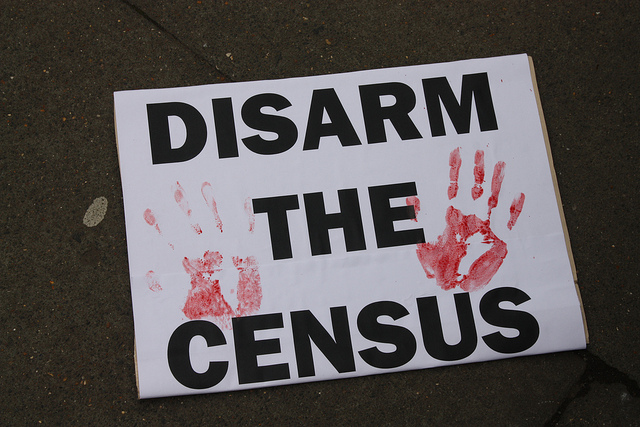
FEARS OVER CENSUS SECURITY FUEL BOYCOTT THREATS


Eight days to go before the Census on Sunday 27 March. Debate, discussion, dissension and protests continue. Here's a piece from today's Guardian.
Fears over census security fuel boycott threats

Backlash against £150m contract for US arms firm

Law professor dismisses worth of data safeguards

By Matthew Taylor

A growing number of people are planning to boycott this year's census amid increasing fears about data security and the involvement of arms manufacturer Lockheed Martin.

Many campaigners are angry that the £150m contract to run the census has been awarded to the American arms company while others claim the legal safeguards in place to prevent breaches in data security are "so flimsy as to be useless".

Chris Browne, from the Count Me Out campaign, said: "The more people who find out about the involvement of the world's largest arms producer in our census, the more civil dissent we will witness, and the bigger the campaign will get."

Protesters held a day of e-action today in which people were urged to swamp Lockheed Martin a "Twitter storm" and email messages detailing the minutiae of their day. Hundreds more are expected to take part in protests across the country on Saturday, with many saying they are willing to risk a criminal record and a £1,000 fine by refusing to fill in the 32-page questionnaire.

"I have no objection to the census itself because I recognise that it has served an important purpose historically," said Emma Draper, an anti-arms trade campaigner from London: "However, I think it is outrageous that the government can get away with paying a huge arms company millions of pounds in order to process data which is supposed to be of benefit to public services and people's welfare."

Lockheed Martin, which makes Trident nuclear missiles and F-16 fighter jets, won the £150m contract in 2008. A spokesman for the Office of National Statistics defended the company's involvement, stating it was "a major supplier of non-defence-related services for the public sector".

An ONS spokesman said: "The contract for census processing was awarded to Lockheed Martin UK – not Lockheed Martin US – in August 2008. Lockheed Martin UK offered best value for money in an open procurement under European law and the EU procurement directives were satisfied."

Symon Hill, writer and associate director of Christian thinktank Ekklesia, said many people remained unhappy about the decision and that he would be among those not be filling out the census. "Lockheed Martin is a company that has armed dictatorships around the world that has played a heavy role in the disastrous wars in Afghanistan and Iraq... I have reflected at great length. I have not taken this decision lightly but I feel that being asked to fill in the census is being asked to co-operate with an arms company and, as a Christian and as a pacifist, that is something that I feel I can not do in conscience."

Data from the census forms, which need to be completed by 27 March, is sent to a secure plant in Manchester and then to Titchfeld, Hampshire, for analysis. It is owned by ONS and a spokesman said it remains confidential for 100 years.

The government uses the information to award billions of pounds in grants and a boycott would cause widespread policy and funding difficulties. Councils would be hit hardest, potentially missing out on hundreds of millions of pounds if large numbers of people are not counted.

A spokesman for the ONS said: "The census ... is a unique snapshot of the population on a single day and is vital for your local community."

Lockheed Martin does more than 60% of its work for the US defence department and assists more than two dozen American government agencies. It is also reportedly involved in surveillance and data processing for the CIA and the FBI.

Campaigners fear that because it is a US company and therefore subject to the Patriot Act, which allows the US government access to any data in its possession, US authorities could have access to personal data on the UK's entire population.

The ONS has dismissed this claim, stating: "Under the contractual and operational arrangements we have put in place, no employees of Lockheed Martin UK or of its US parent or of any other US company will be able to access personal census data. The US Patriot Act could not therefore, be used to access such data." The spokesman added that a recent independent review had declared: "the public can be assured that the information they provide to the 2011 census will be well protected and securely managed".

Douwe Korff, professor of international law at London Metropolitan University, has questioned the security arrangements, warning that the "legal safeguards against breaches of confidentiality are so flimsy as to be useless".

"In a democracy under the rule of law, one should not have to rely on blind trust in the authorities; the law should guarantee restraint," he wrote in e recent paper. "However, the law that applies to the census data shortly to be collected does nothing of the sort. It does not stand in the way of the UK police, or intelligence services, or indeed foreign law enforcement agencies and secret services, seeking access – not just in exceptional cases but for general 'trawling' or 'fishing'."