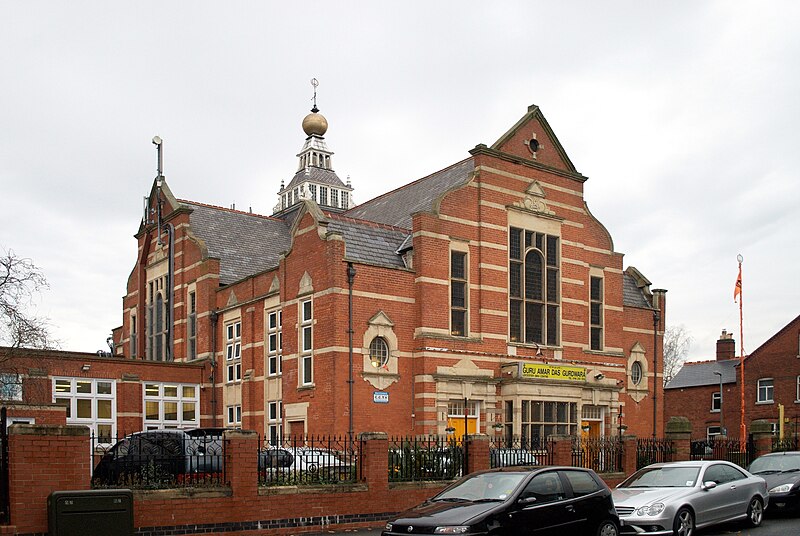
Showing posts with label Guru Amar Das Gurdwara. Show all posts

Tuesday, 16 October 2012

DOZENS ENJOY PILGRIMAGE ROUND CITY VISITING DIFFERENT FAITH COMMUNITIES

This article appears in today's Leicester Mercury:
Dozens enjoy pilgrimage round city visiting different faith communities
More than 40 people took part in an annual inter-faith walking pilgrimage in Clarendon Park, Leicester, at the weekend.
The event, which took six hours to complete, visited seven sites where pilgrims were welcomed by a different faith community.
The tour began at noon, at Guru Amar Das Gurdwara, before moving on to the Quaker Meeting House, then St John the Baptist Church, before being hosted by Baha'is in the Octagon Room, attached to St John's.
The walkers then visited the Neve Shalom Progressive Synagogue, The Art of Living Centre, in Toller Road, finishing at the Geeta Bhavan Hindu Temple and Community Centre, in Clarendon Park Road.
At each stage, the group was welcomed with a talk about the community hosting them and the place of worship. They also joined in a short devotional activity.
Barbara Butler of Christians Aware, which organised the event, said: "We spent a little time with Sikhs, Quakers, Anglicans, Baha'is, Jews and Hindus. We're grateful to those who played host to our group."

Tuesday, 1 November 2011

LEICESTER COUNCIL OF FAITHS AGM 2011


It's Leicester Council of Faiths Annual General Meeting this evening at Guru Amar Das Gurdwara, Clarendon Park Road.

I've been with Harry and Grace in Wigston. Around teatime every Tuesday I whisk them back and forth between two choirs of which they’re members (well, Harry two and Grace one). This evening, as soon as I drop them off at Guthlaxton College for the Leicester Phoenix Youth Chorale, I'm in a taxi, which I've booked to get me to the gurdwara on time.

I have an interesting chat with the driver en route - about where I'm and why I'm going there. He assumes I've said I want to go to the gurdwara just because it's a reference point in Clarendon Park Road. When I tell him, no, I'm actually going to the gurdwara itself, it sparks an unexpected conversation. He's clearly a bit phased by a white British guy asking to be driven to a Sikh place of worship. It's this kind of encounter that reminds me just how unusual my job is, even in a city as diverse and mixed as Leicester.

With a bit of foresight, I’ve spent some time in the gurdwara earlier this afternoon, putting up our exhibition (blogged here), so that it’s ready for the meeting this evening, panic and stress-free.

I arrive, to find that the agenda has been rejigged. I've managed to miss the food and have to jump in just as the meeting proper starts.

Our guest speaker is Paul Weller, Professor of Inter-Religious Relations at the University of Derby, who gives a presentation entitled, "Faith Communities, Groups and Organisations in Civil Society: Opportunities, Issues and Challenges". Prof. Weller's talk is based on seven theses and his comments following on them.
Thesis 1: The importance of not marginalising religions from public life
A tendency to assign religions to the private sphere will impoverish the state by marginalising important social resources and might unwittingly encourage those reactive, backward- and inward-looking expressions of religious life that are popularly characterised as "fundamentalism".
Comment: Secularists should beware the Law of Unintended Consequences in relation to religion. 
Thesis 2: The need to recognise the specificity of religions
Religious traditions and communities offer important alternative perspectives t the predominant values and power structures of states and societies. Religions are a reminder of the importance of the things that cannot be seen, touched, smelled, tasted and heard, for a more balanced perspective on those things that can be experienced in these ways.
Comment: After the technocratic death of politics and on the other side of the global financial crisis, could religions contribute to the rebirth of the politics of the human? 
Thesis 3: The imperative for religious engagement with the wider community
Religious communities and traditions should beware of what can be seductive calls from within their traditions to form "religious unity fronts" against what is characterised as "the secular state" and what is perceived as the amorality and fragmentation of modern and post-modern society.
Comment: Why are religions (and, at the moment, especially Christianity) seem to be getting so fearful about a perceived Secularist lobby and agenda? Is such fear justified? 
Thesis 4: The need for a reality checkNational and political self-understandings that exclude people of other than the majority traditions, either by design or by default are, historically speaking, fundamentally distorted. Politically and religiously such self-understandings are dangerous and need to be challenged.
Comment: What about the BNP and its appropriation of Christian symoblism? But is it only such groups who should be the cause of concern? 
Thesis 5: The need to recognise the transnational dimension of religions
Religious communities and traditions need to pre-empt the dangers involved in becoming proxy sites for imported conflicts involving their coreligionists in other parts of the world. But because they are themselves part of wider global communities of faith, religions have the potential for positively contributing to a better understanding of the role of states and societies of their own countries within a globalising world. 
Thesis 6: The importance of religious inclusivity
Religious establishments as well as other traditions and social arrangements that provide particular forms of religion with privileged access to social and political institutions need to be re-evaluated. There is a growing need to imagine and to construct new structural forms for the relationship between religion(s), state(s) and society(ies) that can more adequately express an inclusive social and political self-understanding than this which currently privilege majority religious traditions.
Comment: Can there not be alternatives to established religions that do not shut religions out of the public sphere? 
Thesis 7: The imperative of inter-religious dialogue
Inter-religious dialogue is an imperative for the religious communities and for the states and societies of which they are a part. There is a need to continue the task of developing appropriate inter-faith structures at all levels within states and societies and in appropriate transnational and international structures.
Comment: Perhaps there is, today, even more need for religious / secular dialogue.

After Prof. Weller’s talk, the main business of the evening is the election of members of the Board of Directors and the Officers. My role during this part is to take the minutes.

At the end of the meeting, I get to promote our local activities for the third national Inter Faith Week, coming up later this month. I have a big bundle of our fliers and of the programme for Phoenix Square, open at the page for the Faiths Film Festival.

I'm the last one out, having to stay behind, take down and pack up the nine pop-up banners in our exhibition. Thanks to Rosemarie Fitton for giving me (and them) a lift home. Then I manage to leave one of them outside my door overnight in the rain. Thank goodness those bags are just waterproof enough!  

Photo © Copyright P L Chadwick and licensed for reuse under this Creative Commons Licence

TAKING A FLYER


For the hour that Harry's in choir practice at St Thomas the Apostle Parish Church this afternoon, I go tromping round South Wigston, delivering by hand bundles of leafflets for Inter Faith Week. I've made up packs of 25, with a compliments slip on which I've written in big, bold, Sharpie letters: "Would you kindly display these leaflets? Thank you!" and included my calling card. All wrapped up in a transparent food bag (from Wilko's, 20 for 18p). I drop one of these bundles in at:

Earlier this afternoon, I dropped one of these bundles in at the Central Avenue Christian Church, Central Avenue.

I've a taxi waiting to take Harry and me from St Thomas to Guthlaxton College, for his second choir practice of the day (Leicester Phoenix Youth Chorale) then I continue on to the Council of Faiths Annual General Meeting at Guru Amar Das Gurdwara in Clarendon Park Road.

SETTING UP FOR ANNUAL GENERAL MEEETING


A flying visit to Guru Amar Das Gurdwara, Clarendon Park Road, where Leicester Council of Faiths is holding its Annual General Meeting this evening.


I rendezvous there with Clive Sutton as he drops off our set of eight banners. He's returning them after they'd been used at the University of Leicester International Chaplaincy, which was celebrating its 20th anniversary last week.


We're welcomed by Sewa Singh, who always greets me as "Mr George" (which I like).  After a bit of a reccy, we decide that the best place for the display is in the short corridor leading off the reception area, as shown in the photo above. That's Sewa Singh walking away from the camera.

Sunday, 12 September 2010

Faiths Trail


Today we're making our contribution to English Heritage's open weekend, called - for our part of the world - "Discover Leicester". This is one of a small number of annual events which is helping earn the Council of Faiths a positive reputation.

I'm only able to join in at lunchtime, as I've taken Harry out to sing in the choir at St Thomas this morning. We meet Clare and Gracie outside Guru Amar Das Gurdwara in Clarendon Park Road (that's them dressed the part, in the photo above). We're there about half an hour before the coach with everyone else turns up.

We've tried to squeeze in too many visits in previous years, so this time we've cut it down from five stops to three. First was the Jain Centre, then the Central Mosque, ending up at Guru Amar Das Gurdwara for the final visit, that includes lunch.

There are 25 people on the trail, including the Lord Mayor of Leicester, Cllr Colin Hall, and his Secular Humanist Chaplain, Dr Allan Hayes. We're grateful to Ajay, the Co-ordinator at the Council of Faiths, for organising this event.

You can see photos of today's Faiths Trail on our Flickr photostream:
http://www.flickr.com/photos/leicestercounciloffaiths/sets/72157624825007277/

Tuesday, 16 March 2010

religion in higher education


At Guru Amar Das Gurdwara, Clarendon Park Road, for a full meeting of Leicester Council of Faiths. Our speakers this evening are Dr Attaullah Siddiqui (Academic Director, Markfield Institute of Higher Education - as well as being past Chair and Honorary Life member of Leicester Council of Faiths) and Dr Clive Marsh (Director of Learning and Teaching, University of Leicester Institute of Lifelong Learning).

Dr Siddiqui is given the floor first. He offers a brief introduction to the history and work of the Markfield Institute of Higher Education (MIHE), Markfield, Leicestershire. Found in 2000, it is the first academic institution of its kind in the west. It presents a unique opportunity to study Islam in an Islamic institution within the context of Higher Education in the UK. In Dr siddiqui's presentation this evening, he tells us how MIHE was the first academic institution to address issues of being a Muslim in Britain today. It has recently begun to offier chaplaincy training, but it does so for Muslims in the context of a mult-faith society, in which trainees are obliged to learn about other faiths. Later in the evening, one of the members of the Council of Faiths remarks that those who have been students at Markfield are distinctive in their ability to join in inter-faith dialogue, mix with people of other religions and visit places of workship with confidence and openness.

In his introduction to his work, Dr Marsh observes that In Leicester, religion is all aorund us, but it tends to be something that other people have. But one can't work or live in this city without at least seeing evidence of people from many different faith traditions and cultural backgrounds -whether as individuals or as communities.

There is currently no undergraduate course in religious studies at either of the universities in Leicester - which is remarkable (even ridiculous) in a city where religion is such a significant part of public life and faith communities are so obvious to the public eye. Leicester University had a department teaching religious studies, but it closed as long ago as 1986 (presumably due to unsustainable numbers). The University of Leicester's Institute of Lifelong Learning does have a BA in Humanities and Arts which contains a Religious Studies component. The Institute is, however, currently also considering developing a Foundation Degree in Faith and Community Studies. This will be an opportunity for Leicester Council of Faiths to work with the Institute of Lifelong Learning on content, delivery etc. As a first step, the ILL is offering a Certificate of Higher Education in the Study of Religion at Vaughan College starting September 2010. Course Director for this two-year programme is Dr Angela Jagger, former Secretary of Leicester Council of Faiths.

Of course, provision and continuation of these courses can't avoid being market-driven. If there's demand for them, they'll flourish - if not, they'll wither away. Certificate courses require twelve students each year to run sustainably.

It's one of the stated aims in the constitution of Leicester Clouncil of Faiths that we should promote the disseemination of accurate knowledge about the faith communities in our city. This new development presents us with an excellent opportunity to put that principle into action.

These programmes of study are not intended to affirm the personal faith of the individuals enrolled on them. Indeed, if anyone signs up for that purpose alone, they may find it an uncomfortable ride. The old-fashioned distinction between "religious eduction" and "religious instruction" came to mind as we discuss this point. Students will be encouraged to look at their own religion (if they have one) and other religions as if from outside. Students should be able to reflect critically on the beliefs, values, history and practices of their own tradition as well as on those of others. These courses should allow students exposure to the life and activities of faith practitioners through contact with individuals (as visiting speakers, for example) and as communities (through visits to places of worship, joing in community, family or neighbourhood events such as festivals, commemorations, celebrations).

Angela will be offering a taster session on the evening of Monday 17 May, during Adult Learners' Week. The Institute of Lifelong Learning will have a stall in Highcross on Saturday 15 May to promote this week of learning opportunities.

Find out more about Dr Attaullah Siddiqui:
http://www.mihe.org.uk/mihe/detail.php?t=6&what=tutor

Find out more about Markfield Institute of Higher Education:
http://www.mihe.org.uk/mihe/

Find out more about Dr Clive Marsh:
http://www2.le.ac.uk/ebulletin/people/appointments/2000-2009/2008/12/nparticle.2008-12-19.5789722496

Find out more about the University of Leicester Institute of Lifelong Learning:
http://www.le.ac.uk/ad/

Sunday, 27 December 2009

2009's TOP 10: 5


Faiths Trail,
Sunday 13 September 2009

This has become a regular fixture in the Council of Faiths calendar over the past few years, organised in conjunction with English Heritage as part of their programme of open days during this week. I got to go on the first one of these tours (it was called a "Peace Pilgrimage" then) after I took up my post in 2007, but missed last year's excursion, so I was pleased to be able to take part this time.

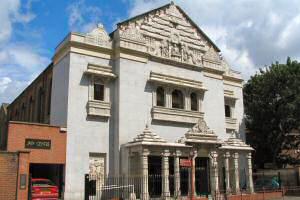
Our party of 25, from a variety of backgrounds and interests (and some from outside Leicester or Leicestershire) convened at Pilgrim House at 0930. We had a few words of welcome and introduction from Minou Cortazzi (Chair of the Council of Faiths), Cllr Manjula Sood (Deputy Lord Mayor and trustee of the Council of Faiths) and Resham Singh Sandhu (Chairman of the Sikh Welfare and Cultural Society and former Chair of the Council of Faiths). Our coach left Town Hall Square shortly before 10 o'clock. First stop was the Jain Centre, Oxford Street (pictured above), where we were joined by the Lord Mayor of Leicester and the Lady Mayoress. From there we proceeded to Shree Jalaram Prarthana Mandal, Narborough Road; then to Guru Amar Das Gurdwara, Clarendon Park Road, where we were treated to lunch (and where the Lord Mayor and Lady Mayoress had to take their leave of us). After lunch we went to the Orthodox Synagogue, Highfields Street; then to the Central Mosque, Conduit Street; and finally, St Philip's Parish Church, Evington Road. As we approached each place of worship, we handed out copies of the relevant leaflet to everyone on the coach, so they'd have a chance to read something about each faith community before each stop on the tour.

Everyone was impressed by the hospitable reception at the various places of worship. Arrangements for the day were made by Ajay Aggarwal, Co-Ordinator at Leicester Council of Faiths.