This evening we have the second in our new series of open meetings, which are taking Leicester Council of Faiths out into different parts of the city, so we can offering speakers and topics that we hope will be of interest to the wider community and open ourselves up to comments, contributions and questions from the general public.
This evening's meeting has been organised by Minou Cortazzi, who represents the local Bahá'ís on the Council of Faiths and who was Chair, 2007-09. Since the Bahá'ís don't have a community premises to call their own, the meeting takes place in the Parish Hall of Sacred Heart Roman Catholic Church, Mere Road, Highfields (which gives it more of an inter-faith allure - and it's fitting for us to have such an event in a Catholic church in the week that St Patrick's Day is celebrated).
Our first meeting of this kind, six weeks ago at Gurth Panth Parkash Gurdwara, Ashford Road (see blog, Tuesday 31 January) was a leap in the dark for the Council of Faiths. However, we were glad that it attracted a higher turnout than we anticipated. I stopped counting at 75, although people were still arriving after that. A reliable source told me that there had been 84 attendees at that meeting; the Leicester Mercury stated, a few days later, that 100 people had shown up. Special guest at that meeting was Sir Peter Soulsby, Mayor of Leicester, and it was held only a few days prior to the second visit to our city by the English Defence League. For those reasons, we thought we got a larger turnout expected turnout (and the media only really seemed interested in what might be said at the meeting about the EDL).
I'm delighted to say that there are more than 60 people here this evening - although one wily way to boost your numbers is to arrange for a panel, rather than a single speaker!
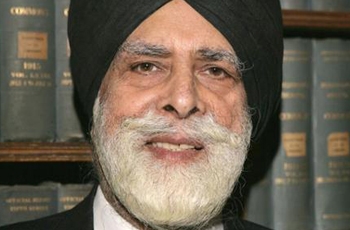
Following refreshments, the meeting gets underway with words of welcome from Father John Lally, Parish Priest at Sacred Heart, long-serving member (and former Secretary) of Leicester Council of Faiths (photo above). He can't imagine that those who founded Sacred Heart in 1883 would ever have conceived that an event like this would have taken place here. Indeed, it might have been inconceivable just a few decades ago. Father Lally closes his welcome by quoting Cardinal John Henry Newman (1801-90) "To live is to change, and to be perfect is to have changed often" - appropriate to the area which Sacred Heart serves.
Father Lally is followed by Cllr Manjula Sood, Chair of Leicester Council of Faiths. She introduces our special guest, Dr Nabil Mustpaha, Founder and current Chair of Elmbridge Multi-Faith Forum, Surrey, who will be facilitating the panel this evening. Here are a few interesting facts about him:
- Retired Consultant in Surgery and Rehabilitation Medicine, with the following qualifications: M.B. B.Ch (Cairo), MRCS,LRCP (London), FRCS (London)
- Egyptian born, British subject since 1968, having lived in UK since 1963
- Chairman of the Elmbridge Multi-Faith Forum, which he initiated in 2003 with the help of a group of Bahá'ís to start with, and now with a very active membership and Executive Committee
- Member of the Independent Advisory Group for Surrey Police, advising on faith and ethnic issues, and participating in other avenues of cooperation
- Trustee of Voluntary Action Elmbridge, the umbrella Voluntary Agency acting as an arm to Elmbridge Borough Council, and Surrey County Council
- Member of Elmbridge Community Partnership of Elmbridge Borough Council
- Chairman of Elmbridge Equality & Diversity Forum, part of Elmbridge Borough Council Community Services Service
- Member of the Surrey Council for Youth Services
- He has published “Economics, the Historical, Religious & Contemporary Perspective”, and translated several books from English to Arabic, the larger one being “Psychology of Spirituality”, by Prof. Hussein Danesh, and had many of poems published in peer reviewed poetry books, edited by Wordpress Poetry
Minou has been interested in bringing Dr Mustapha to Leicester ever since she heard him speak on the BBC Radio 4 programme, Something Understood, a year or so ago, then bumping into him at a conference of the Persian Society for Arts and Letters a few months later. And I should say that from the first time I heard the title for this evening's presentation, I liked the sound of it. It's a neat little twist on a somewhat tired little phrase ("My faith in God"), giving it a nice little kick.

After his own brief introductory remarks, Dr Mustapha (photo above, standing) introduces each speaker in what he described as historical order, giving each of them a maximum of seven minutes for their respective contributions - and he says he'll be tough on any who overrun. While I might not concur with his order (which I've followed in the list below), I have to commend him on his fine chairmanship, since no one overruns their allotted time.
- Leon Chariker, President of Leicester Progressive Jewish Congregation, gives a Jewish perspective
- Vinod Chadusama, who works at The Race Equality Centre (TREC) has been drafted in at the last moment to give a Hindu perspective.
- Shane Bordoli, Buddhist representative on Leicester Council of Faiths on Leicester SACRE, gives a Buddhist perspective
- Revd Sonia Brown, Curate at St Philip's Parish Church, Evington, gives a Christian perspective
- Rumena Choudhury and Sumaiya Mulla, from Strive (photo below), combine to give a Muslim perspective
- Kartar Singh, who has become a regular presence at events such as this over the past year or so, gives a Sikh perspective
- In the absence of a Jain speaker, Dr Mustaphaha read an extract on the Jain life from a booklet which Elmbridge Multi-Faith Forum has published
- Finally, Leila Fananapazir, who is studying biochemistry at the University of Leicester, gives a Bahá'í perspective. I've been tweeting some text and a photo for each panellist as the evening progresses, but unfortunately the battery on my iPhone dies just as Leila gets to her feet.

Dr Mustapha offers his own summing up of the main points made by each speaker before inviting comments and questions from the floor. Here are some of those contributions:
"Secularists don't follow any God, but they defend the right of people to worship as they choose. People of good will, no matter what path they may follow, must work together to help those who are not affiliated to any religion understand what it is to to be a good human being."
Our two Muslim panellists were asked to say more about their activities with women in the community, particularly in connection with domestic violence, female genital mutilation, mental health. Rumena and Sumaiya faced up to the claim that it's often said that Islam condones or justifices these practices and the isolation of women. Strive works to differentiate culture from religion and appeals to scriptural authority in changing the lives of Muslim women.
"When you see the current climate of conflict around the world, does your own spirituality help you deal with the injustice in today's world?"
"Do people of faith bring competition into the world rather than cooperation? At bottom, can we really get away from saying that our faith is the only true one?" Usually I only put the questions in here, so that you, faithful reader, can think of your own answers rather than taking issue with the answers given at the event (and because its easier to write down the comparatively shorter questions compared to the comparatively longer answers). However, I can't resist recording the response Leon gave to this question: "I like the football analogy here: each one of us supports our own team, but we all love football." Nuff said!
At the end of the evening, Dr Mustapha thanks Leicester Council of Faiths for the opportunity to come here and join in this meeting; and on behalf of the Council of Faiths, Cllr Sood in turn thanks Dr Mustapha (and all the speakers) for their contributions. She leaves us with some poignant reflections on her own visits to the Bahá'í House of Worship in New Delhi, popularly known as the Lotus Temple.
A footnote: I share the short bus ride into the city centre with Ian Vernon, from Leicester Pagan Alliance. Ian has attended both our open meetings and made positive contributions on each occasion. We chat briefly about how to spread more accurate information about Paganism and Wicca, as this community has become concerned that certain misconceptions about who they are and what they do may be influencing public opinion about them. I advise him to post updates that he thinks would be helpful on the Council of Faiths Facebook page. I'm glad to see that before the evening's out, he's done just that.