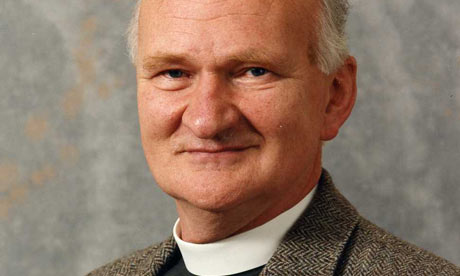
While doing some
routine googling, I come across tributes to Maxwell Craig.
Maxwell was Chair of Sharing of Faiths in Glasgow when I became involved
in inter faith work there, aged 19. The last time I saw or heard anything of
him was on a TV news bulletin at the time of the Dunblane shootings (1996),
speaking on behalf of the Cathedral community in that smallest of Scottish
cities, touched by an incomprehensible act of utter wickedness. I'd left
Glasgow and its environs almost ten years before - but I remember thinking at the
time that if anyone were to appear in public and say something meaningful,
intelligent and comforting from a religious perspective about what had happened
in Dunblane, it would be Maxwell Craig.
Ian Mellin, one of the friends who joined in the
Sharing of Faiths activities (himself dead some 30 years now) dubbed Maxwell
Craig, "Bampot Maxie". That name stuck and it's how many of the
younger people who knew him in Glasgow referred to him. if that sounds
insulting, believe me it wasn't. Yes, a "Bampot" is a headbanger, but
... Maxwell Craig was so full on, so front-and-centre of the whole inter faith
"movement" (if there's any such thing, now or then) it was as if he
was the front man, the virtuoso in the band, the one who could always be relied
upon to step forward. We mimicked his distinctive way of speaking too (don't
all clergymen have a distinctive way of speaking?). The tic we picked up on was
how he would emphasise the last word or syllable of a key sentence by pausing,
then leaning slightly forward, tapping his foot as the last bit came out,
usually accompanied by lightly but firmly slapping a rolled-up programme or
sheet of notes in his right hand into the open palm of his left. But there was
no disrespect on our part; anything but, even from a bunch of us hardly out of
our teens. If you find that hard to grasp, faithful reader, then all I can say
is–that's Glasgow for you!
I recall vividly an occasion on which I saw Maxwell's tolerance – even
indulgence – of our youthful capers. It was at the opening ceremony of the
annual "Presentation of Faiths", held that summer in the splendid
(if rather inaccessible) setting of the City Chambers in George Square.
In his opening speech, Maxwell drew on an analogy which had just become popular
at the time: that the bumble bee, according to the laws of aerodynamics,
shouldn't be able to fly - but that it could, because it knew nothing of the
laws of aerodynamics. From his vantage point on the stage, I could see that
Maxwell could see Big D mimicking the flight of the bumble bee which suddenly
snaps to the command of the laws of aerodynamics and plunges from the sky in
ever-decreasing circles, with little muted buzzing noises, sounding
increasingly desperate, then resigned, then ... er, dead. Big D thought himself
concealed by the display boards of the exhibition, hos performance just for the
entertainment of the handful standing near him. But from my position, looking
over his shoulder toward the stage, I could see how his performance had grabbed
the attention of Maxwell Craig, as the next speaker took their turn. But
nothing was made of the bumble bee performance and when Maxwell took the
assembled dignitaries on a brief tour of the exhibition, he included Big D in
his introductions as warmly as anyone else.
As an example of how he reacted to something
that wasn't just youthful high spirits and the typically Scots working class
puncturing of authority (which he surely understood and played along with,
rather than opposed), I recall another occasion from that same event–the same
day or a day or two later. We were delighted to have been invited to take our
annual public event from the McClellan Galleries in Sauchiehall Street to the
City Chambers. It was a sign of recognition and value from Glasgow City
Council (and from the Lord Provost in particular). The down side, however, was
that it took away the opportunity for yer punter to walk in off the streets and
discover the Presentation of Faiths for themselves. This is just what I had
done, just a few years before. To make up for us sitting in splendid isolation
in the city chambers, at each lunchtime a small number of us went down into
George Square below at noon, representing each of the faith communities
involved, to read something appropriate and scriptural through a megaphone to
the crowds who would pass through the square at lunchtime. After Maxwell gave a
brief introduction, he handed the megaphone to one of the participants, who
took a good few minutes to chant a passage in the original language. When he
ended the recitation then said, "And now for the English
translation," Maxwell stepped over and snatched the horn from him, handing
it to the next in line. He believed in us all getting a fair crack of the whip.
As a young, and newly enrolled Bahá'í (I'd only joined the Glasgow Bahá'í
community a couple of months before I was asked to represent them on the
Sharing of Faiths committee), an enthusiastic promoter of a faith which itself
eschews the institution of clergy, ministry or priesthood in any of its forms,
it may have been more troubling than I realised at the time to encounter a man
who so consummately filled this venerable office with his towering
influence for good. As I settled into my newly adopted belief structure,
it was a lazy option to think that, because we didn't have them, they were of
no worth or importance anywhere. Of course that's not the true Bahá'í
position, as I came to understand later, when I became more familiar with the
writings of Bahá’u’lláh and passages such as this:
Respect ye the divines and learned
amongst you, they whose conduct accords with their professions, who transgress
not the bounds which God hath fixed, whose judgments are in conformity with His
behests as revealed in His Book. Know ye that they are the lamps of guidance unto
them that are in the heavens and on the earth. They who disregard and neglect
the divines and learned that live amongst them–these have truly changed the
favour with which God hath favoured them.
I have Maxwell Craig to thank for helping me
learn that lesson, as I saw in him a man whose actions spoke louder than words.
I'd certainly never spent that much time in the company of any clergyman
before. When I was a kid, my brother and I used to be sent scurrying into our
bedroom when the local minister called round on a pastoral visit. Maxwell Craig
was the first minister from whom I got a sense of what a clergyman could–indeed should–be. In many respects, he's
remained my model of the good minister of the Kirk. Back then, he was someone I
found awe-inspiring but not unapproachable. The older I get, the clearer it
becomes to me that for a few years I had the privilege and honour of standing
with someone who can now be seen as a great man in the life of my city and my
country.
I didn't actually know that Maxwell had died until I stumbled across these
tributes today. He wasn't all that old after all, at 77. I'm sad just now,
feeling a real physical knot about this. I thought it right to share some
important things about him with you, faithful reader.
Below is the text of the eulogy read at the Thanksgiving Service for Maxwell
Craig's life and work, held on 7 October 2009 at the Church of the Holy Rude,
Stirling.
Maxwell Craig was a big man in every sense–big in stature, big in personality,
big in the impact he had on other people’s lives, big in vision and intellect,
big in compassion and generosity of spirit. No words of mine can adequately
sum him up or do justice to his accomplishments. We have already heard
movingly what he meant to his family. Each one of us here this morning has our
own personal memories–vivid and precious–to cherish and recollect.
Maxwell was born on Christmas Day in 1931 in Halifax, West Yorkshire, the
youngest of four children of a Scottish doctor who had moved south at a time
when it was hard to get jobs in Scotland. He went to school at Bradford Grammar
School and then Harrow; then on to Oriel College, Oxford to read
classics. National Service for a couple of years mostly in Stirling and
Berlin – with the Argylls, latterly commissioned as a 2nd Lieutenant. Two
years in Sheffield with United Steel, four years in the fast stream of the
civil service with the Ministry of Labour in London. And then the call to
ministry–three years in Edinburgh at New College, a term in Germany at
Tubingen, a subsequent year for an MTh in the United States at
Princeton. His assistantship with Jack Orr at St John’s Oxgangs in
Edinburgh; seven years at Grahamston, Falkirk including the creation of a
united church, one of Scotland’s first ecumenical parishes; sixteen years at
Wellington in the west end of Glasgow; two years at Bridge of Don, another
ecumenical project; seven years as the first General Secretary of the new
ecumenical body Action of Churches Together in Scotland, to which Alison has
already referred. And then, following his retirement in 1998, a
succession of significant locum ministries – St Andrew’s, Jerusalem; Breich Valley
in West Lothian; St Andrew’s, Rome; then four years at the priority area charge
of St Mark’s, Raploch, here in Stirling.
These are some of the bare facts but of course there is so much more to tell,
above all of course his family who meant so much to him–Janet whom he met at
Oxford and married in 1957. They came from remarkably similar backgrounds
(Janet’s father was a Scottish doctor who had settled in Manchester); they
shared so many interests, complemented each other so well and, although certainly
both strong and independent personalities, like many of you, I’m sure, I’ve
come, as it were, to think of them in a single breath! And the family–in
and from whom Maxwell took and derived such pride and joy–Margaret, Sarah, Lucy
and Rob, their spouses, the grandchildren. It’s been said that to discern
our real concerns and priorities we should look at what our children have done
with their lives. The Craig family stand out in this respect–medicine, law,
wind energy, health service, a commitment to serving those on the margins, an
inherited love of the hills, the continuing regular family gatherings at
Christmas and on other special occasions, the recollection of the ups and downs
of family holidays in the north-west, a host of stories–memorable and often highly
amusing.There was something of a paradox about Maxwell. He could perhaps be seen
as a traditionally orthodox, unfailingly gracious, and respectable, even
"establishment" figure–public school and Oxford, Argylls officer, 121
committee convener, Queen’s Chaplain. But alongside that there was the
radical dimension – the strong commitment to social justice and to
peace-making. And that stemmed from his Christian faith and from his
compelling desire to share in the building of God’s kingdom. For Maxwell
faith touched every aspect of life: one cannot separate religion from the world
of politics. For him the life of faith was about encounter and
engagement – about valuing human relationships, pursuing social concerns and
trusting in God’s transforming grace. Janet suggested to me that his views
were shaped by his early experience among poor families in Halifax where he
earned pocket money by going round to collect fees due to his father before the
National Health Service was in place. Out of these beginnings developed Maxwell
the campaigner and activist on so many fronts over the years. In both
Falkirk and Glasgow his involvement in children’s panel and Samaritans. The
contribution he made in Glasgow to Stella Reekie’s work, the development of the
International Flat and the Sharing of Faiths project, whose legacy continues to
this day. His very effective and high-profile term as convener of the
Church and Nation committee, to whose work he gave a real cutting-edge in the
heady days of anti-Thatcherism–the miners’ strike and a visit to a Fife
colliery to share in the early-morning shift; the march from Gartcosh to London
when Ravenscraig first came under threat; his contribution to the Claim of
Right that laid the foundation for the Scottish Constitutional Convention and
the creation of the Scottish Parliament. Frequent visits to Faslane. His
long-standing commitment to housing issues fulfilled most recently in his much
appreciated term as chair of Scottish Churches Housing Action. Then his
work as a director of the Scottish Refugee Council, membership of the visiting
committee for Polmont Young Offenders Institution. The catalogue
goes on and on; and his latest campaign, as so often on the edge of
controversy, and characteristically self-effacing, arguing in the public arena
that, when health and social services resources are limited, funds should be
diverted from the care of the elderly to other more pressing priorities with
longer-term benefits.
Many of us will remember Maxwell the leader speaking out on public platforms
and through the media on the issues of the day, always from the standpoint of
faith. He was a powerful, passionate and persuasive speaker–and his
prayers were memorable: they truly came from the heart; sometimes he almost
seemed to be pleading with God. In his years at Wellington in
particular–but in a sense this is the story of his life–his ministry is valued
for the way in which he opened up fresh perspectives and new horizons in the
congregation’s life–through the guest preachers who came, the inter-faith and
ecumenical themes he introduced and developed, the early Easter morning service
at the top of Dumgoyne, and other projects. Sometimes people’s feathers
were a little ruffled–for instance, there was the "vote Labour"
poster in the manse window! But he was also a sensitive and capable
pastor; he was a good listener and had a great capacity for getting alongside
people, relating to them, caring for them, giving them his time and full
attention; he had the knack of encouraging and empowering people and making
wise choices as to leaders of congregational activities; and with his breadth
of vision, intellectual ability and charm he was able to hold together in unity
people with a diversity of opinions.
Maxwell’s membership of the Iona Community was important to him and underpinned
so many of his concerns. He was impressed when George MacLeod came to
speak at Oxford and, with Janet, was a member of the Iona Society there and
attended St Columba’s church where a Community member, Raymond Bailey was minister.
The Iona connection continued when Maxwell and Janet moved to live in London
and worshipped at the Presbyterian church where another Community member Ian
Renton was minister. He joined the Community in 1964 and served it in many
ways over the years. He valued especially the monthly meetings of the
local Family Group to which Janet and he belonged–the worship, the exploring of
issues, the deep sharing of concerns.
I suspect that Maxwell was not always easy to live with, but he was almost
impossible not to love. There was that expansive smile, and an immense grace
about him – a deep joy and contentment. He was a lively person it was always good
to be with – there was much laughter, and inevitably so much to talk
about. He was warm, charming, and invariably courteous. There could
at times be a degree of stubbornness, a dogged persistence in pursuit of the
principles and objectives to which he was committed, but he consistently evoked
respect and affection. His opponents were never regarded nor thought of
themselves as enemies. Once he’d made his mind up there was a strength of
purpose and single-minded determination, which sometimes made working with him
a little hard. But he was always positive: indeed there was, as we’ve
heard, almost an element of the Utopian romantic about him – what was described
to me as his "incurable optimism" – but usually Janet and the rest of
the family kept him "earthed".
Maxwell’s was truly a rounded life. Most of us know of his passion for
walking and climbing, his sense of achievement in completing all the
Munros. He was interested in sport – frequently attending Brockville when
they lived in Falkirk, usually after half-time when you got in free; and for
many years he was a regular at Murrayfield and still took a keen interest in
Scotland’s fortunes on the rugby field. And music was always an important
part of his life; music – RSNO concerts, opera and a surprising ability to
remember and sing the songs of the shows from the 50s and 60s. In his
retirement all these interests continued and developed – holidays with
friends and family in Tuscany, Crete and elsewhere; the enjoyment he got
in playing golf just across the road from his house; the monthly expeditions
with a group of men friends, the "yo-yos" going up and down hills a
little less demanding than the ones he’d climbed when he was Munro-bagging;
regular bridge to which he brought a measured and accomplished deliberation;
and of course singing with the Stirling City Choir of which he was currently
chairman.
Somehow the circumstances, so sudden and unexpected, of his death sum up
Maxwell’s life – alongside friends at a sing-along Messiah, at the end of a week
spent on Iona as member in residence at the Community’s MacLeod Centre, where
his helpful, cheerful presence had been so much appreciated that the warden’s
parting words were–"You must come again next year for two weeks, and make sure you bring Janet with you ..."
But it is not to be. At a time like this we are reminded once more of the
fragility of life and of our own mortality. But above all we celebrate a
faithful, faith-filled and well-lived life that has touched and enriched our lives. We rejoice that Maxwell has passed through
the mystery of death into the eternal joy of God’s nearer presence. And we
give thanks to God.
Amen