Showing posts with label Pagans. Show all posts

Tuesday, 25 September 2012

DRUIDS MARK EQUINOX WITH HILL CEREMONY

This article appears in today's Leicester Mercury (but not on the website):
Druids mark equinox with hill ceremony
Druids have marked the changing of the seasons with a ceremony celebrating the autumn equinox at Beacon Hill.
More than 30 people formed a ring at the ancient Bronze Age site, near Loughborough, to mark the lengthening of the dark and the receding of the light, just after noon on Sunday.
As part of the celebrations - one of eight which punctuate the Pagan year - bread and mead were passed among the gatherers; the mead "so none should thirst" and the bread "so none should hunger".
Songs of peace were sung to north, east, west and south and the four elements of wind, fire, earth and water were venerated.
Mark Graham, of the Charnwood Grove of [sic] druids, said that Beacon Hill and locations across Charnwood Forest had a long history as druid meeting places.
We call this  place Caer Ban (Beacon Hill). It means lofty fortress. "This is where sky and earth meet, making it a special place, and the views are stunning.
"People gather here at this time to mark the equinox, the tipping points of the year, the changing of the seasons."
He said the sudden change from warm sunshine to autumn wind and rain had affected attendance numbers.
"At the summer solstice we had 200 people." he said.
"Today's turnout reflects the weather."
Charnwood Groves's celebration of the equinox was also filmed by a crew for The Hairy Bikers cookery programme, to be shown on the BBC in tha autumn.

Thursday, 5 April 2012

EASTER'S CULTURE CLUB HARKS BACK TO PAGAN TIMES

Dr Philip Shaw's first Person column appears in today's Leicester Mercury:
Easter's culture club harks back to Pagan times
When we use the word Easter, we think first and foremost of the Christian festival. But the word itself is not part of the Christian tradition. In the first quarter of the eighth century AD, the Venerable Bede, a Northumbrian monk and scholar, composed a text called On the Reckoning of Time.
This work describes how to calculate the date of Easter – a vexed theological question of the time – and along the way it also gives us some clues to the names that pagan Anglo-Saxons gave to the months of the year, before their conversion to Christianity.
According to Bede, one of these months, which roughly corresponded with April in our calendar, was called Eosturmonath, after the pagan goddess Eostre.
But can the newly Christianised Anglo-Saxons really have named the most important festival of the Christian year after a pagan goddess?Many scholars have suggested Bede invented the goddess Eostre. I disagree: Bede was a careful researcher, and not prone to inventions of this sort, as far as we can tell.
And we also now know that there were a group of minor goddesses with a related name worshipped by continental speakers of a Germanic language.
In 1958, more than 150 votive inscriptions from the second or third century AD were discovered near Morken-Harff in Germany.
These inscriptions must mark the site of an important cult centre, and the goddesses to whom these inscriptions were set up were called the matronae Austriahenae, loosely translated as "the eastern matrons" or "the matrons of the easterners".
The name Austriahenae comes from the same Germanic root as Eostre, suggesting that this was a root used in naming goddesses.
There is also evidence of its use in English place names and in the names of Anglo-Saxon individuals. There is every reason, then, to trust what Bede says about Eostre: she was a goddess whose name was attached to a month by the pagan Anglo-Saxons. When the Anglo-Saxons were converted to Christianity, the name of the month in which Easter usually fell was transferred to the name of the festival itself.
Eostre also provides us with clues to the way in which Anglo-Saxon paganism worked. The word from which her name derives means "eastern", and is found in place names in England, which suggests that she may well have been a local goddess.
We are accustomed to think of pagan gods as having roles – war god, fertility god – but Eostre suggests that Anglo-Saxon goddesses may have been defined instead by their relationship to a local community.This Easter, spare a thought for the word Easter – a precious window on the past.

Dr Philip Shaw is a lecturer in English Language and Old English at the University of Leicester

Sunday, 10 July 2011

LIGHTS OUT ON THE DARK SIDE


Sorry to see that The Dark Side Cafe close down this weekend. The cafe, in Leicester's Cank Street, had acted as an informal centre for many in the local Pagan community, as well as being a watering hole for a good number of folk who would pride themselves as being of an alternative nature. Meetings such as the local Pagan Moot were held there, as were other gatherings, many of which were open to the public. The basement had potential for use as a performance space, although it was never really put to such use. I gave The Dark Side a big shout out in the blog whenever I could (including local media coverage about its struggle to stay afloat) and I took a group of girls visiting from Blackpool there as part of a tour of Leicester's centres of faith or belief. It's notoriously difficult to run an independent cafe and Leicester city centre is overrun with Costa and Nero and Starbucks as it is, leaving the ten or so independents to square off for a relatively small share of the remaining customers. Although The Dark Side undoubtedly had its loyal fanbase, that wasn't enough to ensure its survival in a very competitive market.


The closure of The Dark Side cafe is a sad loss to the richness and diversity of Leicester. I (and many, many others) wish all the best in future to Lucie Belikova (above), who was the warm, welcoming and charming manager and hostess at The Dark Side.

Monday, 9 May 2011

PAGANS VOICE CONCERNS ABOUT THOR


Here's a nice piece I picked up from USA Today's Faith & Reason column, which describes itself as "A Conversation About Religion, Spirituality and Ethics".
Pagans voice concerns about Thor
By Sarah Pullium Bailey for USA TODAY
Thor offers the unexpected start to the Hollywood blockbuster season, as most people may not be familiar with the 49-year-old Marvel Comics hero. Fewer people are probably aware of the Norse god Thor, who is still followed in some pagan traditions.
Reviews have been fairly positive so far, but some pagans have been posting concerns about the movie popularized in the comic book instead of in the tradition they follow. Thor is described as a great warrior of enormous strength.
Leading up to the film, some pagans voiced concerns over the film's depiction of Thor as a deity. Eric Scott wrote a post at Killing the Buddha that set off a chain of reactions on "What happens when Hollywood gets a hold of your gods."
The truth is, I looked at the toys in my hands and I saw the result of millions of dollars of development and thousands of hours of manpower, put into something bearing the name of a god, my god, and it had nothing to do with me. Their Thor was a god forgotten by all except the few quiet geeks who read his adventures in Journey into Mystery and The Mighty Thor for forty years. It wasn't that they meant to upset or unsettle me; they simply realized that people like me were too few to matter. It's impossible to think of a story about Jesus like this, not written to pander to or irritate Christians, but simply not considering them at all.
Hollywood uses Christian characters as well, Alexandra Erin argues, assuming people will be familiar with the names and symbols.
While it must be remembered that Christianity enjoys a very privileged position in our culture and thus can't claim to be injured by off-target pop culture depictions, the fact remains that the Christian religion *is* treated as mythology by Hollywood to be pillaged wholesale for stories and characters. Consider the move Legion, which has a gun-toting archangel action hero facing off against the legions of heaven and/or hell to save a come-again Baby Jesus from the wrath of a petulant God.
Perhaps the film is an opportunity to introduce people to Paganism, Star Foster of Patheos' Pantheon blog says:
Thor is an opportunity. People will seek out Pagans due to this film, silly as that may sound. When they come we should greet them with answers and hospitality, especially if we weren't received that way. Thor can mark a change not only for seekers, but for how our communities interact with them.
Are you planning to see Thor? Have you felt like Hollywood has misrepresented or taken advantage of your beliefs?

I have to declare a special kind of interest in this story. While I wouldn't exactly say I'm a worshipper of Thor, I've certainly been a fan since I was very young. I first encountered The Mighty Thor (to give him his full title - sadly, the movie versions tend to drop the great adjectives, so we don't get the Amazing Spider-Man or The Uncanny X-Men - it's a wonder that they didn't give us just "The Four" as a movie) in the pages of Fantastic comic, which was launched in 1967, when I was an impressionable eight year old (as distinct from the impressionable 51 year old I am today). This featured short black and white instalments of the adventures of several Marvel superheroes, the Mighty Thor amongst them. I used to colour in the pages myself. When I eventually discovered that they were available in colour, between glossy covers and had stories it didn't take months to follow to their conclusion, it was like entering a new world. It's one that still holds its attractions for me, as a cursory glance of my bookshelves, bedside reading or Amazon wish list would confirm.
 
 
For ages, I implored my dad, who was a skilled wood-machinist at Upper Clyde Shipbuilders, to make me a wooden version of Mjolnir, Thor's hammer (translated from the Icelandic, the name means "that which smashes"). He gave it to me when I was 10 or thereabouts; it was about half as tall as I was.

In my first year at Allan Glen's, aged 11 or 12, I illustrated a project in history class about the Vikings by cutting out scenes from some of my Thor comics (an unprecedented sacrifice by itself) and pasting them into my jotter. I got 0/10 for the project and my history teacher wrote in angry red script that I should remove every trace of these from my book and do the project over again - properly this time.

In keeping with my own devotion to the god of thunder then, I've used an image from the comic, rather than the movie at the top of this blog post.

Saturday, 12 March 2011

SO WHAT HAPPENS NEXT?

Today's edition of the Leicester Mercury carries a double-page spread entitled "So what happens next?" comparing various beliefs (religious and non-religious) about death - and what we think might come after. It’s not on the Mercury website, but it’s interesting reading so I’ve typed it up. I've included a photo of the article, as it has some nice pictures of some of the people who were approached for comment by the Mercury.

The article doesn't mention Leicester Council of Faiths and it doesn't cover all the religions represented on it. There’s no Bahá'í, Buddhist or Jain point of view given here. The Council of Faiths wasn't approached to take part in this (as far as I know) which I think is a pity, but a couple of our members are quoted here. The article also contains contributions from a Pagan, a scientist, a pathologist and "Britain's Youngest Columnists, Aged 8". Definitely some diversity in there then!

So what happens next?

So then: death. We like to try to answer the big questions in the Mercury. Here Adam Wakelin and Lee Marlow asked some Leicestershire experts the ultimate one: what happens when you die?

For something that doesn't really bear thinking about, we spend an awful lot of time thinking about it. Perhaps only sex can eclipse death when it comes to all the different expressions we've thought up for it.

When you breathe your last, you don't just die. You croak it, cark it, kick the bucket, push up the daisies and give up the ghost. Put more sensitively, you pass away, meet your maker, join the choir invisible, cross over, go to a better place.

But where and what is that "better place" exactly? Does it even exist?
We went looking for answers. here with their thoughts are religious leaders, scientists and our blabbermouth eight-year-old columnists Dylan and Oliver - who, let's face it, have no less experience on this subject than anybody else.

The Hindu
We are all, whether we know it or not, riders on a great cosmic carousel.

"We believe in Karma" says Hindu priest Hemang Bhatt. "What goes around comes around."

Death is as elementary as an Albert Einstein equation, believes Hemang. Energy isn't created or destroyed, he says. It simply goes somewhere else.

Coal can be burnt to create electricity and light. When someone dies the same principle follows. Our life energy, or soul, passes into another living being.

Do good deeds and it will enter into a human. Be less virtuous and you may come back as an insect or animal.

"A dog cannot pray or cook its own food," says Hemang. "It suffers."

Only when the slate has been "wiped clean" for past sins will someone be reincarnated again as a human.

Be good enough for long enough over many, many lifetimes and your soul will reach Nirvana, God's abode.

"You never feel cold and are never hungry, you stay with God in bliss for billions and billions of human years."

And after that? You go back into a human body and the cycle begins once again.

The Jew
For Jews this life is a preparation for the next. We sometimes get a taste of paradise here, but it is a mere morsel in a draughty corridor compared to the feast we savour in Heaven - provided you've behaved yourself.

"This world is just an antechamber. What lies beyond is a banquet hall," says Rabbi Shmuli Pink.

"When someone passes away it is not the end of the road. They continue on a different plane."

If a person has lived a sinful life there will be no entry to Heaven - at least for a time.

"If your soul is a dirty suit, then the place called hell in the modern world is a bit like the dry cleaners," says the Rabbi of Leicester Hebrew Congregation. "Only once the mud has been removed can you go on to a better place.

"Heaven is above and beyond any type of pleasure we can receive in this world."

"That doesn't mean we shouldn't cherish what we have in this world, and help others while we are here.

"We should glorify life, focus on the here and now and accomplish as much as we can."

The Scientist
Those of squeamish disposition are advised to skip this bit. 

Heaven might be boundless Elysian fields of daffodils and delight, but biological death is nasty, ugly and gruesome.

Decomposition begins with bacteria in the bowel starting to proliferate says Paul Whiting, professor of biomedical science at De Montfort University.

"Gas and all sorts of other nasty things are released," says Professor Whiting. Rigor mortis sets in a few hours after and will last for nearly a day. 

Skin contracts, darkening the face with a five o'clock shadow bristly beard. Blood, with no pumping to keep it circulating, obeys the law of gravity. Ugly blooms of congealed purple appear under the flesh.

After 20 hours or so, bacteria are starting to break down the cells of your body. "Horrible enzymes" safely locked away in these cells when everything was working are released.

These "suicide bag enzymes" - responsible for breaking down food, mopping up injured cells and digesting bacteria in life - now run amok.

The technical term is autophagy. Auto is Greek for self. Phagy is Greek for eat. Your body - that thing you looked after, fed, and possibly even treated to a couple of pints of lager on a Friday night - has gone cannibal. It is, quite literally, eating itself.

Heat and humidity have a large say in decomposition, but flesh and blood usually becomes a bag of bone within a year or two.

So that's it? Well not quite. Boil us down and we're basically just a jumble of billions of atoms. They don't die. They just become something else.

The Pagan
Not entirely sure what happens when you die? Can't make your mind up whether it's one thing or another, or something else entirely?

Come and join the Pagans. They're not entirely sure, either.

Sally Singer-Fraser is a wicca [sic], a Pagan witch, and a firm believer in the liberal notion that you should be free to believe what you want to believe, not what some ancient scripture tells you.

"There are all sorts of ideas about death and dying under the umbrella of Paganism," she says.

"It varies. We don't tell people what they should believe. Paganism allows you to make your own mind up."

There's a fairly common theme - that is, when you die, the body is committed to the earth, and the Goddess, the Earth, takes over.

"I believe your body decays, but your soul, your consciousness, is eternal and is looked after by the Goddess. The Goddess is the creative spirit of the universe.

"She looks after everyone, equally. You don't have to buy a place in this kingdom by going to church or doing endless good deeds. She loves everyone, regardless of their faults.

"Lots of pagans believe in reincarnation. And there's also a belief that you build your own debt in this life - and that if you have been bad, then maybe there will be a lesson for you to learn in the next life."

The Pathologist
Where do you go when you die? The existential answer has given us the greatest stories ever told. Fact or fiction? Who knows? The flesh and blood practicalities of your final journey are easier to map.

You either go to a funeral parlour or you find yourself on a pathologist's table.

No pulse and no breathing are not good signs for any of us, says Angus McGregor, a consultant historo-pathologist at Leicester Royal Infirmary.

Should those symptoms persist then you are as dead as the proverbial dodo. 

Your GP or a hospital doctor, depending on where you die, will generally take care of the paperwork.

A death certificate will be issued if they are sure, on the balance of probabilities, how your demise occurred. You can't be buried or cremated without a death certificate. that's the law.

If you might have been murdered, died as a result of an accident or a possible suicide, succumbed to an industrial disease or simply expired unexpectedly, then the coroner will be called.

The coroner, depending on the circumstances, will probably request a post-mortem to be carried out by a pathologist.

This might be a forensic post-mortem - to establish possible foul play or other factors that may lead to a prosecution - or a general post-mortem to establish the cause of death.

Only then will the death certificate be issued. 

This will allow your family or loved ones to formally register your death and get on with funeral arrangements.

The Muslim
There is precious little difference between the Muslim view of death and spirituality and the version favoured by many Christians, says Suleman Nagdi, chair of the Muslim Burial Council of Leicester.

"They are both very similar," he says. "They are both Abrahamic religions, after all, and they share many of the same messages.

"We see death not as the end, but as a gateway to the spiritual life. The body that houses you soul, that goes to the earth when you die.

"But the soul itself ... the soul never dies."

This is a conversation that could go on for hours, says Mr Nagdi, a topic that could fill every page of today's Mercury.

"It's tricky to give this to you in a snapshot, but, basically, we believe that everything you do in life has a consequence - and that will determine your after life.

"There are two strands to this: i) you have to believe in the oneness of God and ii) you have to be a good person who does good things."

Always? And what are "good things"?

"Well, that is up to God to judge. You can do 99 things wrong and do one thing right, and if that's acceptable to him, then that is okay.

"Likewise, you could do 99 things right and one thing wrong and he could turn you away.

"This is our struggle. It is a permanent reminder that we must continue to choose the right path, not the wrong one."

Britain's youngest columnists, aged 8
OLIVER: I think you go to heaven when you die, if it really exists.

DYLAN: When you die, your soul flies up into the clouds.

OLIVER: You're a ghost when you're dead. Ghosts can go through walls, but not bodies. When you're a skeleton they can get out. They go to heaven.

DYLAN: It's really hot up there in heaven because it's really right next to the sun.

OLIVER: Heaven is a nice place. there are quite a lot of nice people there. You go and join your family. There are no knives or forks so you have to eat with your hands.

DYLAN: It's like being on your summer holidays, but it lasts longer.

OLIVER: Some people say there are quite a lot of nice ladies in heaven and some of them are your slaves. I don't believe it. There are nice ladies, but they’re not slaves.

DYLAN: When you're in heaven your body gets covered with soil. You don't need your body any more and it slowly fades away.

OLIVER: I think God might live in a castle in heaven, like the Queen, but I only think that. I don't know. You only see him on special occasions.

DYLAN: God is in heaven, but he's in space as well. He's everywhere. You can only see him when you're dead.

OLIVER: Hell is like a gigantic prison, 100 times bigger than any prison on earth. You go to hell if you do something against the law, even if you don't get caught for it, like thieving or fighting in a pub.

DYLAN: I think the good bit of you goes to heaven and the bad bit goes to hell. And that bit gets stuck there forever. That's why you need to be good.

The Sikh
Sikh Surinder Singh Jagdev is a civil engineer. He’s from London, where he lived with his family, earning a decent wage while wondering if there is more to life than the one he was living.

In 2005, he came to Leicester to volunteer at the Welford Road Gur Panth Parkash temple. He was supposed to stay for two weeks. Six years later, he’s still there. “I think this is the happiest and most fulfilling time of my life.”

Death, says Surinder, is merely the end of one chapter in the Sikh religion. The body decays, but the soul soars and never dies. The soul is eternal, living on not in heaven or hell – but in the body of another.

“We believe that when you die, your soul enters another body – a body chosen by the creator,” says Surinder. “So a child is born and a soul is allocated.”

The allocation of souls and bodies is not haphazard, it’s deliberate, says Surinder. Your acts in the previous life will determine the body and the life you are given in the next.

“It is why one child is born in depravation, and why one child is born with a silver spoon in their mouth.

“It is here where you account for your behaviour and your deeds to the creator, who is omnipresent, formless, he is everywhere.

“We don’t believe in a heaven or a hell.

“We believe in a life on earth, a journey from darkness to light, from ignorance to knowledge, where one should always strive to do good deeds, because that will lead to a better, more wholesome life when you die.”

The Christian
First things first, says Canon David Monteith: he has no rational proof for his beliefs; no irrefutable “here-you-are” scientific evidence.

“But I have faith,” he says. “I believe that God has made me, that he loves me, and that death – while it’s an interruption – is not the end.

“All that’s valuable in life, all that God has given us, will continue to be held by God in his hands.

“So, while death is devastating and, naturally, there is grief for the ones left behind, it is not the final word, the last act of the play.

“It was St Paul who said: ‘Where is your sting, oh death? Where is your victory?’

“Death is what makes us human, it is what differentiates us from God and, as Christians, that allows us to face death head on.”

So what happens when you die? To the body and spirit?

“The body decays, it goes back to the ground, but the spirit continues to grow, nurtured by God’s love. I don’t believe in reincarnation. Yes, some Christians do, but the church does not teach it.”

It is up to you if you want your spirit to enter the Kingdom of God, says Canon Monteith.

“I like to think that offer is open to everyone regardless – it is up to you if you want to take it.

And you don’t save that place by going to church ever Sunday?

“He doesn’t say go to church. He says love your neighbour and love God.

“I don’t think God punishes you. He welcomes you. It is up to you if you want to be welcomed.”

Friday, 4 March 2011

Answering "no religion" won't change government policy

The Guardian runs a question of the week in its "Comment is Free: Belief" online section. This week's question is: "What should we tell the census about our religious affiliation?" There have been responses on Monday and Wednesday. Here's today's response, by Church Mouse - an Anglican blogger, ranked top of the Wikio blog listings in the category of religion and belief. Church Mouse states that what interests him most is how badly people in church are able to relate to people outside church.
Answering "no religion" won't change government policy

The humanist campaign supposes a link between census responses and public policy that does not exist

The religion question in the census seems to be getting far more than its fair share of attention. This year will see campaigns to write "mind your own" in response, to state your religion as "Dudeist" (followers of the Dude from The Big Lebowski) or pagan, and of course the Jedis are still after your support. The biggest campaign, however, comes from the British Humanist Association (BHA), who want you to say that you have no religion, in line with similar campaigns in Ireland, Australia and elsewhere.

In Monday's response to the question Andrew Copson from the BHA argued that if you are not religious, you should say so. And, of course, he is right. Mouse offers his support to all of these campaigns. If you are a Dudeist, pagan, atheist or a privacy advocate, then you should act as your conscience dictates, and accurately state your convictions.

Copson's main concern is that people who aren't "proper" Christians may say that they are due to a vague cultural association with Christianity, rather than any real belief. However, let's not quite write off the "weak cultural affiliation" that Copson is campaigning against. If you think you are a Christian, don't let him tell you that you are not.

There are generally three aspects to religiosity measured by surveys and statistics: religious identity, religious belief and religious behaviour. These three dynamics operate independently – some believe with all their heart but do not go to church, whilst others go to church every week and don't believe a word of it. Still others consider they belong to a religious group but are not sure what they believe. The census question does not try to untangle this knot, but aims to measure religious identity.

Far from being "ridiculous" and "aberrant", as Copson claims, the 2001 census result on religion was very much in line with the ONS's yearly Integrated Household Survey. Last year, yet again, it showed that over 70% consider themselves Christian when asked the question "what is your religion, even if you are not currently practising". This question is deliberately designed to measure religious affiliation, and not belief or practice. Of course, measures of the other factors do show different results.

However, while Mouse supports the general call to fill in the census form accurately, he does take issue with the claim that "major public policy developments have occurred and resources allocated on the back of these erroneous numbers". The BHA campaign website provides a long list of policies which have been linked to the 2001 census question, from the growth of faith schools to the presence of bishops in the House of Lords.

Yet the underlying evidence provided to substantiate a direct link is rather flimsy. It includes quotes from non-policy reference documents, such as the Faith in the system educcation report and verbal comments from bishops in the House of Lords, which clearly were not part of the policymaking process. Both faith schools and Lords Spiritual, for example, existed long before the religion question was asked in the 2001 census and to draw a causal link between the two is spurious.

So if you are going to say that you have no religion, Mouse suggests you do so because it is true, not because you think that will change government policy.

Read this article on The Guardian's website, along with reader comments: http://www.guardian.co.uk/commentisfree/belief/2011/mar/04/census-religion-humanist-policy

Follow Church Mouse's blog (if you aren't put off by his habit of referring to himself by his nomme de plume, informally and in the third person): http://churchmousepublishing.blogspot.com/

Wednesday, 2 March 2011

THE WITCH REPORT: PAGANS' MEETING PLACE IS A CITY CAFE


Full page article in today's Leicester Mercury about the city's Pagan community and their meeting place, The Dark Side cafe in Cank Street. The article isn't on the Mercury website right now. As soon as it is, I'll copy and post the text here. In the meantime, here's a photo of the page with the article. Don't try and read it here though - you'll do your eyes in!

Sunday, 21 March 2010

spring has sprung!


Today, Sunday 21 March, is the Vernal Equinox - the first day of spring. It may be stating the obvious to say that this day has long been an auspcious day in many faiths and cultures - but it may also be acknowledging something normally taken for granted. I thought I'd devote an entry to going below the surface of how we see this day, from a number of different but related religious or spiritual perspectives.

The UN General Assembly in 2010 recognized the International Day of Nowruz, describing it a spring festival of Persian origin which has been celebrated for over 3,000 years. During the meeting of The Inter-governmental Committee for the Safeguarding of the Intangible Heritage of the United Nations, held between 28 September – 2 October 2009 in Abu Dhabi, Nowrūz was officially registered on the UNESCO List of the Intangible Cultural Heritage of Humanity. Since 2010, the United Nations General Assembly recognizes March 21 as the "International Day of Nowruz".

Naw Rúz is one of nine holy days for adherents of the Bahá'í Faith worldwide. The Bahá'í calendar is composed of 19 months, each of 19 days (with four "Intercalary Days" added in to make it up to 365 days), and each of the months is named after an attribute of God; similarly each of the nineteen days in the month also are named after an attribute of God. The first day and the first month are given the attribute of Bahá, an Arabic word meaning splendour or glory, and thus the first day of the year is the day of Bahá in the month of Bahá. Naw Rúz comes at the end of 19 days of fasting from sunrise to sunset, which takes up the last month in the Bahá'í calendar. Bahá'u'lláh wrote, "Praised be Thou, O my God, that Thou hast ordained Naw Rúz as a festival unto those who have observed the fast for love of Thee". As with all Bahá'í holy days, there are few fixed rules for observing Naw-Rúz, and Bahá'ís all over the world celebrate it as a festive day. Bahá'ís of Persian origin or background still observe many of the Iranian customs associated with Naw Rúz such as the Haft Sín, but Bahá'í communities would exemplify the diversity in their customs and practices today. Some may have a potluck dinner, perhaps with music or other live entertainment, along with prayers and readings from Bahá'í scripture. Bahá'ís in Leicester got together at Feast India on Melton Road for their New Year celebration today.

The calendar followed by Bahá'ís is a solar one, so the dates on which feasts and festivals etc are marked stay the same each year in relation to the Gregorian calendar. Each day in this calendar begins at sunset, so Naw Rúz begins (and the month of fasting ends) at sunset on 20 March. The first year in this calendar dates from 1844 CE, the year in which the Bahá'í era begins. So this Naw Rúz celebrates the start of the year 166 in the new calendar followed by the Bahá'í community.

The day is also used to symbolise the renewal of time in each religious dispensation. 'Abdu'l-Bahá, Bahá'u'lláh's son and successor, explained that significance of Naw-Rúz in terms of spring and the new life it brings. He explained that the equinox is a symbol of the messengers of God and the message that they proclaim is like a spiritual springtime, and that Naw-Rúz is used to commemorate it.

Read messages from Prime Minister Gordon Brown and Leader of the Opposition David Cameron to the UK Bahá'í community on the occasion of their New Year:
http://bahainews-uk.info/2010/03/20/prime-minister-sends-uk-bahais-naw-ruz-greetings/

Read a report of Bahá'í New Year being celebrated in the Houses of Parliament, sponsored by the All Party Parliamentary Friends of the Bahá'ís:
http://bahainews-uk.info/2010/03/23/bahai-new-year-celebrated-in-uk-parliament/

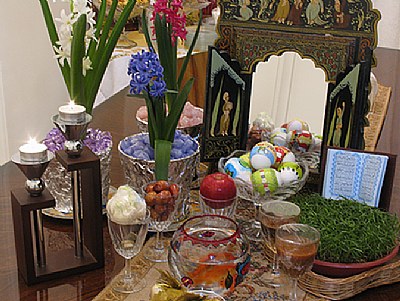
It's the first day of the new year ("Norooz") for Zoroastrians and Parsees, for whom it's the most important day of the year. Zoroastrian customs for Norooz include wearing new clothes, giving gifts, and settling disputes. Zoroastrians of Iranian origin generally put up a Haft Sin table as is tradition for Iranians.

Haft Sín (Persian: هفت سین) or the seven S's is a major tradition of Nowruz. Today the haft sin table includes seven specific items, all starting with the letter S or Sín (س in the Persian alphabet). The items symbolically correspond to seven creations and holy immortals protecting them. Originally called Haft Chin (هفت چین), the Haft Sín has evolved over time, but has kept its symbolism. Traditionally, families attempt to set as beautiful a Haft Sín table as they can, as it is not only of traditional and spiritual value, but also noticed by visitors during Nowruzi visitations and is a reflection of their good taste. The Haft Sín items are:
  1. sabzeh (سبزه) wheat, barley or lentil sprouts growing in a dish, symbolising rebirth;
  2. samanu (سمنو) a sweet pudding made from wheatgerm, symbolising affluence;
  3. senjed (سنجد) the dried fruit of the oleaster tree, symbolising love;
  4. sír (سیر) garlic, symbolising medicine;
  5. síb (سیب) apples, symbolising beauty and health;
  6. somaq (سماق) sumac berries, symbolising (the colour of) sunrise;
  7. serkeh (سرکه) vinegar, symbolising age and patience.

     
A slightly less traditional Haft Sín may also include:
  • sonbol (سنبل) the fragrant hyacinth flower, symbolising the coming of spring;
  • sekkeh (سکه) coins, symbolising prosperity and wealth;
  • sekanjabin, a sweet mint syrup;
  • decorated eggs, sometimes one for each member of the family (fertility);
  • a bowl with goldfish, symbolising life (and the sign of Pisces which the sun is leaving);
  • a bowl of water with an orange in it, symbolising the earth floating in space;
  • A poetry book, such as the Shahnameh or the Divan of Hafez, and/or a holy book such as the Quran or the Bible (or a compilation of Bahá'í prayers if appropriate).
Zoroastrians of Parsi (South Asian) origin do not traditionally use a Haft Sin. They set up a standard "sesh" tray - generally a silver tray, with a container of rose water, a container with betel nut, raw rice, raw sugar, flowers, a picture of Zarathustra the prophet, and either a floating wick in a glass filled with water topped with oil for fuel, or an "afargania", a silver urn with a small fire nourished by sandalwood and other fragrant resins.

Find out more about how people of Persian origin all over the world are celebrating Norooz, first day of their national and cultural calendar:
http://payvand.com/blog/1389/2010/02/07/new-year-norouz-1389-2010-times-%D8%AA%D8%AD%D9%88%DB%8C%D9%84-%D8%B3%D8%A7%D9%84/

The Vernal Equinox is celebrated today by our Pagan friends. Find out more about the Pagan celebration of Ostara in the Northern Hemisphere:
http://web.grinnell.edu/groups/pagan/pagan-home-ostara1.html

I'd like to acknowledge Wikipedia as the source for most of this information.