Showing posts with label English Heritage. Show all posts

Friday, 1 February 2013

CATHEDRAL REVAMP APPROVED

This article appears in today's Leicester Mercury:

Cathedral revamp approved
Plans to create a new public square outside Leicester Cathedral have been given the go-ahead.
The Cathedral Gardens project was approved by Leicester City Council's planning committee on Wednesday.
Church leaders said they were delighted to have gained permission for the £3 million scheme and hoped clearing the hurdle would make it easier to raise the cash they need to make it happen.
City mayor Sir Peter Soulsby has pledged to finance half of the scheme if the Diocese of Leicester can raise the rest.
Project director the Rev Pete Hobson said: "It's an important hurdle to clear because we do need to raise a lot of money and, understandably, there can be a reluctance to offer support to a project that doesn't have planning permission.
"This is a significant scheme for the city and we have worked very hard on it.
"We know we are dealing with a sensitive part of the city's heritage and we want to get it right."
English Heritage had raised concerns about some elements of the scheme, such as the types of flagstones used and the removal of listed railings, but it withdrew objections after the diocese revised the project.
However, Leicester Civic Society chairman Stuart Bailey said he remained concerned about a section of grade II-listed wall which will be reduced in height from seven feet to 16 inches to open the historic Guildhall building up to the new square.
He said: "This has gone through as an alteration to a listed structure which is being reduced in height, but in my view it is simply the destruction of a bit of the city's historic fabric which, once gone, will be lost forever."
The cathedral believes the wall dates from 1888 but Mr Bailey said he thought it was much older, a remnant of the medieval city.
He said: "It's actually irrelevant how old it is. It's listed so it should not be destroyed.
Mr Hobson said there was a "genuine difference of view" on the historic value of the wall.
The scheme will see the overhaul of the cathedral forecourt off Peacock Lane, which was built in 1987, with new lawns and paths installed.
Mr Hobson said the cathedral was anticipating a surge in visitors should human remains discovered by archeologists in a nearby car park turn out to be those of Richard III. He said he expected most of the work on the gardens would be done in 2014.
Anyone wishing to donate to the project should call Mr Hobson on 0116 261 5200.

Tuesday, 22 January 2013

THE "JEWEL OF LEICESTER'S CHURCHES" NEEDS SUPPORT

This article appears in today's Leicester Mercury:

The "jewel of Leicester's churches" needs support
I was pleased to hear a "significant grant" of £40,000 was made just before Christmas to St Mary de Castro, from the National Churches Trust.
Known as the "jewel of Leicester's churches", grade I-listed St Mary de Castro is nationally important: it is where King Henry VI was knighted in 1426 and it is thought the poet Geoffrey Chaucer was married there.
King Richard III's body is also believed to have lain in rest there after his death at the Battle of Bosworth.
Today, with Leicester Castle, it forms one of the important heritage areas of the city.
However, at more than 900 years old, its 80ft-tall spire is needing urgent financial attention, as Vic Allsop, of St Mary de Castro explains: "We are delighted English Heritage/Heritage Lottery Fund has made a significant in principal grant of £187,000 towards restoration.
"We're in phase one, the development project. Phase two is the work itself.
"When the project started and scaffolding was erected inside the spire, close inspection revealed bad news.
"Previous inspections with 'cherry pickers' and binoculars did not identify cracks in the tower that were severe, putting the potential stability and future viability of the spire at stake.
"We had to act quickly: permission was given to carry out advance works to stabilise what was potentially a serious situation for the church.
"At the churches own cost of £30,000, the spire was stabilised and made safe by introducing nine stainless steel bands inside the spire."There is a possibility the spire will need to be taken down and rebuilt, which could potentially exceed £500,000. The phase one specification will confirm the final figure.
"The damage to the spire was caused by previous restorations, inappropriate stone and concrete pointing at the top of the spire, which has put pressure on and is eroding the stonework below.
"Regular inspections take place from the internal scaffolding. In the summer, the SOS (Save Our Spire) Appeal started. We have been overwhelmed by many offers of support and it is clear St Mary de Castro has the support of the community.
"We recently launched the Save our Stones Appeal with the help of one of our sponsors Newby Castleman. This is a practical way in which people can make a contribution to the restoration of the spire."
For more information on how you can help, contact appeal co-ordinator Rosemary Mason on 07710 531792 or via: sosstmarydecastro@ btinternet.com
www.stmarydecastro.org.uk

Saturday, 29 December 2012

CATHEDRAL GARDENS REVAMP CRITICISED BY HERITAGE GROUP

This article appears in today's Leicester Mercury:
Cathedral gardens revamp criticised by heritage group
English Heritage has raised concerns about £3 million plans to revamp the area outside Leicester Cathedral.
The heritage watchdog says it is unhappy with elements of the Cathedral Gardens project and has joined the Leicester Civic Society in voicing misgivings about the scheme.
Church leaders say they want to create a worthy setting for the 12th-century building, in St Martin's, and an attractive public space.
However, English Heritage has looked at details of the scheme and, though it supports the principle, it says it cannot support it in its current form.
In a letter to Leicester City Council planning officers, its historic building adviser, Helen Ensor, said: "Overall, we see the potential for intervention into this now tired-looking space and the opportunity to create a fitting and functional new forecourt to the cathedral.
"However, we cannot fully support the scheme at this stage and would welcome the opportunity to advise further.
English Heritage opposes the removal of listed railings along the boundary of St Martin's House and St Martin's Lane West as well as the use of Roman-style paving stones.
It has also objected to the removal of headstones.
Ms Ensor said: "Not only are they fine and interesting sculptural elements which point to the cathedral's past as a medieval parish church, but they also represent the life and death of the people who have worshipped here and must be considered as important to the social history of the church and city."
As previously reported in the Mercury, the civic society opposes plans to reduce the height of a grade II-listed Tudor wall, which dates back to 1519, and was part of the Wyggeston Hospital.
It also objects to the alterations to another grade II-listed wall from 1757 which will be reduced in height from eight feet to 16 inches and have an opening created to allow access to the cathedral visitor centre.
It says these will be a loss of historic fabric that has not been justified.
Civic society chairman Stuart Bailey did, however, say the designs for the area were generally of a high quality.
Nobody from the Diocese of Leicester was available for comment yesterday, but the Bishop of Leicester, the Rt Rev Tim Stevens, has previously said: "Work has been going on to develop proposals for a new Cathedral Gardens space, uniting the current cathedral precincts and St Martin's House grounds to provide not only a more fitting setting for our cathedral, but also a safe and beautiful garden space at the heart of our city for all its residents and visitors."

Saturday, 22 December 2012

SPIRE APPEAL GETS BIG BOOST

This article appears in today's Leicester Mercury:

Spire appeal gets big boost
An appeal to save the spire of one of England's most historically important churches has been given a £40,000 funding boost.
St Mary de Castro's spire appeal has been given the money by the charity National Churches Trust.
Described as the "jewel of Leicester's churches", its spire is in desperate need of repair after six-metre cracks were discovered on four of its six faces.
The money donated will go towards the SOS (Save Our Spire) fund-raising appeal, which was launched in September and is looking to raise up to £500,000 to fix the damage.
Church member and appeal co-ordinator Rosemary Mason said the award was a timely boost for the appeal.
"We are one of only eight church projects in the country to be awarded one of these grants, so it's a big coup for us," she said.
"It helps a tremendous amount towards paying for essential repairs and in building up momentum behind the appeal."
Claire Walker, chief executive of the National Churches Trust, said: "We are delighted to be providing funding – a £40,000 Cornerstone grant will help fund major repairs to the church spire of this nationally significant church."
The grade I-listed St Mary de Castro is on heritage watchdog English Heritage's 'at risk' register.
King Henry VI was knighted in St Mary's in 1426 and it is also thought Geoffrey Chaucer was married there.
King Richard III's body is believed to have lain in rest in the church after his death at the Battle of Bosworth.
English Heritage has already offered to pay £187,000 towards the spire repair, with supporters raising more than £2,000 since the appeal's launch.
"The appeal is going really well," said Mrs Mason.
"Our Sponsor a Stone scheme has had a very positive take-up, with about 45 people signing up and more people approaching us every day for the chance to have their names recorded in the church archives for posterity.
"It's been a fantastic response and we're grateful to everyone for their continued support."
De Montfort University students have adopted the spire appeal as part of the university's Square Mile (Mile2) regeneration project, supporting the communities of Woodgate, Tudor Road, Fosse Road and Newfoundpool.
Mark Charlton, Mile2 manager, said: "St Mary de Castro historically served these areas and our students wanted to be part of the SOS campaign.
"We organised a fundraising carol concert in the church and students will stage a vintage clothing fair in the spring."
Work on the spire is expected to begin in the new year.
www.stmarydecastro spireappeal.co.uk

Tuesday, 18 September 2012

AMBITIOUS £3M VISION FOR LEICESTER CATHEDRAL GARDENS UNVEILED

This article appears in today's Leicester Mercury (and, oddly, in identical form in the next day's edition too)

Ambitious £3M vision for Leicester cathedral gardens unveiled
Church leaders have unveiled images of proposed new £3 million gardens outside Leicester cathedral.
Staff at the historic building want to create an area with trees and flowers that could host outdoor services and concerts.
As previously reported in the Mercury, the clergy and Leicester City Council are jointly funding the £3 million scheme and yesterday artist's impressions were published.
The move will see the precincts of the cathedral being combined with the car park of the redeveloped St Martin's House diocese building for a new public space.
The gardens will be capable of being turned into an outdoor venue with seating for up to 800 people.
They will include a tranquil graveyard created with the gravestones that stand outside the cathedral.
In 2009, before St Martin's House was started, the cathedral announced plans to transform the grounds but a lack of cash was a problem.
The diocese plans to raise its half of the £3 million through grants and private donations.
The Bishop of Leicester, Tim Stevens, said the scheme, which is waiting for planning permission, was going ahead thanks to the backing of city mayor Sir Peter Soulsby.
He said: "We have long wanted to give the cathedral its proper setting in the city and to make our spaces more attractive. Cathedral Gardens will now allow us to do just that.
"We are very grateful to the city mayor for his backing in getting us to this point and look forward to realising our vision during 2013."
The city council cash will come from the £19 million Connecting Leicester fund set up by the city mayor.
The cash will also be used for a new Jubilee Square at St Nicholas' Circle nearby.
Sir Peter said: "Cathedral Gardens would provide a wonderful setting for our city's cathedral and is an excellent example of what could be achieved through a shared Connecting Leicester vision."
The new gardens will include a central lawn and a water feature outside the cathedral.
The planning application will also include the demolition of a wall on the north side of the St Martins House car park to create a new cafe that will link Cathedral Gardens and the entrance to the Guildhall.
Demolishing the wall is likely to be a stumbling block though.
Chairman of Leicester Civic Society Stuart Bailey said: "The wall is a listed building in its own right and we and English Heritage have expressed our concerns about losing it."
He said there were also concerns about plans to straighten the footpath to the east of the cathedral.
The plans are being sent to the city council and the Church of England's own planning authority for approval. Artist's impressions are available at: www.cathedralgardens. dioceseofleicester.com

Monday, 10 September 2012

AN APPEAL TO IN-SPIRE US ALL

This article appears in today's Leicester Mercury:

An appeal to in-spire us all
An appeal has been launched to save the spire of one of England's most historically important churches.
The spire of St Mary de Castro, Leicester, is in desperate need of repair after six-metre cracks were discovered on four of its eight faces.
Architectural engineers have been called in to install steel bands inside the 120ft structure to save it from collapsing.
However, up to £500,000 may be required to fix the damage properly.
Supporters have now launched an SOS – Save Our Spire – Appeal. Its official launch took place at the church on Saturday, where civic leaders and guests gathered to hear about the 900-year-old building's plight.
Vic Allsop, chairman of the SOS Appeal, said: "Repair of the structure of the spire is necessary due to it being identified by English Heritage as not safe in its present condition.
"English Heritage has kindly offered us a grant of £187,000 towards our £329,000 target.
"However, the project could well end up costing up to £500,000.
"A tremendous amount of work has gone in over the past few months in getting us this far but there is still a long way to go.
"I was born in Leicester and this church is important to me, our city and to an awful lot of other people.
"Heritage is something we lose if it's not looked after."
Church member and appeal co-ordinator Rosemary Mason, said: "The spire is such an iconic feature in Leicester's skyline and we at St Mary's wish to preserve this gem for future generations to enjoy.
"St Mary's is a church for everybody and that's why help from the whole community is so important to this project."
People can sponsor a single stone for £15, or a decorated stone for £250, and have their names inscribed on it.
The church's rescue plan includes developing links with the wider community.
A brass band concert will be one of the first big fund-raisers on December 1.
City mayor Sir Peter Soulsby and chairman of Leicestershire County Council Peter Lewis attended the appeal launch, where Lady Gretton, Lord-Lieutenant of Leicestershire, was revealed as its new patron.
 Accountants Newby Castleman is sponsoring the appeal.
Sir Peter said: "I am very impressed at how the church has brought so many people together and I'm confident individuals and businesses will support the spire appeal."
Councillor Lewis said: "We should all work together to make sure that in this time of cuts and financial difficulty, treasures such as this building are not forgotten."
For details of how to donate or get involved call Mrs Mason on 07710531792, e-mail:sosstmarydecastro@ btinternet.com
www.facebook.com/SaveOurSpireStMaryDeCastroChurchLeicester

Friday, 27 July 2012

TEMPLE PLAN FOR HISTORIC SITE

This article appears in today's Leicester Mercury:

Temple plan for historic site
An historic building in the heart of the St George Conservation Area in Leicester could become a place of worship.
The city council has received a licensing inquiry about the empty Edwardian Guild for the Disabled building, in Colton Street, from the Shri Shirdi Baba Temple Association, an international religious organisation.
Leaders would like to use the Grade II-listed building, which is on English Heritage's "at risk" list, as a temple and meeting place.
Darshan Singh Nagi is chairman of the Shri Shirdi Baba Temple Association, which has a UK base in Wembley, north London.
He said: "We are in the process of signing a lease with the owners but want to be sure that it would be okay to use the building for worship.
"That's why we have applied to the council for a certificate for this purpose."
The temple association takes its name from Indian holy man and deity Sai Baba, of Shirdi, a village near Mumbai, who preached peace, charity and harmony under one god.
Mr Singh said: "He was well known for performing miracles and although his millions of devotees worldwide observe a loosely Hindu tradition, he is revered by Sikhs, Muslims, Christians and Hindus alike.
"The hall would be used by our followers in Leicester and all people would be welcome."
Built in 1909 by city architects A and T E Sawday, the building, now called the Charles Venue, was the first in Britain, and possibly the world, to be designed for people with disabilities, complete with wheelchair access. Listed by English Heritage in 1992, it has been empty since 2000, when disabled charity Mosaic moved to new headquarters.
The city council refused a licensing application last year by Belgrave developer Ashik Madlani – who wanted to use it to stage plays, films, wrestling, live music and dance events – after concerns were raised by residents over noise disturbance.
"Our use would be a very quiet and peaceful one," said Mr Singh.
"We would like to breath new life into this truly beautiful and historic building so that the people of Leicester can be proud of it once again."
Graham Lees, spokesman for the Leicester Victorian Society, said: "When a lovely building like this is left empty for too long it is a big concern to us.
"It is far better for it to cared for and maintained while being used in an appropriate way."
A Leicester City Council spokesperson said: "The application is for a Certificate of Proposed Lawful Use.
"This process allows the applicant to ask for the council's legal opinion as to whether or not the Guild for the Disabled can be used as a place of worship without the need for planning permission.
"Current planning legislation allows for the grouping of similar uses in one category. A training centre and place of worship would fall within the same group.
"A change between uses within the same group will not normally require planning permission.
"We are undertaking research into the history of the site to identify if the building can be used as a place of worship without the need for further planning permission.
"Any related alterations to the building would still need planning permission."

Thursday, 26 July 2012

MAPPING FAITH & PLACE IN LEICESTER CONFERENCE


The Grand Hall in St Martins House is the venue for this conference, concluding the first phase of the University of Leicester's Mapping Faith and Place project. I haven't been in the Grand Hall before, but it's a setting that lives up to its name, one fit for a queen. Literally, in this case, as HM Queen Elizabeth II was served lunch here on her recent visit to Leicester which kicked off her Diamond Jubilee Celebrations. Some of those attending today were guests on that occasion.

Deirdre O'Sullivan (Lecturer in Medieaval Archaeology at the University of Leicester) welcomes attendees and introduces the project. The rest of the day is taken up with a number of presentations:
Heritage and Multi-Faith in Leicester, Canon Dr John Hall, Director, St Philip's Centre for Study andEngagement in a Multi-Faith Society
English Heritage Policy on Faith Buildings, Dr Lind Monckton, English Heritage
History and Interpretation, Surinderpal Rai, Chair, Guru Tegh Bahadur Gurdwara
Leicester Perspective, CllrManjula Sood, Assistant Mayor (and Chair, Leicester Council of Faiths)
Jain Heritage in Leicester, Dr Atul Shah, CEO, Diverse Ethics
The Church of St Mary de Castro: a Document in our Midst, David Lamb, St Mary de Castro
An Archaelogical Approach to Understanding Religious Buildings, Neil Finn, Archaeological Consultant
The Story of Leicester, Sarah Levitt, Leicester City Council Arts and Museums Service

An interesting variety of presentations, to be sure, but it wouldn't be unfair to say that they're something of a mixed bag. Although the conference is sponsored by the University of Leicester, it's not, strictly speaking, an academic occasion, so it would be wrong to hold all the contributions to the kind of rigorous standard. Let's just say that the standards of preparation and delivery vary today.

Mapping Faith and Place in Leicester has been funded by the Art and Humanities Research Council (AHRC) within their funding stream, "Care for the Future: Thinking Forward Through the Past". After the end of this initial period of funding, the project moves into a new phase, focusing on the past, present and future uses of one faith-related site in particular: Guru Tegh Bahadur Gurdwara on East Park Road.

The Council of Faiths has lent a hand at various stages of the Mapping Faith and Place in Leicester project (although if we'd grasped how significant it is, we'd surely have done more to help). I've posted entries about the launch event in October 2011 and the first, second and third seminars for the project in this blog. We borrowed the project's pop-up banners for our display at Highcross during Inter Faith Week 2011, when we also distributed many copies of the Leicester Faith Trail booklet (the second, updated edition of which is published today). Members of staff Deirdre O'Sullivan and Dr Ruth Young (Senior Lecturer in Archaeology and Director of Distance Learning Strategy) and students from the School of Archaeology and Ancient History took part in that exhibition. There are several members of the Council of Faiths here today and, of course, our Chair, Cllr Manjula Sood, is one of the platform speakers. But I can't help wishing we'd been able to make a more formal presentation. There were some questions from the floor about inter-faith issues in Leicester that some of the platform speakers were unable to answer, that would have surely been part of a proper presentation by the Council of Faiths (regarding consultation with the city's decision-making bodies, for example).

I've enjoyed being involved in this project. It's opened some doors for me and introduced me to some good people I might otherwise never have met. I hope that I (and Leicester Council of Faiths) can play an active part in the project's future development and even find new ways to contribute and collaborate.

As I do at the end of all my blog posts referring to St Martins House, I refer any reader wondering about the omission of the possessive apostrophe from the building's name to a letter from Rev. Peter Hobson, Director of St Martins House, published in the Leicester Mercury, 29 March 2011.

Saturday, 21 July 2012

CONSIDERING WORSHIP

This article (regarding the conference rounding off the University of Leicester's Mapping Faith and Place project) appears in today's Leicester Mercury:
Considering worship
Places of worship will be the subject of a conference next week.St Martin's House, in Peacock Lane, Leicester, will host the event, which runs from 9.30am to 4pm on Thursday.
There will be guest speakers from faith groups, English Heritage, Leicester City Council and the University of Leicester, and a chance to debate the role of faith buildings.
For more details, call Heather Lomas on 0116 270 0386.

Tuesday, 28 February 2012

CASH GRANTS WILL REPAIR CHURCHES

This article appears in today's Leicester Mercury:
Cash grants will repair churches
Some of the county's oldest churches will share more than half a million pounds of lottery cash for urgent repairs.
The 12th Century church of St Mary de Castro, the city's parish church, will receive £187,000 to fix stonework and look at ways to mend its crumbling spire, which has been shifting slightly, causing cracks.
Deputy churchwarden Michael Hay said: "This will make a very big difference. The church's council couldn't have raised the money itself.
"The spire is 500 years old and the stone is of pretty poor quality and has been weathered badly. It hasn't been repaired for nearly 100 years."
Most of the money will fund an investigation to find the best way to fix the spire.
Once that is complete a larger, more expensive repair project will begin.
Mr Hay said: "For the main job we'll be launching a county-wide fund-raising appeal once we know the full costs. We're expecting something in the order of £500,000 but it could be more."
St Peter's in Kirby Bellars, near Melton, will get £145,000 for masonry work on the tower and spire, which are crumbling so badly the church bells have not been rung in more than a year for fear of causing more damage.
Vicar, the Rev Peter Collins said: "I want to get the tower and spire restored so the bells can ring down the Wreake valley again, so this is absolutely terrific news."
Another church benefiting from the Heritage Lottery Fund cash will be All Saints Church in Seagrave, Charnwood, which will receive £66,000 to replace copper roofing and timber.
St Martin's in Stapleton, near Hinckley, will receive £31,000 to repair the spire, St Peter's in Redmile, near Bottesford, will get £47,000 to fix the roof and St Peter's in Tilton on the Hill, near Leicester, got £59,000 for tower repairs.
The money comes from the National Lottery and is given out by English Heritage. Places of worship for all faiths and denominations can get grants of up to £250,000.
Emma Sayer, head of Heritage Lottery Fund in the East Midlands, said: "Historic places of worship are an irreplaceable part of our heritage.
"In the past 10 years, the Heritage Lottery Fund has invested £155 million into these wonderful buildings."
For more information, visit: www.english-heritage.org.uk

Tuesday, 18 October 2011

MAPPING FAITH & PLACE: 1st SEMINAR


Faithful reader, won't you welcome please, guest blogger Rosemarie Fitton:
I attended the first seminar of a project, Mapping Faith and Place, run by Leicester University, "investigating the significance of South Asian religious and cultural heritage in Leicester's urban landscape." This took place at New Walk Museum and Art Gallery. There are two further seminars to run next year followed by a public conference. I was wearing a number of hats, firstly as the creative director of Heterarchy, my interior design practice, based here in Leicester, secondly as an academic from DeMontfort university and thirdly, after George had asked me to write a blog about the seminar, as a member of the Leicester Council of Faiths. 
The seminar was organised by Dr Deirdre O'Sullivan and Dr Ruth Young, both from the School of Archaeology & Ancient History at Leicester University. 
There were a series of talks which were preceded by an introduction to the project by Dr Chris King, who had originally conceived and obtained funding for the research; Dr King, formerly of Leicester University, is now based at Nottingham University.
Dr King outlined the purpose of the project which is for academics and non-academics to work together to share knowledge and insights in order to gain an understanding of Leicester's cultural and religious landscape. In this series of seminars we will be looking at ways to take the project forward and how to best connect with people from the different communities. 
Dr Deirdre O'Sullivan and Dr Ruth Young talked about the work that had already taken place, which has resulted in The Faith Trail, most of the work for which was carried out by students at Leicester university. There is a website and booklet which accompanies this part of the project.
We then had a talk by Linda Monkton of English Heritage, who is head of research policy for places of worship. She spoke about the National Heritage list for England which includes an on-line database of all nationally designated heritage assets and the National Heritage Protection Plan, which is a framework for the key priorities for research over protection issues. She was very interested in finding out ways that English Heritage could foster good relationships with local contacts in the different faith communities. 
I then gave a talk on the work my company had carried out on the interiors for the new Swaminarayan Hindu temple on Gypsy Lane, which opened on the 8th-9th October. Describing how we had become involved in the project and how we set about the design process, to create interiors which reflected the rich cultural heritage of the Swaminarayan faith yet in a more contemporary style.
Rupert Allen, Assistant Church Buildings Development Officer for the Diocese of Coventry and Leicester spoke about the re-use of historically significant buildings and ways in which these could be sympathetically re-ordered to accommodate the new occupants.
In the afternoon we had lively discussions which initially looked at the issue of the Leicester orthodox synagogue which has recently been put up for sale, and the significance of religious buildings and their heritage as "sustainable sacred space".
This was followed by looking at ways to move the project forward and what the major issues were for the different faith communities in terms of buildings and the built environment and other groups who had an interest such as English heritage and academics.


Thanks Rosemarie, your contribution is much appreciated. I look forward to you having future stints as guest blogger.

Friday, 2 September 2011

SOULSBY VISITS SECULAR HALL

This article appear in today's Leicester Mercury:

Soulsby visits Secular Hall
City mayor Sir Peter Soulsby visited Leicester's Secular Hall on Humberstone Gate on Wednesday, August 26.
The Leicester Secular Society is celebrating two important anniversaries this year – the hall is 130 years old and it is 160 years since the society was formed, making it the oldest secular society in the world.
An important part of the city's cultural heritage, the Secular Hall has hosted lectures from historic figures including William Morris, George Bernard Shaw and Bertrand Russell.
However, the hall is in need of significant modernisation including the installation of a lift, new kitchens, new toilet facilities and sound insulation between floors if it is to be brought up to contemporary standards.
During his visit, Sir Peter was shown around the premises and discussed plans for the hall's regeneration with members of the society.
Sir Peter said: "It's been really good to hear from the society members about the condition of the hall and to see it for myself. It's a wonderful space and deserves to be brought back to top-quality condition."
Dr Emma Chung, the first female president in the society's history, said: "I was really thrilled to see Sir Peter shares our enthusiasm for the beauty of Secular Hall and was very positive about wanting to preserve it.
"The hall is a unique building and a real hidden gem in the centre of Leicester."
The Leicester Secular Society is hosting an English Heritage Open Day on September 11 when members of the public will be able to look around the Hall and learn all about the history of the society.

Thursday, 31 March 2011

FOR SALE: ONE HISTORIC CHURCH - GUIDE PRICE £250,000 TO £750,000

This article appears in today's Leicester Mercury:
For sale: one historic church - guide price £250,000 to £750,000
It’s a striking example of gothic Victorian architecture , and part of the legacy of a world-famous designer. Yet it is disused, falling into disrepair and up for sale. Adam Wakelin reports
St Saviour's Church used to have its name stuck on the front in plastic letters. Many have now fallen off or been stolen. It is ST VIOU S C CH now. Oddly appropriate, perhaps. A gibberish sign for a boarded-up building that doesn't make much sense around here any more. Not as it is, anyway.
Assistant surveyor Joe Welch, of Andrew Granger & Co, is sliding back the last of the heavy bolts on a side door when the Mercury arrives for a viewing.
Inside, the temperature drops like a brick. It's cold enough to stiffen a line of washing, even on a sunny day like this one. Boards nailed across the windows to deter vandals keep the interior in darkness.
Joe goes to switch on the lights. When they come on, it is easy to see why the building is Grade II* listed. Standard estate agent blurb doesn't begin to do somewhere like this justice.
That's probably why Andrew Granger & Co hasn't bothered with it. The building's sale brochure sets aside superlatives and sticks to thefacts:
A large Victorian gothic church designed by architect Sir George Gilbert Scott; red brick with a stone spire and slate roof, built in 1875-77, the last and largest church of the man who built the Midland Grand Hotel at St Pancras and the Albert Memorial. To be sold as a job lot with the next door neighbourhood centre, a former school. Guide price: £250,000 to £750,000.
"We want to focus on the fact that here is a fantastic opportunity to acquire a wonderful piece of Leicester's heritage and really bring it back into use," says Joe.
Doing that comes with all manner of complications – and it tells the story of just how difficult it is to stop some of Leicestershire's best buildings falling empty and derelict.
You don't have to be religious to be awed by a building like St Saviour's. Inside and out, the sheer size of the place is enough to draw a gasp.
It really is magnificent, a muscular monument to Christianity that has towered over everything else in this corner of Highfields for more than 130 years.
The building is big in thought and deed. Four rows of long pews stretch into the distance, lolly stick-small in Gilbert Scott's cavernous space. Once, 1,000 worshippers flocked here to be spiritually uplifted and consoled, and they were comfortably accommodated.
Not any more. St Saviour's has been closed for six years. The last time it was anything like full must have been decades ago.
Most of the fixtures and fittings have been stripped out, removed to stop them being burned or smashed by vandals who used to break in before the building was made more secure.
A few things remain. You can see how its congregation fell away in the framed Christening lists that still hang on one wall. In the 1970s there were five or six new names being added every month. By the early 90s, there would be one. Often not even that.
But St Saviour's was on borrowed time even as its mortar began to dry. Leicester's religious impulse was already beginning to wane.
As early as the 1890s, Church of England attendance began a slow but inexorable decline.
The veil-wearers and men with beards walking past the building today tell you what happened next without saying a word.
Religion again thrives around St Saviour's. There is no shortage of believers in Highfields, but this is now an overwhelmingly Muslim area.
In 2005, the church was closed. Three years later, Leicester City Council decided not to renew its lease on the nearby neighbourhood centre. It too was boarded up. Leaving the buildings to rot was never an option. But what do you do with them?
The Diocese of Leicester, along with Andrew Granger & Co, has been working on that for several years.
There are more than 300 CofE churches in Leicestershire. They form some of the county's finest architecture, yet some are ruinously expensive to repair and maintain as congregations dwindle.
The decision to close a church is never taken lightly, says Andrew Roberts, acting secretary for the Diocese of Leicester.
Sometimes, though, there is no other option. Selling a building is better than letting it fall down.
Six city and county churches are on the market or under offer: St Saviour's, St Peter's Church in Belgrave, St Gabriel's Church off Gipsy Lane, St Paul's Church in Kirby Road, St Peter's Church in Saxby and St James' Church, Snibston in Coalville.
Selling those properties is a lot more complicated than you might think.
St Saviour's Church, like many of the others, is a listed building.
Neither English Heritage nor the local planning authority will allow a development that compromises its character or architectural integrity. Even something as basic as removing the pews will have to be justified.
Then there are the Church Commissioners who have to be satisfied.
They handle the sale of the building on behalf of the diocese – and they have to be assured it will be put to good use.
It would not be deemed appropriate, for example, to turn a church into a pub or betting shop, says Mr Roberts.
And there lies the conundrum. In St Saviour's you have beautiful, historic Christian building in an area that's nice enough, but not particularly upwardly mobile or wonderfully served by transport links.
Nothing is an easy fit with Gilbert Scott's grand gothic vision.
The estate agents and the diocese have attracted some criticism for allowing the building to stand empty for so long.
But making a quick sale then seeing it fall through because the buyer got bogged down in planning problems would not have been sensible, says Joe.
To prevent that, they have worked with English Heritage and Leicester City Council to develop a planning brief for the church and neighbourhood centre. This outlines potential future uses of the buildings and provides general guidance on acceptable alterations.
Options for the church include: keeping it as a place of worship; turning it into a community centre, creche or day nursery; creating an art gallery or museum; or using it as an educational or medical centre.
It could also be converted into offices, flats or even a hotel – although any residential conversion will be challenging due to the difficulties of sub-dividing the building without compromising its architectural integrity.
Would an upmarket hotel or swanky apartments work in Highfields?
It's hard to see how.
"It's one of those buildings where we'll have to let the market decide what to do with it," says Joe.
Anyone interested in making a bid has to do so before July 1. The best options will go forward to be developed further.
The asking price of between £250,000 and £750,000 reflects the different uses to which the building could be put.
The Church Commissioners won't let the building be sold for a song, but cash won't be the only consideration. A third of the proceeds will go to the Churches Conservation Trust, which looks after closed churches, and the remainder will go to funding social and community work.
The first preference is often to retain a church for a denomination of Christian worship, says Mr Roberts. If that's not possible, then they would probably like to see at least some of the site put to community use.
Perhaps the old school could accommodate something more commercial, and the church could be opened up to benefit local residents.
"It is finding the right balance to make the site work in a social and commercial sense," he says. "Sometimes you get schemes that are residential conversions and they are sympathetic. No-one likes selling churches, but you can't just let them fall down. It is about finding an appropriate use for them."

Sunday, 12 September 2010

Faiths Trail


Today we're making our contribution to English Heritage's open weekend, called - for our part of the world - "Discover Leicester". This is one of a small number of annual events which is helping earn the Council of Faiths a positive reputation.

I'm only able to join in at lunchtime, as I've taken Harry out to sing in the choir at St Thomas this morning. We meet Clare and Gracie outside Guru Amar Das Gurdwara in Clarendon Park Road (that's them dressed the part, in the photo above). We're there about half an hour before the coach with everyone else turns up.

We've tried to squeeze in too many visits in previous years, so this time we've cut it down from five stops to three. First was the Jain Centre, then the Central Mosque, ending up at Guru Amar Das Gurdwara for the final visit, that includes lunch.

There are 25 people on the trail, including the Lord Mayor of Leicester, Cllr Colin Hall, and his Secular Humanist Chaplain, Dr Allan Hayes. We're grateful to Ajay, the Co-ordinator at the Council of Faiths, for organising this event.

You can see photos of today's Faiths Trail on our Flickr photostream:
http://www.flickr.com/photos/leicestercounciloffaiths/sets/72157624825007277/

Sunday, 27 December 2009

2009's TOP 10: 5


Faiths Trail,
Sunday 13 September 2009

This has become a regular fixture in the Council of Faiths calendar over the past few years, organised in conjunction with English Heritage as part of their programme of open days during this week. I got to go on the first one of these tours (it was called a "Peace Pilgrimage" then) after I took up my post in 2007, but missed last year's excursion, so I was pleased to be able to take part this time.

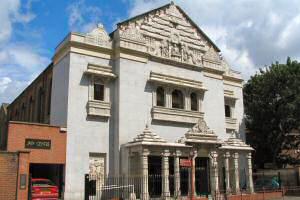
Our party of 25, from a variety of backgrounds and interests (and some from outside Leicester or Leicestershire) convened at Pilgrim House at 0930. We had a few words of welcome and introduction from Minou Cortazzi (Chair of the Council of Faiths), Cllr Manjula Sood (Deputy Lord Mayor and trustee of the Council of Faiths) and Resham Singh Sandhu (Chairman of the Sikh Welfare and Cultural Society and former Chair of the Council of Faiths). Our coach left Town Hall Square shortly before 10 o'clock. First stop was the Jain Centre, Oxford Street (pictured above), where we were joined by the Lord Mayor of Leicester and the Lady Mayoress. From there we proceeded to Shree Jalaram Prarthana Mandal, Narborough Road; then to Guru Amar Das Gurdwara, Clarendon Park Road, where we were treated to lunch (and where the Lord Mayor and Lady Mayoress had to take their leave of us). After lunch we went to the Orthodox Synagogue, Highfields Street; then to the Central Mosque, Conduit Street; and finally, St Philip's Parish Church, Evington Road. As we approached each place of worship, we handed out copies of the relevant leaflet to everyone on the coach, so they'd have a chance to read something about each faith community before each stop on the tour.

Everyone was impressed by the hospitable reception at the various places of worship. Arrangements for the day were made by Ajay Aggarwal, Co-Ordinator at Leicester Council of Faiths.