Showing posts with label Leicester University Institute of Lifelong Learning. Show all posts

Thursday, 27 January 2011

A much better understanding of faith is needed

Here's the "First Person" column from today's Leicester Mercury, by Dr Clive Marsh, Director of Learning and Teaching at the Institute of Lifelong Learning, University of Leicester. The Council of Faiths has lent some assistance to Dr Marsh over the past several months in his efforts to get one or more courses that include some aspect of the study of religion off the ground (see blog entries passim).
A much better understanding of faith is needed

Dr Clive Marsh explains why the search for religious literacy is so important in our society

Behind the headlines created by Baroness Warsi's talk at the University of Leicester recently was a basic concern which many, religious or not, might agree with: the need for a better understanding of religion in society.

It is widely accepted by people across the political spectrum, and with widely differing views about religion, that you don't really understand British culture without grasping religion's place within it.

Even if you think religion's a bad influence, and the Church should be kept well apart from the state, it is vital to know something about Britain's Christian past, and about the many different religions which feature in British society.

But how do we develop our knowledge of faith traditions? Where do we discuss openly and honestly the role that religions play in society? In Leicester, we have ample opportunity for informal interaction with people of many faiths and none. We just need to talk to neighbours, or with those with whom we work or spend our leisure time. This is the benefit of living in a "multi-cultural" society, though it's rightly been said that "multi-cultural" often means in practice that we live alongside those of different cultures and faiths. "Inter-culturalism" should be what we aim for, where there is genuine interaction between people.

We might, though, want something more formal. We have in Leicester two faith-based training institutions (the Markfield Institute of Higher Education and the St Philip's Centre) both of which offer courses open to the public to assist in the development of the understanding of religion. The work of Leicester Council of Faiths is also well-known.

But where might the "faith-suspicious" meet the "faith-based" in a constructive, respectful way? Two days before Baroness Warsi's speech I attended "Skeptics in the Pub" which meets monthly at Square Bar in the centre of Leicester. I didn't find the discussion quite as rational and evidence-based as the group might like to think. But I'd love to see the people there meeting up with the many religious people I know to have a serious conversation. It would help the literacy of all.

A university is not a "neutral" space, despite its own quest for scientific methods which are as objective as possible. But it is a place where this longed-for conversation might happen. It is not to be claimed by any single religious group. The Institute of Lifelong Learning's part-time Certificate in the Study of Religion could entice people to study at university level for the first time. And by studying religion, those of any faith or none could understand themselves and their society better, and gain useful critical skills at the same time.

Find out more about the Institute of Lifelong Learning at the University of Leicester: http://www2.le.ac.uk/departments/lifelong-learning

You can read this article on the Mercury website, along with reader comments: http://www.thisisleicestershire.co.uk/news/better-understanding-faith-needed/article-3149522-detail/article.html

Friday, 3 December 2010

WORLD RELIGIONS 101


At lunchtime today walking through Welford Place, I bump into Chris Minter (photo above), Head of Service for Leicester City Council Adult Skills and Learning Service (LASALS). We worked together recently on Leicester Speaks (AKA Local Democracy Week). Our quick chat (it's much too cold to stand and talk outside for long) moves from Leicester Speaks to National Inter Faith Week and our Highcross exhibition, thence to something that I've been nursing for ages: the possibility of the Council of Faiths offering a "World Religions 101" course, as part of the Adult Skills and Learning programme, in a popular venue such as the Adult Education College in Wellington Street. This wouldn't be like the sort of post-grad course offered by St Philip's Centre, or what we've been discussing at Leicester University Institute of Lifelong Learning, but a beginners' guide for interested members of the general public. I've roughed out versions of just such a course, which could be offered in 10, 16 or 32 sessions in one of my little black books. Chris likes the sound of the idea, asks me to drop him a line and he'll pass it on to his colleagues in Curriculum. Nice!

When I mention to Chris that Leicester City Council gave zero recognition or support to National Inter Faith Week just gone by, he tells me that it sounds like the sort of thing that the Adult Skills and Learning Service should be getting behind and that we should think of ways of working together to promote it in 2011.

Tuesday, 16 March 2010

religion in higher education


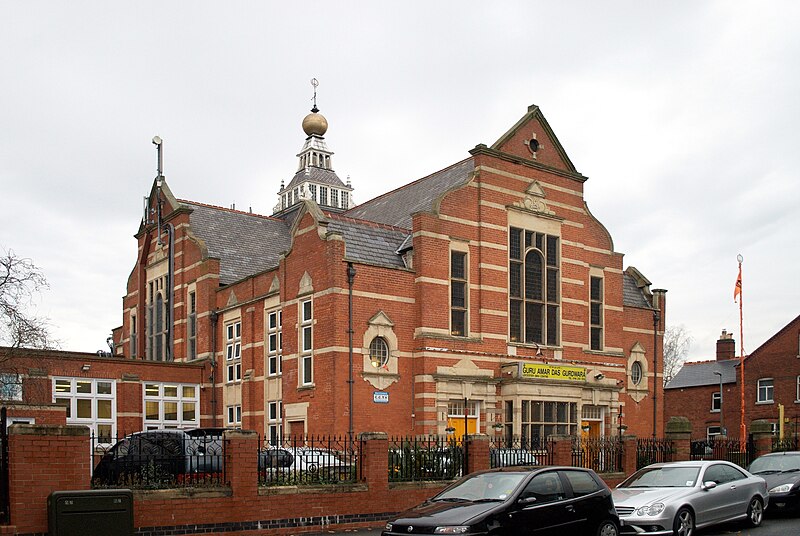
At Guru Amar Das Gurdwara, Clarendon Park Road, for a full meeting of Leicester Council of Faiths. Our speakers this evening are Dr Attaullah Siddiqui (Academic Director, Markfield Institute of Higher Education - as well as being past Chair and Honorary Life member of Leicester Council of Faiths) and Dr Clive Marsh (Director of Learning and Teaching, University of Leicester Institute of Lifelong Learning).

Dr Siddiqui is given the floor first. He offers a brief introduction to the history and work of the Markfield Institute of Higher Education (MIHE), Markfield, Leicestershire. Found in 2000, it is the first academic institution of its kind in the west. It presents a unique opportunity to study Islam in an Islamic institution within the context of Higher Education in the UK. In Dr siddiqui's presentation this evening, he tells us how MIHE was the first academic institution to address issues of being a Muslim in Britain today. It has recently begun to offier chaplaincy training, but it does so for Muslims in the context of a mult-faith society, in which trainees are obliged to learn about other faiths. Later in the evening, one of the members of the Council of Faiths remarks that those who have been students at Markfield are distinctive in their ability to join in inter-faith dialogue, mix with people of other religions and visit places of workship with confidence and openness.

In his introduction to his work, Dr Marsh observes that In Leicester, religion is all aorund us, but it tends to be something that other people have. But one can't work or live in this city without at least seeing evidence of people from many different faith traditions and cultural backgrounds -whether as individuals or as communities.

There is currently no undergraduate course in religious studies at either of the universities in Leicester - which is remarkable (even ridiculous) in a city where religion is such a significant part of public life and faith communities are so obvious to the public eye. Leicester University had a department teaching religious studies, but it closed as long ago as 1986 (presumably due to unsustainable numbers). The University of Leicester's Institute of Lifelong Learning does have a BA in Humanities and Arts which contains a Religious Studies component. The Institute is, however, currently also considering developing a Foundation Degree in Faith and Community Studies. This will be an opportunity for Leicester Council of Faiths to work with the Institute of Lifelong Learning on content, delivery etc. As a first step, the ILL is offering a Certificate of Higher Education in the Study of Religion at Vaughan College starting September 2010. Course Director for this two-year programme is Dr Angela Jagger, former Secretary of Leicester Council of Faiths.

Of course, provision and continuation of these courses can't avoid being market-driven. If there's demand for them, they'll flourish - if not, they'll wither away. Certificate courses require twelve students each year to run sustainably.

It's one of the stated aims in the constitution of Leicester Clouncil of Faiths that we should promote the disseemination of accurate knowledge about the faith communities in our city. This new development presents us with an excellent opportunity to put that principle into action.

These programmes of study are not intended to affirm the personal faith of the individuals enrolled on them. Indeed, if anyone signs up for that purpose alone, they may find it an uncomfortable ride. The old-fashioned distinction between "religious eduction" and "religious instruction" came to mind as we discuss this point. Students will be encouraged to look at their own religion (if they have one) and other religions as if from outside. Students should be able to reflect critically on the beliefs, values, history and practices of their own tradition as well as on those of others. These courses should allow students exposure to the life and activities of faith practitioners through contact with individuals (as visiting speakers, for example) and as communities (through visits to places of worship, joing in community, family or neighbourhood events such as festivals, commemorations, celebrations).

Angela will be offering a taster session on the evening of Monday 17 May, during Adult Learners' Week. The Institute of Lifelong Learning will have a stall in Highcross on Saturday 15 May to promote this week of learning opportunities.

Find out more about Dr Attaullah Siddiqui:
http://www.mihe.org.uk/mihe/detail.php?t=6&what=tutor

Find out more about Markfield Institute of Higher Education:
http://www.mihe.org.uk/mihe/

Find out more about Dr Clive Marsh:
http://www2.le.ac.uk/ebulletin/people/appointments/2000-2009/2008/12/nparticle.2008-12-19.5789722496

Find out more about the University of Leicester Institute of Lifelong Learning:
http://www.le.ac.uk/ad/