Showing posts with label Bahá'í Publishing Trust. Show all posts

Wednesday, 12 December 2012

INTER-FAITH FORUM IN RUTLAND PROVES A SUCCESS


It's been quite a few years since I last picked up a copy of the Rutland Times. I lived in Oakham for 16 years (1987-2003) and during those years the Rutland Times and I were on very good terms. I used to write regular small pieces about the sizeable and active Bahá'í community we had there at that time, as well as about the business of the Bahá'í Publishing Trust, where I worked then. I also wrote obituaries for the paper of John and Vera Long (who pioneered for the Bahá'í Faith in 1963, when they moved from Leicester to establish a new Bahá'í community there) when they both passed away in 1992. The Rutland Times also used to have occasional pieces about my Creative Writing classes and it once ran a profile piece about me. I don't have a copy of that any more; it would probably be embarrassing to read now. Those were more innocent times, in many ways.

Arriving at Launde Abbey today for the Christians Aware Christmas lunch, I find a copy of this week's edition of Rutland Times (edition published Saturday 8 December 2012) in the bar. Flicking through it, I'm glad to read the following short but pleasing article:
Inter-faith forum proves a success
A church welcomed people of several religions for an inter-faith forum.
Christians, Sikhs and Muslims joined together at St Andrew’s Church in Lyddington at the invitation of the Rev Jane Baxter.
Faith representatives included the newly-elected police and crime commissioner for Leicester and Rutland, Sir Clive Loader, and Judge Saleem Ahmed. 
Penny Escombe from Northamptonshire gave the opening address on spirituality in public life, followed by a talk from Chioneso Kulwant Kaur.
Former High Sheriff of Leicestershire, Resham Sandhu, said: “We are very fond of Rutland, and I hope we can repeat this successful event in Wing next year.”

Coincidentally, Resham's wife Surinder is here for the Christmas lunch, so I'm glad to be able to show the article to her.


Considering how much effort and resources we threw into Rutland promoting inter faith activities during the years I lived there (never mind the by the Bahá'ís who were there before and after that time) I am glad to see that the flame is being kept alive. I also joined in a Fellowship of Contemplative Prayer in Rutland, that was run by a small group of women from All Saints Parish Church in Oakham, that had an inter faith dimension. We once used extracts from Bahá'u'lláh's Hidden Words as the text for a session of contemplative prayer. I don't think that is still going, but it was a joy while it lasted.


Photo of St Andrew's Church, copyright Julian Dowse and licensed for reuse under this Creative Commons Licence.

Saturday, 11 June 2011

ADELPHI HOTEL'S MOST DISTINGUISHED GUEST


Regarding the Adelphi Hotel, Liverpool, where I'm attending the first national conference of Philosophy in the Pubs (PIPs): the first Adelphi Hotel on the present site was opened in l826 by owner James Radley. It soon became the most popular hotel in the city, and gained a reputation throughout Britain and Europe.

In 1912, another great hotelier, Arthur Towle, acquired and rebuilt the Adelphi. Today’s building still reflects his care and ambition to make it one of the most luxurious in Europe, with solid marble walls in many of the bedrooms, a fine indoor heated swimming pool, sauna and full central heating. The Sefton Suite in the hotel is in fact a replica of the First Class Smoking Lounge on the ill-fated Titanic.


Many famous visitors have stayed in the Adelphi, including Roy Rogers and his horse Trigger, who were  supposed to have made a grand entrance from the mezzanine floor to the main lounge.


'Abdu'l-Bahá stayed in the Adelphi Hotel for three nights in 1912 on his historic speaking tour in the West. He arrived in Liverpool on Friday 13 December, on board the SS Celtic which had sailed on 5 December from New York (photo above). This was 'Abdu'l-Bahá's second visit to these shores, having already been in England from 3 September to 3 October 1911. Find out more about 'Abdu'l-Bahá's visits to Britain here.


While in Liverpool, 'Abdu'l-Bahá made two addresses, one to the Theosophical Society on the evening of Saturday 14 December and one at Pembroke Chapel, a Baptist church, on Sunday 15 December. He left for London the next morning. 


A famous photo of 'Abdu'l-Bahá was taken during his stay in Liverpool. This much loved picture (a detail from which is reproduced above) has been treasured by Bahá'ís throughout the world for generations and can be seen in many Bahá'í  homes and centres and has been used in a variety of books and other publications.

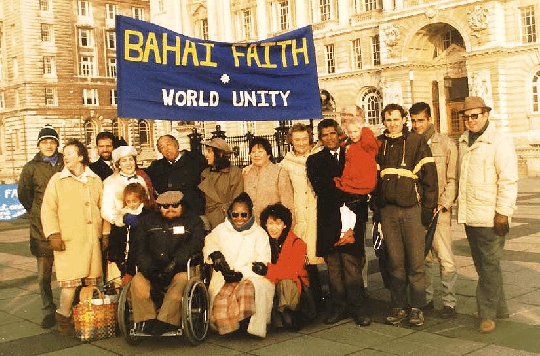
In 1987, more than 400 people gathered to celebrate the 75th anniversary of 'Abdu'l-Bahá's visit to Liverpool, tracing his route from the Pier head to the Adelphi Hotel. The photo below shows a group of celebrants gathered together shortly before the procession.


I was at that event. I came up from Oakham with other members of staff from the Bahá'í Publishing Trust  to run a book shop for those attending. I wouldn't have seen anything of the procession because I'd have been in the Adelphi, erecting and stocking the book shop, for those who were coming in the procession - and many more besides. I didn't stay in the hotel overnight though, as we were put up by friends outside the city in Newton-le-Willows.

Preparations are currently under way to mark the centenary of these memorable visits, in 2011 and 2012-13 respectively - and not only in Liverpool, but also in the other places 'Abdu'l-Bahá visited in Britain (Bristol, Edinburgh, London, Oxford and Woking - where he visited the Mosque joined by members of the Christian, Muslim and Jewish faiths together with distinguished visitors from east and west).


I wonder if this is the first time anyone has mentioned Roy Rogers and Trigger and 'Abdu'l-Bahá in the same breath? Worse still, when googling for information and images about this topic, I had to put 'Abdu'l-Bahá and Celtic side by side in the search box!

Sunday, 2 May 2010

BAHÁ'Í NATIONAL CONVENTION


To East Midlands Conference Centre (photo above) at Nottingham University this afternoon, to drop in for a few hours at Bahá'í National Convention. Today is the Twelfth Day of Ridván, marking the end of the holiest festival period in the Bahá'í calendar. National Convention is always held during this period, not just for the Bahá'ís in the UK but for every national Bahá'í community all over the world.

When I worked for the Bahá'í Publishing Trust in Oakham (between 1987 and 2003), I attended this event every year, often as a delegate for the regional community: Rutland (as I lived in Oakham virtually all that time) combined variously with parts of Cambridgeshire, Leicestershire, Lincolnshire and Northamptonshire. I remember conventions in Cheltenham, Edinburgh, Harrogate, Llandudno and Southport, among other places. I'd attended National Convention for several years before that, again, often as a delegate for Glasgow and its environs. I would also have attended other national Bahá'í events around the country, representing the Publishing Trust - maybe another two or three per year. After leaving the Bahá'í Publishing Trust in the spring of 2003, I thought I'd take some time away from these events, after fifteen years in suit and tie working in the bookshop. Amazing how time flies; this is the first national Bahá'í event I've done since 2002 (apart from a flying visit to a speak to a special interest group at a national Bahá'í conference held in Warwick University, January 2008).

The East Midlands Conference Centre is an excellent, modern, stylish facility, with the main meeting hall, food, space for exhibitions, displays and the ever-popular bookshop, rooms for children's activities and breakout meetings all under one roof, parking and overnight accommodation on site. I've visited here once before: 19 January, for the first in the series of Involvement Events with the Regional Equality and Diversity Partnership (REDP). I didn't get to see much of the centre that day, though I remember it being very cold inside - not something you could say about it today.


These events always provide evidence of the Bahá'í welcoming - and enjoyment - of diversity. This time, activities for those who aren't delegates include the opportunity to have a go at playing in a gamelan orchestra of Indonesian drums and gongs!

I'm here with Clare, on her first visit to a Bahá'í event. There are around 700 Bahá'ís here in all. We're hardly through the door and have already met half a dozen or more old friends of mine, who greet us warmly: Dickie Fuscoe, Laili Cleasby, Wendi Momen, Shahram and Karin Firoozmand, Marlyn Thoburn, Shiva Nolan, Mahzad Mazloomian, Jackie Mehrabi. They and others offer hugs, kisses and exceptionally kind words of welcome. I get to talk to all of them about my work for the Council of Faiths, leave them with my card and samples of our leaflet on Leicester's Bahá'í community. Some of them ask if I could come out to their communities to give them advice on local inter-faith work.

Half an hour or so is spent in the main hall, before the session breaks up for dinner. Not having seen this for so many years, I'm impressed all over again by how courteous, reflective, good-humoured, positive, collaborative, considered - even stately - the process of Bahá'í consultation can be. I can't help but wish more of my friends and colleagues could see this for themselves, as it's such a distinctive model of discussion and decision-making. As well as consulting together on the main issues that affect the current condition and future progress of the UK Bahá'í community, the 95 delegates have the responsibility to elect the National Spiritual Assembly of the Bahá'ís of the UK. Our local delegate is Minou Cortazzi, former Chair of Leicester Council of Faiths.

We don't stay very long (hardly more than three hours) and go back to Leicester before dinner. But it's enough to leave me with the sure and certain feeling that it's been good to reconnect after all this time.

Tuesday, 6 April 2010

one planet, one people


In 2001, the St Mungo Museum of Religious Life and Art presented an exhibition focusing on the Bahá'ís. The exhibition ("One Planet, One People: The Bahá'ís - a Worldwide Community") ran from 2 June to 21 October. As well as a series of panels outlining the teachings and history of the Bahá'í Faith and a profile of its followers, it included a multimedia display, a series of works of art by Bahá'í artists and a "Tranquillity Zone" (a space for private prayer and meditation developed by Bahá’ís in Swindon which have been set up in hospitals, police stations and offices around the country). The exhibition was expected to attract over 40,000 visitors during its five month run. It was arguably the biggest public exposure of the Bahá'í Faith to take place in Scotland since the visit of 'Abdu'l-Bahá to Edinburgh in 1913 (a subject covered in depth by Anjam Khursheed in his 1991 book, The Seven Candles of Unity).

At the time, the exhibition was described as marks-ing the fruition of a long-term relationship which the Bahá'ís have had with the museum since it opened in 1994. Although at the time, it was disappointing that the Faith was not included in the museums "Gallery of World Faiths", a positive contact was maintained and developed. Interestingly, the event which finally prompted the museum to host the exhibition was a letter from a Bahá'í couple who visited the museum and who asked why there was so little about the Faith displayed there - which proves that some good can come out of complaining after all. The exhibition was partly sponsored by the Bahá'í Council for Scotland.


Noteworthy items on display were an original letter from 'Abdu'l-Bahá to Andrew Carnegie (on loan from the Internaional Bahá'í Archives in the Holy Land), a "One World Tree" and a model of the New Delhi Temple (commonly known as the "Lotus Temple"), borrowed from the Peace Museum in Verdun, France. The tree consisted of branches constructed by Scottish Bahá'ís around the country and was used to collect thoughts, reflections, hopes and aspirations for humanity which visitors to the exhibition could hang on it. I visited the exhibition three times: at its opening, around halfway through its run and on the closing day. During the exhibition's lifetime, we had the unforgettable events of September 11th of course. There was a clearly noticeable change in the nature of the thoughts, reflections, hopes and aspirations - and the emergence of new fears - that visitors wrote to leave on the "One World Tree".

To coincide with the exhibition, the Bahá'í Publishing Trust produced a 32-page full colour glossy booklet complementing the display panels, which could also be used as a general introduction to the Bahá'í Community in Scotland. This was entitled, A World-Embracing Vision. I was manager of the Bahá'í Publishing Trust at the time (based in Oakham). It was a difficult time for the Trust (wasn't it always?) but I was determined to get this booklet out. The goal was to have it ready for the launch of the exhibition, but that didn't happen. In the end, it was launched at the close of the exhibition and was adopted as a sort of legacy of the St Mungo display. I'm now sorry that I didn't put my name on the book. Admittedly some of it was adapted from existing sources (there are only so many ways you can describe a Bahá'í House of Worship after all) but I consider it the best (and most original) thing I worked on during my sixteen years at the BPT. Here's a review of the booklet, published on amazon.co.uk (not written by me, I hasten to add!):

Does exactly what it says on the cover (16 Jun 2009)

This booklet's aims are set out in its subtitling: "the Baha'is... who they are, what they believe, and what they do" and it covers the ground well. The text is comprehensive it is well illustrated with many photographs in colour, and the whole is well laid out and presented. It has a number of strengths that make it particularly useful in sharing information about the Baha'i Faith. It is tailored to the British (primarily the Scottish, but with more general application) community in its presentation of Baha'i history and activity. The photographs are well chosen and wide-ranging. The content includes a lot about what Baha'is have been involved with, what they actually do to try to help make the world a better place. In summary it is an excellent introductory work to be shared with enquirers and therefore a valuable resource. Not only that but many Baha'is will find it worth reading for their own information and will want to keep back a copy for their own bookshelves.


The themes of the eight panels were: "Being a Bahá'í"; "The Importance of Family"; "The Bahá'í Community in Glasgow"; "The Bahá'ís in Scotland"; "Bahá'ís in the United Kingdom"; "European Bahá'ís"; "Bahá'ís Around the World"; "Bahá'u'lláh". Although this kind of display is commonplace today, it was a real step forward for the Scottish Bahá'í community - and possibly the first time I'd seen this sort of display used for educational purposes. The banners are still in use at various events and locations around Scotland.

In addition a series of events was planned to run in parallel with the exhibition including seminars, arts presentations and discussion groups.

See the eight-panel display created for the Bahá'í exhibition here:
http://www.bci.org/scotland/intro/home.htm

Find out more about St Mungo Museum of Religious Life and Art:
http://www.undiscoveredscotland.co.uk/glasgow/stmungomuseum/index.html