At Christchurch, Clarendon Park Road this evening, visiting friends attending the regular Monday evening meeting of Christians Aware. It's the last session in a series focusing on spirituality and the visual arts, run by my neighbour, Beatta. I've attended two of these Monday evening courses at Christchurch, "Exploring the Diversity of Hinduism" and "Mindfulness") and spoken at one of them (on the Bahá'í Faith and environmental responsibility) all of which have been featured in this blog but I've been unable to attend any sessions of this present course, sad to say.
I'm here to drum up some support for our exhibition in Highcross during National Inter Faith Week. Members of Christians Aware gave strong support to the event last year and I'm hoping to draw on the same this time. As this is the last meeting for this term, the attendees are sharing a communal meal rather than having a formal meal. Between the savouries and the sweet, Barbara Butler asks me to speak about the exhibition. I've brought along one of the banners, chosen at random (it's the Jewish one) and put it up at the end of the table. It attracts many positive comments (naturally). There's general support and just about everyone here promises to consult their diaries then see if they can commit themselves to helping out at one or more slots.
Showing posts with label Exploring the Diversity of Hinduism. Show all posts
Showing posts with label Exploring the Diversity of Hinduism. Show all posts
Monday, 15 November 2010


Monday, 18 January 2010
Mindfulness and Meditation (1)
To Christchurch, Clarendon Park Road, this evening, for the first session of the new season's Faiths Awareness programme, run by Christians Aware. I enjoyed the course they ran at the same venue in the autumn, "Exploring the Diversity of Hinduism" (see earlier blog entry, "top ten 2009: special mentions").
This new course looks right up my street: a subject in which I've long been interested, with a useful practical dimension to it. I was surprised to see that there were only two people there who had been on the Hinduism course - a dozen or so faces were new to me. I was more surprised, though, to see that the course tutor was Ian Grayling, who had taught me on the Professional Certificate in Education with Leicester University several years ago. Ian is currently Executive Director of the East Midlands Centre for Excellence in Teacher Training (EMCETT), based at South Leicestershire College. He describes himself this evening as a practising Buddhist, living a contemplative life and adhering to a set of universal values. He said that, as far as he's concerned, mindfulness could be described from the standpoint of psychology, physiology or faith and it would be the same thing from each of these perspectives.
Ian (and his colleague Kevin Commons, also attending) are members of the Serene Reflection Meditation Group.
The course will make use of a range of delivery techniques, including hands-on activities. The aim will be to promote active and reflective earning in an atmosphere of mutual respect and trust. More specifically, the programme seeks to enable us to:
- use a range of mindfulness skills in daily life;
- increase our knowledge of ourselves, and awareness of ourselves in relation to others;
- develop a positive attitude to the simple activities of daily life;
- value stillness.
As an ice breaker activity, we are asked to write, on a PostIt note, one thing that we would say about ourselves that helps define who we are - one think about us that we think other people wouldn't know. Then we had to fold it up tight and throw it on the floor in the middle of the room. Ian unfolded the notes, read them aloud and we had to try and guess who had written each one. Here's a few of them:
"Meditation gave me the insight to manage difficulties at work and eventually led me to move to a new job."
"Through using my senses I can love others more."
"I lead a hectic life; I may appear calm but there is always a tension in me between mental activity and inwardly closing my eyes due to God's presence."
"Love for Africa through being brought up on a farm."
"A retired insurance broker."
"I enjoy riding my bike."
"I love questions, running every morning and being loved."
"I don't think there is one thing only that I am, and being is richness."
"I am silenced by being questioned."
"Searching for inner peace and calmness."
"The fact that I'm an identical twin has affected my life in certain ways."
"I once sang 'Mary's Born Child' on stage at the age of 4 in a crowded theatre."
"I love teasing."
"I recently found out that I am half an inch taller than I thought I was."
"Quite independent."
"Born in Yorkshire and didn't leave willingly."
Can you identify mine from the list above, faithful reader? Since I only knew three people attending, I didn't have much chance. A further complication would have arisen from the fact that those who might regard themselves as introverted may have written something about their outward-facing selves and vice versa - since they are meant to be things that we thought others wouldn't know about ourselves. A bit of a double-bluff - even on ourselves!
This led us to consider together the many ways of defining who we are, what we are: by our occupation; by where we were brought up; by how we were brought up; by our social networks; by our family; by how other people treat us (especially in childhood, by teachers, parents, siblings); by our beliefs and values.
As well as being an introduction to the course, this evening's meeting is devoted to establishing ground rules for the conduct of future sessions. The weeks ahead are laid out as follows:
- Session 2 (25 Jan) Seeing (using perception and drawing exercises)
- Session 3 (1 Feb) Listening (using activities to explore attention and deep listening)
- Session 4 (8 Feb) The Other Senses (using exercises related to the other senses - followed by half term week)
- Session 5 (22 Feb) Thinking and Feeling (material about the three levels of the brain)
- Session 6 (1 Mar) Beliefs and Values (exploring individual perspectives)
- Session 7 (8 Mar) Pointing Beyond Thinking and Feeling (the place of meditation or contemplation)
- Session 8 (15 Mar) The Faith Specific Context (representing all faiths and none)
Thursday, 31 December 2009
2009'S TOP 10: SPECIAL MENTIONS
Before arriving at number one in this top ten countdown for 2009, I thought I'd write a little about a few other events and occasions that didn't make it into the countdown proper, but which still deserve special mention here.

For several months starting summer 2008, around 70 people who had been members of Leicester’s Jewish population in the 1940s and 50s contributed to a mixture of writing and photography workshops, oral recordings, emails, phone calls and letters. This provided raw material for a reminiscence writing project coordinated through Writing School Leicester, published as Jewish Voices. Having taught in the Writing School for the past five years or so, I was involved in the project, contributing editorial support. This launch event for book, touring exhibition and website brought this part of the project to a successful conclusion - and brought forth a great new set of resources at the same time. My work on this project was done in 2008 and my involvement in the launch was to sit at the back of the room, drink tea and eat cake. That might go some way to explaining why, as good as it was, this event didn't get into my top ten then.

The flavour of Islam on offer in this delightful mosque differs strongly from that with which we find in Leicester - or anywhere else in the UK for that matter: a clear and enjoyable illustration of the diversity of Islam. I know that's obvious to those who know this sort of thing, but it's still a point worth making. The Paris Mosque was built in 1922 to honour the North African countries that had helped France during World War I and closely resembles mosques to be found in Marrakesh, Morocco. A major renovation of the mosque was completed in 1992 (and there was considerable restoration work going on the day I was there). I spent a few hours at the mosque in a personal capacity on a very hot Monday morning. Being in the mosque was cool and soothing, as well as inspirational. This lovely experience left an impression on my mind and heart that remains strong and sweet - rather like the tea I had in the mosque's restaurant, where little birds with bejewelled anklets flitted around the tables.

We could say it was quite a coup to have this prestigious event in Leicester, but the Council of Faiths can't take any credit for it. In fact, we somehow caught wind of this rather late and didn't really make the most of the opportunities that this event presented. The Inter Faith Network for the UK chose Leicester for its major annual and national event. We had the luxury of joining in like other attendees despite the fact it was in our own back yard. We were able to showcase our work and resources to a good number of people from all over the UK. The conference theme was the engagement of young people in inter faith work; the Scottish Inter Faith Council sent a delegation to speak on this theme, made up of young people whom I'd met at the "Beyond Tolerance" event at Glasgow University in June (see number 6 in this list of my top ten for 2009). The Inter Faith Network of the UK published its report of this event online.

A ten-week course on Monday evenings, run by Christians Aware. Their courses are almost always attractive and thought-provoking, but I've not been able to commit to one before. I didn't get to every meeting of this course in the end, though I'd rather that I had. I've retained a lively interest and deep affection for many aspects of Hinduism, from my teen years when I read the Bhagavad Gita and Upanishads and listened to recorded recitation of the Vedas. My encounter with Hinduism influenced how I dressed, what I ate and drank, the music I listened to - and in those days I was able to devote a couple of hours a day to yoga and meditation. I found this course refreshing and inspirational. I felt like it put me back in touch with something that had once been central to my life, and has always provided something meaningful, even if it's been in the shadows. Several people whom I met on this course came forward to support the exhibition at Highcross during National Inter Faith Week and I'd like to express my thanks for that here (I have thanked them individually of course).

I'd been involved in planning this event for well over a year, part of a small group spearheaded by Rev Dr Alan Race. The event was originally planned to span three days in July, be much more international in scope, with speakers and attendees from different countries. It was also intended to be part of the centenary celebrations for St Philip's Church. However, publicity for the event was sent out around the time people started becoming seriously nervous about the recession, so the original plan had to be scaled down to this one-day event. I didn't actually get into any of the sessions, as I sat outside taking registration, pointing out the way to the loos, rustling up refreshments etc. I also had to dash back to the Welcome Centre late morning to pick up some paperwork that should have been on site, so I got to see virtually nothing of the conference itself and didn't hear the speakers or panels. I did these things on the day voluntarily, I should add - but for that reason it hasn't made it into my top ten proper. Those who did take part in the sessions and workshops seemed to feel the benefit tremendously though! A report of this event was published on the World Congress of Faiths website.

This was the first time I'd heard of Apple Day, but it's an annual celebration, normally held on October 21 each year, of apples and orchards. Apple Day was initiated by Common Ground in 1990 and has been celebrated in each subsequent year at hundreds of local events around Britain. Common Ground describe the day as a way of celebrating and demonstrating that variety and richness matter to a locality and that it is possible to effect change in your place. Common Ground has used the apple as a symbol of the physical, cultural and genetic diversity we should not let slip away. In linking particular apples with their place of origin, they hope that orchards will be recognized and conserved for their contribution to local distinctiveness, including the rich diversity of wildlife they support. More recently Apple Day has evolved into a weekend event, usually taking place on the Saturday and Sunday closest to 21 October. (thanks, Wikipedia!)
This particular celebration was arranged by Transition Leicester, and held at one of the city's most accessible and adaptable places of worship. I think that simply reproducing the programme here will be more effective than me chuntering on about it.
Harry and Grace thoroughly enjoyed themselves; my abiding memory is of Harry peddling furiously on a stationary bike, the energy from which was being used to crush a bucket of apples. He ended up spattered with a lot of apple shrapnel!
I'd recommend a look at Common Ground, the organisation which founded Apple Day. They exist to promote local distinctiveness, have much to say about the "spirit of place" and encourage creation of "Local ABCs". In my mind, this could all be creatively applied to Leicester with great effect - since we're so proud of our diversity. That's work still to be done by someone or an interested group; I'm sure there are more people than just me who have an interest in this.
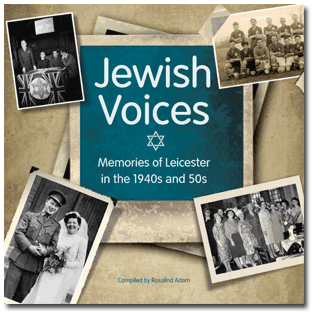
Launch of "Jewish Voices",
Brookfield Bowls & Social Club,
Kimberley Road, Leicester,
Wednesday 11 March 2009
For several months starting summer 2008, around 70 people who had been members of Leicester’s Jewish population in the 1940s and 50s contributed to a mixture of writing and photography workshops, oral recordings, emails, phone calls and letters. This provided raw material for a reminiscence writing project coordinated through Writing School Leicester, published as Jewish Voices. Having taught in the Writing School for the past five years or so, I was involved in the project, contributing editorial support. This launch event for book, touring exhibition and website brought this part of the project to a successful conclusion - and brought forth a great new set of resources at the same time. My work on this project was done in 2008 and my involvement in the launch was to sit at the back of the room, drink tea and eat cake. That might go some way to explaining why, as good as it was, this event didn't get into my top ten then.

Visit to Mosquée de Paris,
Monday 25 May 2009
The flavour of Islam on offer in this delightful mosque differs strongly from that with which we find in Leicester - or anywhere else in the UK for that matter: a clear and enjoyable illustration of the diversity of Islam. I know that's obvious to those who know this sort of thing, but it's still a point worth making. The Paris Mosque was built in 1922 to honour the North African countries that had helped France during World War I and closely resembles mosques to be found in Marrakesh, Morocco. A major renovation of the mosque was completed in 1992 (and there was considerable restoration work going on the day I was there). I spent a few hours at the mosque in a personal capacity on a very hot Monday morning. Being in the mosque was cool and soothing, as well as inspirational. This lovely experience left an impression on my mind and heart that remains strong and sweet - rather like the tea I had in the mosque's restaurant, where little birds with bejewelled anklets flitted around the tables.

National Meeting and AGM of the Inter Faith Network for the UK,
Leicestershire County Cricket Club, Grace Road, Leicester,
Monday 6 July 2009
We could say it was quite a coup to have this prestigious event in Leicester, but the Council of Faiths can't take any credit for it. In fact, we somehow caught wind of this rather late and didn't really make the most of the opportunities that this event presented. The Inter Faith Network for the UK chose Leicester for its major annual and national event. We had the luxury of joining in like other attendees despite the fact it was in our own back yard. We were able to showcase our work and resources to a good number of people from all over the UK. The conference theme was the engagement of young people in inter faith work; the Scottish Inter Faith Council sent a delegation to speak on this theme, made up of young people whom I'd met at the "Beyond Tolerance" event at Glasgow University in June (see number 6 in this list of my top ten for 2009). The Inter Faith Network of the UK published its report of this event online.
"Exploring the Diversity of Hinduism",
Christchurch, Clarendon Park Road, Leicester,
21 September - 30 November 2009
A ten-week course on Monday evenings, run by Christians Aware. Their courses are almost always attractive and thought-provoking, but I've not been able to commit to one before. I didn't get to every meeting of this course in the end, though I'd rather that I had. I've retained a lively interest and deep affection for many aspects of Hinduism, from my teen years when I read the Bhagavad Gita and Upanishads and listened to recorded recitation of the Vedas. My encounter with Hinduism influenced how I dressed, what I ate and drank, the music I listened to - and in those days I was able to devote a couple of hours a day to yoga and meditation. I found this course refreshing and inspirational. I felt like it put me back in touch with something that had once been central to my life, and has always provided something meaningful, even if it's been in the shadows. Several people whom I met on this course came forward to support the exhibition at Highcross during National Inter Faith Week and I'd like to express my thanks for that here (I have thanked them individually of course).
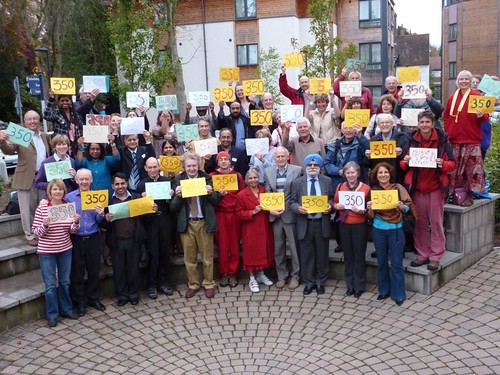
Climate Change Conference,
John Foster Hall, University of Leicester,
Saturday 24 October 2009
I'd been involved in planning this event for well over a year, part of a small group spearheaded by Rev Dr Alan Race. The event was originally planned to span three days in July, be much more international in scope, with speakers and attendees from different countries. It was also intended to be part of the centenary celebrations for St Philip's Church. However, publicity for the event was sent out around the time people started becoming seriously nervous about the recession, so the original plan had to be scaled down to this one-day event. I didn't actually get into any of the sessions, as I sat outside taking registration, pointing out the way to the loos, rustling up refreshments etc. I also had to dash back to the Welcome Centre late morning to pick up some paperwork that should have been on site, so I got to see virtually nothing of the conference itself and didn't hear the speakers or panels. I did these things on the day voluntarily, I should add - but for that reason it hasn't made it into my top ten proper. Those who did take part in the sessions and workshops seemed to feel the benefit tremendously though! A report of this event was published on the World Congress of Faiths website.

Apple Day,
Quaker Meeting House, Queens Road, Leicester,
Saturday 31 October 2009
This might seem out of place at first sight, but I surprise even myself sometimes at how much of my everyday experience can be relevant to my job. This event relates to a common and growing phenomenon that has interested me for a few years now: people who describe themselves as being "spiritual but not religious". There were many things about this celebration of Apple Day that illustrated this principle, in my opinion. It drew together a diversity of people (in terms of age, class, culture, educational attainment) welcomed them all and offered things for them to do appropriate to their needs and interests. On a more subtle level, it used an artifact that has long suffered a negative symbolic status and appropriated it for positive purposes. The use of the apple as something that not only binds us to nature, but also functions as a symbol of national pride, is quite a meaningful step. Over and above all that, there was plenty of apple-based food and drink on offer. A lovely slice of apple pie, combined with custard (surely another symbol of our national culture) was very welcome.
This was the first time I'd heard of Apple Day, but it's an annual celebration, normally held on October 21 each year, of apples and orchards. Apple Day was initiated by Common Ground in 1990 and has been celebrated in each subsequent year at hundreds of local events around Britain. Common Ground describe the day as a way of celebrating and demonstrating that variety and richness matter to a locality and that it is possible to effect change in your place. Common Ground has used the apple as a symbol of the physical, cultural and genetic diversity we should not let slip away. In linking particular apples with their place of origin, they hope that orchards will be recognized and conserved for their contribution to local distinctiveness, including the rich diversity of wildlife they support. More recently Apple Day has evolved into a weekend event, usually taking place on the Saturday and Sunday closest to 21 October. (thanks, Wikipedia!)
This particular celebration was arranged by Transition Leicester, and held at one of the city's most accessible and adaptable places of worship. I think that simply reproducing the programme here will be more effective than me chuntering on about it.
10.00-11.00 Apple music improvisation. Come and experiment with voices, instruments and sound on a theme of apples. All ages welcome. No experience needed. Bring instruments if you want to.
11.00-11.30 Low input apple growing talk. A short talk about growing apples in a time of climate change and peak oil with a chance to ask questions afterwards.
11.45-12.45 Storytelling. Listen to a storyteller bringing magical, fantastical, mythological and English apple and tree stories to life.
12.30-1.30 Apple rounds. Learn apple rounds to sing in unison and harmony. You don’t need to be able to read music or sing well to enjoy making fabulous music with other people.
1.30 – 4.30 Apple Impression print workshop. Use discarded apples and natural colours to print your own stunning patterns. Make a picture to hang up or a cover for your recycled notepaper. Anyone can drop in and out at any point. Children especially welcome.
1.30-2.00 Low input apple growing talk. A short talk about growing apples in a time of climate change and peak oil with a chance to ask questions afterwards.
2.00-3.00 Starting where North, South, East and West meet, apples are for everything not just to eat. A writing workshop for children aged 8-12. Use play, listening, feeling and guessing to bring words to life. Parents needed to support children who find writing hard.
2.30-3.30 Harvesting a crop of juicy words. Creative writing on a theme of apples for adults.
2.30-3.30 Biting the Apple. In this workshop for teenagers we will be looking at the symbolism of apples, playing collaborative automatic writing word games and coming up with individual takes on a crunchy theme.
4.00-5.00 Storytelling. More apple tree filled stories and worlds for you to enter with your storytelling guide.
Harry and Grace thoroughly enjoyed themselves; my abiding memory is of Harry peddling furiously on a stationary bike, the energy from which was being used to crush a bucket of apples. He ended up spattered with a lot of apple shrapnel!
I'd recommend a look at Common Ground, the organisation which founded Apple Day. They exist to promote local distinctiveness, have much to say about the "spirit of place" and encourage creation of "Local ABCs". In my mind, this could all be creatively applied to Leicester with great effect - since we're so proud of our diversity. That's work still to be done by someone or an interested group; I'm sure there are more people than just me who have an interest in this.
Subscribe to:
Posts (Atom)