Showing posts with label Jewish Voices. Show all posts

Saturday, 9 July 2011

NEVE SHALOM: OASIS OF PEACE


Despite having been in post for more than four years, I'd not yet visited Neve Shalom - the synagogue of Leicester Progressive Jewish Congregation. I was speaking with my friend Leon Charikar (Chair of LPJC and Programme Manager for NHS Pacesetters in the East Midlands) earlier this week and mentioned this omission - yet again. All the more shameful on my part, as I live only ten minutes walk from Neve Shalom and pass it on a fairly regular basis. Not for the first time, Leon extended an invitation to visit the synagogue. He mentioned that today would be a good occasion on which to do so, as they'd be celebrating a Bat Mitzvah, with  Baroness Rabbi Julia Neuberger, a public figure I've long admired (even if she doesn't share my enthusiasm for Glasgow novelist James Kelman) coming up from London to conduct the service.

I've visited the Orthodox Synagogue in Highfields Street three or four times now, so this seems like a good day on which to start redressing the balance.

Neve Shalom means "Oasis of Peace" (Isaiah 32:18). It is named as a tribute to the village near Jerusalem known as Neve Shalom / Wahat al Salam, where Jews, Christians and Muslims live together, creating a living example of harmony in diversity, showing that these three great faiths can live and work together for the greater good. The life of that village is a constant source of inspiration and a beacon of hope for peace for Jews, not just in Leicester but all over the world.

I'd picked up some of the story of the origin of Leicester Progressive Jewish Congregation when I was part of the team working on the Jewish Voices oral history project, covering the life of Jews in the city in the 1940s and 50s. Most of the information given below has been taken from literature that I picked up in the Synagogue today. I prefer to have people and groups featured in this blog speak for themselves, in their own words as much as possible.

In the late 1940s a small group of Jews in Leicester were seeking an alternative to Orthodox Judaism. In 1950 they formed the Liberal Jewish Group, affiliated to the Union of Liberal and Progressive Synagogues, later renamed Liberal Judaism. They held services in members' homes and hired halls  for festival services and religion school.

By the 1960s the name was changed to the Leicester Progressive Jewish Congregation. they held biweekly services at the Friends Meeting House until the present building was bought in January 1995 and refurbished to become a synagogue. the building itself had previously been used as a nursery school and was designed by Leicester-born Ernest Gimson, described by one authority as,  "the greatest of the English architect-designers".[

Leicester Progressive Jewish Congregation is an affiliate of Liberal Judaism. They cherish and honour Jewish heritage, but interpret Jewish tradition in the light of modernity, while preserving all that is good in those traditions. They promote pluralism and engage in dialogue with other streams of Judaism, other religions, cultures and philosophies. it practises full gender equality in all aspects of congregational life. Services are conducted by visiting rabbis from the Liberal and Reform movements, as well as by their own members. The prayer books they use, published by liberal Judaism contain gender-inclusive language, in both Hebrew and English.

LPJC is represented on Leicester Council of Faiths and is active in the field of inter faith understanding. They support and work for Tikun Olam (Repairing the World) in its widest sense. They support and help Asylum Seekers and a number of other good causes, Jewish and non-Jewish. Neve Shalom is registered as a Fairtrade Synagogue.

Eleven o'clock is the starting time for the service; Leon has advised me to get there a quarter of an hour before that. When I arrive, the first person I meet whom I know is Denise Bergman. I've worked alongside Denise a few times at events in Leicester College (where she teaches), at SACRE and on our first exhibition at Highcross during National Inter Faith Week 2009. She finds a spare kippah for me to wear and we go to the back of the gathering, where I sit with her and her husband Andrew.

Today's Order of Service contains a page about Bar/Bat Mitzvah by D. Mottram-Epson, entitled, "Just in case you aren't sure what it is all about":
A Bar/Bat Mitzvah is a male or female aged thirteen or over who gains adult responsibilities within their synagogue and Jewish community. A Bat Mitzvah means daughter of the commandments, and refers to a Jewish girl who has reached the age of thirteen. Strictly speaking you become Bar or Bat Mitzvah, rather than have a Bar or Bat Mitzvah. The rite of passage ceremony will vary according to the branch of Judaism and the customs of the synagogue. But in all cases the ceremony marks the Jewish child going from childhood to adulthood.
In a Liberal synagogue the ceremony is the same for both genders. It has evolved so that the Bat/Bar Mitzvah can demonstrate that they are able to fulfil the necessary requirements of a Jewish adult in the service. For a Liberal or Reform Jew the person should be familiar with Jewish history, Jewish practices and festivals and have a decent standard of reading Hebrew. This ceremony is Incorporated into the Shabbat Morning service on or after the child turns thirteen. The Bar/Bat Mitzvah leads certain prayers. Then they have an aliyah (call up), where the rabbi calls them up to the bimah using their Hebrew name, to read from the Torah scroll. The Bar/Bat Mitzvah says the blessing before and after reading from the scroll, and will generally read between 10-25 verses of the week's portion. The Bar/Bat Mitzvah may also choose readings and/or poems from Jewish literature to personalise the service. It is a Jewish parent's religious obligation to teach his or her child or children about Judaism including helping them to prepare for their Bar/Bat Mitzvah though importantly it should not signal the end of their religious education.
Family is a very important part of Judaism and, like other religions, they gather for important festivals and events and this occasion provides a perfect opportunity to get family together. In addition, some family members are often asked to participate in the service. For example, opening the doors of the Ark, undressing the Torah scroll or holding the Torah. This is considered an honour. After the service the Bar/Bat Mitzvah holds a party and celebrates.


I must say, I am very impressed with the young girl who takes centre stage as Bat Mitzvah today. As part of the service she reads an exegetical essay on the story of Balaam and his talking donkey from the Torah. It's a remarkable thing to listen to, researched, written and read by someone who has just turned thirteen. Rabbi Julia Neuberger (who is officiating today largely because she is a long-term friend of the family) takes this text as the basis of her short sermon later on, in which she extols the virtues of being able to change one's mind.

While I would confess to being lost in the many passages of Hebrew singing, I don't need to know the language in order to clap along.

Over a hundred people attend the service today, not all of them from the Leicester congregation. This (apparently) is evident in the variation in tunes and rhythm followed in the singing; not that I'd have noticed, but the rabbi does, remarking on it with good humour more than once). A great many of those present are children and young people. Live music at the beginning and end of the service is provided by the Bat Mitzvah herself (doubling up on trumpet and clarinet) and her family. The gathering ends with the serving of what has become the Jewish signature dish on such occasions: bagel with cream cheese and smoked salmon and dill pickle.

I am really taken (moved, even) with my first visit to Neve Shalom - Leicester's own Oasis of Peace. I'll certainly ensure that it isn't my last!

Thursday, 2 June 2011

BUILDING TOLERANCE

Photo of Leicester Orthodox Synagogue by Ben Ravilious (with permission)
A follow-up article in today's Leicester Mercury, after it reported the attack on the home of the Rabbi of Leicester Hebrew Congregation on its front page last Saturday (28 May)
Building Tolerance 
What happened to Rabbi Pink and his family was cowardly and creates fear. That is what we are working against
By Adam Wakelin
It was a throwback, the kind of headline you don't expect to see any more. Certainly not in Leicester. Yet there it was, on Saturday's front page: "Rabbi's home attacked by racist thugs".
We need to keep things in perspective, of course. Religious and cultural tolerance isn't coming off the rails just because a few brain-dead bigots took it upon themselves to break Rabbi Shmuli Pink's windows.
Even so, it doesn't sit easily with how we like to see ourselves.
Part of who we are, of what we've become, is that people in this city all rub along relatively happily.
Leicester has never knocked anyone flat with the force of its personality, but it has forged an identity from its respect of different cultures.
Once upon a time we made socks and shoes. Now we do diversity. Rather well, usually.
And the Jews, Leicester's oldest and perhaps least visible minority, have done more than most to build those bridges – and much else.
There are many notables from a community that has never numbered more than 700 to 800.
Children of all creeds and colours chase the pigeons around the fountain in Town Hall Square.
The fountain was bought for us by a Jew: Wealthy businessman, philanthropist and four-times mayor Israel Hart.
He also paid for the building of Leicester's first branch library and laid out Spinney Hill Park.
Goldsmiths Library, another landmark, was paid for by the industrialist Mac Goldsmith.
The illustrious Dr Dub, a deputy director of public health in Leicester, could have earned handsome sums from a private practice. Instead, he chose to pioneer the treatment of the city's children.
Dr Frank May, a Leicester businessman, was given the Freedom of the City for his charitable endeavours. Three city mayors have been Jewish.
"A lot has been achieved by a small community," says Aubrey Newman, an emeritus professor of history at the University of Leicester.
"It has always punched above its weight."
If confirmation is needed of how big a part the Jewish community has played in Leicester's public life you only need look at the names of donors who helped pay for the building, in 1897, of the synagogue in Highfields.
Jews and Gentiles sit side by side on that board in the synagogue's vestry – a statement of unity and an acknowledgement of the contribution made to the city's economic and civic prosperity by Jews.
It was a community that had come a long way in a short space of time.
Simon De Montfort may have infamously banished the Jews from Leicester in 1231, but a formal Jewish community didn't really establish itself in the city until the 1870s.
A lot has been made of De Montfort's edict and the indelible stain his actions left on a city that has founded its future on tolerance.
His greatest crime was being a man of his time, believes Prof Newman.
There have never been anti-Semitic riots in Leicester, says Prof Newman. Even De Montfort's medieval purge wasn't entirely successful.
He didn't have dominion over all of the city and there is evidence Jews did remain.
That's not to say life was without its bumps and bruises.
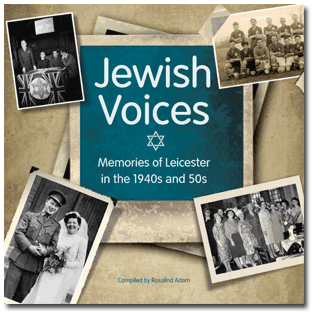
The book Jewish Voices: Memories of Leicester in the 1940s and 50s has first-hand accounts of how hard it could be.
"One of my earliest memories is being told by the twins who lived across the road that they weren't allowed to play with me. Why? Because I was a Jew," said Rifka Mayers.
"I learnt at an early age to deny who I was – it made being at school safe."
Bernard Besbrode told a similar story. "At school you lived with anti-Semitism," he said. "I know all the names. I've been called all the names."
Mathilda Applebaum was at Wyggeston Girls' School in the early 1950s. The rather fine hedge now in Regent Road is testament to those less enlightened times.
"We had to stay out of assembly and scripture lessons so we did gardening," she said.
Others had different experiences.
"I never experienced anti-Semitism," said Katherine May. "We had lots of non-Jewish friends who, when they entertained us, made sure they provided all the food we could eat."
The late 1970s and early 80s were another troubling time as Swastikas started appearing on walls and the National Front went on the march against Asians, blacks and Jews.
The idiots didn't get their way. That doesn't mean prejudice ever completely went away.
Leicester is a world in one city now, and it has a world's worth of problems to absorb. Not always successfully.
When tensions explode in Palestine and Israel, it has ramifications much closer to home.
"I have some wonderful friends in the Muslim community. We are working hard on community cohesion and mutual respect," says Tony Nelson, the Jewish vice-chairman of Leicester's Council of Faiths.
"Down at grassroots level it is perhaps a different story. There is an awful lot of vitriolic stuff on the internet – and young people are impressionable.
"No-one can condone what happened to Rabbi Pink and his family. It was cowardly and it creates fear. That is what we are working against."
A lot is being done to defuse tensions and tackle prejudice.
Three colleges in Leicester have a Jewish chaplain. The synagogue holds open days for schoolchildren.
A Family of Abraham dialogue group has been established to bring members of the Christian, Muslim and Jewish communities together.
The St Phillip's Centre, established to build bonds between faiths, takes roadshows into schools and colleges.
Laurels aren't being rested on. But that doesn't make the fear go away.
A couple of Jewish people who spoke to the Mercury for this story didn't want their names going in the newspaper.
Why? They feared repercussions. Putting your head above the parapet is something some in this community are still instinctively fearful of.
Last year's Mitzvah Day, which saw progressive and orthodox Jews standing outside supermarkets to collect cash to help victims of domestic violence, was momentous in its own modest way.
It was the first time the community had rattled a tin under the noses of the Leicester public and said, hey, we're Jewish, we're doing something good here, help us out.
The reaction was overwhelmingly positive.
What happened to Rabbi Shmuli is a setback.
"It's very depressing and quite concerning that a major religious leader has been attacked," says Riaz Ravat, an interfaith worker at the St Phillip's Centre. "Our thoughts and prayers go out to him.
"The Jewish community is doing a sterling amount of work to tackle prejudice and misunderstanding.
"These incidents illustrate that we are on a journey and we have to keep plugging away."

Tuesday, 23 March 2010

SOCIAL ENTERPRISE IN THE VOLUNTARY AND COMMUNITY SECTOR

At Action Deafness, Welford Road, this morning for a breakfast networking event with the theme, "Social Enterprise in the Voluntary and Community Sector in Leicester, Leicestershire and Rutland". Round the table are nine organisations:


I'm here today speaking not only for the Council of Faiths but also for the Regional Equality and Diversity Partnership (REDP).

Jenny Hand, from LASS, chairs the meeting. It is facilitated by Jacqui Tilyard, who has worked with Business Link (amongst others) and is a freelance business trainer and consultant. She's particularly interested in the "social entrepreneur". I first met Jacqui at the launch of the Jewish Voices book, exhibition and website. Her husband, Glen, took the photos for that book and has long worked for Writing School Leicester, for which I've taught from time to time.

This meeting, and the informal network of contacts invited to it, are supported by the Modernisation Fund, which promotes collaboration and merger. The former is appealing to the VCS, the latter not necessarilly so. A few organisations which have obtained some funding from this source are committed to the network that has grown out of their involvement: how is it working? is it a network of organisations or of individuals? can it be expanded? should it be expanded? Today we discuss some of these, and related, issues: sharing resources, experience and expertise; consolidating back office functions; making joint funding bids; identifying best practice; overcoming isolation; retaining and transmitting values; tapping into our network of networks (a brief explanation of the relevance of REDP fits in here). We consider how to use the more positive aspects of our common anxiety about the future - how it is making many in the VCS world come out of their shells and reach out to others. Plans are made for moving forward, which should be taken up soon.

Thursday, 31 December 2009

2009'S TOP 10: SPECIAL MENTIONS

Before arriving at number one in this top ten countdown for 2009, I thought I'd write a little about a few other events and occasions that didn't make it into the countdown proper, but which still deserve special mention here.


Launch of "Jewish Voices",
Brookfield Bowls & Social Club,
Kimberley Road, Leicester,
Wednesday 11 March 2009

For several months starting summer 2008, around 70 people who had been members of Leicester’s Jewish population in the 1940s and 50s contributed to a mixture of writing and photography workshops, oral recordings, emails, phone calls and letters. This provided raw material for a reminiscence writing project coordinated through Writing School Leicester, published as Jewish Voices. Having taught in the Writing School for the past five years or so, I was involved in the project, contributing editorial support. This launch event for book, touring exhibition and website brought this part of the project to a successful conclusion - and brought forth a great new set of resources at the same time. My work on this project was done in 2008 and my involvement in the launch was to sit at the back of the room, drink tea and eat cake. That might go some way to explaining why, as good as it was, this event didn't get into my top ten then.


Visit to Mosquée de Paris,
Monday 25 May 2009

The flavour of Islam on offer in this delightful mosque differs strongly from that with which we find in Leicester - or anywhere else in the UK for that matter: a clear and enjoyable illustration of the diversity of Islam. I know that's obvious to those who know this sort of thing, but it's still a point worth making. The Paris Mosque was built in 1922 to honour the North African countries that had helped France during World War I and closely resembles mosques to be found in Marrakesh, Morocco. A major renovation of the mosque was completed in 1992 (and there was considerable restoration work going on the day I was there). I spent a few hours at the mosque in a personal capacity on a very hot Monday morning. Being in the mosque was cool and soothing, as well as inspirational. This lovely experience left an impression on my mind and heart that remains strong and sweet - rather like the tea I had in the mosque's restaurant, where little birds with bejewelled anklets flitted around the tables.


National Meeting and AGM of the Inter Faith Network for the UK,
Leicestershire County Cricket Club, Grace Road, Leicester,
Monday 6 July 2009

We could say it was quite a coup to have this prestigious event in Leicester, but the Council of Faiths can't take any credit for it. In fact, we somehow caught wind of this rather late and didn't really make the most of the opportunities that this event presented. The Inter Faith Network for the UK chose Leicester for its major annual and national event. We had the luxury of joining in like other attendees despite the fact it was in our own back yard. We were able to showcase our work and resources to a good number of people from all over the UK. The conference theme was the engagement of young people in inter faith work; the Scottish Inter Faith Council sent a delegation to speak on this theme, made up of young people whom I'd met at the "Beyond Tolerance" event at Glasgow University in June (see number 6 in this list of my top ten for 2009). The Inter Faith Network of the UK published its report of this event online.


"Exploring the Diversity of Hinduism",
Christchurch, Clarendon Park Road, Leicester,
21 September - 30 November 2009

A ten-week course on Monday evenings, run by Christians Aware. Their courses are almost always attractive and thought-provoking, but I've not been able to commit to one before. I didn't get to every meeting of this course in the end, though I'd rather that I had. I've retained a lively interest and deep affection for many aspects of Hinduism, from my teen years when I read the Bhagavad Gita and Upanishads and listened to recorded recitation of the Vedas. My encounter with Hinduism influenced how I dressed, what I ate and drank, the music I listened to - and in those days I was able to devote a couple of hours a day to yoga and meditation. I found this course refreshing and inspirational. I felt like it put me back in touch with something that had once been central to my life, and has always provided something meaningful, even if it's been in the shadows. Several people whom I met on this course came forward to support the exhibition at Highcross during National Inter Faith Week and I'd like to express my thanks for that here (I have thanked them individually of course).


Climate Change Conference,
John Foster Hall, University of Leicester,
Saturday 24 October 2009

I'd been involved in planning this event for well over a year, part of a small group spearheaded by Rev Dr Alan Race. The event was originally planned to span three days in July, be much more international in scope, with speakers and attendees from different countries. It was also intended to be part of the centenary celebrations for St Philip's Church. However, publicity for the event was sent out around the time people started becoming seriously nervous about the recession, so the original plan had to be scaled down to this one-day event. I didn't actually get into any of the sessions, as I sat outside taking registration, pointing out the way to the loos, rustling up refreshments etc. I also had to dash back to the Welcome Centre late morning to pick up some paperwork that should have been on site, so I got to see virtually nothing of the conference itself and didn't hear the speakers or panels. I did these things on the day voluntarily, I should add - but for that reason it hasn't made it into my top ten proper. Those who did take part in the sessions and workshops seemed to feel the benefit tremendously though! A report of this event was published on the World Congress of Faiths website.


Apple Day,
Quaker Meeting House, Queens Road, Leicester,
Saturday 31 October 2009

This might seem out of place at first sight, but I surprise even myself sometimes at how much of my everyday experience can be relevant to my job. This event relates to a common and growing phenomenon that has interested me for a few years now: people who describe themselves as being "spiritual but not religious". There were many things about this celebration of Apple Day that illustrated this principle, in my opinion. It drew together a diversity of people (in terms of age, class, culture, educational attainment) welcomed them all and offered things for them to do appropriate to their needs and interests. On a more subtle level, it used an artifact that has long suffered a negative symbolic status and appropriated it for positive purposes. The use of the apple as something that not only binds us to nature, but also functions as a symbol of national pride, is quite a meaningful step. Over and above all that, there was plenty of apple-based food and drink on offer. A lovely slice of apple pie, combined with custard (surely another symbol of our national culture) was very welcome.

This was the first time I'd heard of Apple Day, but it's an annual celebration, normally held on October 21 each year, of apples and orchards. Apple Day was initiated by Common Ground in 1990 and has been celebrated in each subsequent year at hundreds of local events around Britain. Common Ground describe the day as a way of celebrating and demonstrating that variety and richness matter to a locality and that it is possible to effect change in your place. Common Ground has used the apple as a symbol of the physical, cultural and genetic diversity we should not let slip away. In linking particular apples with their place of origin, they hope that orchards will be recognized and conserved for their contribution to local distinctiveness, including the rich diversity of wildlife they support. More recently Apple Day has evolved into a weekend event, usually taking place on the Saturday and Sunday closest to 21 October. (thanks, Wikipedia!)

This particular celebration was arranged by Transition Leicester, and held at one of the city's most accessible and adaptable places of worship. I think that simply reproducing the programme here will be more effective than me chuntering on about it.
10.00-11.00 Apple music improvisation. Come and experiment with voices, instruments and sound on a theme of apples. All ages welcome. No experience needed. Bring instruments if you want to.
11.00-11.30 Low input apple growing talk. A short talk about growing apples in a time of climate change and peak oil with a chance to ask questions afterwards.
11.45-12.45 Storytelling. Listen to a storyteller bringing magical, fantastical, mythological and English apple and tree stories to life.
12.30-1.30 Apple rounds. Learn apple rounds to sing in unison and harmony. You don’t need to be able to read music or sing well to enjoy making fabulous music with other people.
1.30 – 4.30 Apple Impression print workshop. Use discarded apples and natural colours to print your own stunning patterns. Make a picture to hang up or a cover for your recycled notepaper. Anyone can drop in and out at any point. Children especially welcome.
1.30-2.00 Low input apple growing talk. A short talk about growing apples in a time of climate change and peak oil with a chance to ask questions afterwards.
2.00-3.00 Starting where North, South, East and West meet, apples are for everything not just to eat. A writing workshop for children aged 8-12. Use play, listening, feeling and guessing to bring words to life. Parents needed to support children who find writing hard.
2.30-3.30 Harvesting a crop of juicy words. Creative writing on a theme of apples for adults.
2.30-3.30 Biting the Apple. In this workshop for teenagers we will be looking at the symbolism of apples, playing collaborative automatic writing word games and coming up with individual takes on a crunchy theme.
4.00-5.00 Storytelling. More apple tree filled stories and worlds for you to enter with your storytelling guide.

Harry and Grace thoroughly enjoyed themselves; my abiding memory is of Harry peddling furiously on a stationary bike, the energy from which was being used to crush a bucket of apples. He ended up spattered with a lot of apple shrapnel!

I'd recommend a look at Common Ground, the organisation which founded Apple Day. They exist to promote local distinctiveness, have much to say about the "spirit of place" and encourage creation of "Local ABCs". In my mind, this could all be creatively applied to Leicester with great effect - since we're so proud of our diversity. That's work still to be done by someone or an interested group; I'm sure there are more people than just me who have an interest in this.