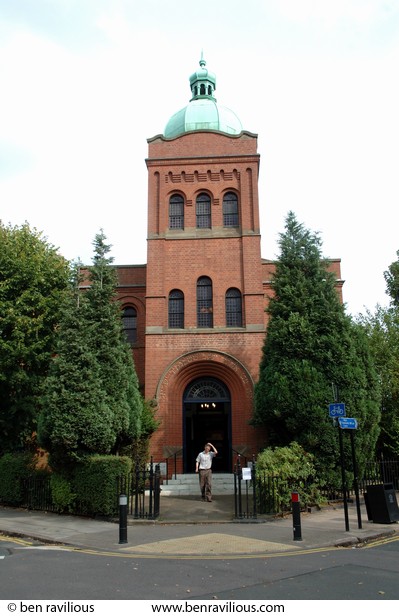
Photo by Ben Ravilious, by permission.


I attended the first seminar of a project, Mapping Faith and Place, run by Leicester University, "investigating the significance of South Asian religious and cultural heritage in Leicester's urban landscape." This took place at New Walk Museum and Art Gallery. There are two further seminars to run next year followed by a public conference. I was wearing a number of hats, firstly as the creative director of Heterarchy, my interior design practice, based here in Leicester, secondly as an academic from DeMontfort university and thirdly, after George had asked me to write a blog about the seminar, as a member of the Leicester Council of Faiths.
The seminar was organised by Dr Deirdre O'Sullivan and Dr Ruth Young, both from the School of Archaeology & Ancient History at Leicester University.
There were a series of talks which were preceded by an introduction to the project by Dr Chris King, who had originally conceived and obtained funding for the research; Dr King, formerly of Leicester University, is now based at Nottingham University.
Dr King outlined the purpose of the project which is for academics and non-academics to work together to share knowledge and insights in order to gain an understanding of Leicester's cultural and religious landscape. In this series of seminars we will be looking at ways to take the project forward and how to best connect with people from the different communities.
Dr Deirdre O'Sullivan and Dr Ruth Young talked about the work that had already taken place, which has resulted in The Faith Trail, most of the work for which was carried out by students at Leicester university. There is a website and booklet which accompanies this part of the project.
We then had a talk by Linda Monkton of English Heritage, who is head of research policy for places of worship. She spoke about the National Heritage list for England which includes an on-line database of all nationally designated heritage assets and the National Heritage Protection Plan, which is a framework for the key priorities for research over protection issues. She was very interested in finding out ways that English Heritage could foster good relationships with local contacts in the different faith communities.
I then gave a talk on the work my company had carried out on the interiors for the new Swaminarayan Hindu temple on Gypsy Lane, which opened on the 8th-9th October. Describing how we had become involved in the project and how we set about the design process, to create interiors which reflected the rich cultural heritage of the Swaminarayan faith yet in a more contemporary style.
Rupert Allen, Assistant Church Buildings Development Officer for the Diocese of Coventry and Leicester spoke about the re-use of historically significant buildings and ways in which these could be sympathetically re-ordered to accommodate the new occupants.
In the afternoon we had lively discussions which initially looked at the issue of the Leicester orthodox synagogue which has recently been put up for sale, and the significance of religious buildings and their heritage as "sustainable sacred space".
This was followed by looking at ways to move the project forward and what the major issues were for the different faith communities in terms of buildings and the built environment and other groups who had an interest such as English heritage and academics.

Rabbi's sadness as synagogue is put up for sale
A Jewish community has reluctantly put its city centre synagogue up for sale.
The Highfields Street home of Leicester's orthodox Hebrew community was put on the market after the dwindling numbers of worshippers meant less money for the building's upkeep.
Rabbi Shmuli Pink, who leads a small congregation in prayer four times a week, said the sale was needed to ensure the future of Leicester's Jewish residents.
He said: "It's sad to part with the synagogue, but it's the people which make the community, not the building.
"We've had to re-evaluate and plan for the future.
"The reason for the sale is the changing demographic and the building is just too big for us at the minute.
"Young Jewish men and women are gravitating towards places like London and Manchester, and away from Leicester, and there aren't enough new members coming in to fill the deficit."
There are about 600 orthodox Jews in Leicestershire. At its height, the community numbered in the thousands after many refugees came to the city after the Second World War. However, the community soon went into decline and now just a handful regularly attend the synagogue.
They are now looking for a place of worship in Oadby.
Rabbi Pink said: "To be honest a move has been on the cards for about 40 years.
"But it's only now that it's got to the stage where we're actually looking at selling.
"We're looking for another community who can use the building for worship. It's beautifully refurbished and a tremendous opportunity."
Rabbi Pink, who has been in charge at the synagogue for 10 years, hopes the building's future owners will also buy the nearby community centre, which stands just a few yards away, in Tichbourne Street.
So far six people, including representatives from the Muslim and Sikh communities, have been to visit the listed building and large community venue. The property's agent, Innes England, describes the building as being "suitable for alternative faiths and uses".
Rabbi Pink said he welcomed interest from members of all faith communities.
The two storey synagogue, on the market for £275,000, was built in 1898. The community centre was built in 1950.
It is the only orthodox Jewish synagogue in Leicestershire.
A separate congregation of progressive Judaism has a place of worship in Avenue Road, in Stoneygate.

A Bar/Bat Mitzvah is a male or female aged thirteen or over who gains adult responsibilities within their synagogue and Jewish community. A Bat Mitzvah means daughter of the commandments, and refers to a Jewish girl who has reached the age of thirteen. Strictly speaking you become Bar or Bat Mitzvah, rather than have a Bar or Bat Mitzvah. The rite of passage ceremony will vary according to the branch of Judaism and the customs of the synagogue. But in all cases the ceremony marks the Jewish child going from childhood to adulthood.
In a Liberal synagogue the ceremony is the same for both genders. It has evolved so that the Bat/Bar Mitzvah can demonstrate that they are able to fulfil the necessary requirements of a Jewish adult in the service. For a Liberal or Reform Jew the person should be familiar with Jewish history, Jewish practices and festivals and have a decent standard of reading Hebrew. This ceremony is Incorporated into the Shabbat Morning service on or after the child turns thirteen. The Bar/Bat Mitzvah leads certain prayers. Then they have an aliyah (call up), where the rabbi calls them up to the bimah using their Hebrew name, to read from the Torah scroll. The Bar/Bat Mitzvah says the blessing before and after reading from the scroll, and will generally read between 10-25 verses of the week's portion. The Bar/Bat Mitzvah may also choose readings and/or poems from Jewish literature to personalise the service. It is a Jewish parent's religious obligation to teach his or her child or children about Judaism including helping them to prepare for their Bar/Bat Mitzvah though importantly it should not signal the end of their religious education.
Family is a very important part of Judaism and, like other religions, they gather for important festivals and events and this occasion provides a perfect opportunity to get family together. In addition, some family members are often asked to participate in the service. For example, opening the doors of the Ark, undressing the Torah scroll or holding the Torah. This is considered an honour. After the service the Bar/Bat Mitzvah holds a party and celebrates.I must say, I am very impressed with the young girl who takes centre stage as Bat Mitzvah today. As part of the service she reads an exegetical essay on the story of Balaam and his talking donkey from the Torah. It's a remarkable thing to listen to, researched, written and read by someone who has just turned thirteen. Rabbi Julia Neuberger (who is officiating today largely because she is a long-term friend of the family) takes this text as the basis of her short sermon later on, in which she extols the virtues of being able to change one's mind.
Building Tolerance
What happened to Rabbi Pink and his family was cowardly and creates fear. That is what we are working against
By Adam Wakelin
It was a throwback, the kind of headline you don't expect to see any more. Certainly not in Leicester. Yet there it was, on Saturday's front page: "Rabbi's home attacked by racist thugs".
We need to keep things in perspective, of course. Religious and cultural tolerance isn't coming off the rails just because a few brain-dead bigots took it upon themselves to break Rabbi Shmuli Pink's windows.
Even so, it doesn't sit easily with how we like to see ourselves.
Part of who we are, of what we've become, is that people in this city all rub along relatively happily.
Leicester has never knocked anyone flat with the force of its personality, but it has forged an identity from its respect of different cultures.
Once upon a time we made socks and shoes. Now we do diversity. Rather well, usually.
And the Jews, Leicester's oldest and perhaps least visible minority, have done more than most to build those bridges – and much else.
There are many notables from a community that has never numbered more than 700 to 800.
Children of all creeds and colours chase the pigeons around the fountain in Town Hall Square.
The fountain was bought for us by a Jew: Wealthy businessman, philanthropist and four-times mayor Israel Hart.
He also paid for the building of Leicester's first branch library and laid out Spinney Hill Park.
Goldsmiths Library, another landmark, was paid for by the industrialist Mac Goldsmith.
The illustrious Dr Dub, a deputy director of public health in Leicester, could have earned handsome sums from a private practice. Instead, he chose to pioneer the treatment of the city's children.
Dr Frank May, a Leicester businessman, was given the Freedom of the City for his charitable endeavours. Three city mayors have been Jewish.
"A lot has been achieved by a small community," says Aubrey Newman, an emeritus professor of history at the University of Leicester.
"It has always punched above its weight."
If confirmation is needed of how big a part the Jewish community has played in Leicester's public life you only need look at the names of donors who helped pay for the building, in 1897, of the synagogue in Highfields.
Jews and Gentiles sit side by side on that board in the synagogue's vestry – a statement of unity and an acknowledgement of the contribution made to the city's economic and civic prosperity by Jews.
It was a community that had come a long way in a short space of time.
Simon De Montfort may have infamously banished the Jews from Leicester in 1231, but a formal Jewish community didn't really establish itself in the city until the 1870s.
A lot has been made of De Montfort's edict and the indelible stain his actions left on a city that has founded its future on tolerance.
His greatest crime was being a man of his time, believes Prof Newman.
There have never been anti-Semitic riots in Leicester, says Prof Newman. Even De Montfort's medieval purge wasn't entirely successful.
He didn't have dominion over all of the city and there is evidence Jews did remain.
That's not to say life was without its bumps and bruises.
The book Jewish Voices: Memories of Leicester in the 1940s and 50s has first-hand accounts of how hard it could be.
"One of my earliest memories is being told by the twins who lived across the road that they weren't allowed to play with me. Why? Because I was a Jew," said Rifka Mayers.
"I learnt at an early age to deny who I was – it made being at school safe."
Bernard Besbrode told a similar story. "At school you lived with anti-Semitism," he said. "I know all the names. I've been called all the names."
Mathilda Applebaum was at Wyggeston Girls' School in the early 1950s. The rather fine hedge now in Regent Road is testament to those less enlightened times.
"We had to stay out of assembly and scripture lessons so we did gardening," she said.
Others had different experiences.
"I never experienced anti-Semitism," said Katherine May. "We had lots of non-Jewish friends who, when they entertained us, made sure they provided all the food we could eat."
The late 1970s and early 80s were another troubling time as Swastikas started appearing on walls and the National Front went on the march against Asians, blacks and Jews.
The idiots didn't get their way. That doesn't mean prejudice ever completely went away.
Leicester is a world in one city now, and it has a world's worth of problems to absorb. Not always successfully.
When tensions explode in Palestine and Israel, it has ramifications much closer to home.
"I have some wonderful friends in the Muslim community. We are working hard on community cohesion and mutual respect," says Tony Nelson, the Jewish vice-chairman of Leicester's Council of Faiths.
"Down at grassroots level it is perhaps a different story. There is an awful lot of vitriolic stuff on the internet – and young people are impressionable.
"No-one can condone what happened to Rabbi Pink and his family. It was cowardly and it creates fear. That is what we are working against."
A lot is being done to defuse tensions and tackle prejudice.
Three colleges in Leicester have a Jewish chaplain. The synagogue holds open days for schoolchildren.
A Family of Abraham dialogue group has been established to bring members of the Christian, Muslim and Jewish communities together.
The St Phillip's Centre, established to build bonds between faiths, takes roadshows into schools and colleges.
Laurels aren't being rested on. But that doesn't make the fear go away.
A couple of Jewish people who spoke to the Mercury for this story didn't want their names going in the newspaper.
Why? They feared repercussions. Putting your head above the parapet is something some in this community are still instinctively fearful of.
Last year's Mitzvah Day, which saw progressive and orthodox Jews standing outside supermarkets to collect cash to help victims of domestic violence, was momentous in its own modest way.
It was the first time the community had rattled a tin under the noses of the Leicester public and said, hey, we're Jewish, we're doing something good here, help us out.
The reaction was overwhelmingly positive.
What happened to Rabbi Shmuli is a setback.
"It's very depressing and quite concerning that a major religious leader has been attacked," says Riaz Ravat, an interfaith worker at the St Phillip's Centre. "Our thoughts and prayers go out to him.
"The Jewish community is doing a sterling amount of work to tackle prejudice and misunderstanding.
"These incidents illustrate that we are on a journey and we have to keep plugging away."


 Leicester has never knocked anyone flat with the force of its personality, but it has forged an identity from its respect of different cultures.