Showing posts with label Baroness Warsi. Show all posts

Monday, 18 March 2013

FAITH IN THE COMMUNITY: AN EXHIBITION


All this week at St Martins House, St Philip's Centre for Study and Engagement in a Multi-Faith Society  presents a collection of inspiring images from winners and finalists of Faith Through a Lens, an annual photographic competition attracting entries from all over the UK. Profiling faith in the community, entrants were judged across three categories:
  • Moments of Faith
  • Community Spirit Against the Odds
  • A Year of Service

Judges for the 2012 competition included renowned photo journalist Don McCullin, Minister for Faith and Communities, Baroness Warsi and the Rt Hon Eric Pickles MP.


All copy below comes from the exhibition catalogue. All images are the property of  Congregational & General Insurance Company, sponsors of the competition.


Brothers in Arms
by Paul Tiller
OVERALL WINNER

This winning entry was praised by all the judges as an exceptional photograph focusing on two Romanian drug addicts who were helped by a Christian ministry. As an image it has immediate impact and was praised for clearly conveying the message of a moment of faith. It has fantastic use of light and has been closely cropped to create a real intensity in its composition. The New Testament seems almost luminous and there is a sense that the two men are in a world of their own as they read these words from the Bible. The photo was a unanimous favourite amongst the judges, with its compelling subject matter and excellent composition making it a worthy winner indeed.

Alfred's Lunch
by Sarah Phipps

Sarah's photograph was highly praised by the judges for profiling the work of unsung heroes who do so much "behind the scenes" in society. it's a simple act of giving someone a meal, but it's a powerful act nonetheless and portrays a positive community spirit message. It's a photograph that has both warmth and visual interest.

There but for the Grace of God
by Bob Boler

Excellent composition and good tonal balance makes this image stand out. There is a connection between the two people and the expressions on their faces are very well caught. it was judged to be powerful, with a sense of movement and several points of interest around the central characters. It's not just a case of "down and out" or a negative portrayal of homelessness. The photograph clearly portrays a service.

Receive
by Angela Broadberry

Singled out for its clear Eucharistic overtones, this photo was praised by the judges for its quality and tone of light. The composition was well liked there is a softness to the photo and calmness much like a still-life painting. The clarity of the lines on the person's hands gives the photo added character and depth.

Hands of Love
by Jennifer Humphreys

This photo was judged to have a strong composition and was well like by the judges with an overall image that symbolises community and openness. The photo speaks of an openness to receive and the strong bonds that exist between members of faith communities across the UK.

Eyes On Me
by Elija Paul Villanueava

A visually interesting image created through the use of colour. This photograph was praised for having a painting-like appearance, much like a Canaletto. The composition was also highlighted being strong with St Paul's Cathedral central to the image conveying a message of faith.

Love of Faith
by Ravin Mehta

The judges felt that this lively image reflected a positive powerful force. There is good colour balance and the setting of Trafalgar Square, the scene of many gatherings over the years, adds dynamism to the scene.

Interfaith Iftaar
by Riaz Ravat

A strong photograph demonstrating the cohesion in society as represented by many different faith and community groups coming together. It communicates diversity and multi-faith strongly and speaks of community spirit too.

Ayyam-i-Ha
by Ronnie Bindra

There is a great deal of vibrancy and activity within this photograph, with people giving, talking and sharing. This was thought to be a good representation of the category as well as being pleasing to the eye. It has a positive image of everyone working together. [I should add here that this photo was taken at the National Bahá'í Centre in Knightsbridge during Ayyám-i-Há, a short period that precedes the Bahá'í period of fasting every March. During Ayyám-i-Há, acts of charity, generosity and hospitality are emphasised. In this photo, people of many faiths and traditions are collecting toiletries to distribute to vulnerably homed people as part of a Year of Service project. - GMB]

Realisation
by Gary Watson

This was thought to be a nicely composed photograph which captures a poignant moment that speaks about faith. The photographer has chosen to highlight certain elements of the scene with colour which draws attention and invites the viewer to question why?

Hope, Faith & Love
by Kamal Mostofi

The image portrays a very strong and dramatic image depicting uncomfortable subject matter. The central character's face shows the pain that homelessness can bring. The power of this photo comes from its clear and gritty portrayal of humanity, but its clear and gritty portrayal of humanity, but its photographic beauty comes from the fact that there is always hope, even in the midst of despair.

Helping Hands
by Bobbie Cook

This simple almost self explanatory street scene was singled out for its very powerful composition; in particular the figures of the elderly man stooped and walking with crutches in juxtaposition to the young helper. It portrays a sense of humanity and the prospect of hope in humanity and the prospect of hope in society too. This was judged to be an uplifting and poignant image.

Faith in the Community runs till 1200 on Friday 22 March. Revd Dr John Hall, Director of St Philip's Centre, presents Seeing is Believing: Exposing Themes for Dialogue, a reflective seminar discussing  themes of the exhibition's imagery and exploring the possibilities for further inter faith dialogue at 1800 on Tuesday 19 March in The Wycliffe Suite at St Martins House.


As I do at the end of all my blog posts referring to St Martins House, I refer any reader wondering about the omission of the possessive apostrophe from the building's name to a letter from Rev. Peter Hobson, Director of St Martins House, published in the Leicester Mercury, 29 March 2011.

Saturday, 3 March 2012

WRONG ABOUT SECULARISM

This letter appears in today's Leicester Mercury:
Wrong about secularism
I've often wondered what it is Baroness Warsi does – and it strikes me that she must have wondered herself.
Hence how readily she embraced her chance to fly the flag for Cameron's UK vision all the way to the Vatican, where, in her Valentine's Day speech, she said militant secularism "demonstrates similar traits to totalitarian regimes."
This paranoid allying of secularism with totalitarianism was coupled with repeated reference to the Pope's state visit to Britain in 2010, and how successful and well received this was.
But she diplomatically avoided mention of the accompanying controversy and protest.
Moreover, she declined to pass judgment on instances of conflict between faith and public policy, genuflecting to someone who continues to evade the serious questions that she wouldn't dream of asking him.
It's not "aggressive secularism by stealth" the religious need fear, it's religious conservative authoritarians.
There were important matters to discuss with Vatican officials the following day: climate change, international aid, Somalia. This did yield a joint declaration calling for an "immediate end" to violence in Syria, which I imagine will make all the difference.
When Warsi says: "For me, one of the most worrying aspects about this militant secularisation is that at its core and in its instincts it is deeply intolerant", this exposes her ignorance of what secularism is.
She further misrepresents secularists as, "... the anti-religionists, the faith deniers... attempting to remove all trace of religion from culture, history and public discourse".
Secularism is not intolerant of any faith; but it rejects that privileged place, and automatic unqualified respect, that religious leaders and lobby groups carry in our political decision-making bodies.
Warsi has embarrassingly let down her country.
Lee Turnpenny, Southampton

Friday, 24 February 2012

MISREPRESENTING SECULARISM

This letter appears in today's Leicester Mercury:
Misrepresenting secularism
Bishop Tim (First Person, February 18 ) suggests that this is an opportunity to "make those who are secular feel at home".
I would welcome that: for I did not feel welcome when he kept me from speaking in the civic service as chaplain to the Lord Mayor, nor when he wrote in these pages that my beliefs were a "tale told by an idiot", nor when the Lord Mayor, Lady Mayoress and I found ourselves listening to a psalm in which the psalmist grieves about "the ungodly" prospering but is reassured knowing that they will "consume: perish and come to a fearful end!".
I do not feel welcome when he insinuates that I would get rid of spires, churches, gurdwaras and temples – he did this several years ago in correspondence over setting up the Samworth Academy – he has had ample time to learn otherwise.
And as for wanting "a secular state from which all signs of human believing have been removed" – it is very difficult to engage with fantasies.
These may be personal matters, but when we come to Baroness Warsi's Vatican Speech, we are getting to serious issues important to us all.
We have a senior figure in our government who seems not to have the first idea of political and religious history, who lacks breadth of vision, who is dangerously intoxicated and naively enthusiastic.
Her smearing and demonising of secularism is frighteningly like the demonising of Islam that she and I would both condemn – it is never plain "secularism", but always "militant and deeply intolerant secularism", "aggressive secularism imposed by stealth", "totalitarian secularism that denies people the right to religious identity", "secularism that attempts to remove all trace of religion from culture, history and public discourse".
How did she get these ideas? Not by growing up in Leicester.Humanists and secularists do not ask people to give up or diminish their faith or dumb down – we ask them to look more deeply into them and share what they can with us.
We fully recognise that religion has a role to play and that it is central to the lives of many – we have always defended and will always defend freedom of religion.
We share with the Pope the view that "the world of secular rationality and the world of religious belief... need one another and should not be afraid to enter into a profound and ongoing dialogue, for the good of our civilisation".
We share with caliph Ali ibn Abu Talib: "Every man is your brother... either your brother in faith or your brother in humanity."
We share with Sayeeda Warsi the view that "the cultures we've created, the values we hold and the things we fight for stem from something we've argued over, dissented from, discussed and built up" – but does she have any idea what these things are? We share humanity with everyone.
Allan Hayes, Leicester Secular Society

It's ironic that, when I read Allan's letter on the Mercury website, two of the three "Ads by Google" listed immediately below it were: "How to convert to Islam" (become a Muslim with Live Help chat) and "Loft Conversion Experts".

Saturday, 18 February 2012

"ANTI-GAY" BOOK PUTS GOVE AT CENTRE OF FAITH SCHOOL TEACHING ROW

This article appears on the website of the Guardian today:
"Anti-gay" book puts Gove at centre of faith school teaching row
Education secretary says Equality Act does not extend to school curriculum – allowing faith schools to use homophobic material
By Jamie Doward
Michael Gove, the education secretary, is at the centre of an escalating row over how faith schools discuss homosexuality in sex education classes.
The TUC has accused Gove of failing in his legal duties by insisting that equality laws, which prohibit discrimination on the grounds of sexual orientation, do not extend to the school curriculum.
The TUC complains that the current situation sends mixed signals to the playground, because schools are legally obliged to condemn discrimination on sexual-orientation grounds but free to use religious materials that equality campaigners claim is homophobic.
Brendan Barber, the TUC's general secretary, wrote to Gove in December expressing alarm that a booklet containing "homophobic material" had been distributed by a US preacher after talks to pupils at Roman Catholic schools across the Lancashire region in 2010.
The booklet, "Pure Manhood: How to become the man God wants you to be", discusses a boy dealing with "homosexual attractions" which it suggested may "stem from an unhealthy relationship with his father, an inability to relate to other guys, or even sexual abuse".
The booklet, which claims that "scientifically speaking, safe sex is a joke", explains that "the homosexual act is disordered, much like contraceptive sex between heterosexuals. Both acts are directed against God's natural purpose for sex – babies and bonding."
Referring to the Equality Act 2010, which prohibits discrimination against individuals, Barber said: "Schools now have a legal duty to challenge all forms of prejudice. Such literature undermines this completely."
But Gove insists: "The education provisions of the Equality Act 2010which prohibit discrimination against individuals based on their protected characteristics (including their sexual orientation) do not extend to the content of the curriculum. Any materials used in sex and relationship education lessons, therefore, will not be subject to the discrimination provisions of the act."
Gove's response has triggered anger from the TUC. "Having written to the education secretary to express our worry about the distribution of homophobic literature in faith schools, his lack of concern is very alarming," Barber said.
A DfE spokesman insisted: "Any school engaging in the promotion of homophobic material would be acting unlawfully." But the row highlights a grey area over the teaching of sex education. A review intended to provide new guidelines on what was appropriate for schools to teach was kicked into the long grass when the last election was called.
"It would certainly be helpful if there was clarity as to what is appropriate for young people of all ages," said Ben Summerskill, chief executive of the gay rights group Stonewall. "The water could no longer be muddied by people pushing age-inappropriate sex material on the one hand and fundamentalist anti-gay religious materials on the other."
The row comes at the end of an extraordinary week in which the role of religion in society has come under acute scrutiny.
The chairman of the Equality and Human Rights Commission, Trevor Phillips, said religious rules should be left "at the door of the temple" and give way to the "public law" laid down by parliament. Phillips said: "Once you start to provide public services that have to be run under public rules – for example, child protection – then it has to go with public law." Phillips spoke out after Baroness Warsi, the Tory minister, warned Britain was under threat from a rising tide of "militant secularisation".
Lord Carey, the former archbishop of Canterbury, warned that Christianity was being marginalised. Days earlier, the high court ruled that councils had no statutory power to hold prayers in meetings, while the Christian owners of a bed-and-breakfast lost an appeal against a ruling that their policy of restricting double rooms to married couples discriminated against a gay couple.
Concerns that faith matters are being marginalised at school has prompted the creation of a new coalition of faith groups and politicians. The Religious Education Council of England and Wales is to back the creation of an all-party parliamentary group that will focus on protecting religious education in schools and stressing its value to young people.

GOVERNMENT OPPOSITION TO SECULARISM SHOULD CONCERN US ALL

This story appears today on the website of the Huffington Post:
Government opposition to Secularism should concern us all
To call Britain a "Christian country" is only marginally more sensible than calling Italy a "Roman country" and it was appropriate that Baroness Warsi made her most recent rallying cry against secularism amongst all the archaic pomp of the Vatican state. As a simple factual statement the "Christian country" line is of course demonstrably false (the most recent British Social Attitudes Survey published at the end of last year put the proportion of Christians at 40% and falling) and as a historical claim it omits as much of our cultural past as it includes. But on this occasion it was not so much Christianity the Baroness had come to praise but secularism she had come to attack.
But it is not overweening secularism that is the UK's problem - it is continuing and entrenched privilege for Christianity and Christian churches, and the consequent efforts by other religious groups for privileges of their own.
It was especially surreal of the Baroness to accuse secularism of being "intolerant" and "illiberal". It is not secular schools in England that are allowed by law to discriminate against children on the basis of their parents' religious beliefs: it's the thousands of state-funded Christian schools and the handful of those run by other religions. It is not secular agencies that reserve employment opportunities for staff according to their beliefs, but the many Christian and other religious agencies who are increasingly having public services contracted to them by the state. It is not non-religious organisations which lobby for and have received special exemptions from laws - like equality laws - that should affect everyone equally. It's not the British Humanist Association that has unelected representatives as of right in our national legislature - it's the 26 bishops of the Church of England who are there.
These and many many other examples of religious privilege and continued official discrimination on grounds of religion or belief give the lie to Lady Warsi's oft-repeated smears. 
by would be good if we could dismiss her as just a minority of one but - at least in her views on this issue - she is far from isolated. Eric Pickles just last week jumped into the row about local councils not being able to include prayer on their formal agendas with the same anti-secularist gusto he has displayed on previous occasions. At the end of last year, David Cameron made his own extraordinary speech on Britain's status as a Christian country, a speech which provoked more astonished bemusement than outrage, with its self-evidently ahistorical and bizarre statements, and its improbable calls on us all to be confident in our Christian nature.
When they are so palpably out of kilter with reality, why do present day politicians keep saying these things?
The most hopeful political reading is that they don't really mean it and are just attempting to pacify the small but increasingly strident minority of Christian lobby groups who are seeking yet great influence in our public life and greater privilege for those with Christian beliefs. It would be a shame that politicians had bought into the crazy narrative of "christianophobia" that these lobby groups promote, but at least we could rest assured that it would just be political rhetoric and no practical harm would come of it.
More alarming is if Warsi, Pickles and Cameron are serious in their message. A government that tried to make Christianity and Christian beliefs the foundation of British values or a social morality would be building on seriously unstable and unshared foundations. Secularism is essentially a political strategy that says, in the context of a diverse society, the state should not discriminate in favour of or against any person because of their religious or non-religious beliefs. For a government to set itself against that principle is concerning, and the expansion of state-funded religious schools, contracting out of public services to religious groups, and official guarantees of Christian privilege in public life give increasing plausibility to this second interpretation of the politicians' words.
If the latter interpretation is the correct one, then politicians should remember that their approach is far from popular. In a 2006 IpsosMori poll, "religious groups and leaders" actually topped the list of domestic groups that people said had too much influence on government. In the research released yesterday by the Richard Dawkins foundation, over 90% of self-described Christians said they did not think religion should have special place in public policy. A majority of the public surveyed - including a majority of Christians - repeatedly say they are against new religious schools. Policies that pursue religious exceptionalism in defiance of demographic reality and public opinion can only cause division and dissent.

Andrew Copson is Chief Executive of the British Humanist Association. 

LIVE AND LET LIVE OVER THE ISSUE OF FAITH

This appears in the Op-Ed column of today's Leicester Mercury:
Live and let live over the issue of faith
There has been a rather heated debate taking place over the past week about the place of religion in our society. First, there was an outcry over a judge's ruling that the saying of prayers as part of the formal proceedings in a council meeting was unlawful. Then, Cabinet Minister Baroness Warsi spoke out against "intolerant secularisation". And leading atheist Richard Dawkins entered the fray with the findings of a survey which he felt showed that religion was largely irrelevant in our society.
Isn't the answer to this faith versus secularisation debate really rather simple? Surely, it all comes down to that old saying: "Live and let live". As the Bishop of Leicester states in his column on the page opposite, nobody is forced to worship in this country against their conscience. We share his hope that we might all become more relaxed about this subject.
The most difficult issue is to what extent religion should play a part in public life. It seems to us that there are two aspects to this. The first is that there are a large number of people in this country who do adhere to a faith. It seems fair enough, then, that this should play some part in our public life and institutions.
If people want to send their children to faith schools, for instance, that seems a reasonable liberty in a tolerant society. To insist that faith schools should not have state funding would automatically deny that option to the vast majority of believers.
The other aspect is the fact that religion is interwoven into our traditions and culture. Churches are part of every village, town and city across the UK. In Leicester, mosques and temples have become part of our landscape. Similarly, religious services form a time-honoured part of many public events. This is part of the rich tapestry of our culture and that is a great strength of this country. We do not see why the saying of prayers in a council meeting, for instance, is any way objectionable. Those who do not want to say them are perfectly entitled to refrain from doing so.
Let's be honest, in this country it really is very easy to take religion or leave it. There is no societal pressure to follow a faith. It is very much a personal choice. We see no need to change the balance which currently exists. To each his own!

VIEW INSULTING TO RELIGIOUS PEOPLE

This letter appears in today's Leicester Mercury:
View insulting to religious people
Yet again, Allan Hayes gives us a dose of secularist propaganda dressed up to look innocent and moderate (Mailbox, February 13).Yes, of course we must all work together, but that will never be achieved without the blessing of God, who is all truth.
To suggest that people holding a particular religious view cannot work with others because of the school they attend is an insult to the very great majority of them.
The idea of the Government to foster the foundation of schools with a religious ethos is a very good one. It is well accepted by many that such schools tend to be better with regard to both the quality of learning and the discipline, and this is why, for example, so many non-Catholic parents try to find a place for their children in a Catholic school, rather than at the Joe Bloggs comprehensive. (There are, of course, notable exceptions on both sides).
Parents have an absolute right to have their children educated in a religious ethos if they so wish, and most will want their children to learn about their own faith before starting looking at other faiths.Most (not all) local education authorities are "dead hands", so taking the provision of assistance to schools from them is no bad thing.
In the end, though, the agenda of Mr Hayes, as always, is to undermine religion, particularly the Christian religion, from which most western culture comes.
It was interesting to hear Baroness Varsi, a prominent Muslim, state that she could see a concerted effort from militant humanism and secularism to push religion out of public life.
Mark W Jacques, OP, Quorn

Tuesday, 14 February 2012

WE STAND SIDE BY SIDE WITH THE POPE IN FIGHTING FOR FAITH

This article appears in today's Daily Telegraph:
We stand side by side with the Pope in fighting for faith
Britain’s delegation to Rome takes a message of religious confidence that should ring out beyond the Vatican walls , writes Baroness Warsi.
Today I have the honour of leading the largest ministerial delegation from the United Kingdom to the Vatican – our reciprocal visit following the momentous State Visit of His Holiness Pope Benedict XVI in September 2010.
We will be celebrating the decision Margaret Thatcher took 30 years ago to restore full diplomatic relations between our countries. The relationship between the UK and the Holy See is our oldest diplomatic relationship, first established in 1479. And today, thanks to the great success of the Pope’s visit, it is one of the strongest too.
But this trip is about more than a Valentine’s Day “love in” with our Catholic neighbours. This is about recognising the deep and intrinsic role of faith here in Britain and overseas. For a number of years I have been saying that we need to have a better understanding of faith in our country. Why? Because I profoundly believe that faith has a vital and important role to play in modern society. But mistakenly, faith has been neglected, undermined – and yes, even attacked – by governments in recent years.
When I met the Holy Father in 2010 he told me that he had heard what I had been saying and urged me to carry on making my case robustly. So today, I am taking a renewed message to the Vatican City; one which I want to ring out beyond the Vatican walls.
I will be arguing that to create a more just society, people need to feel stronger in their religious identities and more confident in their creeds. In practice this means individuals not diluting their faiths and nations not denying their religious heritages.
This is a message I’ve delivered on these pages before. But today I will be taking the argument one step further. I will be arguing for Europe to become more confident and more comfortable in its Christianity. The point is this: the societies we live in, the cultures we have created, the values we hold and the things we fight for all stem from centuries of discussion, dissent and belief in Christianity.These values shine through our politics, our public life, our culture, our economics, our language and our architecture. And, as I will say today, you cannot and should not extract these Christian foundations from the evolution of our nations any more than you can or should erase the spires from our landscapes.
My fear today is that a militant secularisation is taking hold of our societies. We see it in any number of things: when signs of religion cannot be displayed or worn in government buildings; when states won’t fund faith schools; and where religion is sidelined, marginalised and downgraded in the public sphere.
It seems astonishing to me that those who wrote the European Constitution made no mention of God or Christianity. When I denounced this tendency two days before the Holy Father’s State Visit in September 2010, saying that government should “do God”, I received countless messages of support. The overwhelming message was: “At last someone has said it”.
That so many people felt moved to write showed just how uneasy they were at the rising tide of secularism.
For me, one of the most worrying aspects about this militant secularisation is that at its core and in its instincts it is deeply intolerant. It demonstrates similar traits to totalitarian regimes – denying people the right to a religious identity because they were frightened of the concept of multiple identities.
That’s why in the 20th century, one of the first acts of totalitarian regimes was the targeting of organised religion.
Of course there is a crucial caveat to all of this. I am not calling for some kind of 21st century theocracy. Religious faith and its followers do not have the only answer. There will be times when politicians and faith leaders will disagree. What is more, secularism is not intrinsically damaging. My concern is when secularisation is pushed to an extreme, when it requires the complete removal of faith from the public sphere. So I am calling for a more open confidence in faith, where faith has a place at the table, though not an exclusive position.
When we look at the deep distrust between some communities today, there is no doubt that faith has a key role to play in bridging these divides. If people understand that accepting a person of another faith isn’t a threat to their own, they can unite in fighting bigotry and work together to create a more just world.
All the major religions ask their followers to stand up for their neighbours. Doing so doesn’t make you less of a Christian, less of a Jew, less of a Muslim – it makes you more of one.
So when I have my second audience with the Holy Father tomorrow afternoon, I will not just be looking back on his remarkable visit. I will be giving him my absolute commitment to continue fighting for faith in today’s society. I hope this is something we can share in and I hope it reinforces this extraordinary relationship between the UK and the Holy See.

BRITAIN BEING OVERTAKEN BY "MILITANT SECULARISTS"

This article appears on the front page of today's Daily Telegraph:


Britain being overtaken by "militant secularists"
Tory Chairman Baroness Warsi says we should defend the role of religion in public life
British society is under threat from the rising tide of “militant secularisation” reminiscent of “totalitarian regimes”, a Cabinet minister will warn on Tuesday.
In an historic visit to the Vatican, Baroness Warsi will express her “fear” about the marginalisation of religion throughout Britain and Europe, saying that faith needs “a seat at the table in public life”.
In an article for The Daily Telegraph, the Cabinet Office minister says that to create a “more just society” Britons must “feel stronger in their religious identities”.
The minister, who is also chairman of the Conservative Party, says: “My fear today is that a militant secularisation is taking hold of our societies. We see it in any number of things: when signs of religion cannot be displayed or worn in government buildings; and where religion is sidelined, marginalised and downgraded in the public sphere.
“For me, one of the most worrying aspects about this militant secularisation is that at its core and in its instincts it is deeply intolerant. It demonstrates similar traits to totalitarian regimes – denying people the right to a religious identity because they were frightened of the concept of multiple identities.”
Baroness Warsi leads an unprecedented government delegation to the Vatican where she will be received by Pope Benedict for a private audience on Wednesday.
She will be the first foreign minister to deliver an address to the Pontifical Ecclesiastical Academy, which trains Papal diplomats, and the party will stay in the Santa Marta, an official residence in the Vatican for visiting cardinals.
The visit, to mark the 30th anniversary of the re-establishment of full diplomatic ties between Britain and the Vatican, follows the Pope’s successful visit to Britain in 2010 when he is said to have been impressed by the Government’s outspoken defence of the importance of religion in public life.
The speech represents one of the most strident defences of the importance of religion by a serving British minister. It comes days after the High Court ruled that local councils could not hold prayers during meetings. There have also been recent cases of public sector workers being banned from displaying Christian symbols at work.
David Cameron welcomed the visit. He said: “Our relationship with the Holy See is an important one and it speaks powerfully of the positive contribution faith can make to all societies.
“Sayeeda Warsi has consistently made the case for a deeper understanding of faith by the British Government so I am delighted that she will be taking this message to the Vatican personally.”
In the speech, Baroness Warsi, the country’s first female Muslim Cabinet minister, is expected to draw strongly on her background to illustrate the importance of religion. She grew up in a Northern mill town where Christian values were important during her youth. The minister has decided to send her own daughter to a Christian school.
The Conservative chairman will say that Christianity is a vital part of British life and warns of the dangers of eroding its importance.
“You cannot extract Christian foundations from the evolution of our nations any more than you can erase the spires from our landscape,” she will say in her speech.
“I see a great danger to this confident affirmation of religion today. It is what the Holy Father called the 'increasing marginalisation of religion’ during his speech in Westminster Hall. I see it in the United Kingdom and I see it in Europe. Spirituality, suppressed. Divinity, downgraded.
“Where, in the words of the Archbishop of Canterbury, faith is looked down as the hobby of 'oddities, foreigners and minorities’. Where religion is dismissed as an eccentricity because it’s infused with tradition.”
However, Baroness Warsi will call for a more robust discussion between people of different faiths. She says that faith has a “key role” in bridging divides. She will say: “Interfaith dialogue works when we debate our differences, when we wear our beliefs on our sleeves. It’s not about you giving your version of God, and me giving my version of God. And us coming to some watered-down compromise.”
In her speech, the peer will urge that European countries need to be “more confident” about the role of Christianity.
“Our continent needs the zeal of a convert,” she will say. “Not from discovering something new but rediscovering something which has underpinned our civilisations for centuries.”
Last year, the Prime Minister made a flagship speech on the importance of faith. However, the Archbishop of Canterbury has been highly critical of some aspects of Coalition policy, particularly government cuts, prompting criticism by some ministers.
In her article for The Daily Telegraph, Baroness Warsi makes it clear she is not calling for religious leaders to have the final say on government and social matters.
She says: “I am not calling for some kind of 21st century theocracy. Religious faith and its followers do not have the only answer. There will be times when politicians and faith leaders will disagree. What is more, secularism is not intrinsically damaging. My concern is when secularisation is pushed to an extreme, when it requires the complete removal of faith from the public sphere.
“I am calling for a more open confidence in faith, where faith has a place at the table, though not an exclusive position.”
Seven ministers including Jeremy Hunt, the Culture Secretary, Owen Paterson, the Northern Ireland Secretary and Michael Moore, the Scottish Secretary, travel to the Vatican on Tuesday. They will be joined by the Archbishop of Westminster. They will meet Holy See officials on Wednesday to discuss issues including human rights and international development.
The delegation will then be received by Pope Benedict XVI — an honour not normally accorded those who are not heads of state or government.
It comes as a report conducted for the Richard Dawkins Foundation for Reason and Science (UK) suggested that almost three quarters (74 per cent) of Christians polled agreed that religion should not influence public policy, while only about one in eight (12 per cent) thought it should, the survey found.
It also found that 92 per cent of Christians agreed the law should apply to everyone equally, regardless of their personal religious beliefs.
Just over a quarter (26 per cent) said they completely believed in the power of prayer, with more than one in five (21 per cent) saying they either did not really believe in it or did not believe in it at all.
Almost half (49 per cent) had not attended a church service in the previous 12 months, apart from on occasions such as weddings, funerals and baptisms.

Sunday, 5 June 2011

PM WINS ROW WITH NICK CLEGG OVER CRACKDOWN ON MUSLIM EXTREMISTS


Here's a piece from today's Observer. Leicester Council of Faiths has never been directly involved in the Prevent agenda, nor have we ever received funding for it or similar activities. We'd like to think that we might be considered for funding in our capapcity as an organisation that promotes community cohesion, as mentioned at the end of this article.
PM wins row with Nick Clegg over crackdown on Muslim extremists
Counter-terrorism review insists groups must reflect British mainstream values to get funds
By Mark Townsend & Hannah Olivennes
David Cameron will emerge as the victor from a bitter cabinet battle over multiculturalism this week as the government unveils a hardline approach to tackling Islamist extremism.
Home Office sources say that Cameron has quashed Nick Clegg's argument for a more tolerant attitude to Muslim groups by insisting on a strategy centred upon the notion that violent extremism is incubated within the ideology of non-violent extremism.
The shift in approach will be outlined when the government's counter-terrorism strategy is unveiled by the home secretary, Theresa May, on Tuesday. Central to the Prevent strategy is a broader definition of extremism that will be extended beyond groups condoning violence to those considered non-violent but whose views, such as the advocacy of sharia law, fail to "reflect British mainstream values".
A Home Office source said: "There will be a direct challenge to these [non-violent] groups."
The Prevent review has been delayed for five months because of disagreements within the coalition cabinet. In his view that engaging with non-violent extremists can be used as a bulwark against violent extremists, Clegg has been joined by the attorney general, Dominic Grieve, the Tory chairman, Baroness Warsi, and others including Charles Farr, the head of the office of security and extremism. They argue it is crucial to maintain a distinction between violent and non-violent extremism and that it is necessary to engage rather than alienate.
Warsi, who sits on the cabinet subcommittee dealing with integration, is understood to disagree strongly with the new direction of Prevent but has been dissuaded from publicly criticising the strategy.
Among those supporting the prime minister on a crackdown on Muslim groups was the education secretary, Michael Gove, and Lord Carlile, who is in charge of the Prevent review.
Ostensibly the strategy echoes Cameron's contentious speech to an international counter-terrorism conference in Munich last February when he suggested that "state multiculturalism" had failed.
During the speech the Tory leader categorised those who espoused an ideology of Islamic extremism alongside those who supported violence. He said: "Move along the spectrum, and you find people who may reject violence, but who accept various parts of the extremist world view, including real hostility towards western democracy and liberal values."
A Home Office source said: "When a prime minister states something so unequivocally, it is unlikely they will be allowed to deviate from that."
The strategy will warn Muslim groups that they will only receive public funding under certain conditions. Groups would be allocated funding on short-term projects but only after proving they do not promote or support extremist views.
"Under the old Prevent strategy we sprayed a lot of cash willy-nilly and the new strategy is opposed to that," said the source.
Haras Rafiq, director of Centri, a counter-extremism consultancy, welcomed the strategy, but said the main challenge was implementation.
"They need to build a criteria to establish which organisation they fund has extremist views, which one doesn't, and ensure extremist groups do not receive funding from other pots."
One group, the Mosques and Imams National Advisory Board, which has links to the hardline Muslim Association of Britain, received £250,000 in the year up to April but has already had its annual public funding withdrawn, the Observer has learned.
During the Munich speech Cameron said it was "nonsense" to fund groups with extremist elements, adding: "Would you allow far-right groups a share of public funds if they promise to help you lure young white men away from fascist terrorism? Of course not."
The strategy, however, will shy away from naming groups, effectively dismissing speculation that the initiative will proscribe non-violent, extremist Islamist groups such as Hizb ut-Tahrir, a step which Cameron has publicly supported but which legal sources advise is not possible.
The Conservative manifesto named Hizb ut-Tahrir as a group it wanted to proscribe; in 2009 the then shadow home secretary, Chris Grayling, promised to "immediately ban" the group if the Tories were elected.
The strategy to be unveiled this week will explain that the issue of funding groups that promote community cohesion will be left to the Department for Communities and Local Government. Sources say that under the previous system community groups had to apply for support from counter-terrorism funding, which succeeded only in stigmatising them.

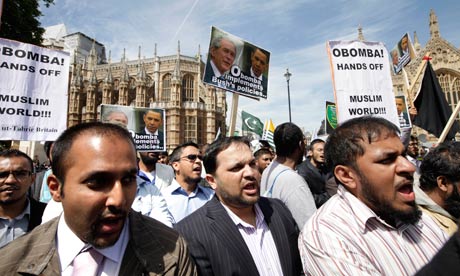
Photo above shows protesters from Hizb ut-Tahrir demonstrate during the recent visit by Barack Obama. The Prevent review has backed away from proscribing the group. Photograph: Lefteris Pitarakis/AP

Wednesday, 6 April 2011

CAMPAIGN AIMS TO DRIVE HOME TRUE MESSAGE OF ISLAM


This article appears in today's Leicester Mercury. After Leicester Secular Society ran their campaign encouraging people to tick the "No religion" box in the recent Census using bus posters, here's another example of that medium employed in a religious context.
Campaign aims to drive home true message of Islam

An advertising campaign to tackle Islamophobia will be coming to Leicester.

Last week, 160 buses in London and Glasgow began carrying the message "Muslims for loyalty, peace and freedom'', paid for by the Ahmadiyya Muslim Association.

The UK group hopes it will educate people about Islam and stop people connecting Islam with terrorism.

During the next six months the campaign is due to be rolled out across Leicester, Birmingham, Leeds and Bradford.

Volunteers will also distribute leaflets door-to-door throughout the UK explaining the peaceful and positive principles of the faith.

Rafiq Hayat, the Ahmadiyya Muslim Association's national president, said: "Through this campaign we are trying to clarify the true teachings of Islam, to speak out against injustices, suicide bombings and terrorism."

Last year, a YouGov poll of 2,152 people found that 58 per cent of those questioned linked Islam with extremism, while 69 per cent believed it encouraged the repression of women.

In a recent speech in Leicester, Baroness Warsi, the co-chairman of the Conservative party, said anti-Muslim prejudice had passed the "dinner table test" to become uncontroversial and socially acceptable by Britons.

Eagle-eyed readers will see, from the above photo of a London bus, that the poster also features that phrase that has come to be so strongly associated with the Ahmaddiya Muslim Association: "Love for all. Hatred for none".

I don't know; are we missing a trick here? Should Leicester Council of Faiths do something like this for our 25th anniversary? "We have faith in Leicester!" could make a real impact if used like this.

Oh and can you see what they did there? "Drive home" - on a bus? Good one, Mercury.

Thursday, 17 February 2011

TIME TO CHANGE OUR ATTITUDE TO MULTICULTURALISM

Manzoor Moghal has written the First Person column in today's Leicester Mercury. 
 
Time to change our attitude to multiculturalism

Chairman of the Muslim Forum Manzoor Moghal speaks out over David Cameron's recent speech

Our Prime Minister's recent salvo at the Muslim community and multiculturalism at the Munich Security Conference seemed to be somewhat gratuitous and very disingenuous. Multiculturalism as a policy supported by the state for several years has indeed been showing signs of fatigue and failure because of the way previous governments have been imposing their will on the communities through large amounts of funding which was misspent.

The recipients of such funding, who were encouraged to promote multiculturalism, were in turn expected to provide political support in electoral terms for the government. This has been the main weakness of the government's misguided policies on multiculturalism, but that does not mean that multiculturalism should cease to exist in the United Kingdom.

It is an undeniable fact that we are a multicultural society and will continue to be so, as indeed are many other countries in the world. What needs to change is the government's and society's attitude towards it. Our multicultural society should be allowed to evolve naturally through the inevitable interaction of these different cultures in all aspects of our lives in the UK, which would then result in a more cohesive and integrated society. It is the interference from government policies which is a problem, and not multiculturalism.

It  is a well known fact that there are some misguided and very vulnerable Muslim youth in the country who have been and will continue to be beguiled by preachers of hate against the West. Some of these elements have killed innocent citizens through their violence and caused huge damage, but that does not mean that the whole community should be directly or indirectly maligned – especially at a time when the likes of the English Degfence League are on a warpath against Islam and Muslims simply because they hate them through their ignorance and racism.

Our intelligence and security services seem to have brought extremist elements under control through their vigilance, and one would like to hope that these extremists are prevented from committing any further acts of violence. However, whilst combating violent extremism and endeavouring to abate extremism from misguided Muslim youth, the government should also feel obliged to review our foreign policies towards Muslim countries, which have been a very significant contributory factor in the radicalisation of Muslim youth both in Britain and in other parts of the world.

Simply to suggest that the illegal war against Iraq and the offensive against Afghanistan were in the past and therefore we should learn to move on, as suggested by Baroness Warsi at her lecture at the Univesity of Leicester, is naïve and supercilious. The alarming drift in Britain and Europe to right-wing politics should be a matter of great concern for all those who espouse democracy, liberty and equality. This alarming trend needs to be checked, and we need people of political maturity to do so.

Saturday, 29 January 2011

ISLAM: A LIFESTYLE CHOICE

This letter appears in today's Leicester Mercury:
Islam: a lifestyle choice
Here is a secular view of what Tory peer Baroness Warsi said on your front page (Leicester, January 21).
It was simply a demand that Islam is above criticism. She claims "prejudice against Muslims in Britain is at an all time high", but offered no evidence to support this claim, unless you count the e-mail she received as an example of prejudice against Muslims.
But the e-mail was nothing more than a concise sentence typical of hard political debate, that used a play on halal, which is indeed a Muslim custom/superstition hated by many, especially animal rights folk, that seemed a fair way to have a dig at her to me.
This is the e-mail: "Instead of bleating like some halal lamb being led to the slaughter, how about ending the knee bending to Islam at every opportunity."
This is mild indeed compared to the messages sent from Islamists to their critics.
She goes on to confuse race with religion. She tries to draw a similarity between racism to the Jews and criticism of Islam, but she is wrong; criticism of Islam is equal to criticism of Zionism – criticism of an ideology. Does Warsi think Zionism above criticism?
Opposition to Islamic aims, as to how we should all lead our lives are not racist, but ideological, as they are with any political creed we may oppose.
When asked whether she still faces regular discrimination, she said: "On the basis of my race? Less so. On the basis of my religion? More so". So Baroness don't be a Muslim, give it up! It's not compulsory. Here in Leicester it's a free choice, unlike being Jewish or Asian. If Warsi is attacked for being Asian, that is racist and she must be defended from that, but when she is criticized for freely following a lifestyle ideology many of us disagree with, she must expect hard arguments against that choice.
Especially as someone who has excepted an unelected, privileged, and well paid role in the Government on the Tory side!
She states that anti-Islamic sentiment is bigotry, so she can call those of us who are critical of Islam bigots, but we must, in her words, "be urged to be more careful about what they say about religion".
Why? She must extend the same freedom of speech to those of us who disagree with her, as she received on the front page of the Mercury.
Mr Lyn Hurst, Leicester

Friday, 28 January 2011

confrontation will not create a better society


When I met Dr Allan Hayes (recently retired President of Leicester Secular Society) at Phoenix Square on Wednesday evening, he told me over a pint (his) and plate of fish and chips (mine) that he'd submitted a "First Person" column to the Leicester Mercury responding to Baroness Warsi's speech at Leicester University last week. This is published in today's edition and reproduced in full below.

Confrontation will not create a better society

Allan Hayes says the concept of "dialogue" was missing from Baroness Warsi's speech

I came away from last week's speech by Baroness Warsi deeply disturbed: I am even more disturbed after reading her speech to the College of Bishops. Islamophobia, bigotry and ignorance are certainly to be combated by us all, on that there can be no disagreement, and we all recognise the good work done by religious charities–it is her views on the wider issue of religion and society and her lack of recognition of the good work done by others that concern me.

We have a dynamic and effective politician who is giving the impression to the religious, particularly Muslims, that religion is under attack from the non-religious; and to the non-religious that government is pushing religion on them. This is not helping anyone.

Speaking in Leicester, she could have highlighted how we are building One Leicester, how we live together, how councillors of different beliefs work together, how we talk to one another, how the oldest secular society in the world is welcoming the vicar of an Alpha Course church and a prominent Muslim academic. She could have mentioned how we came together against the English Defence League.

The concept of "dialogue" is missing. She shows no recognition of the serious discussions that are going on between people of different beliefs, religious and non-religious, and no awareness of the amicable relations between many secularist, humanist and religious members of our society. She is all for confrontation.

She calls for us to combat bigotry and religious illiteracy and to use reason, but to her, bigotry is anti-faith bigotry and she seems not accept that secular and non-religious views need to be acknowledged and understood–it is not sufficient for religious leaders to explain their faiths better. We have to remind ourselves that she speaks not as an individual but as a minister with influence. She proclaims that her government not only "does God" but "gets God"–whatever that means. She sees herself far too much as the leader of a religious revival–this is dangerous stuff.

She is pushing us towards a society where we may have to ask what is the religion of a politician as well as of a school or a social centre–this is not a good way to go.

Where can we go? To paraphrase her: we need to build a more open, inclusive society, a more grown up-society. Could we start by reversing the Government's decision to exclude Religious Education and Collective Worship from the forthcoming curriculum review; and by having a more open discussion of its policy on faith schools?

And perhaps she could include in her history the rights to freedom of religion and for elected MPs to take their seat regardless of any religion or belief? She might find that secularism had something to do with securing these rights.

Now ... interesting as I find this piece in its own right, I probably wouldn't have added it to this blog were it not for the conversation I had with Allan on Wednesday evening, during which we discussed the pros and cons of having an occasion like this in Leicester.

Obviously, Dr Hayes has his own agenda, which is well known, given his position and prominence in Leicester life. (He is Humanist Chaplain to the present Lord Mayor, Humanist representative on the Leicester Standing Advisory Council on Religious Education and - nationally - a trustee of both the British Humanist Association and of the Sea of Faith Network.) He makes no attempt to disguise that agenda here, flying the flag, as he always does, for the cause of Secular Humanism. But I would not do him the disservice of presenting an edited version of his short piece in today's Mercury or take the risk of quoting him out of context just to further my point here. It's more interesting and effective to read it as a whole. Dr Hayes doesn't need an apologist for his views - least of all me. But I think it shows the nature of the debate over these issues in our city that we can so often stand side-by-side with those who might be assumed to be our opposites. There's much more common ground than most folk realise. And in instances like this, I keep coming back to the Equality Act 2010, which protects everyone from having religion or belief being made into a stick with which to beat us, no matter what our personal affiliations may be.

Baroness Warsi's speech was certainly high profile, being of national - even international - interest, having been picked up, published and republished by all sorts of media (print, broadcast and social) all over the world. It certainly took off among those agencies, bodies, organisations - and individuals - with an online presence promoting issues to do with culture, religion and society in general - and Islam in particular. Overlooking the muddle over just where the talk was taking place (see my blog entry for the event) it was surely to the benefit of Leicester University to host it. But why Leicester? We agreed that Leicester is probably the safest city in which to make this kind of speech (demonstrations were threatened for Baroness Warsi's appearance at the university, but in relation to spending cuts and tuition fees, not ones to do with the actual content of her speech). But Allan made the point (as have others who heard the speech - I have to remind you, faithful reader, that I did not) that she could have been making it in a vacuum. The content did not reflect anything about Leicester as a community, how Islam is seen here, how Muslims live here - how we all live here. It was perhaps analogous to the recent broadcast of The Big Questions (see my blog entry) in which the speakers and panelists were brought in from outside Leicester, spoke about the issues in ways that were disconnected from the actual life of our city, then go away at the end, leaving the viewer with the impression that they had been shown something about how we are here. It was so disconnected to Leicester that it might as well have been broadcast from TV Centre in London, or from the bottle city of Kandor for that matter. Did Baroness Warsi do any different? Did she speak on the basis that what she has concluded, largely on the basis of her own experience, holds true for everywhere- including Leicester? In speaking and going like this, with hardly even the most cursory nod to the distinctive nature of the city hosting her, the question arises of whether Baroness Warsi is really on the side of the angels.