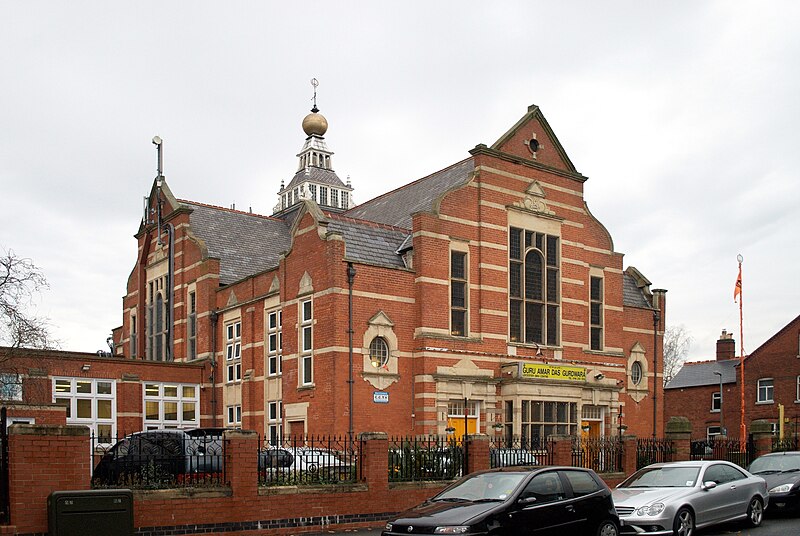
At Guru Amar Das Gurdwara, Clarendon Park Road, for a full meeting of Leicester Council of Faiths. Our speakers this evening are Dr Attaullah Siddiqui (Academic Director, Markfield Institute of Higher Education - as well as being past Chair and Honorary Life member of Leicester Council of Faiths) and Dr Clive Marsh (Director of Learning and Teaching, University of Leicester Institute of Lifelong Learning).
Dr Siddiqui is given the floor first. He offers a brief introduction to the history and work of the Markfield Institute of Higher Education (MIHE), Markfield, Leicestershire. Found in 2000, it is the first academic institution of its kind in the west. It presents a unique opportunity to study Islam in an Islamic institution within the context of Higher Education in the UK. In Dr siddiqui's presentation this evening, he tells us how MIHE was the first academic institution to address issues of being a Muslim in Britain today. It has recently begun to offier chaplaincy training, but it does so for Muslims in the context of a mult-faith society, in which trainees are obliged to learn about other faiths. Later in the evening, one of the members of the Council of Faiths remarks that those who have been students at Markfield are distinctive in their ability to join in inter-faith dialogue, mix with people of other religions and visit places of workship with confidence and openness.
In his introduction to his work, Dr Marsh observes that In Leicester, religion is all aorund us, but it tends to be something that other people have. But one can't work or live in this city without at least seeing evidence of people from many different faith traditions and cultural backgrounds -whether as individuals or as communities.
There is currently no undergraduate course in religious studies at either of the universities in Leicester - which is remarkable (even ridiculous) in a city where religion is such a significant part of public life and faith communities are so obvious to the public eye. Leicester University had a department teaching religious studies, but it closed as long ago as 1986 (presumably due to unsustainable numbers). The University of Leicester's Institute of Lifelong Learning does have a BA in Humanities and Arts which contains a Religious Studies component. The Institute is, however, currently also considering developing a Foundation Degree in Faith and Community Studies. This will be an opportunity for Leicester Council of Faiths to work with the Institute of Lifelong Learning on content, delivery etc. As a first step, the ILL is offering a Certificate of Higher Education in the Study of Religion at Vaughan College starting September 2010. Course Director for this two-year programme is Dr Angela Jagger, former Secretary of Leicester Council of Faiths.
Of course, provision and continuation of these courses can't avoid being market-driven. If there's demand for them, they'll flourish - if not, they'll wither away. Certificate courses require twelve students each year to run sustainably.
It's one of the stated aims in the constitution of Leicester Clouncil of Faiths that we should promote the disseemination of accurate knowledge about the faith communities in our city. This new development presents us with an excellent opportunity to put that principle into action.
These programmes of study are not intended to affirm the personal faith of the individuals enrolled on them. Indeed, if anyone signs up for that purpose alone, they may find it an uncomfortable ride. The old-fashioned distinction between "religious eduction" and "religious instruction" came to mind as we discuss this point. Students will be encouraged to look at their own religion (if they have one) and other religions as if from outside. Students should be able to reflect critically on the beliefs, values, history and practices of their own tradition as well as on those of others. These courses should allow students exposure to the life and activities of faith practitioners through contact with individuals (as visiting speakers, for example) and as communities (through visits to places of worship, joing in community, family or neighbourhood events such as festivals, commemorations, celebrations).
Angela will be offering a taster session on the evening of Monday 17 May, during Adult Learners' Week. The Institute of Lifelong Learning will have a stall in Highcross on Saturday 15 May to promote this week of learning opportunities.
Find out more about Dr Attaullah Siddiqui:
http://www.mihe.org.uk/mihe/detail.php?t=6&what=tutor
Find out more about Markfield Institute of Higher Education:
http://www.mihe.org.uk/mihe/
Find out more about Dr Clive Marsh:
http://www2.le.ac.uk/ebulletin/people/appointments/2000-2009/2008/12/nparticle.2008-12-19.5789722496
Find out more about the University of Leicester Institute of Lifelong Learning:
http://www.le.ac.uk/ad/