
Showing posts with label Birmingham. Show all posts
Showing posts with label Birmingham. Show all posts
Monday, 21 January 2013
MUSLIM SNOWMAN


Friday, 14 September 2012
SIKH MENTAL HEALTH & WELLBEING CONFERENCE

At the Tower Ballroom, Edgbaston, Birmingham today for a major national conference: "Sikh Mental Health and Wellbeing". This event, the first of its kind, is sponsored by SikhHealth.
Based on national statistics, one in four people in the UK will suffer at least one diagnosable episode of mental illness this year alone. This translates into some 200,000 Sikhs or over 900,000 South Asians from every background. Sadly, cultural practices and Asian value systems and traditions can exacerbate the negative impact of mental illness because of how it is perceived by families, friends, clinicians and sometimes by the service user him/herself. Mental illness stigma, superstitions, taboos and discrimination often result in South Asians not receiving timely or appropriate access to mental health services and tend to come into services in crisis. Disseminating the message to South Asians that mental illness affects all communities – regardless of age, creed, gender, nationality or status – continues to be a huge challenge. The conference has been widely promoted as an opportunity to:
- Raise awareness and understanding in an open and honest way about South Asian cultures, values and attitudes to mental illness, especially in the Sikh/Punjabi community
- Explore creative ways of providing intervention such as the Sikh Model of coaching/mentoring
- To appreciate what NHS based psychological therapies offer and how they can improve accessibility and acceptability
- Examine new strategies which encourage faith communities to challenge mental illness stigma and discrimination and develop a stronger response at a local, regional and national level
- Provide a platform at local, regional and national level for professionals, faith leaders, clinicians, service users and carers so that they engage with each other collectively in developing best practice in mental health interventions
- Increase awareness and understand the role Sikh religious/spiritual beliefs can play in managing mental illness and wellbeing
- Explore ways of addressing mental health stigma, taboos and prejudice in the Sikh/Punjabi Diaspora as well as providing timely and appropriate access to mental health services
- Help develop innovative and practical prevention and early intervention responses appropriate to South Asians
- Take ideas and positive messages about mental illness to our respective communities, family and friends and professional services
This national conference is intended to raise awareness, in an open and honest way, about attitudes to mental illness in the Sikh, Punjabi and South Asian communities. The conference is being held to explore key issues and practical solutions in a bid to create a national prevention and early intervention strategy for addressing mental illness stigma, superstitions, taboos and discrimination within the Sikh, Punjabi and South Asian communities. In addition, collectively utilising the power of faith organisations, professionals, patients, carers and community networks, the conference should send out a clear message to the Sikh, Punjabi and South Asian communities that there is nothing to fear or be ashamed about mental illness because it affects all communities regardless of age, creed, gender, nationality or status. With timely access and appropriate supports available, people can recover completely or can manage the illness and go on to live full and fulfilling lives. Speakers and their topics are as follows:
Sadhu Singh Gill (Chair – Sikh Health & Wellbeing Trust) speaks about the duty of care that faith leaders have in educating themselves about mental illness in order to begin to challenge the stigma and taboo that are know to exist. He also calls upon Gurudwaras and other faith organisations to open their doors to those experiencing mental health problems, often the most vulnerable and isolated members of our communities, so that appropriate resources can be put in place to support and nurture them and their carers.
Dr Panthratan Singh Grewal (Consultant Psychiatrist – Birmingham & Solihull Mental Health NHS Foundation Trust) gives a brief introduction to mental illness for the benefit of those in the audience who may be new to the field. He promotes the message that mental illness is common and can affect anyone in any community, at any point in their life regardless of gender, ethnicity, social or cultural background. He gives an overview of the common symptoms and dispels some common misconceptions. He explains that mental illness can often be effectively treated and managed, especially if recognised early and summarises some of the treatment options that are available. He also emphasises how crucial it is that mental health issues are not ignored because with early and appropriate treatment and support, people can recover and go on to live full and fulfilling lives within their family and community.
Simran Kaur Khinder (Diverse Cultures Community Support Team Manager and Approved Mental Health Professional – South Essex Partnership University NHS Foundation Trust) presents a powerful case study with the aim of exploring the interplay between the complex and often ingrained cultural practice of izzat (protecting family honour) and the lack of appropriate care after unfortunate circumstances that can result in intense long term psychological distress. The audience is invited to consider to what extent issues such as the fear of losing honour within families and the community act as an obstacle to seeking appropriate help when someone has been the victim of abuse and/or violence. She explores how we could better facilitate and manage seeking help in such situations.
Sachdev Singh Seyan (Justice of the Peace, Senior Community Engagement Worker – Hertfordshire Partnership NHS Foundation Trust) explains the concept of izzat, exploring how stigma begins and becomes established. He explores the often devastating impact of mental illness that is further impacted upon by stigma, superstition and the taboos that prevail within the Sikh, Punjabi and South Asian communities. He also highlights how the Eurocentric model of psychiatrically based mental health services needs to change in order to appreciate and incorporate race, culture, faith and spiritual factors into their formulation of mental health difficulties. He explains the need for professionals to become better informed about the terminology including the different cultural metaphors that are used to describe mental illness and psychological distress.
Bhai Sahib Mohinder Singh (Chair – Guru Nanak Nishkam Sewak Jatha) urges the Sikh community to take the lead in addressing mental health issues and the stigma related to seeking help from mental health services. Referencing the Sikh scripture, he speaks about the rich spiritual and worldly guidance that Sikhism itself provides in terms of looking after our own health and wellbeing as well as that of others, be it in the family or the community.
Peter Gilbert (Emeritus Professor of Social Work and Spirituality – Staffordshire University and Project Lead for the National Spirituality and Mental Health Project) speaks about spirituality and mental wellbeing ith reference to his own life experience. He explains the importance of understanding and utilizing spirituality and religion by the person coping with mental illness, their family and carers. In relation to the long-established secular “scientific” position still held by mental health services, he suggests an alternative holistic and person-centred approach to recovery, based on spirituality.
Gisela Stuart MP (Labour: Birmingham and Edgbaston) welcomes attendees and contributors, emphasising that mental health issues transcend party politics.
Avneet Kaur Chana reads her poem, "Bipolar Me". Avneet appeared on Channel 4's 4thought.tv when it addressed the topic, "Is faith a remedy for depression?"
Kamel Kaur Chahal (Senior Chartered Clinical Psychologist – South London and Maudsley NHS Foundation Trust, former Chair of Race and Culture Faculty – Division of Clinical Psychology) explains the role of psychology within NHS-based mental health services and what talking therapies consist of, what they can provide and where and how they can be accessed. She also talks about why there is a need for collaborative partnerships to be established between psychology and mental health services and the Sikh, Punjabi and South Asian communities with regard to actively developing a bio-psycho-social-spiritual approach. This could help adapt both the content and the provision of talking therapies to ensure that they are more meaningful and effective to and for these communities.
Inderjit Singh Bhogal (Wellbeing Leadership Coach and Director – Sikh Aid International) speaks about developing listening therapies and advocates that the art of listening impartially is fundamental to facilitating self-awareness that can lead to good health and wellbeing. By referencing Gurumukhi (the language of the Sikh Gurus which is similar to Punjabi) he puts forward a Sikh Model of Coaching (whose distinctions and metaphors are derived from the Sikh Scripture) as a creative solution to stress-related issues for individuals and their families. He suggests that the Sikh Model of coaching also helps to bridge the often-observed linguistic, cultural and metaphorical gaps between the world of the elders and that of younger members of the community - and between the medical profession and patients.
Lakvir Rellon (Director of Community Engagement and Partnerships – Birmingham and Solihull Mental Health NHS Foundation Trust) provides a professional reflection about stigma and mental health issues. By referencing service user stories she illustrates how stigma can impact on the rate of recovery, how support can be offered to families and how we can tackle stigma in our communities, thereby aiding people in recovery.
Swaran Preet Singh (Head of Division – Mental Health and Wellbeing, University of Warwick Medical School) speaks about the social context, precursors and consequences of mental illness and explores the broader sociocultural, political and economic forces that affect our mental health as well as the impact that mental illness has on wellbeing. He focuses on recent advances in psychiatric care such as early intervention which have begun to improve the chances of young people recovering from mental illness and returning to a normal developmental trajectory. He shares recent research evidence on how sociocultural factors can help (or sometimes hinder) recovery from mental illness in South Asian communities. He also offers practical examples of how mental health services should adapt to meet the particular needs of Sikh, Punjabi and South Asian communities, and how communities can better engage with local NHS services.
Neil Deuchar (Associate Medical Director – NHS Midlands and East, Commissioning Lead - Royal College of Psychiatrists, Co-Chair – Joint Commissioning Panel for Mental Health) speaks about developments in commissioning for mental health and in particular, the introduction of a national Joint Commissioning Panel for Mental Health. He will also talk about activities related to designing better commissioning for mental health serves across the Black and Minority Ethnic (BME) communities and the learning about diversity within Health and Wellbeing Board strategies.
Harjinder Singh Bahra (Barrister and Executive Director – Sikh Health and Wellbeing Trust) speaks about why SikhHealth has been created and describes its mission, vision and values. He outlines some of the programmes being developed by SikhHealth and puts forward ideas of how we can collectively utilise the power and influence within faith-based communities. He invites organisations, professionals, service users, patients, carers and community networks to create collaborative partnerships in order to develop a grassroots strategy of prevention and early intervention for the Sikh, Punjabi and South Asian communities in relation to mental and physical health and wellbeing.
Patrick Geoghegan (Chief Executive – South Essex Partnership University NHS Foundation Trust) highlights the key messages from the conference and speaks about the new possibilities of service providers working in partnership with faith leaders and faith organisations. The aim of these collaborative partnerships would be to more effectively address the key health and wellbeing issues within the Sikh, Punjabi and South Asian communities.

There's a fascinating variety of stalls and displays ringing the auditorium, among them:
- Care 4 You Birmingham
- Community Learning for Healthy Living in Birmingham
- Derbyshire Healthcare NHS Foundation Trust
- Friendship Mental Health Services - The Carers Network
- Mind in Harrow
- Nishkam Centre
- NSUN Network for Mental Health
- Rethink Mental Illness
- Sikh Aid International (photo above)
- Unique Therapies (Perm Bassi, photo below)

This is another one of those occasions when I feel privileged to be doing this job. I'm witness to what I feel is something special here – a community baring its soul. One of the speakers (Kamel Kaur Chahal) talked in her presentation about "community therapy", something akin to family therapy, but on a qider scale. That's surely what's taking place here today. It's brave of the Sikh community as a whole to do this in public. I'm sorry that I'm the only person from Leicester present to witness it.
Sadly, I'm unable to stay for the evening's entertainment, a jazz performance by INDI and His Unconventional Crooners (aka "The Sikh Sinatra" – photo below). Now that I would have liked to see!

Wednesday, 8 June 2011
TURBANOLOGY: RECLAIMING THE TURBAN'S RELEVANCE
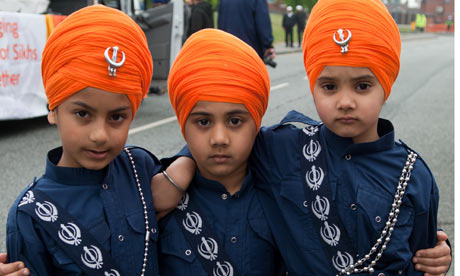
Reclaiming the turban's relevance
By Safraz Manzoor
British Sikhs' religion requires them to leave their hair uncut, and the turban is the most popular way for men to encase this long hair. But the turban has increasingly come to be associated with violent Islamic jihadism because members of the Taliban in Afghanistan wear turbans, as have some British Muslim terrorists in their suicide videos.
A new exhibition, Turbanology: Sikhs Unwrapped, which opens in Birmingham on Friday, is seeking to raise awareness about the true history of the turban and its significance for Sikhs. In addition to specially commissioned films and talks, the exhibition hopes to provide knowledge and perspective on the turban's spiritual importance and will provide hands-on demonstrations on how a turban is tied. Exhibition director Jay Singh-Sohal hopes that the exhibition will counter negative preconceptions of the turban.
"A survey for the exhibition suggests that 33% of turban-wearing Sikhs have received verbal abuse and a further 14% have faced racial discrimination because of their turban," he says.
Sikhs and their turbans have been in Britain since the 1860s and have historically been associated with bravery, loyalty and acts of courage as they fought for Britain during two world wars, and all over the empire. Their turban was representative of their identity and protection. In the immediate aftermath of 9/11, however, Sikhs came under attack from people who assumed their turbans meant they were Muslim radicals.
Singh-Sohal wants the exhibition to challenge this assumption that the turban represents something to fear. "The aim of the exhibition is to tackle these preconceptions in a fresh and fun way by focusing on the aesthetic, the symbolism of the turban and the things that British Sikhs have done to earn their place as respected members of our society," he explains.
The exhibition will travel to Derby, Slough and Leeds and at each location schools will be invited to participate so that young people can learn about the history and relevance of the turban.
In Britain, according to Singh-Sohal, the turban is seeing a revival among young British Sikhs who are finding new ways to wear their hair long. In India, however, the turban is in decline as more Sikhs cut their hair in order to fit in or to get jobs and avoid abuse. "All too often it is those Sikhs that come to Britain from India who cut their hair in order to be more western," says Singh-Sohal, "despite the fact that wearing the turban is protected by law in the UK."
Turbanology will be reminding visitors of the journey that British Sikhs have taken to ensure that the turban is accepted. Singh-Sohal says: "It will show it has an exciting future ahead as well as an illustrious history."
Turbanology opens at the Nishkam Civic Association, Birmingham on 10 June. Tour details at www.turbanology.info
In the photo above: Young Sikh boys wearing traditional dress and turbans for the Sikh new year festival of Vaisakhi (photograph: Jaskirt Dhaliwal)
Read this article, along with reader comments (and the opportunity to leave your own) on the Guardian Society off diary website: http://www.guardian.co.uk/society/2011/jun/07/turban-exhibition-sikh-history?INTCMP=SRCH
Saturday, 4 June 2011
"ASIAN MR LEICESTER" DIES
This article appears in today's Leicester Mercury:
"Asian Mr Leicester" dies
One of the first Asians to settle in Leicester has died at the age of 93.
Abdul Haq arrived from India in the 1930s, decades before the big influx of the 1970s.
He was a co-founder of Leicester's first mosque, in Sutherland Street.Mr Haq died of heart failure and pneumonia on Wednesday.
His son, Zuffar, said: "He was very much an Asian Mr Leicester. We are very proud of him."
Zuffar said his dad had followed in the footsteps of his own father, Ali Mohammed, who came to the city in 1919 to find work in the emerging centre of the textile industry.
However, it wasn't until 1938, aged 20, that Abdul joined a community of about half-a-dozen Indians. He worked as a door-to-door salesman.
Zuffar said: "He was one of the few Asian faces in the city and people regarded him as a bit of a curiosity.
"People didn't know anything about India. He was a source of information about a far-off place – a window on the world.
"People were always stopping him in the street, shaking his hand and inviting him to dinner."
During the Second World War, Mr Haq worked in a munitions factory, in Tudor Road. He was also an air-raid warden.
He returned to Punjab in 1958 to visit his mother, who told him to stay and find a wife.
He married Kishwar Sultana and they had their first child, Adbada, before returning to Leicester in 1959.
At that time, the city's small Muslim community had to travel to Birmingham to worship.
So, in 1965, Mr Haq and his friends bought a house in Sutherland Street and turned it into the city's first mosque.
He became a traffic warden in 1972 but quit after six months.
Zuffar said: "That didn't suit him because he had to give tickets to a lot of his friends.
"In one case, he ended up paying half the fine because he liked the chap so much."
Mr Haq went on to become a security guard at Marks & Spencers, in Gallowtree Gate, where he spent the last 20 years of his working life.
Kishwar died 17 years ago and Mr Haq leaves four children and eight grandchildren.
Malik Salim, chairman of the Sutherland Street mosque, said: "I got to know him very well. He was very active in the community."
Friday, 14 January 2011
Leicester Speaks again!

We're not sure of national dates for Local Democracy Week yet, but we're planning on running it in Leicester over two weeks: a pre-launch week (beginning Mon 10 Oct) concentrating on schools and colleges, then the week proper (beginning Mon 17 Oct). That second week is Half Term, which will hopefully allow us greater participation from young people.
We've all got our thinking caps on. What can we do for 2011 that will be new and innovative, that can build on what we achieved last year?
We'll probably extend the public launch event throughout the day, rather than run it for an hour or so, as we did last year. We might have (say) three sessions: morning, lunchtime and late afternoon, perhaps with themed groups taking part in certain slots.
We're also commissioning our own mobile Speakers' Corner, to replace the one we borrowed from Speakers' Corner Trust last year.
There's also the possibility of linking up with Birmingham and Nottingham, to give the week some stronger coverage across the Midlands. Leicester Council of Faiths might be able to do something in association with inter faith organisations in those cities.
A promotional event, introducing Leicester Speaks to potential new stakeholders, is being planned for next month. A six-page brochure (with DVD) will be published then, showcasing what was done last year and promoting what can be done later this year.
With withdrawal of funding for our role as Host Organiation from 31 March, this is one of the activities we may not be able to continue after that date. I've made that known to the group.
Find out what happened in Leicester Speaks 2010:
http://leicesterspeaks.wordpress.com/2010/11/04/thus-spake-leicester/
Friday, 10 September 2010
MORE THAN 500 LEICESTERSHIRE PILGRIMS TO JOIN MASS WITH POPE
This article appears in today's Leicester Mercury:
More than 500 Leicestershire pilgrims to join mass with Pope
A convoy of more than 500 pilgrims is to leave Leicester on a week on Sunday to take part in an open-air mass celebrated by the Pope.
Eleven coaches full of worshippers will be heading to Birmingham on an organised trip for the service with Benedict XVI.
Strict security is being imposed for the mass, which is part of a four-day official state visit, to prepare against any disruption.
Peaceful protests are likely over the Pope's record on child abuse in the Catholic church, his views on homosexuality and opposition to the ordination of women.
In all, 70,000 Roman Catholics including 1,000 priests are expected at the ceremony in Cofton Park.
The mass will beatify Cardinal Newman, a Victorian clergyman who converted to the Roman Catholic Church from the Church of England.
The service will mark a step towards Cardinal Newman being canonised as a saint.
Local Papal visit co-ordinator Father David Cain, who is based at St Peter's Catholic Church in Leicester, is confident the day will pass off well but he said security was a serious consideration.
Father Cain said: "Originally we had thought of just the coach leaders having photo ID. But it was felt that if everyone had it then the police would be helped and we all could be identified should something happen."
All the pilgrims will carry either a passport, photo driving licence or other form of identification card with a picture.
As part of a "pilgrim pack" which costs £25, there will be an itinerary for the day and orders of service.
Places on the trip were in high demand and oversubscribed.
Each parish in Leicestershire was allocated 16 places on a coach which would have worshippers from three parishes.
Father Cain said: "Each of the 11 coaches will have 49 passengers. Parishes had their own selection systems.
"Some held lotteries. At one parish, I picked out the winning numbers."
The convoy will leave at 3.45am from the Mother of God Church, in New Parks Boulevard.
Gates will open at 6am, there will be a morning service followed by the beatification mass at 10am. One county resident guaranteed to meet the Pope is Marion Lewis, who is a member of the Church of England.
She will be attending a welcoming reception by the Queen at Holyrood Palace in Edinburgh shortly after the pontiff lands in Britain on Thursday.
Mrs Lewis is the national chairman of the Neighbourhood Watch scheme.
She has been chosen by the Home Office to represent voluntary organisations.
Mrs Lewis, who lives in Market Harborough, said: "I have had some ribbing from my Catholic friends who could not get a place on the bus when they found out I was going to meet the Pope."
She said security for the reception would also be very tight.
"I too have been asked to bring photo identification at the event to accompany my official invitation," she said.
Monday, 7 June 2010
EQUALITY & DIVERSITY FORUM: HOW TO USE THE EQUALITY ACT 2010

In Birmingham today, for an event sponsored by the Equality and Diversity Forum (EDF), entitled "How to Use the Equality Act 2010". The Equality and Diversity Forum is a network of national organisations committed to equal opportunities, social justice, good community relations and respect for human rights. Its objectives are:
- To promote equality and in particular the elimination of discrimination on the grounds of age, disability, gender, gender identity, race, religion or belief, sexual orientation or any combination thereof;
- To promote Human Rights;
- To promote for the public benefit the efficiency and effectiveness of Voluntary Sector Providers working in the areas of age, disability, gender, gender identity, race, religion or belief, sexual orientation and Human Rights or any combination thereof;
- The advancement of conflict resolution or reconciliation between competing strands of equality and diversity.
This event sports some high level speakers:
- Jonathan Rees, Director General of the Government Equalities Office: "Key Features of the 2010 Equality Act"
- Amanda Ariss, CEO of the Equality and Diversity Forum, "How NGOs might use the Equality Act in Their Work"
- Peter Reading, Acting Director of Legal Policy at the Equality and Human Rights Commission, "EHRC's Role in Implementing the Act"
After lunch, I take part in two workshops. the first of these is "Equality Impact Assessments" (presented by Janine Garel, Citizens Advice), the second, "The Public Sector Equality Duty" (presented by Ali Harris, Citizens Advice and Ewan Kennedy, ROTA).
The venue for this event, Maple House on Corporation Street is very good. Central, close to Birmingham New Street rail station, with friendly staff and good food. But what I like most about it are the names of the meeting rooms. They're called "Accelerate!", "Forward!", "Hasten!", "Proceed!" and "Propel!". They sound like team names from The Apprentice. All they're missing is an exclamation mark at the end of each one - so I've added them here for good measure!
Subscribe to:
Posts (Atom)