Showing posts with label Zoroastrians. Show all posts

Friday, 27 May 2011

COUNCIL OF DHARMIC FAITHS UK FORMED


In a very interesting development for inter faith relations on a national level in the UK, a Council of Dharmic Faiths has been formed. In the presence of leading figures from the Hindu, Jain, Buddhist and Sikh communities, the Council of Dharmic Faiths was launched at the House of Commons on 16 May. Dharma is a word common to all the religions involved and has the meaning of righteous conduct or teaching. The Council of Dharmic Faiths has been established with the aim of encouraging friendship, goodwill, respect, equality and increased understanding within these communities, and between members of these communities and others in the UK. The Parsi (Zoroastrian) community has associate membership of the Council of Dharmic Faiths.

The launch event at the House of Commons marked the culmination of a process that has in its earlier stages seen the national circulation of a discussion paper in 2007 on the "Advancement of Dharma" for all major faith leaders in the UK, followed by the discussion of the desirability of a "Four Faiths Forum" for those religions which historically originated in India. Then there was a historic gathering of leaders of national faith organisations of the Hindu, Sikh, Buddhist, Jain and Zoroastrian communities in Finchley at the end of March this year, where arrangements were finalised for the formation of the Council of Dharmic Faiths.

There are estimated to be more than one and a half million followers of Dharmic religions in the UK. The Council of Dharmic Faiths has been established with the intention of promoting education and training,offering advocacy, improving the quality of health and social welfare, encouraging appropriate recreational activities and preserving the cultural heritage and promoting the interests of these faith communities in the UK.

The elected Chair of the Council of Dharmic Faiths is Dr Natubhai Shah, who is certainly well known in Leicester. Dr Shah was a prime movers in the establishment of the Jain Centre here and was prominent in public inter faith work in the city when I arrived here in the late 1980s.

If anyone were to think of this as an odd or innovative development, I would say think of the Family of Abraham grouping, that we've been used to in the inter faith world for donkey's years. I'm impressed by this new Council's public denial of being a caucus of religions who share special interests or who feel the need to define themselves in contrast or opposition to any other grouping of faith communities or any one faith in particular.

The Council of Dharmic Faiths has its own Facebook page.

Tuesday, 22 June 2010

FAITHS FORUM EAST MIDLANDS AGM


To Loughborough University early this evening, for the Annual General Meeting of Faiths Forum for the East Midlands (FFEM). The meeting is being held in the university's Faith and Spirituality Centre - a facility I've not visited before. We're welcomed by Simon Harrison, Director of the Centre, which will become fully operational for students and staff at the university come the new term in September. Councillor Jill Vincent, Mayor of Charnwood, is the special guest.


I'm wearing two hats this evening: one for Leicester Council of Faiths, the other for the Regional Equality and Diversity Partnership (REDP). Faiths Forum for the East Midlands is one of the few organisations focusing on one of the "protected characteristics" that has a remit to operate across the region. It's a natural partner for REDP and some of its personnel have given solid support at a number of REDP's Involvement Events in different parts of the East Midlands over recent months. CEO Patrica Stoat highlights FFEM's association with REDP when presenting her annual report. I was asked to write a short piece about REDP's work for inclusion in the latest edition of FFEM's newsletter, which is distributed to attendees this evening.


Leicester Council of Faiths is a constituent member of FFEM. Our former Chair, Resham Singh Sandhu, is a Trustee of FFEM, representing Leicester Council of Faiths. Our Coordinator, Ajay Aggarwal, is also a Trustee.


I get to chat with some members of the local congregation of the Church of Jesus Christ of Latter Day Saints (AKA Mormons). Their counterparts in Leicester wrote recently to our Council of Faiths, making initial enquiries about obtaining representation. I explain to them that while no decision has been made about their request at any recent meeting, the Council of Faiths is obliged, by the terms of our status as Host Organisation for Leicester Partnership on issues to do with religion, faith and belief, to establish good working relations with as many of the city's faith communities as possible. This doesn't mean that we're compelled to increase our membership, but it's against the spirit of our arrangement with the Local Strategic Partnership to allow anyone to feel left out.


Speaker this evening is Sandra Herbert on "Faith and the Media". Sandra has considerable knowledge and lengthy experience of this topic, having worked as a producer with BBC Radio Leicester and trained people from various faith backgrounds in media skills. lengthyShe gives a lively, amusing and inspiring presentation. She makes lovely jam too. Lots of people make jam, but this is none of your amateurish, kitchen table homemade stuff. Very professional, with some unusual combinations - her pear and chocolate one is my kids' favourite. The one she's showing off this evening is gooseberry and strawberry - just the one pot. I buy it from her.


In response to Sandra's presentation, I get a chance to plug Leicester Council of Faiths' foray into social media: Facebook, Twitter, Flickr and (of course) this blog.


It's an auspicious time to be discussing this topic as Channel 4 has just announced the introduction of a new daily religious slot entitled 4thought (can you see what they've done there?). This will to be broadcast immediately following their main news, just before eight o'clock. Channel 4's head of specialist factual, Ralph Lee, said contributors to the slot will be "as diverse as the views expressed". They will include members of minority religions, such as Bahá'í and Zoroastrianism.


Today's trivia: four people sharing a taxi from Loughborough to Leicester works out cheaper for each individual than buying a single on the train - even though Loughborough and Leicester are one stop apart and the train journey takes just ten minutes.

Sunday, 21 March 2010

spring has sprung!


Today, Sunday 21 March, is the Vernal Equinox - the first day of spring. It may be stating the obvious to say that this day has long been an auspcious day in many faiths and cultures - but it may also be acknowledging something normally taken for granted. I thought I'd devote an entry to going below the surface of how we see this day, from a number of different but related religious or spiritual perspectives.

The UN General Assembly in 2010 recognized the International Day of Nowruz, describing it a spring festival of Persian origin which has been celebrated for over 3,000 years. During the meeting of The Inter-governmental Committee for the Safeguarding of the Intangible Heritage of the United Nations, held between 28 September – 2 October 2009 in Abu Dhabi, Nowrūz was officially registered on the UNESCO List of the Intangible Cultural Heritage of Humanity. Since 2010, the United Nations General Assembly recognizes March 21 as the "International Day of Nowruz".

Naw Rúz is one of nine holy days for adherents of the Bahá'í Faith worldwide. The Bahá'í calendar is composed of 19 months, each of 19 days (with four "Intercalary Days" added in to make it up to 365 days), and each of the months is named after an attribute of God; similarly each of the nineteen days in the month also are named after an attribute of God. The first day and the first month are given the attribute of Bahá, an Arabic word meaning splendour or glory, and thus the first day of the year is the day of Bahá in the month of Bahá. Naw Rúz comes at the end of 19 days of fasting from sunrise to sunset, which takes up the last month in the Bahá'í calendar. Bahá'u'lláh wrote, "Praised be Thou, O my God, that Thou hast ordained Naw Rúz as a festival unto those who have observed the fast for love of Thee". As with all Bahá'í holy days, there are few fixed rules for observing Naw-Rúz, and Bahá'ís all over the world celebrate it as a festive day. Bahá'ís of Persian origin or background still observe many of the Iranian customs associated with Naw Rúz such as the Haft Sín, but Bahá'í communities would exemplify the diversity in their customs and practices today. Some may have a potluck dinner, perhaps with music or other live entertainment, along with prayers and readings from Bahá'í scripture. Bahá'ís in Leicester got together at Feast India on Melton Road for their New Year celebration today.

The calendar followed by Bahá'ís is a solar one, so the dates on which feasts and festivals etc are marked stay the same each year in relation to the Gregorian calendar. Each day in this calendar begins at sunset, so Naw Rúz begins (and the month of fasting ends) at sunset on 20 March. The first year in this calendar dates from 1844 CE, the year in which the Bahá'í era begins. So this Naw Rúz celebrates the start of the year 166 in the new calendar followed by the Bahá'í community.

The day is also used to symbolise the renewal of time in each religious dispensation. 'Abdu'l-Bahá, Bahá'u'lláh's son and successor, explained that significance of Naw-Rúz in terms of spring and the new life it brings. He explained that the equinox is a symbol of the messengers of God and the message that they proclaim is like a spiritual springtime, and that Naw-Rúz is used to commemorate it.

Read messages from Prime Minister Gordon Brown and Leader of the Opposition David Cameron to the UK Bahá'í community on the occasion of their New Year:
http://bahainews-uk.info/2010/03/20/prime-minister-sends-uk-bahais-naw-ruz-greetings/

Read a report of Bahá'í New Year being celebrated in the Houses of Parliament, sponsored by the All Party Parliamentary Friends of the Bahá'ís:
http://bahainews-uk.info/2010/03/23/bahai-new-year-celebrated-in-uk-parliament/

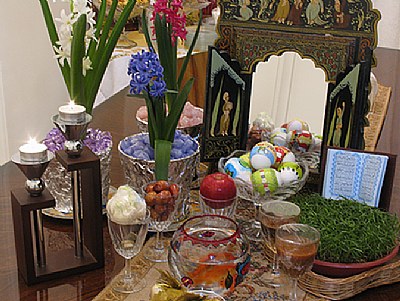
It's the first day of the new year ("Norooz") for Zoroastrians and Parsees, for whom it's the most important day of the year. Zoroastrian customs for Norooz include wearing new clothes, giving gifts, and settling disputes. Zoroastrians of Iranian origin generally put up a Haft Sin table as is tradition for Iranians.

Haft Sín (Persian: هفت سین) or the seven S's is a major tradition of Nowruz. Today the haft sin table includes seven specific items, all starting with the letter S or Sín (س in the Persian alphabet). The items symbolically correspond to seven creations and holy immortals protecting them. Originally called Haft Chin (هفت چین), the Haft Sín has evolved over time, but has kept its symbolism. Traditionally, families attempt to set as beautiful a Haft Sín table as they can, as it is not only of traditional and spiritual value, but also noticed by visitors during Nowruzi visitations and is a reflection of their good taste. The Haft Sín items are:
  1. sabzeh (سبزه) wheat, barley or lentil sprouts growing in a dish, symbolising rebirth;
  2. samanu (سمنو) a sweet pudding made from wheatgerm, symbolising affluence;
  3. senjed (سنجد) the dried fruit of the oleaster tree, symbolising love;
  4. sír (سیر) garlic, symbolising medicine;
  5. síb (سیب) apples, symbolising beauty and health;
  6. somaq (سماق) sumac berries, symbolising (the colour of) sunrise;
  7. serkeh (سرکه) vinegar, symbolising age and patience.

     
A slightly less traditional Haft Sín may also include:
  • sonbol (سنبل) the fragrant hyacinth flower, symbolising the coming of spring;
  • sekkeh (سکه) coins, symbolising prosperity and wealth;
  • sekanjabin, a sweet mint syrup;
  • decorated eggs, sometimes one for each member of the family (fertility);
  • a bowl with goldfish, symbolising life (and the sign of Pisces which the sun is leaving);
  • a bowl of water with an orange in it, symbolising the earth floating in space;
  • A poetry book, such as the Shahnameh or the Divan of Hafez, and/or a holy book such as the Quran or the Bible (or a compilation of Bahá'í prayers if appropriate).
Zoroastrians of Parsi (South Asian) origin do not traditionally use a Haft Sin. They set up a standard "sesh" tray - generally a silver tray, with a container of rose water, a container with betel nut, raw rice, raw sugar, flowers, a picture of Zarathustra the prophet, and either a floating wick in a glass filled with water topped with oil for fuel, or an "afargania", a silver urn with a small fire nourished by sandalwood and other fragrant resins.

Find out more about how people of Persian origin all over the world are celebrating Norooz, first day of their national and cultural calendar:
http://payvand.com/blog/1389/2010/02/07/new-year-norouz-1389-2010-times-%D8%AA%D8%AD%D9%88%DB%8C%D9%84-%D8%B3%D8%A7%D9%84/

The Vernal Equinox is celebrated today by our Pagan friends. Find out more about the Pagan celebration of Ostara in the Northern Hemisphere:
http://web.grinnell.edu/groups/pagan/pagan-home-ostara1.html

I'd like to acknowledge Wikipedia as the source for most of this information.

Saturday, 20 February 2010

JEWEL IN THE LOTUS


To the Quaker Meeting House, Queens Road, for a dayschool looking at correspondences between Hinduism and the Bahá'í Faith. This is led by Anupam Premanand, who has travelled here from Nivelles, Belgium (despite difficulties with the Eurostar service since the train crash outside Brussels earlier this week). Anupam came into the Bahá'í Faith in India some 19 years ago. He's a striking example of a phenomenon that often happens when people become Bahá'í, and after a while find themselves possessed of a deeper knowledge and greater love for the faith tradition into which they were born. The same thing happened to me when I became Bahá'í in 1979, having been brought up vaguely Protestant in the Church of Scotland.

Anupam has an infectious enthusiasm for the subject that conveys itself to everyone here today. There are more than 25 attendees, mostly from Leicester and its environs, a few from Nottingham.

While the Bahá'í World Centre in Israel has long sported buildings of architectural note and splendid gardens (recently named to UNESCO's World Heritage List in recognition of their "outstanding universal value" to the common heritage of humanity) it's the Bahá'í House of Worship in New Delhi that has arguably become the single most recognisable symbol of the Bahá'í Faith worldwide. The Lotus Temple (as it's popularly known) was dedicated to public worship in 1986 and has become a tourist landmark in India. Figures show it to be the most popular visitor attraction in the country after the Taj Mahal. Many people of Indian origin and heritage in Leicester have visited the Lotus Temple and have come away with a very positive impression of it. While that is undoubtedly a good thing, one may wonder how much such visitors glean about the history, beliefs and practices of the Bahá'ís themselves. Of course, a similar question may be asked of the Bahá'ís: how much do they know in their turn about Hindus and Hinduism - particularly in Leicester, where  Hindus are such a large and significant element in the local population? The purpose of this study day is to help the Bahá'ís understand and appreciate more about their Hindu neighbours: what they believe and how their beliefs impact on their lives. Bahá'ís are into finding correspondences between the world's religions as part of their programme for elimination of prejudice and building bridges between different cultures. This event is a good example of them doing just that.

Our day starts with an introduction to the religious and cultural diversity of India, and we see how the history and development of the Bahá'í community of India fits in that context. Since the earliest days of the Baha'i Faith, in the 1840s, some of its followers settled in India, having trading links with the city of Bombay (as it was then). Over the years, many teachers whose names are still celebrated in the annals of the Bahá'í community travelled the length and breadth of India, introducing the Bahá'í teachings to people of diverse backgrounds and interests. Up until the late 1950s and early 1960s, there were only a handful of Bahá'ís scattered around India, mainly in the north, mostly of Zoroastrian (Parsee) background. Indian adherents of Bahá'í would mostly have been educated people, living, working or studying in the major cities. However, after that period, the Bahá'í Faith became more widely known and better supported in the smaller towns and villages. In terms of numbers alone, India has the world's biggest Bahá'í community, at nigh on one-and-a-half million, although this pales into virtual insignificance when seen as part of that country's total population.

Now, many of the Hindu friends I talk with don't seem to mind the name, "Hindu" being used to describe themselves or their communities. But as I learned while writing the Council of Faiths leaflet on Hinduism, when it comes to the name of the religion they follow, many dislike it and prefer the term Sanatan Dharma - meaning the eternal path, way or law. Seeing this religion in that light helps Bahá'ís align their thinking with Hindus, as it brings out relations between the way the two religions see "progressive revelation" - a concept central to them both. Indeed, there are so many fundamental beliefs and practices in common between Bahá'ís and Hindus, many Bahá'ís have found (and, to go on the reactions here today, are still finding) that some of the more abstract teachings in their religion make sense when seen alongside comparable teachings in Hinduism. This is often to the surprise of many Bahá'ís who come from a background more influenced by the Abrahamic traditions of Judaism, Christianity and Islam - and surprise most often grows into delight at recognition of the similarities.

Before the end of the day, Anupram has us learning a Bahá'í prayer in Hindi and chanting a key verse from the Bhagavad Gita in Sanskrit! When one of these songs is over, someone wonders if there are any recordings of it available; "As long as it's not that one" I pitch in. Well, the comment sounded amusing on my side of the room! Here's a photo taken in the garden at the Quaker Meeting House of some of the attendees at this study day. Anupram is second from the right:


During one of our breaks, I bump into a few members of a chapter of the Friends of the Western Buddhist Order (FWBO) newly established in Leicester. They're holding their own meeting upstairs. In my job for the Council of Faiths I'm keen to establish, maintain and develop good relations with all kinds of religious and spiritual groups in the city, so I stop them for a chat. A little later in the afternoon, when their meeting is over, one of their number comes downstairs to hand out invitations that we might join them in their future day retreats or discussion evenings, which are held in the Quaker Meeting House. As their business is done for the day and they're in the process of packing up, I'm invited upstairs for a few minutes to tell them a little about the Council of Faiths and about my role with them. Positive contact is made today, and I come away with a phone number for follow up.