Showing posts with label Liverpool. Show all posts

Thursday, 18 April 2013

BACKING BID TO BE CULTURE CITY

This article appears in today's Leicester Mercury:
Backing bid to be culture city
by Alan Thompson
More than 150 people representing businesses and organisations answered mayor Sir Peter Soulsby's call to get behind Leicester's UK City of Culture bid.
In two briefing sessions at Curve this week, Sir Peter and his bid team told representatives of business, arts, faith and other organisations involved in the cultural life of the city about the latest stage of the bid.
Leicester is seeking to become the UK City of Culture in 2017.
The city's initial bid will be submitted on April 30 and the final entry in September.
At least £10 million will be needed to stage a UK City of Culture programme, according to the Government.
Leicester is one of 11 areas hoping to successfully bid for the title, held by Londonderry, in Northern Ireland.
Neil Peterson, one of the bid writers told the audience: "When Liverpool was European Capital of Culture, £120 million was spent over five years. It brought in £800 million in additional economic benefits.
"People go to places other than Leicester. It isn't as well known for its attributes as it should be. Overall, it has so much to offer. It has an outstanding cultural offer.
"A successful bid could offer significant long-term economic impact."
Artist Ashok Mistry said: "I am born and bred and work in the city. Whatever we put together needs to be artist-led – and from the heart."
George Ballentyne, of Leicester Council of Faiths, said: "I experienced Glasgow as the European City of Culture. It signalled a renaissance of the city which kick-started it as an ongoing city of culture."
Mr Ballentyne, who took his 11-year-old daughter Grace and son Harry, 12, to the meeting, said: "We need to engage people in this age group now and co-opt them in the creative processes. From now until 2017 is a huge gap in the life of a young person."
City councillor Ted Cassidy said: "There is a huge opportunity over the next five years, bringing together grassroots and young artists, people making things happen in the city. Don't let's wait until 2017."
City councillor Susan Barton said: "Leicester is already a city of culture.
"We need to make sure everyone outside Leicester knows about it as well."

Tuesday, 14 June 2011

COULD THIS BE THE CHURCH TO CALM OUR SECULAR OUTRAGE?


Very apposite and interesting article in today's Guardian by John Harris. It addresses some ongoing themes of this blog (social engagement of religious people, pan-equalities work, secularism) and it focuses on Liverpool, where I've just spent the weekend (at the first national conference of Philosophy in Pubs - PIPs).

It's part of a series of crowd-sourced articles and films called, called "Anywhere but Westminster", in which John Harris visits a different part of the UK each month to measure the gap between what politicians talk about and the reality of people's lives.
Could this be the church to calm our secular outrage?
By John Harris
Evangelical worship gets many on the left hostile or awkward. So how do we respond to believers that save the destitute?
It's a particularly remarkable feature of modern British life: the way that in certain circles even the mention of the most modest form of theistic belief is enough to bring down great torrents of hostility. Often the explanation is traceable to the liberal-left's justified concerns about the blurred relationship between religion and state. But, in keeping with the drive of militant secularism to attack the very idea of God as much as what faith means in practice, much of the shouting is usually about philosophical fundamentals. The result: an ongoing scrap between equally staunch believers and non-believers, which arguably gets nobody anywhere.
When we asked our online readers to give us a steer as to the social role played by religion where they lived, it all kicked off again. "I don't trust anyone who needs an instruction manual to tell them how to be good," offered Newbunkie. "My personal view is that all religious groups should be banned," said someone called Youbloodydidwhat.
In response there were slightly more measured claims of religion's practical benefits. "I have seen churches set up hostels for the homeless because the local vicar has encountered so many people sleeping rough in the church porch," wrote JonathanBW. "[They] establish credit unions to help people who are financially excluded … Most of this work does not involve any element of evangelism or proselytising." Similar news came from Manchester, Northampton and Glasgow – and in response, members of the Dawkins-Hitchens tribe dutifully went ape again.
If many of them set foot in Liverpool's Frontline Church, they would presumably explode. It's a standalone evangelical organisation based on the forlorn-looking borders of Picton and Wavertree. Having arrived in Liverpool in 1991, it now draws about 1,000 people – whose average age seems to be around 35 – to the three services staged each Sunday. Recent visitors have included Nick Clegg, Chris Grayling and Cherie Blair; among the first members of the congregation I met the day I visited was a local Labour councillor. Here, God is not acknowledged in that rather bashful way one associates with the tea-and-biscuits model of Anglicanism but loudly saluted. "We are amazed by you," goes one part of the apparently ad hoc liturgy. "We are in awe of you."
Now, I am an unshakeable agnostic. There is something about the unabashed nature of evangelical Christianity that unsettles my very British sensibilities – and I reach my peak of awkwardness during a Sunday service that dispenses with the fusty business of hymns and holy communion, and instead builds itself on music that suggests a grim hybrid of Snow Patrol and LeAnn Rimes. There are collection buckets rather than plates; suggesting that Rymans may have an overlooked sacramental aspect, the flock are invited to write their highest thoughts on Post-It notes, which are then stuck to flip charts.
Drawing on the Book of Joshua, the presiding pastor, a former Bristol GP named Nic Harding, advises his audience to fix their sights on metaphorical mountains, parts of society where their beliefs might be brought to bear. The examples he offers might chill any non-believer to the bone: "Education, healthcare, politics, government – these are all areas where God says, 'Who will claim that mountain?'"
In fact any mention of current affairs brings nonplussed responses from the congregation, and even the pastor tells me that politics is too "top down", and that he wants instead to work against greed and individualism one soul at a time. By way of bowing to the inevitable, I also ask him about the place his church gives to such issues as abortion and gay rights. "To me, those issues are right on the margin of the things we should be focusing on," he says. "The real issues are how we should express and find love for the outcasts and the downtrodden."
This is where he and his people direct their work, as evidenced by Streetwise, a weekly operation in which a handful of volunteers take food, tea and condoms to the city's sex workers. I watch them spend three hours in the encroaching dark as women in various states of drug-related distress flit between their van and streets where money has to be snatched from the jaws of occasionally life-threatening danger. They sometimes quietly pray for those they help, but they don't evangelise. "We're not bible-bashing," one of them tells me. "Whether these girls come to church or not, it makes no difference to how we treat them."
The next day I meet a former sex worker, now apparently off drugs, set on somehow starting college and a regular Frontline worshipper. "I was a prostitute and a drug addict for 11, 12 years – maybe more," she tells me. "God is so forgiving – he wants me to win." Wider society, she says, is "too judgmental … it's: 'That's a prostitute, that's a drug addict.' They don't want to know." And how has the church helped her? "Oh, it saved my life," she shoots back. "I would be dead if it wasn't for this church."
A question soon pops into my head. How does a militant secularist weigh up the choice between a cleaned-up believer and an ungodly crack addict? Back at my hotel I search the atheistic postings on the original Comment is free thread for even the hint of an answer, but I can't find one anywhere.

You can also watch John Harris's film that accompanies his article and contribute ideas of your own to the ongoing series, "Anywhere but Westminster" at the same site.

Sunday, 12 June 2011

PHILOSOPHY IN PUBS NATIONAL CONFERENCE: DAY 3


Third and final day of the first national conference of Philosophy in Pubs (PIPs) at the Britannia Adelphi Hotel, Liverpool. The morning programme features two presentations by PIPs members from Liverpool (abstracts of their essays below). After each of the presentations we engage in smaller scale group "enquiries" around our tables, then listen to feedback from each each group.

"The talent myth and confidence trick" (Paul Doran)
The first part of my exposition (The Confidence Trick) began to formulate itself from observations had during my experience in further education, bot as a mature student and as a teacher. The culmination of which was that confidence, i.e. the magic stuff - was not what we ordinarily thought it was. (I say magic stuff because to some extent that phrase captures the sort of status or esteem that confidence is a necessary condition required prior to certain actions being carried out, is wrong, because in fact it is a product of our ability not a condition of it. During that time I cam across the saying: Talent deserves no credit (Cowboy). the enigmatic moniker was intriguing, but the bold statement itself captured my interest, as it connected to my developing understanding of the so-called magic stuff (confidence). That understanding being, that it was the effort or striving involved that was commendable rather than any talent (innate gift) and that, in turn, tied into particular notions of how confidence actually manifests. Recent reading have supported the above understandings to the point where, I believe an argument of sorts can be put together and expounded, which I will endeavour to clarify. So, the contention of my essay is to show that our common understanding of what confidence is, and the status and character of talent, is somewhat mistaken and in need of modification. Moreover, the at the prevailing understanding and policy making that follows from it militate against progress to a more democratic culture - particularly within the realm of education.

"Where does courage lie?" (Jim Stanton)
According to Aristotle courage lies between the vices of cowardice and recklessness, the latter being a thoughtless action. True courage appears to require fear and its eventual overcoming through the power of will. But where does courage lie? It seems that any amount of thought will not constitute courage alone without leading to an act. However, if courage lies in the act then that brief movement of thought becoming action seems insubstantial, like a mindless headlong leap into another state. Perhaps then the moment of courage is a heightened moment, or duration, something like that of Augustine's idea of distension, a moment extending out of the past and into the future.

After lunch, the final session is delivered by Roger Sutcliffe, a leading figure in the Philosophy for Children movement.

In the photo above: Bernadette Hughes (who presented on "Logic, Nature and Truth" on Saturday and Jim Stanton, presenter on Sunday morning of "Where Does Courage Lie?)

Saturday, 11 June 2011

ANTHONY WALKER FOUNDATION


These guys were having a ball (if you’ll pardon the pun – or should that be "puns"?) at the Adelphi Hotel, Liverpool, this evening. I don't think I'd heard of them before seeing this poster in the hotel, but having looked them up online, they should definitely be more widely known. So I thought it right and fair to big them up on here – they could hardly be more welcome on this blog!

The Anthony Walker Foundation (AWF) was established to eliminate racial discrimination within the community and create cultural harmony and awareness in young people by providing activities and access to resources to overcome such barriers. It seeks to organise a range of activities that promote community relations in young people in Liverpool and nationwide. This is done with particular focus on the integration of good race relations between people of all racial origins and particularly those who are disadvantaged, disaffected and socially excluded.

PHILOSOPHY IN PUBS NATIONAL CONFERENCE: DAY 2


At the Britannia Adelphi Hotel, Liverpool for day two of the first national conference of Philosophy in Pubs (PIPs). Today's programme features a mix of presentations by PIPs members and professional philosophers.

Here are the abstracts for the first two essays, which showcase the range of topics that interest PIPs members. Following presentation of the essays we have smaller scale "enquiries" in groups of half a dozen or so, then each group feeds back to the whole.

"Logic, Nature and Truth" (Bernadette Hughes)
Problem: Is innate knowledge possible; and if it is, how might it inform us about reality?
A biological response: Evidence that supports the argument. If genes are determined, in part, by external factors such as environmental conditions, then it would seem that an organism must have the capacity for certain external factors to have build into it patterns or structures that will tend to promote its survival.
Central argument: Reasons to support the conclusion. The world is structured, we are a product of those structures; therefore, those structures will be innately reflect in our being. So, our innate natural structures reflect the natural structures of the world.
Conclusion: We can understand the world, in highly reliable ways, by making sense of the innate structures.

Here are a few of the things that came up during our enquiry on Bernadette's essay.

I was reminded of Wordsworth's poem, "Ode: Intimations of Immortality from Recollections of Early Childhood" (1807) which addresses this topic of innate knowledge:

Our birth is but a sleep and a forgetting:
The Soul that rises with us, our life's Star,
Hath had elsewhere its setting,
And cometh from afar:
Not in entire forgetfulness,
And not in utter nakedness,
But trailing clouds of glory do we come
From God, who is our home:
Heaven lies about us in our infancy!
Shades of the prison-house begin to close
Upon the growing Boy,
But He beholds the light, and whence it flows,
He sees it in his joy; (ll.58–70)

There are religious, spiritual or cultural traditions that would contend that a child is born with innate knowledge (indeed, some of them would go so far as to say that a child comes into the world possessed of all knowledge) and then the world beats it out of them; that our life is a continual process of forgetting. Furthermore, isn't such a belief in innate knowledge part of the justification for reincarnation? Easter traditions and philosophies would have something to say about the topic of this essay, but they're not represented here.

It made me think of how we, as cultures and societies, create grand narratives or meta narratives that we buy into, consciously or unconsciously, to explain our collective history and our personal stories. It's as if there's an ongoing story and we appear in chapter XX of that story (and exit from it in chapter XXX!). This could also be related to our beliefs in cause and effect (think of Hume's billiard balls here).

Could the capacity for language being encoded in our genes (after Chomsky) be classed as this kind of "innate" knowledge? Language underpins everything about being human. I'm familiar with evidence from research that newborns show observable, verifiable communication skills as early as 20 minutes after delivery. If that's not innate knowledge, then what is?

Innate knowledge proves a base, a platform that promotes our survival, not just as a physical species, but as humans - we come into the world prepped for a sort of Human 101.

Interesting how there's a blurring of knowledge, motor skills and instinctual behaviour evident in the enquiries and feedback.

Much of what we've talked about in this part of the programme resurfaces in different but related forms over the rest of the weekend (of course!)

"The Challenge of the Big Society" (Arthur Adlen)
The government's promotion of the "Big Society" is an ideological attack on the Welfare State and public services. For many years people involved in voluntary organisations and community groups have called for more power to deliver local services themselves. The government is now challenging us to do just that. I believe that, as citizens, we are between a rock and a hard place in facing up to this challenge. Citizenship should enable us to participate in the running of political affairs, and strive for the "good life", with the institutions of social life providing a means to that end. Faced with the choice of losing public services we will have to take up the running of those we are capable of running and campaigning to save those we cannot. Otherwise we are idiots.

There are clear implications in Arthur's presentation that Big Society would be, in effect, the introduction of a very modern kind of slavery. He also made the memorable point that a large part of the reason why no one knows what Big Society is comes from the fact that the name is nonsense. He said it's like when a rock band picks two names out of the air and sticks them together, like "Zodiac Soup" (that one's got legs: I'm going to do my best to make sure that these two words become synonymous with "Big Society"!)

Arthur is using "idiots" in its original sense, from the Greek, denoting members of the community who have the right to participate in the democratic process, but - for reasons best known to themselves - abstain from doing so.

We discuss the issue of public libraries and the possibility of them being staffed by volunteers. I wonder if our discussion of the social necessity of public libraries might be seen in 50 years time as being about as relevant and quaint as people who campaigned to save public laundries (the "steamy" as it was known in Glasgow).

PIPs could be seen as a medium or forum for discussion on the nature of our society and its relation to public services etc. People talking together, rather than being talked at by experts, government figures and so on. This might be a way to figure out the meaning of "Big Society".

After lunch, we have a presentation from Stephen Law. Stephen is editor of Think - the journal of The Royal Institute of Philosophy. He's Senior Lecturer in Philosophy at Heythrop College, University of London. He's the author of several book, of which the latest is Believing Bullshit. His blog is worth following.

Stephen presented on The Evil God Challenge - the philosophical hypothesis that there is just as much evidence (if not more) for the existence of an all-powerful, all-hating, evil Creator God as there is for its opposite.

Later in the afternoon, there's a meeting for organisers of local chapters of PIPs. I'm not involved in that one, so take the opportunity to do a bit of blogging (natch!)

Dinner seems to take an awful long time. We're seated at table for the best part of an hour before our first course shows up (despite having been asked to order this evening's meal a the end of last night's - I couldn't really see that idea working, especially when no one seems to be sitting in the same seats as we were the night before). Never mind, we're philosophical about it.

I'm afraid I miss the guest speaker this evening, Derek Tatton on "Community Education". As for American Beauty, the movie that brings the programme to a close, it gets started late enough that it could have been replaced with Sleeping Beauty!

In the photo above: the founding fathers of PIPs (l-r: Paul Doran, Rob Lewis, Arthur Adlen)

ADELPHI HOTEL'S MOST DISTINGUISHED GUEST


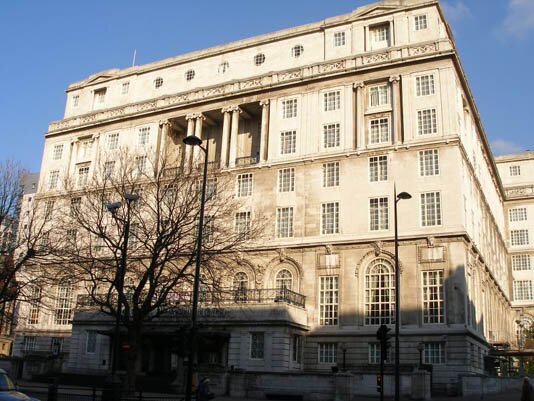
Regarding the Adelphi Hotel, Liverpool, where I'm attending the first national conference of Philosophy in the Pubs (PIPs): the first Adelphi Hotel on the present site was opened in l826 by owner James Radley. It soon became the most popular hotel in the city, and gained a reputation throughout Britain and Europe.

In 1912, another great hotelier, Arthur Towle, acquired and rebuilt the Adelphi. Today’s building still reflects his care and ambition to make it one of the most luxurious in Europe, with solid marble walls in many of the bedrooms, a fine indoor heated swimming pool, sauna and full central heating. The Sefton Suite in the hotel is in fact a replica of the First Class Smoking Lounge on the ill-fated Titanic.


Many famous visitors have stayed in the Adelphi, including Roy Rogers and his horse Trigger, who were  supposed to have made a grand entrance from the mezzanine floor to the main lounge.


'Abdu'l-Bahá stayed in the Adelphi Hotel for three nights in 1912 on his historic speaking tour in the West. He arrived in Liverpool on Friday 13 December, on board the SS Celtic which had sailed on 5 December from New York (photo above). This was 'Abdu'l-Bahá's second visit to these shores, having already been in England from 3 September to 3 October 1911. Find out more about 'Abdu'l-Bahá's visits to Britain here.


While in Liverpool, 'Abdu'l-Bahá made two addresses, one to the Theosophical Society on the evening of Saturday 14 December and one at Pembroke Chapel, a Baptist church, on Sunday 15 December. He left for London the next morning. 


A famous photo of 'Abdu'l-Bahá was taken during his stay in Liverpool. This much loved picture (a detail from which is reproduced above) has been treasured by Bahá'ís throughout the world for generations and can be seen in many Bahá'í  homes and centres and has been used in a variety of books and other publications.

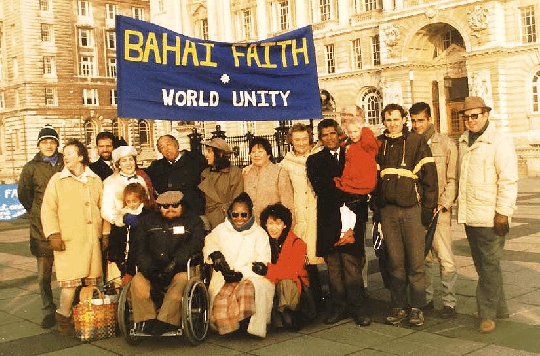
In 1987, more than 400 people gathered to celebrate the 75th anniversary of 'Abdu'l-Bahá's visit to Liverpool, tracing his route from the Pier head to the Adelphi Hotel. The photo below shows a group of celebrants gathered together shortly before the procession.


I was at that event. I came up from Oakham with other members of staff from the Bahá'í Publishing Trust  to run a book shop for those attending. I wouldn't have seen anything of the procession because I'd have been in the Adelphi, erecting and stocking the book shop, for those who were coming in the procession - and many more besides. I didn't stay in the hotel overnight though, as we were put up by friends outside the city in Newton-le-Willows.

Preparations are currently under way to mark the centenary of these memorable visits, in 2011 and 2012-13 respectively - and not only in Liverpool, but also in the other places 'Abdu'l-Bahá visited in Britain (Bristol, Edinburgh, London, Oxford and Woking - where he visited the Mosque joined by members of the Christian, Muslim and Jewish faiths together with distinguished visitors from east and west).


I wonder if this is the first time anyone has mentioned Roy Rogers and Trigger and 'Abdu'l-Bahá in the same breath? Worse still, when googling for information and images about this topic, I had to put 'Abdu'l-Bahá and Celtic side by side in the search box!

Friday, 10 June 2011

PHILOSOPHY IN PUBS NATIONAL CONFERENCE: DAY 1


In Liverpool this evening, for the start of the first national conference of Philosophy in Pubs (PIPs). We're based in the Britannia Adelphi Hotel for the weekend, a great venue which is a stunning monument to Liverpool's grand architectural heritage. This conference has the following aims:

1.     To allow space and time for reflection on what we see as the PIPs vision, reconsider its purpose and, perhaps, the need for renewal and reinvigoration.

2.     To provide an opportunity for members to express their philosophical ideas/theories in a more detailed/extensive way, and provide the opportunity for peer review and enquiry of and into those ideas.

3.     The conference will also provide us with an opportunity to hear and respond to professional philosophers speak on chosen subjects.

4.     This is a new development of PIPs and will allow for sustained philosophical and social engagement, relaxation and reflection with our fellow PIP members that goes beyond the usual meetings.


Being a Friday night in Liverpool, there's a lot of partying going on in the hotel. There's a wedding reception or birthday bash going on till the wee small hours. The women in the Adelphi this evening look like they've just walked off the set of a lost episode of Blake's 7 - one entitled "Planet of the Space Vixens" or the like. I've never seen shoes so teeteringly high, skirts so short, hair so precariously piled and material so shimmery and gravity-defying! I'm in a second floor room and there's a disco underneath it, the door just below the window. I finally fall asleep somewhere around 0130.

The opening talks by Rob Lewis and Paul Doran (on respectively, the origin, aims and vision of PIPs and its present and future national position) really strike a chord with me. I felt transported back to my teen years, on Saturday afternoons in the Gemini and the Third Eye Centre in Sauchiehall Street, when I first began learning about philosophy and philosophers among the filter coffee, lemon and sultana cheesecake and the smoke from roll-ups. Now, like then, I really got off on the union of thinking better and living better - changing oneself on the inside and consequently changing things around us, on the outside.

Rob says that once he realised how "doing philosophy with other people was a way of overcoming the sense of alienation that many of us feel at time, which comes from being in a society that wants to measure you in very limited ways and then judge you to see what shaped hole you might fit into and what life chances you might be worthy of".

He describes how he "saw the thinking skills and especially thew thinking attitudes that are developed through doing philosophy as essential to the task for overcoming this process of over rationalisation  that leads to social structures that are designed to perpetuate the exploitation and alienation of people, generation after generation after generation."

I think it worthwhile to reproduce a little more of Rob's talk here.
"Further analysis of these social structures by Marcuse and Chomsky talks of how they serve to desublimate the beauty in human relations, desublimate human production and desublimate human existence itself. So the sublime or beautiful, creative and uplifting is replaced with desublimated commodities and our desire for them is manufactured in the form of false needs or false consciousness. "The upshot is that public thought, the intellectual public agenda and all importantly the public scrutiny of that agenda is controlled and serves the interests of exploitation, alienation, disempowerment and desublimation. As such, genuine democracy is lost - the possibility to seek out or influence a sublime, achievable and sustainable social agenda and its outcomes is severely to tokenistic gestures by politics, media and the dominant cultural forces such as Fox, Disney and Hollywood; and those how control the most vital and defining structures in this social reality are able to function most effectively beyond the penetrating stare of public scrutiny.
"So the purpose of PIPs, from my perspective, was to form communities of philosophical enquiry for those people who have suffered greatly or marginally from the effects of these exploitative, alienating, disempowering, desublimating and dehumanising social structures. I believe as Bertrand Russell did in the power of philosophy, in the power of being able to think well, as humans can.
"Russell in his Principles of Social Reconstruction (1916) tells us that men fear thought as they fear nothing else on earth, even more than death. Thought is subversive, revolutionary, merciless and destructive towards privilege, established institutions and comfortable habits; thought is anarchic, lawless and indifferent to authority. Thought looks into the pit of hell and is not afraid. Thought is swift and free, the light of the world and the chief glory of man.
"This is what Russel said of thought but what of thinking well? Perhaps we can say that thinking well means making the light shine brighter and our chief glory shine all the more gloriously. Thinking well will surely make us bolder when we stare into hell and all the more effective when we turn our thought towards the task of scrutinising and restructuring our social reality."

I hadn't realised quite how popular Philosophy in Pubs had become in Liverpool; nor how many groups there are in and around the city (15). And its founders and supporters here are only too conscious of its place in the tradition. As Rob put it in his opening presentation,
"I'd also like PIPs and PIPs members to become more aware that we have something of a place in the history of grass-roots community learning and empowerment, similar to that of the mutual improvers, the Reformers and the Chartists of the 18th and 19th centuries. PIPs connects, to some degree inadvertently, to a history of social movement that it can be proud of and no reason to shy away from and this history has a role to play [...] in terms of shaping and forging some aspects of its identity."