Showing posts with label multiculturalism. Show all posts

Sunday, 28 July 2013

INDEPENDENT ON SUNDAY FEATURE ON LEICESTER


Peter Popham's article about Leicester is published today in the Independent on Sunday's New Review magazine. His piece is entitled "We're all in this together: How Leicester became a model of multiculturalism (even if that was never the plan)". You can go straight to it and read the whole piece for yourself (and comments by readers) by clicking on the title of the article above.

The Independent on Sunday is not the easiest newspaper to find in Wigston. After trying out quite a few shops, I get my hands on the last two copies in the Co-Op Food Store in Bell Street. But when I get them home, there's no New Review with either of them! I take them back for a refund and start searching again, rather late in the day. Thankfully, there are two more copies in the Tesco filling station. *Phew!*


The article is illustrated with photos of Surinder Pal Rhai (President of the Leicestershire Council of Gurdwaras), Cllr Manjula Sood (Assistant City Mayor and Chair of Leicester Council of Faiths) and Jawaahir Daahir (Chair of Somali Development Services). The one of Manjula is particularly good, standing magisterially in the Council Chamber.


I'm a bit surprised that none of the people to whom I introduced Peter on his first visit to Leicester don't appear in the article. But he has included many good interview subjects with good quotes from all of them. On reflection, I think that Peter probably treated that first visit as an initial reccie and got down to business when he returned (with a photographer) a few days later.

I'm happy with this - and look forward with anticipation to how it's received by other people in the city.

Saturday, 4 May 2013

ODDS IN OUR FAVOUR

This article appears in today's Leicester Mercury:
Odds in our favour
by Tom Mack
Bookies are taking bets on the race to become the 2017 Capital of Culture – with one making Leicester joint second favourites.
William Hill has the city at 5/1, in equal second place with Swansea Bay and only Chester, at 4/1, has better odds to win.
In total there are 11 cities vying for the title and Leicester's multi-cultural population is helping boost the odds in its favour.
William Hill spokesman Joe Crilly said: "There's an awful lot of regeneration going on in Leicester and it's vastly multicultural.
"I went to the University of Leicester for four years and I know myself it has been a standard-bearer for multiculturalism in Europe."But he said the betting had been fairly quiet so far.
"There have been a couple of bets placed on Leicester to win since we started on Wednesday.
"It's not much of a money-spinner compared to the football and the betting is predominantly for Dundee."
Ladrokes have been less generous to Leicester, putting the city in equal sixth place with Plymouth at 8/1. Ahead of it are Aberdeen, Chester and Southampton and Portsmouth, with Swansea Bay as favourite.
The other locations in the running to become the 2017 UK Capital of Culture are Hull, Southend on Sea, East Kent, Hastings & Bexhill on Sea.
Ladbrokes spokeswoman Jessica Bridge said: "The odds were worked out in the usual way based on the facts and figures we knew, as well as the likely impact of the celebrities backing the cities and the success of the cities that have gone for the title in previous years.
"In terms of betting, the most has been for Swansea Bay and the Southampton and Portsmouth joint bid isn't doing badly for money being put down.
"There hasn't been a lot of love for Leicester yet but it's still early days."
Among the celebrity backers for Leicester to win the title is actor and film director Richard Attenborough.
Lord Attenborough grew up in Leicester and he made his stage debut as a boy at the city's Little Theatre.
He has been a life-long supporter of the city's arts scene and his collection of ceramics by Pablo Picasso are on long-term loan to the New Walk Museum and Art Gallery.
The 89-year-old said the city had "evolved into a huge multi-cultural centre".
If Leicester wins, it aims to stage a Festival of Light, based on the annual Diwali celebrations, as well as a re-enactment of the Richard III story.

Wednesday, 27 February 2013

CITY'S STRONG MIXTURE OF OLD AND NEW

This editorial appears in today's Leicester Mercury:
City's strong mixture of old and new
What does "culture" mean? We ask the question because Leicester is launching a bid to become the UK's next City of Culture in 2017. We probably all have slightly different definitions of what we mean by the word culture. However, the Collins Dictionary defines it as: "The artistic and social pursuits, expression and tastes valued by a society or class."
The UK City of Culture then should be a place which is able to offer outstanding and highly valued artistic and social pursuits. And, given that this title is a national one, it should also be a place with a cultural mixture which represents and reflects the values of modern Britain.
On any assessment, Leicester has a very strong case.
We have seen in recent months the city's long and rich history gain national attention through the remarkable discovery of King Richard III's remains. Visitors to Leicester can learn about the king's life and death at a pivotal point in history, as well as the archaeological quest to locate his last resting place.
It is a story which has captured the imagination of people across the world and gives Leicester a cultural dimension that few other cities can match.
In addition, Leicester is not only a very old city, but also a very modern one. And this is best reflected in its multi-cultural community.
The city is home to many festivals and events reflecting the diversity of its population. The Diwali festival, for instance, is celebrated by thousands of people from many backgrounds. It is a demonstration of multi-culturalism in action.
There are many other cultural highlights: the huge success of the Curve theatre; Dave's Comedy Festival which celebrated its 20th anniversary this year; the classical music programme and other events at De Montfort Hall; and the dramatic recreation of the Easter story through Christ in the Centre, to name a few.
All of these elements demonstrate a thriving and varied cultural programme which appeals to a broad range of tastes.
Leicester has a great story to tell: through its history; its modernity; and its sheer range of venues and events.
We think the case for it to become the UK City of Culture is a compelling one and we wish all those involved in this bid every success.

Friday, 18 January 2013

WHAT'S TO CELEBRATE ABOUT BEING A MULTI-CULTURAL CITY?

This letter appears in today's Leicester Mercury:
What's to celebrate about being a multi-cultural city?
In his First Person column ("Let's start new year with pride and confidence", Mercury, December 31), Sir Peter Soulsby reckons that two events need celebrating.
Firstly, the census shows Leicester to be one of the most "diverse" cities in the country and, secondly, Richard III's remains are probably ours, which will be good for tourism.
This does not seem to make a great deal of sense. To begin with, why are we supposed to be celebrating the idea that Leicester is now one of the least English cities in England?
Are we not supposed to enjoy our own company? In which case, why would tourists?
And Richard III is part of English history – any tourism would be based on the idea of our monocultural, English heritage, wouldn't it?
Which is going to be tricky anyway because, dead kings apart, we seem to have knocked down a very respectable proportion of our historical heritage and seem to be waiting for a large part of the rest to collapse from neglect.
Besides which, how is more immigration a good idea when we cannot find enough jobs to keep the present population fully employed, in tourism or otherwise?
Or enough housing since we are now supposed to wreck a large part of our very attractive and tourist-friendly countryside in order to accommodate a population which, I have read, makes us the fourth most densely populated country in the world.
Possibly a new walk to a world of muck, brass and realism is in order.
Russ Ball, Leicester

Thursday, 13 December 2012

DO OTHERS SHARE SUNDIP'S VIEWS?

This letter appears in today's Leicester Mercury:
Do others share Sundip's views?
I refer to the letter from Sundip Meghani ("Take a long, hard look in the mirror", Mailbox, November 28). He writes about "sensible" letters from people who "reflect the true face of Leicester people". Given the chance he would "try to give Clarissa Dickson Wright and all of her fans a much needed education".
Finally he suggested that, "the sooner we accept multi-culturalism and move on the better off we will be".
I would be interested to know how many more councillors share his views. I do not take kindly to being dictated to in this manner and suspect others agreeing with Clarissa Dickson Wright's views feel the same.
RJ Atkins, Leicester

Wednesday, 28 November 2012

TAKE A LONG, HARD LOOK IN THE MIRROR

This letter appears in today's Leicester Mercury:
Take a long, hard look in the mirror
I was dismayed to read the letter from T Green ("I no longer feel at home in my city", Mailbox, November 22), one of several recent letters and online comments from people jumping on the Clarissa Dickson Wright bandwagon.
Thankfully, I have also seen more sensible letters from Ann Collins and Eddie Sentance, among others, reflecting the true face of Leicester people and the common decency and human compassion that most of us share.
Firstly, in response to T Green, I hate to break it to you, but you appear to be suffering from a bout of xenophobia.
Take two visits with friends to an Indian restaurant and perhaps a place of worship, followed by a long, hard look in the mirror.
If symptoms persist, contact your nearest library and try reading a few good books. Before long, you will discover that humans of different ethnicity are biologically identical and that different cultures – like languages – are not something to be afraid of, but something to be embraced.
You have to make a bit of an effort in order to understand something that's a tad different to what you're used to. Good luck with your recovery!
As for poor Clarissa Dickson Wright, one of the things she said in her widely-reported remarks was that she once got lost in a part of Leicester and none of the Muslim men would talk to her.
Well, to be honest, I'm not Muslim myself but if fox-hunting enthusiast Clarissa Dickson Wright came barrelling towards me on a Leicester side street, I would probably ignore her too.
On a serious note, I did find her comments about Leicester to be both idiotic and exaggerated.
But it was one particular phrase that really caught my attention, where she casually questioned whether or not multi-culturalism works.
Now, of course, I don't have enough column inches here to run through all the reasoned arguments as to why multi-culturalism does work, has worked and will continue to work in the future. (Or for that matter to try to give Clarissa Dickson Wright and all her fans a much-needed education).
But for the sake of brevity I will simply say this: St George was an Arab, the royal family is German, our national dish is Indian and some of our most gifted Olympians are of African descent.
Questioning multi-culturalism is akin to questioning evolution – both are part and parcel of the human story.
The sooner we accept that and move on to creating for ourselves a life of purpose and fulfilment in this increasingly globalised society, the better off we'll be.
Sundip Meghani, Leicester city councillor

Friday, 23 November 2012

CHEF'S EXPERIENCE DESERVES SYMPATHY

This letter appears in today's Leicester Mercury:
Chef's experience deserves sympathy
Having read the article ("Fury at star's comments on city muslims", November 16) regarding the comments made by Clarissa Dickson Wright about her experiences with certain members of the Muslim community in her latest book, I must admit that my sympathies in this case are with her.
Leicester does have a fair-sized Muslim community, as well as numerous other religious groups and foreign nationals, and as such, multi-culturalism has got to be the order of the day if people are to co-exist together in relative harmony.
This, however, does not mean that sexism and downright rudeness from either side of the divide is ever acceptable, regardless of religious tradition or the interpretation of such traditions made either in religious texts or simply handed down verbally from generation to generation.
Miss Dickson Wright points out in the article that none of the men would talk to her because to them she was an English female, and in their culture they do not talk to females they don't know.
In my experience, Leicester's Muslim community is just as helpful as any other when being asked for directions or aid, but then again I am a man and Miss Dickson Wright is a woman.
I must admit that if I had been treated with the same amount of apparent discourtesy and rudeness from virtually everyone I asked directions from, then I would not be afraid to say so, or who to point the finger of blame at.
Also, let us not forget that Miss Dickson Wright was born into a time in English culture when courtesy, respect and good manners ruled the day, and the term 'political correctness' had not yet replaced them.
In a multi-cultural society, exceptions to some traditional rules have to made, and a good rule of thumb surely has to be this: "To be courteous and helpful to any one in distress regardless of race, gender or any other social difference."
Rather than chastising Miss Dickson Wright for having the backbone to express her displeasure over such downright rudeness, surely it would be much better for representatives of the Muslim community to apologise for the behaviour of the small minority that she encountered, and to invite her to sample the excellent delights of Muslim culinary dishes with perhaps the hope that she may write yet another book extolling the tastes of a true multi-cultural tradition.
Alan R Pendragon, South Knighton

Friday, 16 November 2012

FURY AT TV CHEF CLARISSA DICKSON WRIGHT'S COMMENTS ABOUT MUSLIMS IN LEICESTER

This article appears in today's Leicester Mercury:

Fury at TV chef Clarissa Dickson Wright's comments about Muslims in Leicester
A celebrity chef has come under fire after making "hurtful" comments about the city's Muslim community.
In her new book, Clarissa Dickson Wright describes a visit to Leicester "as one of the most frightening experiences of my life".
The 65-year-old dedicates a chapter of Clarissa's England: A Gamely Gallop Through the English Counties to each county in England, discussing their culinary, cultural and historical merits. On Leicestershire, she writes of the city's "ghetto".
She describes coming off the ring road to escape a traffic jam and becoming lost.
"I found myself in an area where all the men were wearing Islamic clothing and all the women were wearing burkas and walking slightly behind them," she wrote.
She said the men would not talk to her "because I was an English female and they don't talk to females they don't know".
She said: "Here I was, in the heart of a city in the middle of my own country, a complete outcast and pariah.
"If multiculturalism works, which I have always been rather dubious of, surely it must be multicultural and not monocultural.
"I can only hope that in generations to come there will be a merging of the cultures and not the exclusion zone that is the ghetto."
Ibrahim Mogra, assistant secretary general of the Muslim Council of Britain, and a city imam, said: "How is she judging an entire community on her one-off rare time of getting lost in Leicester?
"I find it very hurtful to read because everybody is working so hard to create a peaceful and happy Leicester.
"It showed a complete lack of appreciation of the fact we are almost two million in this country, doing our bit for our country.
"When she says that she was in the centre of a city in the centre of her own country, I take objection. This is also my country and this is also my city.
"I would like to call on Leicester people to be even more welcoming and hospitable than we've been so far."
Mayor Sir Peter Soulsby said: "That is the sort of thing that makes me very angry – when someone breezes in from outside and paints a picture of Leicester that does not have any foundation in reality."It may help sell books but it is cheap."
Councillor Manjula Sood, chairman of Leicester Council of Faiths, urged readers to ignore her comments.
"I don't believe a meeting with one person on one street should mean you can label a whole city," she said.
Both Coun Sood and Mr Mogra invited Ms Dickson Wright back to the city for an opportunity to change her opinions.
When contacted by the Mercury, the chef, who lives in Edinburgh, said: "I'm surprised any of the people who might object could read what I wrote as it is written in English.
"When you get to 65, you will think back on this conversation and I think you might find yourself in my frame of mind."
She said she had a lot of Muslim friends but her experience of Leicester was "unpleasant".
"It scared me and I am not scared easy," she said.
Asked why, she said: "Because it was part of my country that I was born in and there are a lot of radical Muslim preachers in this country.
"I was in London when the July 7 (2005 bomb attacks) happened and this to me was proof for those people who have been saying we're getting ghettoisation of Muslim areas.
"I have never believed that political correctness was a reason not to say what I have experienced."
She said she had "done a lot" for Leicestershire, campaigning for the protected geographical status of Melton pork pies and Stilton.
In her book, Ms Dickson Wright praised Melton's food festival, saying "it was just everything that a good food festival should be".
She also wrote about "charming" Market Harborough, and "pleasant" Oakham.
She is signing copies of her book at Northfield Farm Christmas Fair, in Cold Overton, on Saturday.

ON THE COUNTY
In her book, Ms Dickson Wright wrote:
Melton: I first came across it at the original Melton Mowbray Food Festival, which, in the first two years, was held in the cattle market in Melton Mowbray and was to my mind without doubt the best food festival in the country.
(It had) produce from the Asian communities, in particular in Leicester, and the West Indian community, and it was just everything that a good food festival should be.
Market Harborough: A charming old town.
Rutland: Rutland is a triumph and a lesson to us all.
Oakham: A pleasant town with all the right sort of shops and bookshops and I am always happy to visit it.
ON LEICESTER
I had one of the most frightening experiences of my life there.
Leicester has a very high Asian Muslim population and I found myself in an area where all the men were wearing Islamic clothing and all the women were wearing burkas and walking slightly behind them.
None of the men would talk to me when I tried to find out where I was and how to get out of there because I was an English female and they don’t talk to females they don’t know, while if the women could speak English they weren’t about to show it by having a word with me.
(She bought a map at a newsagents.) Somebody, very reluctantly, pointed to where I was and then I had to work out the rest myself.
I have many good acquaintances and even some friends among the Muslim community, yet here I was, in the heart of a city in the middle of my own country, a complete outcast and pariah.
If multiculturalism works, which I have always been rather dubious of, surely it must be multicultural and not monocultural.
However, everything has an upside and one of the results of this is that Leicester has a very good selection of Asian restaurants.
I can only hope that in generations to come there will be a merging of the cultures and not the exclusion zone that is the ghetto.


Saturday, 18 August 2012

MULTICULTURALISM IS THE PAST NOT FUTURE

This letter appears in today's Leicester Mercury:
Multiculturalism is the past not future
The Olympics has resulted in multiculturalism again being espoused in some parts of the media.
Multiculturalism is frequently confused with diversity but actually means "many cultures", something which this country had long before mass immigration.
Before then we had working class culture, middle class culture and upper class culture.
We had aspiring middle class culture – "keeping up with the Joneses" – middle class culture and faded genteel middle class culture.
We had grimly decent working class culture, "I have absolutely no intention of ever working" working class culture and "proud to be working class" culture.
We had huntin', shootin', fishin' upper class culture, disturbingly smooth and urbane upper class culture and dissolute, idle upper class culture.
We had an astonishing variety of fixed attitudes, received ideas and preconceived notions.
Practically everybody could define themselves in terms of which little box they occupied and which one you did.
The result was that we spent inordinate and regrettable amounts of time in mutual recrimination, internecine struggles and dialogues of the deaf while the country hurtled downwards faster than a lead balloon.
It was generally agreed that our diverse cultures were divisive, corrosive, a futile waste of time and energy and that we had to change.
Multiculturalism is not the future, it's the past.
Russ Ball, Leicester

Wednesday, 4 April 2012

WHO DECIDES HOW LEICESTER IS PORTRAYED?

This letter appears in today's Leicester Mercury:
How decides how Leicester is portrayed?
In an article on gypsy encampments in the Mercury ("Such appalling views" , Mailbox, March 20), a contributor declaims that "Leicester is supposed to be one of the most multicultural and diverse cities in the country... but is it?". More to the point, actually, would be to ask who took it upon themselves to decide it was.
Like an ever-increasing number of decisions, it doesn't seem as if the rest of us were ever asked to vote on whether we thought it was a good idea. It's on a par with suddenly being ordered not to smoke because this is "National non-smoking day". According to whom, exactly?
Or being ordered to be more "aware" because this is "International women's day." (Really? It was just Friday when I woke up).Apparently every day of the year has been used up in this fashion. I imagine that February 29 is "Intergalactic alien day" (Well, you never know).
But does anyone remember having any input on any of this? Allied with these arbitrary decisions is the peremptory manner of those who expect everyone else to fall into line.
Nobody is expected to be so bumptious as to dispute that this is a multicultural city. Smokers are castigated for ignoring a decision made by... non-smokers?
But why should we put up with such autocratic, arrogant assertions?The title of the article on the gypsy encampments was "Such appalling views".
A better question might be where did the people who insist on making all our decisions for us pick up such appalling attitudes?
Russ Ball
Leicester

Monday, 27 February 2012

ANTI-ENGLISH DISCRIMINATION

This letter appears in today's Leicester Mercury:
Anti-English discrimination
On behalf of the English Community Group (Leicester) I wish to thank Nick Knight for his letter regarding our community organisation and asking for evidence concerning how the British state systematically discriminates against the English (Mailbox, February 10).
I wish to list just a few examples:
English ethnicity is excluded in the Census and also from ethnic monitoring forms, essential if the English as an ethnic group are to receive appropriate levels of government funding and policies.The label "White British" not only disenfranchises the English from its legal identity but as an identity based purely on skin colour it provides far less legal protection.
The English have no official bank holiday patron saint's day; no English Parliament; no specific English anthem; no English passport; there is no consultation of the English regarding our inclusion in the European Union and of mass immigration into England.
There is no English Olympic team; English flags are being taken down by councils; local English food produce not marked as English; no original Old English language, history and culture is taught in schools.
English university students are forced to pay full fees while Scottish students receive it free.
The English have higher airport taxes; a health apartheid where English patients are charged for prescriptions while Scottish patients receive theirs free; no English community centres, and where thousands of charities and community groups exist for ethnic minorities, there is only one charity, the Steadfast Trust, for the English.
Finally, to reassure Nick that we are ideologically separate from the English Defence League (EDL), we are focussed entirely upon the needs and concerns of the English community, as opposed to the EDL which is concerned solely with militant Islam.
The EDL does not recognise English ethnicity, preferring to hide behind a false British identity and encompassing a multicultural approach to its movement.
The English Community Group (Leicester) remains a community-orientated and ethnic-specific organisation totally distinct from the EDL.
Clive Potter, chairman, English Community Group (Leicester)

Sunday, 31 July 2011

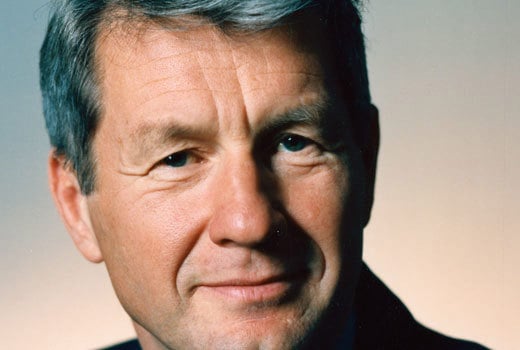
Nobel chairman warns Europe's leaders over 'inflaming far-right sentiment'

From today's edition of The Observer:


Nobel chairman warns Europe's leaders over 'inflaming far-right sentiment'
Thorbjørn Jagland says Europe's leaders are 'playing with fire' if they use right-wing rhetoric when discussing multiculturalism
By Mark Townsend, Home Affairs Editor
Europe's leaders, including David Cameron, have been warned to adopt a more "cautious" approach when discussing multiculturalism. The Norwegian chairman of the Nobel Peace Prize committee has told them they risk inflaming far-right and anti-Muslim sentiment.
Thorbjørn Jagland, a former prime minister of his country, said leaders such as the British premier would be "playing with fire" if they continued to use rhetoric that could be exploited by extremists.
Four months ago in Munich, Cameron declared that state multiculturalism had failed in Britain, a view immediately praised by Nick Griffin, leader of the BNP, as "a further huge leap for our ideas into the political mainstream". Marine Le Pen, vice-president of the far-right National Front party in France, also endorsed Cameron's view of multiculturalism, claiming that it corroborated her own party's line.
Jagland's comments come in the wake of the Oslo bomb and the massacre on Utøya Island that left 77 people dead. The killer, Anders Behring Breivik, said he was inspired by the right-wing English Defence League. Breivik sent his manifesto, published online hours before the attacks, to about 250 British members of the BNP, the EDL and the Stop Islamisation of Europe group.
Jagland, who is also secretary general of the Council of Europe, told the Observer: "We have to be very careful how we are discussing these issues, what words are used.
"Political leaders have got to defend the fact that society has become more diverse. We have to defend the reality, otherwise we are going to get into a mess. I think political leaders have to send a clear message to embrace it and benefit from it.
"We should be very cautious now, we should not play with fire. Therefore I think the words we are using are very important because it can lead to much more."
Jagland has also urged leading politicians to change their terminology. He said the word "diversity" was better than multiculturalism because the latter had become defined in different ways by different groups. "We also need to stop using 'Islamic terrorism', which indicates that terrorism is about Islam. We should be saying that terrorism is terrorism and not linked to religion," said Jagland.
Over the years before his attacks, Breivik developed an ultra-radical stance that initially incorporated the forced repatriation of Muslims from Europe, but ultimately targeted Norway's centre-left government, which had encouraged multiculturalism. During his court appearance on terrorism charges, the 32-year-old said he had acted to prevent the "Muslim takeover" of Europe.
[...]
During Cameron's Munich speech, which combined a passage on terrorism with one on integration, the prime minister talked extensively about "Islamist extremism" as being the source of terrorism.
Breivik saw David Miliband, Gordon Brown and Tony Blair as worthy of assassination because, according to his 1,500-page manifesto, they had a "friendly attitude" to immigrants.
Jagland says he has sympathy with Cameron's attempt to robustly promote a shared set of British values as an alternative to multiculturalism, if not with his delivery. "We are not searching for a society where we have only different cultures. We also need to have something that holds us together, to respect common values," he said.
Jagland, who last year gave the Nobel peace prize to jailed Chinese dissident Liu Xiaobo, who was represented by an empty chair at the ceremony in Oslo, added that the immigration debate also needed to be less negative.

Friday, 17 June 2011

IS LEICESTER GETTING MORE RACIST?

From today's Leicester Mercury:
Is Leicester getting more racist?
Dr Samuel Lebens believes it is. This is his tale of two cities: an old, welcoming one, and a modern city that he says tolerates hatred of its embattled Jewish minority
I was privileged to grow in up in Leicester; a beautiful city with fantastic schools, and a vibrant multi-cultural community. I cherish the ethnic diversity of my childhood.
Now, I'm studying to become a Rabbi where the study of Judaism is the only religion on the curriculum.
But, so moved was I during my youth by the wealth of multicultural wisdom around me that I chose to take a GCSE in Sikhism – a strikingly elegant religion with an egalitarian ethic.
I was also struck by the beauty of the other religions that surrounded me: Hinduism, Islam, and Christianity. These experiences, I carry with me in to my adult life.
As a leader of the National Union of Students (NUS), I was in joint charge of their campaign against racism and fascism.
I recall a motion that was debated at a national conference. The motion called for the NUS to condemn the practice of women wearing a headscarf.
My childhood experiences in Leicester had inoculated me from the xenophobia that motivates this suggestion.
I was among the first to stand in front of the 1,000 students at the conference, to defend a woman's right to dress as she pleases.
I couldn't be moved by the notion that Islam is inherently bigoted or prejudiced. My childhood included too many counter examples to any such claim.
I grew up in a Jewish community that felt safe within this multicultural environment.
Leicester has never been home to a large number of Jews. But we've always been proud of our association with it.
Indeed, the number of Jewish mayors that have graced Leicester's City Hall is vastly disproportionate to our numbers.
Growing up in that community, habituated to the tolerance around me, gave me a confidence in my minority identity. I owe that to the city of Leicester.
But let me describe to you another city.
At best, it can be described as a city that tolerates the anti-Semitism in its midst.
In the past few years, I have found it is almost impossible to walk down its main streets without having anti-Semitic abuse hurled at me and my family.
Cars slow down, with windows opened, in order to unleash a bloodcurdling howl of Jew-hatred.
I don't feel comfortable to dress, outwardly, as a Jew in that city.
It is a place to which I fear to bring my children; I don't want them to know the face of anti-Semitism.
A young relative of the Rabbi, in that city, had a pellet gun shot at him indiscriminately. The synagogue there has been the target of repeated acts of vandalism.
Recently, anti-Semites located the home of its only Orthodox Rabbi.
They hurled bricks through its door in the middle of the night. The fear that such an attack can strike into the hearts of a young family is barely describable.
When will the next brick come? Will it still be a brick, or will it, God forbid, be something worse?
How are they supposed to explain the attacks to their children? It is the sort of fear that can drive a family, and even a community, out of a city.
The city I'm now describing is also Leicester; the Leicester of my adulthood.
Not since Simon de Montfort, who was known for his Jew-hatred, has Leicester been so overcast with the shadow of anti-Semitism.
Leicester's Jewish community is shrinking. It is unlikely to last as a viable community for another generation.
Its youth are attracted to larger centres of Jewish life. But, under the leadership of its vibrant young Rabbi and his wife, the community has been host to something of a renaissance.
Leicester would like to believe its greatest asset is its communal cohesion.
Mercury reporter Adam Wakelin's recent feature expressed his dismay at the attacks on our Rabbi and his family, but concluded that Leicester is, nevertheless, a tolerant town.
"Once upon a time we made socks and shoes," he wrote. "Now we do diversity. Rather well, usually."
But Leicester should be under no illusion about the scale of the problem it faces.
Very few of Leicester's Jews dress outwardly as Jews (in skull caps, and fringes on the corners of their clothes).
But, when a Jew does walk around dressed in traditional garb, there's almost bound to be to be a confrontation.
Community cohesion might be good, generally, but if even one religious identity cannot flourish there, then it cannot be said to be a city that "does diversity".
What are Leicester's faith communities going to do? What is the council going to do?
Other than issuing reassuring statements, how are they going to combat the rise of anti-Semitic attitudes?
Many of the anti-Semites who have confronted me in Leicester were of clear religious affiliation, and belonged to ethnic minorities themselves. They should have known better.
I haven't a clue who's responsible for this most recent spate of attacks; I certainly won't jump to any assumptions.
However, Councillor Sood was surely right to claim that "attacks on one religion are attacks on all religions".
Until the rank and file membership of faith groups in Leicester take this lesson to heart, those communities have a duty to do more than issue reassuring quotes, however heartfelt.
I appreciate their support but what are they actually going to do? What are you going to do?
The last chapter of Leicester's Jewish history is currently being written.
It could be a glorious ending: an old, venerable community, winds down, merging with larger communities elsewhere.
Alternatively, the last chapter could be one in which the Jewish community is hounded and bullied out of its city by an anti-Semitism that almost goes unnoticed.
Which of these cities does Leicester want to be?

Dr Samuel Lebens is studying towards Rabbinical ordination and lives with his wife and two children in Israel.

Sunday, 5 June 2011

PM WINS ROW WITH NICK CLEGG OVER CRACKDOWN ON MUSLIM EXTREMISTS


Here's a piece from today's Observer. Leicester Council of Faiths has never been directly involved in the Prevent agenda, nor have we ever received funding for it or similar activities. We'd like to think that we might be considered for funding in our capapcity as an organisation that promotes community cohesion, as mentioned at the end of this article.
PM wins row with Nick Clegg over crackdown on Muslim extremists
Counter-terrorism review insists groups must reflect British mainstream values to get funds
By Mark Townsend & Hannah Olivennes
David Cameron will emerge as the victor from a bitter cabinet battle over multiculturalism this week as the government unveils a hardline approach to tackling Islamist extremism.
Home Office sources say that Cameron has quashed Nick Clegg's argument for a more tolerant attitude to Muslim groups by insisting on a strategy centred upon the notion that violent extremism is incubated within the ideology of non-violent extremism.
The shift in approach will be outlined when the government's counter-terrorism strategy is unveiled by the home secretary, Theresa May, on Tuesday. Central to the Prevent strategy is a broader definition of extremism that will be extended beyond groups condoning violence to those considered non-violent but whose views, such as the advocacy of sharia law, fail to "reflect British mainstream values".
A Home Office source said: "There will be a direct challenge to these [non-violent] groups."
The Prevent review has been delayed for five months because of disagreements within the coalition cabinet. In his view that engaging with non-violent extremists can be used as a bulwark against violent extremists, Clegg has been joined by the attorney general, Dominic Grieve, the Tory chairman, Baroness Warsi, and others including Charles Farr, the head of the office of security and extremism. They argue it is crucial to maintain a distinction between violent and non-violent extremism and that it is necessary to engage rather than alienate.
Warsi, who sits on the cabinet subcommittee dealing with integration, is understood to disagree strongly with the new direction of Prevent but has been dissuaded from publicly criticising the strategy.
Among those supporting the prime minister on a crackdown on Muslim groups was the education secretary, Michael Gove, and Lord Carlile, who is in charge of the Prevent review.
Ostensibly the strategy echoes Cameron's contentious speech to an international counter-terrorism conference in Munich last February when he suggested that "state multiculturalism" had failed.
During the speech the Tory leader categorised those who espoused an ideology of Islamic extremism alongside those who supported violence. He said: "Move along the spectrum, and you find people who may reject violence, but who accept various parts of the extremist world view, including real hostility towards western democracy and liberal values."
A Home Office source said: "When a prime minister states something so unequivocally, it is unlikely they will be allowed to deviate from that."
The strategy will warn Muslim groups that they will only receive public funding under certain conditions. Groups would be allocated funding on short-term projects but only after proving they do not promote or support extremist views.
"Under the old Prevent strategy we sprayed a lot of cash willy-nilly and the new strategy is opposed to that," said the source.
Haras Rafiq, director of Centri, a counter-extremism consultancy, welcomed the strategy, but said the main challenge was implementation.
"They need to build a criteria to establish which organisation they fund has extremist views, which one doesn't, and ensure extremist groups do not receive funding from other pots."
One group, the Mosques and Imams National Advisory Board, which has links to the hardline Muslim Association of Britain, received £250,000 in the year up to April but has already had its annual public funding withdrawn, the Observer has learned.
During the Munich speech Cameron said it was "nonsense" to fund groups with extremist elements, adding: "Would you allow far-right groups a share of public funds if they promise to help you lure young white men away from fascist terrorism? Of course not."
The strategy, however, will shy away from naming groups, effectively dismissing speculation that the initiative will proscribe non-violent, extremist Islamist groups such as Hizb ut-Tahrir, a step which Cameron has publicly supported but which legal sources advise is not possible.
The Conservative manifesto named Hizb ut-Tahrir as a group it wanted to proscribe; in 2009 the then shadow home secretary, Chris Grayling, promised to "immediately ban" the group if the Tories were elected.
The strategy to be unveiled this week will explain that the issue of funding groups that promote community cohesion will be left to the Department for Communities and Local Government. Sources say that under the previous system community groups had to apply for support from counter-terrorism funding, which succeeded only in stigmatising them.

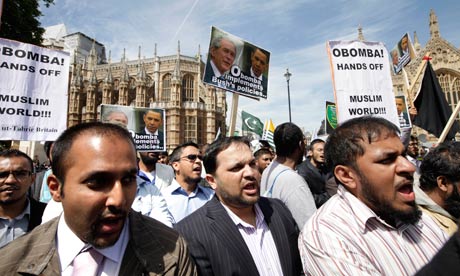
Photo above shows protesters from Hizb ut-Tahrir demonstrate during the recent visit by Barack Obama. The Prevent review has backed away from proscribing the group. Photograph: Lefteris Pitarakis/AP

Monday, 4 April 2011

NEW STATESMAN: WHO ARE THE ENGLISH?


This week's New Statesman is a special issue on Englishness in which we look at a nation in the grip of an identity crisis. Dominic Sandbrook provides a history of English radicalism, Mehdi Hassan disputes the claim that multiculturalism has failed, and Jon Cruddas argues that Labour must rediscover a politics of English virtue.

Sunday, 20 March 2011

I WANT TO BE MISS UNIVERSE. FOR THAT I GET DEATH THREATS


Interesting piece from  today's Observer. A surprising topic, perhaps, but it didn't take long to see that I should post it here. This one really comes out of left field - but I really like it when that happens. See how many equality and diversity issues are involved in this one, faithful reader.
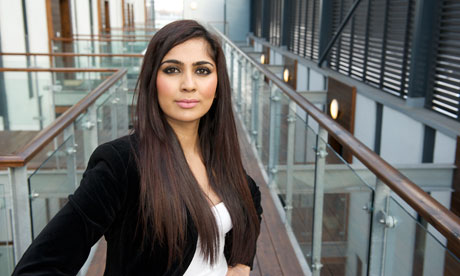
"I want to be Miss Universe. For that I get death threats"

Shanna Bukhari was subjected to a tide of online hate after entering the British heats of the beauty contest. Now she fears her life could be in danger

By Mark Townsend

When Shanna Bukhari decided she wanted to be the first Muslim to represent Britain in a global beauty pageant, she suspected the road ahead might not be smooth, but nothing could have prepared her for the abuse she received.

"I have felt in fear for my life," said the 24-year-old Miss Universe contestant. The attacks escalated last week when Bukhari received her first death threat.

The censure has come from various quarters, ranging from Muslims who claim that she is denigrating the name of Islam, to white supremacists who say that an Asian cannot represent the UK, and to women who condemn beauty pageants as an affront to feminism.

Bukhari, born in Blackburn, grew up in Lancashire and is no stranger to intolerance. When she was nine, she ended up in hospital after a man screaming racist abuse had thrown a brick at her, causing so much damage to her stomach that she suffered a blood clot and had to undergo surgery.

But even she has been surprised by the furore that her participation in the British heats of Miss Universe has prompted. Rather than confirming her hopes that society had progressed since her childhood, the controversy has made her question the state of multiculturalism in modern Britain. "It has highlighted the divisions that exist, a lack of social integration, a lack of adhesion between white and coloured people, and this needs to be addressed," she said. "I thought my participation might be something that people did not agree with, but I never thought I'd get abused."

The attacks on the Manchester-based English literature graduate began after a local newspaper ran an article 10 days ago revealing her ambition to become the first Muslim to represent Great Britain at the beauty contest. Since then, she has received around 300 messages a day on her Facebook page, a handful of which are abusive. Most of the negative comments have come from a minority of Muslim men. "I get people saying, 'you're not a Muslim' and 'you're using religion to get attention'. I said they were the ones bringing religion into it. I'm not representing Islam; I just want to represent my country, and of that I am very proud. They are trying to control me, using religion as a tool to attack."

Bukhari accuses her abusers of having the same sort of mindset as those who support "honour" killings and beat women. Many of the comments are, she says, from individuals who want sharia law instead of a liberal democracy. "We simply live in a multicultural society where there are significant numbers of Muslims. Islam is about peace; abusing me is itself wrong in Islam."

Away from the religious-themed criticism, Bukhari detects a broader anti-female resentment from men who combine sleaze with slurs. "Maybe it's because I'm a woman saying to other women 'stand up for yourself, don't let anyone dictate what you can do or can't'. Some men don't like that," she said.

But not all the abuse is from men: Bukhari has also attracted opprobrium from feminists. "I've had a few girls saying 'shame on you' or 'rot in hell'. But I'd like to know what their real issues are, so we could have a constructive debate."

The abuse that truly shocked Bukhari arrived last Tuesday in the form of an online racist rant. Within hours she had shut down her Facebook fan page, but a friend was then sent a number of internet links to images of people murdered for standing up for their principles. "She rang up and said, 'Shanna, you need to be very careful because he's trying to make me aware that things will happen'. Not a direct death threat perhaps, but he was trying to say that something is going to happen to me."

Bukhari takes the threat of physical violence seriously. She makes sure she is never alone, both in her Manchester flat and on the city streets, and has contacted a private security firm for protection when attending charity events to raise money for the Joshua Foundation, a charity for terminally ill children. She fears that Britain's Miss Universe finals in Birmingham in May will also be a target: "It worries me that haters will turn up. I know what they are capable of."

One Facebook message calls her a "dirty Muslim" and asks why she is representing Britain "when you don't even fucking belong here". Bukhari said: "I actually replied to him in a very calm manner because I'm not one to retaliate, my family taught me to rationalise rather than react. Then I thought 'why can't I represent Britain?' I was born here and am proud to be British. My parents are from Pakistan but I am not going to represent Pakistan as this is my country."

Bukhari says the abuse has been disillusioning partly because she enjoyed a liberal upbringing; her parents sent her to a Catholic school in Blackburn where she was the only Muslim but was "completely accepted". It was only when she moved to Manchester in 2001, she said, that she became aware of segregation as an issue. She does not agree with David Cameron's speech last month in which he asserted that state multiculturalism in Britain had failed. She believes that more must be done to break down mistrust.

Bukhari cites the thousands who have offered their backing. Support has come from Spain, the Middle East, Pakistan, India and China. Most women supporters say she represents not just a role model for Muslim women, but all those who refuse to be cowed by bullies.

During last month's semi-final for Britain's Miss Universe candidate Bukhari received the most public votes. Britain has never won the title. It is increasingly possible that its first victor might also be its first Muslim representative.

Monday, 14 March 2011

THE MULTICULTURALISM THAT THE EUROPEAN RIGHT FEARS SO MUCH IS A FICTION - IT NEVER EXISTED


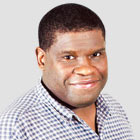
An excellent piece in today's edition of The Guardian by Gary Younge. Mind you, all Gary Younge's pieces in The Guardian are excellent, in my opinion.
The multiculturalism the European right fears so much is a fiction – it never existed

The state never backed cultural difference at the expense of cohesion. What is emerging is people's lived experience

On 12 March 1983 A Sivanandan, one of the sharpest minds on the British left, gave a talk at the Greater London Council Ethnic Minorities Unit Consultation on Challenging Racism. "I come as a heretic, as a disbeliever in the efficacy of ethnic policies and programmes to alter, by one iota, the monumental and endemic racism of this society. There is nothing wrong with multiracial or multicultural education as such … But [it] has become the vogue … Government monies for pluralist ploys – the development of a parallel power structure for black people, separate development, Bantustans – a strategy to keep race issues from contaminating class issues."

The left has long had a critique of multiculturalism. While Tories were still arguing for Nelson Mandela's imprisonment, there were progressive voices debating its inadequacies, limitations and potential. The notion that those who attack it today, in Britain or elsewhere, are slaughtering a holy cow is laughable.

But Sivanandan was contesting something definite, whereas the target of the more recent onslaught is vague. Over the last decade multiculturalism, like political correctness, has come to mean whatever its opponents want it to, so long as they don't like it. Usually, the policies and dilemmas referred to are difficult to fathom or entirely invented. Ill-defined, the term is much-maligned – a lightning rod for the majoritarian impulses, cultural anxieties, economic insecurities and nationalist mythologies of the 21st century. Its contemporary critics keep telling multiculturalism's supporters to admit it has failed, without identifying what "it" is and who ever supported the lampooned version they present.

In this debate there are two types of multiculturalism: one rooted in fact, the other in fiction. The multiculturalism of fact is the lived experience of most people in Europe and the world. Cultures are dynamic, and emerge organically from communities. None exist in isolation or remain static. So the presence of a range of cultures in Britain or anywhere else is not novel, but the norm.

This is not the product of our genius for tolerance as a nation but of constant negotiation. Take the Notting Hill carnival. It emerged as a response to racist attacks after teddy boys went on a "nigger hunting" spree in 1958. Today it is a mainstay of British culture, but it was once viewed as inimical to British culture. "Many observers warned from the outset that mass immigration from poor countries of substantially different culture would generate anomie, alienation, delinquency and worse," argued the Daily Telegraph in 1977.

Its survival has little to do with government policy. Governments can barely clear snow or make the trains run on time. They cannot single-handedly create or thwart culture, let alone multicultures. The French have staked their founding revolutionary creed against the notion of multiculturalism. They are losing. Like it or not – and the state doesn't – it's a multicultural country.

Germany insisted for two generations that it was not an "immigrant country": that didn't mean there were no immigrants there. Not recognising something does not mean that thing does not exist. It merely means you don't see it.

Moreover, these multicultural facts have nothing to do with race, religion or immigration. The Bretons in France, Basques in Spain, Bavarians in Germany and Sicilians in Italy are a few examples of cultural affiliations that thrive independently of the nations they inhabit.

This is the multiculturalism many of us on the left, including Sivanandan, are defending. The right to assert autonomy and cultural difference underpinned by an understanding that national identity is just one among many identities and may well not be the primary one: an affirmation of plurality against calls for assimilation that attempt to first invent and then enforce "British values" and other national orthodoxies.

Then there is the multiculturalism of fiction. This evokes a liberal, state-led policy of encouraging and supporting cultural difference at the expense of national cohesion. It champions practices, we are told, that have caused segregation, alienation and ghettoisation of racial and religious minorities. This, the argument continues, has laid the basis for an acceptance of abhorrent and barbaric practices, such as honour killings, forced marriages and female genital mutilation, that sacrifice the basic tenets of western, liberal civilisation and universalism at the altar cultural tolerance.

There are several problems with this framing but for now let us just deal with three. First, in most of Europe no such co-ordinated policies ever existed. In many places where "multiculturalism" is currently being read its last rites, it never actually lived in its professed form. "We never had a policy of multiculturalism," explains Mekonnen Mesghena, head of migration and intercultural management at the Heinrich Böll Foundation, responding to Angela Merkel's claim that the "multikulti" experiment had failed. "We had a policy of denial: denial of immigration and of diversity. Now it's like we are waking up from a long trance."

In Britain, it is similarly difficult to discern precisely what critics are referring to beyond the activities of some local councils. In his most recent speech on the subject, David Cameron did not offer one concrete example.

Second, the trend towards segregation is a myth. Asian Muslims, Sikhs and Hindus all marry outside of their own groups at the same rates as whites. For most ethnic minorities in Britain, roughly half or more of their friends are white while only 20% of those born in Britain have friends only from their own group. So even if the state were promoting separation, it clearly isn't working.

Finally, who, with any credibility, on the left has ever supported the crimes described? Like "on-street grooming", "black-on-black violence" or the "down-low", such practices are specifically ethnic, racial or religious terms employed to pathologise a specific community in which every transgression is refracted through an ethnic or religious lens. Imagine we invented a term "toff bonking" to describe the infidelities of the upper classes, and then decried the epidemic every time Boris Johnson was caught in an indiscretion.

That doesn't seek to understate these problems but to recast them. Forced marriages are kidnapping; honour killings are murder. We have laws for these that should be applied without fear or favour. I've yet to hear anyone on the left argue otherwise.

These ostensible liberal dilemmas seek to pit opposition to Islamophobia against support for liberalism as though they are mutually exclusive. But in reality they pose no challenge at all. You don't give antisemitism a pass if it comes from a Muslim any more than one would give Islamophobia a pass if it came from a Jew. If a state forces women to wear a burqa, we should oppose that. And if the state bans women from wearing a burqa, we should oppose that too. Because as feminists and progressives we believe the state has no right to tell women what to wear.

That does not mean there are no problems. But it distorts the reality and misstates the true nature of the threat to national cohesion, which comes not from a fictitious multiculturalism but from the very real economic vandalism wrought by this coalition government. The decimation of public services will reduce the common space – be it schools or community centres – that we all might share, while growing inequalities will provide greater opportunity for scapegoating minorities.

The multiculturalism of fact is rooted in considerable achievements of who we have become. The multiculturalism of fiction is rooted in the fear of what has never been.

Read this article on The Guardian website, along with reader comments:
http://www.guardian.co.uk/commentisfree/2011/mar/14/multiculturalism-fears-fiction-europe-state

Wednesday, 9 March 2011

EDUCATION ABOUT BELIEFS "VITAL" FOR A PLURAL SOCIETY


Here's a news release distributed today by Ekklesia (a thinktank which examines the role of religion in public life) contributing to the debate about multiculuralism following the Prime Minister's recent high profile speech on that subject. I've put this in the blog not only for its general interst, but also specifically because of Leicester Council of Faiths' involvement with formal education at different levels (e.g. SACRE) and with adult training in a variety of settings (I don't think that the kind of education discussed in this article begins and ends with formal school, college or university based teaching and learning). The notes at the end of the press release are also from Ekklesia.
Education about beliefs "vital" for a plural society


A senior educationist has said that good quality teaching about the religions and beliefs is vital for the development of shared understandings and positive citizenship practices in a plural society.


Writing for the beliefs and values thinktank Ekklesia, Robert Jackson, who is Professor of Education at the University of Warwick and Director of Warwick Religions and Education Research Unit, says that "peaceful coexistence depends on knowledge about each other's religions and worldviews and sharing common interests as well as doing things together."


He was responding to the debate about 'multiculturalism' sparked last month by the Prime Minister.


David Cameron needs to give more attention to the views of young people, to the positive contribution religions and cultures can make to the community, and to the need for "an intellectually challenging forum in the school" on belief issues "taught by well-trained teachers", says Professor Jackson.


Referring to the findings of the European Commission Project on Religion, Education, Dialogue and Conflict (REDCo) among 14-16 year olds across eight countries, Professor Jackson points out that "students who learn about religious diversity in school are more willing to have conversations about religions/beliefs with students of other backgrounds than those who do not."


The research shows that pupils "do not want to be told what to believe... [but] they want teachers to combine expertise in the study of religions and social and cultural issues with expertise as facilitators of discussion and exchange," he explains.


Both the Council of Europe and the Organisation for Security and Cooperation in Europe (OSCE) have called for teaching about religions and beliefs as a fundamental part of promoting inter-cultural understanding.


But Professor Jackson says that the government is not demonstrating serious intent in this area. Teacher training numbers for religious education have been reduced by 50 per cent for 2012, training courses are closing, and RE is not being considered as an exam subject in relation to the proposed English baccalaureate - downgrading the intellectual rigour required.


Simon Barrow, co-director of Ekklesia, commented: "Literacy in the religious and non-religious worldviews shaping our world, and influencing the relations between people and culture, is crucial to promoting peaceful co-existence in a mixed society - not least among the young. Bigotry and violent extremism breed on isolation and ignorance."


He added: "Tub-thumping about 'British values' is not the way forward. We need practical steps to ensure that a dialogical, critical approach to religion and belief becomes a properly resourced and scrutinised part of the national curriculum - as educationists from a variety of backgrounds have been arguing for some time."


Founded in 2001, Ekklesia examines politics, values and beliefs in a changing world, from a Christian perspective. It has been listed by The Independent newspaper among 20 influential UK think-tanks. According to Alexa / Amazon, it has one of the most-visited religion and politics / current affairs websites in Britain. More: http://r20.rs6.net/tn.jsp?llr=y7uzgobab&et=1104765833544&s=16026&e=0015xfifYu_WkMeZbBODmJFT8mVoNcIwcmMLQK0gjkjgbw_JnQ4dgrbnqQLU2InzxuzdfaqYA3y3L6eGxgCzCfSkDYqzkYKum35yu4nZswfd-ydD-N58t742eBwLTPLOnCgMFeagq_tlS82T_UoEpyr4w==


Professor Robert Jackson's article, Cameron, 'multiculturalism' and education about religions and beliefs can be found at http://r20.rs6.net/tn.jsp?llr=y7uzgobab&et=1104765833544&s=16026&e=0015xfifYu_WkNkrrxbBP1SuLSsA21P4ErdwYfeDGbSv0n2uzePpqBPuJrB-_kmQf0u4Ry5Zla9ESwQxak9kr8lU_prS1D3_O6BD_35F0BvfHVdCvKDGD-6Xhks6eXHFFiuo9qYAiv_mJ4=


Robert Jackson is Professor of Education at the University of Warwick and Director of Warwick Religions and Education Research Unit. He is also Professor of Religious Diversity and Education at the Council of Europe-related European Wergeland Centre, based in Oslo, concerned with human rights, citizenship and intercultural education across Europe. He led the Warwick team involved in the REDCo Project.