Further to my blog entry yesterday about the Office for National Statistics consultation on developing indicators to measure national well-being, there's a good piece in today's edition of The Guardian that I enjoyed reading. Visit the paper's website and read Suzanne Moore's article entitled "More stuff does not make us happier. Doing stuff, especially for others, does" along with reader comments: http://www.guardian.co.uk/commentisfree/2011/apr/16/suzanne-moore-action-for-happiness?INTCMP=SRCH
In her article, Suzanne Moore refers to Action for Happiness. The Guardian covered its launch with an article on 12 April by Alexandra Topping. You can read "Action for Happiness movement launches with free hugs and love" (along with reader comments) here: http://www.guardian.co.uk/society/2011/apr/12/action-for-happiness-london-launch?INTCMP=SRCH
Showing posts with label Office of National Statistics. Show all posts
Showing posts with label Office of National Statistics. Show all posts
Saturday, 16 April 2011


Friday, 15 April 2011
How are you feeling, Britain?
One of the regular tasks that falls upon the Core Partners of the Regional Equality and Diversity Partnership (REDP) - of which Leicester Council of Faiths is one - is to read and respond to consultation documents, papers and proposals from various agencies and organisations that impact upon areas of equality and diversity.More often than not, these are produced by this department or that within national - local (within the East Midlands) or national .
I've just made such a response on behalf of REDP to the consultation run by the Office for National Statistics on developing indicators for Measuring National Well-Being. The consultation period has been running since November and closed today. But the website remains live, so you can check it out for yourself if you wish, faithful reader.
I've just made such a response on behalf of REDP to the consultation run by the Office for National Statistics on developing indicators for Measuring National Well-Being. The consultation period has been running since November and closed today. But the website remains live, so you can check it out for yourself if you wish, faithful reader.
Saturday, 12 March 2011
A quick tally of census concerns
There are a number of letters in The Guardian today that inform some of the things I've been putting in the blog about the Census. Here are the two I consider most relevant - all the more interesting because of their apparently contradictory nature:
***
In your article (Will it be the return of the Jedi?, G2, 10 March), I want to clarify a point on confidentiality. No personal census information has been or will be provided to EU member states or EU institutions - only statistical tables and counts. No approved researchers will be able to see names or addresses or anything that might identify any person. A recently published independent review of census data security says: "The public can be assured that the information they provide to the 2011 Census will be well protected and securely managed." The Office of National Statistics takes the security and confidentiality of personal census information extremely seriously.
Glen Watson
Census director, 2011 Census, ONS
***
The cost of the Census is estimated at £482m and the US company, Lockheed Martin, is being given £150m to run it. All American companies are subject to the Patriot Act, which allows the government to have access to all data held. This could mean that the US government could hold access to all the detailed, personal data on any of us who complete their forms. This should be of great concern to us all.
Ann Bellingham
Newbridge, Cornwall
Thursday, 10 March 2011
DO WE ACTUALLY NEED A CENSUS?
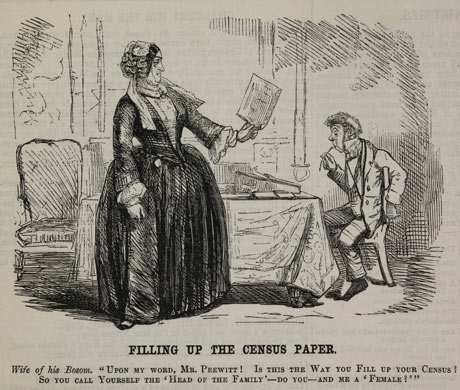
Here's one of the best all-round articles on the Census I've seen, written by Jon Henley and published in the G2 section of today's Guardian.
Two hundred and 10 years ago today, pursuant (as we once said) to a groundbreaking "act for taking an account of the population of Great Britain, and the increase or diminution thereof", a small army of town clerks, wealthy householders, overseers of the poor, schoolteachers and clergymen set off with sharpened pencils and forms to undertake, parish by parish, this country's first national census.
It was a rudimentary affair, prompted largely by a desire to settle a burning 18th-century debate over whether the population was expanding or contracting (in 1798, Thomas Malthus shocked the nation by suggesting that "the power of population is greater than the power in the earth to produce subsistence for man" – in other words, we might starve – and a string of poor harvests had underlined the point). But, it was also conceded, if the exercise was repeated every 10 years, then the information might conceivably be useful for legislative purposes too. So out went the officials to count the number of houses in their parish; the number of families who occupied them; the number of people and their employment; and the numbers of baptisms, burials and marriages. A government statistician called John Rickman crunched the data and laid it before parliament: the population of England and Wales was all of 8.87m, plus half a million-odd soldiers, seamen and convicts not present for counting.
This month, we will be asked to fill in the form for Britain's 21st national census. It will also very likely be its last. At £482m, the whole operation – performed every decade since 1801 with one exception, the wartime year of 1941 – is expensive, inaccurate and inefficient.
That, at least, is the government's view: Francis Maude, the Cabinet Office minister, is looking for "ways of doing this which will provide better, quicker information, more frequently and cheaper". The census, he complains, is "out of date almost before it's done"; data held by the likes of the NHS, councils, Royal Mail, the electoral register, tax returns and even credit card firms and phone companies can do the job.
It is a view disputed by those who use the data the census provides. But it warms the heart of the many who – on any number of grounds – resent it, as many always have. In one early and unsuccessful debate in 1753, the MP for York asserted that a census would "impair the liberty of the individual", describing it as a "most effectual engine of rapacity and repression". (Some apparently also feared a census might incur the wrath of God, as happened when King David foolishly ordered a census of the Israelites and 70,000 died in the ensuing plague.)
Mostly, however, says Ian Cooke, curator for political studies at the British Library, which is currently staging an intriguing exhibition on the history of the census, early opposition tended to focus on "fears about the government using the figures to direct labour, and the consequences of Britain's enemies finding out exactly what the country's population was". Fears, in other words, about how the authorities might try to use the data, and about what would happen should it fall into the wrong hands: about privacy, and security.A couple of centuries on, those remain among the principal objections. "This is information the government does not need, cannot protect and should not collect," says Guy Herbert, general secretary of NO2ID, which, having seen off the national identity card, now campaigns energetically against what it sees as the broader evils of the "database state".
Few would dispute that the census has grown into something of a monster: from a single foolscap sheet, it has become a 32-page booklet with four pages of questions for every person. Among other things, it wants to know what type of central heating we have, how many bedrooms we have got, who is staying over on the night of 27 March (plus their age, sex and where they usually live), how well we speak English, and what our employer's address is.
Census data, argues the Office of National Statistics, is vital to decisions including central funding for the devolved and local authorities; policy development and planning by some 40,000 government and government-related bodies, at all levels, in key fields such as housing, transport, education and health; and for an enormous amount of social research, corporate strategy and charity campaigning. The census remains, it adds, the "most extensive source of demographic and social statistics available in the UK today", unique in both detail and consistency because it aims to cover every person usually resident in the country on a single night.
Herbert begs to differ. "The motives may be beneficent, but the effects are maleficent," he says. "Information on people is power over them. If Tesco finds out I like cheese, the worst it can do is send me a few special offer vouchers. The government can use information to enforce or 'nudge' my behaviour." He points to the steadily evolving role of, for example, the DVLA in collecting, distributing (even selling) vehicle and driver data to councils and private companies as evidence of "a growing government obsession" with information-sharing.
Data security is his other major worry. "I have no objection to a simple statistical abstract," he says, "although there are far cheaper ways of getting it: if, during the last election, both major political parties could buy off-the-peg computer programmes to identify potential voters with great accuracy, why a census like this?
"But because of computer technology, vast amounts of information are now being collected that can be processed and referenced in ways that simply weren't possible before. Census data is supposed to be confidential for 100 years, but the law already allows it to be shared with all 27 EU member states, public bodies and approved researchers – and there's no guarantee that some bright spark in Whitehall won't want to use some subset of data for something even more intrusive. While the data is there, the temptation will be too."
Alex Deane of Big Brother Watch makes broadly similar points. "No other free country requires this degree of detail," he says. "It's a real intrusion of the state where it doesn't belong. There is a need for a simple headcount, yes, of course. But this goes way beyond that'"
Objections to the census do not stop there. Many point out the exercise is not particularly reliable: besides the undeniable fact that many people's situations will have changed long before the findings are published, last time around, in 2001, the census managed to miss 900,000 men under 40. Beyond the perfectly plausible explanation that they were simply down the pub or round at their girlfriend's, no one seems to quite know how this happened, but the incident was serious enough to prompt councils, including Manchester and Westminster, to take legal action over the consequences of such a big discrepancy between census data and their own figures, and is in large part responsible for this year's question about overnight visitors.
Famously, the 2001 census – the first to ask a question, albeit voluntary, about religious belief – also recorded that 390,000 British residents were Jedi knights. This followed an internet campaign that claimed the Star Wars belief system would win official recognition if only enough people said they adhered to it. It wasn't, sadly, the case, but for the time being at least, Jedi is Britain's fourth-largest religion.
(Perhaps surprisingly, there is little evidence that we are more than usually dishonest in filling out our census forms. Facetious, certainly: in 1911, one man gave "Peter Tabby" as an occupant of his house and listed his nationality as "Persian" and his occupation as "mouser"; in 1851, another described herself as a "mangle worker" and her husband's job as "turning my mangle". More often, despite the threat of a £1,000 fine for not completing the census form, we simply don't bother: an estimated 3 million people didn't last time.)
The religion question has sparked controversy again this year. The British Humanist Assocation, for one, objects strongly to its wording: although there is a "No religion" option alongside boxes for the major faiths, it argues that the question "What is your religion?" encourages people to answer in terms of whatever loose cultural affiliation they may feel, rather than actual belief. "The effect is to artificially increase the number of religious people in Britain, and decrease the number of non-religious," says Andrew Copson, the BHA's chief executive. In 2001, 77% of us said we were religious – and more than 70% of us Christian – whereas it is plain from, for example, the British Social Attitudes survey that more than 50% of us consider ourselves non-religious, and more than 60% of us never attend religious services.
"It's important because those figures are then used to justify, for example, an increase in the number of faith schools, keeping bishops in the House of Lords and other policies that are damaging, divisive and don't reflect the real demographics of British society," says Copson.
The BHA is urging everyone who isn't religious to tick the "No religion" box. The Pagan Federation is also up in arms, insisting druids, wiccans, witches and other pagans constitute a serious and growing religious group, maybe 250,000 strong, and deserve proper recognition. A Facebook campaign to get heavy metal admitted as a religion has garnered nearly 35,000 supporters.The census's question on ethnicity, also long avoided as too sensitive, is another bone of contention. The Sikh Federation last year threatened legal action against the ONS's continued refusal to include Sikh – an option in the religion question –as a printed option in the ethnicity question. The ONS says this is for reasons of space, and points out that anyone who feels their ethnicity is not reflected in the choices available on the form can state it in a box provided.But the Sikh community argues it has been recognised as an individual race under British law, and fears scarce government resources risk being unfairly allocated. Some Jews have also made a similar argument ("Jew" is not an ethnicity option either), and the Board of Deputies acknowledges the census probably underestimates the number of Jews in Britain (partly because of a historic reluctance to reveal such information to the authorities). Some academics also fear results from the ethnicity question may in future be unfairly used in the immigration and nationalism debates, along the lines of "Look: half of British Pakistanis consider themselves Pakistani rather than British."A battle also seems to be brewing over the role of the US arms manufacturer Lockheed Martin is gathering and processing the data for this year's census. A coalition of anti-war groups, pacifists and digital activists has already said its members are ready to face the £1,000 fine for boycotting the census over the involvement – on a £150m contract – of the arms giant that makes Trident nuclear missiles, F-16 fighter jets and cluster bombs.All these disputes, however, look set to pale into insignificance beside the big question of whether – as the government seems determined will happen – the 210-year-old census really should come to an end following this year's exercise. For academics such as David Voas, Simon professor of population studies at the University of Manchester, the decennial census is not only a useful and important tool, but very difficult to replace. Many objections to the census, he contends, are more or less groundless. Intrusiveness? "The information held by many credit card companies is far more detailed," he says. And the ONS does "a very good job" of resisting pressure for ever more questions. Although most other national censuses, including the US's, include income bands with tick-boxes in their forms, Britain decided not to "because it was deemed too sensitive. It was feared people would not answer."
The confidentiality issue is largely a red herring, says Voas. "This is probably the most secure of any data set around. The lengths the ONS go to preserve anonymity and confidentiality are remarkable, to the extent of undercutting the value of the data. The principle is that no one should be able to point to a number on a table and say: 'That's me'. An absurd example, but if there was just one middle-aged man in Derbyshire, he shouldn't be able to identify himself on any census table – even by combining it with data from other sources. Small numbers are fudged, white noise inserted."
Voas regrets an "increasing suspicion" of public data-gathering, which he says is both misplaced and unfortunate, because "this is one really important exercise that decides how a great many services are provided . . . It has real, practical utility." The historic continuity and consistency of census data is also priceless, he adds.
What, then, might replace it? "We're a little bemused in the demographic community," he says. "While it's possible, maybe even desirable, to move towards some kind of population register and a periodic count, we'd always assumed a system like that would be based on something like a national ID card scheme. Now that's been done away with, how could it work?"
The problem, he says, is that big and unwieldy and far-reaching as the census may be, "It is a single, highly controllable exercise. If you try to pull that same information from all the other data sets out there – GPs, NI, credit card records, commercial databases, local authorities – there's going to be an awful lot of duplication, an awful lot of incompleteness. How do you marry these data sets? How can you be sure different records refer to the same people? It's very hard to believe that either accuracy or security will be anything like as good. And even if you concede that on a national level you may arrive at information that's more or less adequate – on ethnicity for example – at a local level it will be an absolute, unmitigated disaster."
Wednesday, 6 October 2010
the next (and final?) Census

Khudeja has been commissioned to find ways of improving the response of the Indian community in Leicester and Leicestershire to the Census when it comes round again. In 2001, this community was one which didn't participate in the Census to its fullest extent (so much so that I've heard it said that one segment within the Indian community in the city might be as much as twice the size recorded in the Census).
For the Council of Faiths in general - and for my post in particular - accurate, up-to-date information about the size, distribution and status of faith communities is essential for many reasons that I'm sure need no explanation.
As well as helping find ways for the Indian community to participate in the Census, we can find other ways for it to have a positive impact locally. The Census has created 35,000 temporary jobs nationally. There was an under-representation among those who filled these posts in 2001 of Indian people, so Khudeja wants to find ways to encourage the Indian community to apply for some of these. So we're looking for ways to publicise the importance of the Census and the availability of these jobs that come with it. Khudeja is interested in getting the chance to speak to our members, as well as organising such activities as "Completion Events" (for those who might be having difficulties filling out their Census forms) in places of worship and community centres for a week or so after the date of the Census.
I provide Khudeja with some contacts, including: Highcross; Oadby & Wigston Hindu Community; Oadby & Wigston Muslim Association; Wesley Hall. What she'd really like is a public endorsement from Leicester Council of Faiths, which would look good in the Mercury with a photograph featuring a Hindu, Muslim and Sikh face. Sounds like the kind of thing we'd be glad to arrange - but after 9 October, as much of our normal work is pretty much on hold till then!
Khudeja is featured on "Faces of the Census":
http://2011mc.census.gov.uk/Faces_of_the_Census.pdf
Subscribe to:
Posts (Atom)