Showing posts with label Guardian. Show all posts

Wednesday, 4 July 2012

PHILOSOPHY IN PUBS, JULY 2012


Leicester PIPs (Philosophy in Pubs) meets on the first Wednesday of the month, upstairs in the Crumblin' Cookie on the High Street. There’s a dozen of us around the table and our stimulus this evening is an article from The Guardian blog by Jon Henley, reproduced below.

Mount Everest: the ethical dilemma facing climbers
Since the first recorded deaths on Everest in 1922, 233 people have lost their lives trying to reach (and return from) the summit of the earth's highest peak. As expedition organisers' experience has grown and equipment improved, the ratio of fatalities to success has fallen. But the sheer numbers of people now climbing Everest – more reached the summit on a single day in 2010 than in the 30 years after the first 1953 ascent – means 70 deaths have occurred since 2000 – including 10 this year.
The deadliest situations occur when large numbers of climbers, all relying on the same forecasts, decide to take advantage of a weather window to make their summit bid at once. This can quickly lead to dangerous, oxygen-wasting bottlenecks of two hours and more, particularly on the more popular southern approach pioneered by Edmund Hillary and Tenzing Norgay in 1953, which follows a single rope line over almost 10km to the summit.
That is what happened when Leanna Shuttleworth, 19, and her father Mark headed for the 29,035ft summit on May 19-20. Up to 200 others had the same idea; six of them lost their lives. "There were quite a few bodies attached to the fixed lines and we had to walk round them", Shuttleworth said later. "There were also a couple who were still alive." Shuttleworth describes coming across one man who she assumed had perished. "As we passed he raised his arm and looked at us," she said. "He didn't know anyone was there. He was almost dead. He was dead when we came back down." Their sherpa did manage to help one of the people they found who was still alive.
The debate around ethics on Everest has raged since 2006, when an estimated 40 climbers passed a dying British mountaineer, David Sharp, without stopping. A week later a US climber, Don Mazur, and his team gave up their own summit bid to co-ordinate the rescue of an abandoned Australian, Lincoln Hall. He survived. On the weekend the Shuttleworths reached the summit, an Israeli climber, Nadav Ben Yehuda, carried a Turkish-born American climber, Aydin Irmak, to safety on his back for eight hours. So should the Shuttleworths have stopped and tried to help? There are no formal guidelines issued to climbers, and we don't know the risk it might have meant for their own lives. But can it ever be right, in the words of mountain leaders Chris and Simon Holloway, for climbers to "carry on to the summit, while there are living people dying behind them"? Ben Yehuda, a former soldier, described his decision to stop as "automatic". For others, it plainly isn't. In an era when climbing Everest has become a form of extreme tourism open to anyone with $10,000, has human life come to count for less than the fulfillment of a personal ambition?

Friday, 28 October 2011

I COULD IMAGINE JESUS BEING BORN IN THE CAMP


When I say to Clare this morning that the Guardian has the strangest and most unexpected headline, she replies, "What, the strangest and most unexpected headline - ever?" I feel I the only reply to that is, "Yes!"

Read the article, "Giles Fraser resignation: 'I couldn't face Dale Farm on the steps of St Paul's'".

Saturday, 22 October 2011

KANDINSKY IN GOVAN


Alastair McIntosh's Face to faith column from today's Guardian:


A century ago this month, Wassily Kandinsky finished a little book called Concerning the Spiritual in Art. Today in Govan, a hard-pressed part of Glasgow, we are celebrating the Russian artist's ideas in a conference on art, spirituality and the future.

What was Kandinsky then, and why is it as relevant as ever today? 

Born in 1866 and living until 1944, Kandinsky grew up in a Russia where the consequences of modernity and nihilistic thought were hotly debated. 

The old certainties of state, church and the soul in the human condition were in turmoil. At the same time, there was excited hope of a spiritual renaissance led by the influx of new ideas from the east. As Kandinsky said: "The nightmare of materialism, which has turned the life of the universe into an evil, useless game, is not yet past; it holds the awakening soul still in its grip." 

As if in anticipation of some of today's Britart, he deplored art that "becomes the satisfaction of vanity and greed … a scramble for good things … of excessive competition, of over-production … this aimless, materialist art". 

He denounced the narcissistic wallow of "art for art's sake" – "this neglect of inner meanings … this vain squandering of artistic power" with its consequence that "hungry souls go hungry away". 

Instead, he urged, art must "feed the spirit" by revealing "the internal truth of art, the soul". This is its prophetic calling in serving society. The artist must "be priest of beauty". Beauty itself is that "which springs from the soul", being anchored in the sacred. 

It was Kandinsky's friend Paul Klee who said that "art does not render the visible; it renders visible". But how? 

Kandinsky's answer was through abstraction. Here I find myself more critical of him. The role of the artist, he suggested, is to separate out the spiritual from the material. Art should be an "advance into the kingdom of the abstract". 

We see this in the geometric abstraction of his later work. Largely gone are the scintillating salsas of dancing colour that made his earlier paintings so magical. 

We might ask: can the spiritual be abstracted from the material? Kandinsky, to his enduring credit, affirms the spiritual on the artistic map, but did he, at the same time, lose the plot by going too far down the road of abstraction? 

Can the incarnate – the infusion of spirit and matter – really be rendered disincarnate? Or has the time come to move towards a new spiritual realism – to art that can represent the outer world (and be able to paint and draw!), but which simultaneously reveals its interiority, its spirituality? 

But why does this matter? There is a local saying that if you throw a stone over a wall in Govan you'll hit an artist. 

The most vulnerable to suffering and with it, to evasions like addiction, are often the sensitive souls, the canaries down the toxic coalmines of our society. 

Such people need art – not pretentious elite art that is up its own backside – but art that recovers meaning, that calls back the soul. 

When I ask hard-pressed folks what they want of art I don't hear calls for the likes of Damien Hirst's For the Love of God with 8,601 diamonds glued to a human skull as "bling on bone". 

I hear people yearning for what Kandinsky saw as prophetic art. Art that reveals hope. Art that breathes the flow of life into the veins.


Alastair McIntosh (photo above) is a Quaker, writer and curator of Kandinsky in Govan.

Talk about bad timing, faithful reader! I have long loved Kandinsky and I used to live in Govan (it’s my ancestral homeland, if you like – as well as being the first place I lived in as a married man). I just came back from a week in Glasgow yesterday! I hadn't heard of this conference, nor had I heard of Govan Folk University, which is hosting it. Might have been a bit hard to persuad Harry (11) and Grace (9) to tag along though.

Saturday, 15 October 2011

SUKKOT INVITES US TO THINK OF THOSE FOR WHOM TRANSIENT LIVING IS IS THE NORM

This is Howard Cooper's Face to faith column in today's Guardian:


Sukkot invites us to think of those for whom transient living is the norm
Inviting guests into one's home is a habitual part of Jewish social living that receives a special emphasis at this time of year 
How much insecurity can you bear in your life? How much awareness of the randomness, the sheer contingency and unpredictability of life? How much do we want to be reminded of the fragility of our bodies, our minds, our social structures, the innate vulnerability grafted into the carefully constructed fabric of our daily lives? 
Religious traditions can seem to offer some respite from the unsettling reality of inhabiting bodies that gradually fail us, and societies where our sense of wellbeing is dependent on social, political and financial forces outside any individual's control. Religions attempt to create a meaningful world for believers to inhabit. They seek to keep existential terror at bay – the terrifying fear that life has no inherent meaning; that it is, in Thomas Hobbes's words, "solitary, poor, nasty, brutish and short"; and that we avoid this fate more by luck than our own good judgment. 
The week-long Jewish festival of Sukkot (Tabernacles), which started this week, offers a plangent perspective on the questions that surround the personal and collective need for security, and our fragmentary awareness that genuine security may not be achieved through attachment to the material world. The central symbol – the temporary shelter, the sukkah, constructed next to one's home, where one eats and sometimes sleeps for the duration of the festival – is an antidote to religious certainty. 
Made of organic materials, branches and leaves, its roof must be such that one can see through to the stars at night: as one looks up, and out, there is a dawning realisation of the impermanence of all we build and hold dear. We recall the origin of these "booths" in the mythic narrative of the Israelites' 40-year journey through the wilderness towards a distant "promised land". The biblical story describes the temporary homes the people built – sometimes for months, sometimes for years – and their education into the reality of following the peripatetic divine force that always moved on them in ways they could never predict or control. 
This annual festival is a reminder that permanence and certainty are antithetical to a spiritual sensibility. The great German-Jewish philosopher Franz Rosenzweig, scribbling a new theology on postcards in first world war trenches, saw the festival of Sukkot symbolising something vital for his diasporic people and something with a universal resonance: it "serves to remind the people that no matter how solid the house of today may seem, it is but a tent which permits only a pause in the long wanderings through the wilderness of centuries". 
In sensitising us to our transience, the festival invites us to think of those for whom transient living is the norm, not merely an annual religious ritual. The invitation of guests, strangers, "outsiders", into one's home is a habitual part of Jewish social living that receives a special emphasis at this time of the year. Hospitality as an everyday virtue takes on a deeper religious significance. My own synagogue is making itself available this winter, along with local churches, as a host venue for Homeless Action in Barnet, offering a cooked meal, a warm place to sleep, washing and toilet facilities, fresh clothes, conversation and breakfast for the area's homeless. 
Our guests will help us understand what George Steiner has called "an arduous truth" that emerges from the mystery of Jewish resilience – "that human beings must learn to be each other's guests on this small planet".

Howard Cooper is a rabbi and psychotherapist, and the author of The Alphabet of Paradiser: An A-Z of Spirituality for Everyday Life


Saturday, 3 September 2011

Tuesday, 9 August 2011

Civil Contingencies Act 2004

This is a link to an article of clear interest to all those concerned with issues related to equality and human rights in the current climate. This comes from "liberty central", the Guardian's Comment is free civil liberties and human rights site

A-Z of legislation: Civil Contingencies Act 2004 | Comment is free | guardian.co.uk

Saturday, 6 August 2011

Europe needs a grassroots movement to tackle the threat of Islamophobia

This is the Face to Faith column from today's Guardian (published online on the Comment is Free: Belief website). It is written by Donald Reeves, founder of the Soul of Europe and author of The Memoirs of a Very Dangerous Man.
Europe needs a grassroots movement to tackle the threat of Islamophobia
We must expose the racist ideology drawn from nazism, in which Muslims have become the new Jews of Europe
Following the events of 22 July in Norway - when Anders Behring Brevik, driven by hatred of Islam, killed 77 people - there have been ample expressions of outrage, analysis and commentary, but little  indication as to what must be done to prevent Islamophobia spreading.
Before 22 July, the Soul of Europe, together with the Soest Forum of Religions and Cultures (a German Muslim archive institute), had begun planning how to interrupt, undermine and dismantle Islamophobia. Beginning in France, Germany, UK and Scandinavia, we are establishing a coalition across Europe of institutions and organisations which are already engaged with Muslim communities. Our aim is to deepen, broaden and strengthen the foundations of those bridges between Muslim and non-Muslims, particularly among the younger generations – above all in practical ways.
One way is to develop patterns of solidarity. For instance: when a religious building is vandalised, whether a mosque or a church or a synagogue, communities will come together to condemn these actions. For condemnation to be effective, more than words are needed. Much depends on the slow, patient building of relationships.
Another way is for local communities to speak up on behalf of others, not least when Muslim communities complain of intimidation and harassment by police. These interventions emerge from relationships that have been established over time. Local politicians and religious leaders – vicars, imams and rabbis – will have to watch their backs. These actions will be seen as divisive among their own constituencies and congregations.
As Marwan Muhammad, director of the Collective Against Islamophobia in France, told the Soul of Europe: "We are scapegoats and are blamed for all of Europe's problems." Muslim communities need to be invited in from the cold. There should be no "them" and "us". We are all "us". Umar Mirza set up the Dutch website We're Here to Stay as "an attempt to create an alternative space … a way of providing a stage upon which the voices of young Muslims can be heard". Dutch Muslims are not going anywhere. The Netherlands is their country, their home.
From among the many different European Muslim communities there are those who are saying: "Enough. We have had enough of discrimination, of being crudely stereotyped, of being scapegoats – of being victims." These men and women are not "extremists". In a debate on Britishness set up by the London-based Young Muslim Voices, a definition was agreed: a cosmopolitan country where people are respectful of different faiths and backgrounds.
Expressions of outrage are no longer enough. There needs to be a grassroots movement across Europe to stand up to those who peddle bogus religious justifications, resurrecting memories of the Crusades; to expose the racist ideology drawn from nazism, in which Muslims have now become the new Jews of Europe; and to tackle the myth of "Islamification" and those who claim to be defending western civilisation, Christian and secular, from conquest by Muslim immigration and the spread of sharia law.
Interreligious dialogue is just one of the links between different religions and religious communities. At a conference I recently attended, a speaker described interreligious dialogue as taking place on the top floor of a high-rise building while on the ground floor a fire was raging out of control. So it is time for those of us who cherish dialogue of every sort to join those who are trying to put the fire out.

Thursday, 4 August 2011

Ramadan: a guide for the perplexed

Here's a nice piece from today's Guardian G2 section, published online in the Comment is free: Belief website.
Ramadan: a guide for the perplexed
I'm fasting for Ramadan. It might be a good time to lay to rest some common myths about the whole business
By Mehdi Hasan
I crawled out of bed this morning at 2.45am, exhausted and bleary-eyed. I wolfed down two eggs, two slices of toast, a croissant, half a banana and several glasses of water. Then I went back to bed.
I performed a similar routine at a similar time yesterday, and the day before that, too. Awoke, ate and slept again. Have I gone mad, I hear you ask? Why do I seem to be having pregnancy-style, middle-of-the-night cravings for fried breakfasts and lots of liquid?
I don't. There's a more prosaic explanation: it is Ramadan and I'm now on to my third day of fasting. Luckily for me, and for the 1.6 billion other Muslims across the world, there are just 27 more days to go. (Is that my stomach I hear groaning?)
Fasting, or "sawm", in Ramadan is one of the five pillars of Islam – the others being the "shahadah" (declaration of faith), "salat" (the five daily prayers), "zakat" (almsgiving) and the "hajj" (pilgrimage). The fast is considered to be a "wajib" or obligatory act (though there are exemptions that I'll come to in a moment).
Muslims fast for 30 days in Ramadan. Just to be clear: we fast from sunrise (hence the 2.45am wakeup) to sunset (around 9pm at the moment) each day. We don't fast for 30 days as a whole. That, of course, would be impossible. Not to mention suicidal.
Ramadan, the ninth month of the Islamic calendar, is regarded by Muslims as one of the most holy months: we believe that it was during Ramadan that the Qur'an was first revealed to prophet Muhammad by the angel Gabriel.
The Islamic calendar has been lunar since its inception in AD622, with each month beginning with the sighting of a new moon. As the lunar year is 11 to 12 days shorter than the solar year, the start date for Ramadan moves back through the western calendar each year. A few years ago, Ramadan coincided with our winter, when the days were shorter and cooler; this year, to much moaning and griping from British Muslims (yes, me included), it's fallen in the summer, with much longer and hotter days. That means the fasting isn't easy. Imagine, for instance, going on the underground in the sweltering August heat without being able to take a bottle of water with you.
In fact, you're not allowed any liquids: no water, no juice, no milk . . . The list of "banned" items and activities in Ramadan is extensive: no cigarettes, drugs, sex, bad language or bad behaviour, from sunrise to sunset. That, dear readers, is the challenge. (In case you're wondering, chewing gum isn't allowed either.)
"Has it begun?" my colleagues asked me earlier this week, their eyes expressing a mixture of sympathy, pity and – just perhaps – awe. Most (well-meaning) non-Muslims view Ramadan as deeply oppressive. Isn't it dangerous, I'm often asked? Doesn't it damage your health? Weaken you?
The short answer is No. Millions (billions?) of Muslims have been fasting for centuries, without suffering any Ramadan-specific illnesses or diseases. Vulnerable groups – the sick, the elderly, children, pregnant women, travellers – are exempt. And, in recent years, a number of academic studies have demonstrated the health benefits of fasting. According to a paper published in April by the Intermountain Medical Centre Heart Institute in Utah, it can lower the risk of coronary artery disease and diabetes, and keep blood cholesterol levels in check. The researchers found fasting could also reduce other cardiac risk factors such as excess weight, blood sugar levels and triglycerides.
Some of the world's leading athletes and sports stars have managed to fast while performing at the highest levels. Next year, Ramadan starts in July, and will cover the whole period of the Olympics. East London will be home to Muslim athletes from across the world, fasting, competing and – I guarantee you – winning medals.
It's nothing new. In the 90s, Hakeem Olajuwon, a devout Muslim considered to be one of the greatest basketball players of his generation, would often play in the NBA for the Houston Rockets while fasting. "It made me stronger and my statistics went up," he later remarked. "I was better during Ramadan, more focused." In February 1995, Olajuwon averaged an impressive 29 points per game and was named NBA Player of the Month, despite the entire month coinciding with Ramadan.
More recently, Manchester City's Kolo Touré, also a practising Muslim, has had no qualms about fasting and playing top-flight football. "It doesn't affect me physically," Touré argued during last year's Ramadan, which happened to correspond with the first month of the Premier League. "It makes me stronger. You can do it when you believe so strongly in something."
Ramadan becomes an unparalleled, month-long opportunity for personal and spiritual growth – and the fast is a deeply private act of worship. "Of the five pillars of Islam, the fast of Ramadan is perhaps the most personal expression of self-surrender to God," the American writer and convert to Islam, Jeffrey Lang, argues in his book, Even Angels Ask. "We can observe a Muslim performing the other four pillars, but, in addition to himself, only God knows if he is staying with the fast."
So far, I've managed three. Now, what time is it? Noon. Hmm. Just eight hours and 55 minutes to go.

Mehdi Hasan is the senior editor (politics) at the New Statesman, author of the e-book,  Summer of Unrest: The Debt Delusion and co-author (with James Macintyre) of Ed: The Millibands and the Making of a Labour Leader.

Monday, 11 July 2011

Christian MP sets up inquiry into religious discrimination

An interesting piece published today on the website of The Guardian:
Christian MP sets up inquiry into religious discrimination
Amid General Synod discussions on religious freedom, Gary Streeter calls on colleagues to examine hate crime and equality
By Riazat Butt, Religious Affairs Correspondent
A select committee-style inquiry on Christianity is to be held in order to clarify how the law affects believers, amid increasing claims of religious discrimination and persecution.
The public hearings, scheduled to last for about three months this autumn, will invite peers and politicians to examine legislation on hate crime and equality and evaluate whether changes are needed.
The inquiry is the idea of Gary Streeter MP, a Christian who chairs the cross-party group Christians in Parliament. He said that, while there was religious freedom in Britain, some groups were "whipping up an alternative view and generating fear" where there did not need to be any. He said: "That fear is growing, that voice is growing. There is a particular problem. In the last 12 months, we have had legal cases that provoked concern. These now need to be tackled."
Christian Legal Centre, which is at the forefront of representing those who feel they are being discriminated against in the workplace because of their beliefs, said earlier this year it had about 50 cases on its books and received up to five calls a day from Christians seeking to take action against employers for failing to respect their faith.
Their clients have included Colin Atkinson, an electrician who wanted to display a crucifix in his van, and Owen and Eunice Johns, who refused to tell foster children in their care that homosexuality was acceptable.
Streeter said the panel would invite submissions from legal professionals, businesses, individuals and social policy groups from faith and non-faith backgrounds.
"The outcome of our inquiry might be that the law needs to be nudged back in certain areas and we won't shy away from saying so," he said.
"The public at large don't care what we do but, in the Christian community, there is a measure of concern about the issue. They will be pleased to see Christian parliamentarians doing something. They will be pleased to receive some reassurance that the fear whipped up is not necessary.
"It's only people of the Christian faith running up into the law; secularists aren't doing that. We are not putting one group of people above one another."
The MP's move came as the Church of England grappled with the issue of religious freedom at this weekend's General Synod meeting in York.
The chair of its public affairs council, Dr Phillip Giddings, told the legislative arm of the Church of England that some employers had "interpreted the law in ways which seem to assume that reasonable respectful expressions of faith, are, almost by definition, offensive".
He said: "This is a cause of great concern. We shall continue to monitor the emerging case law on how far employers can lawfully limit the ability of Christians to manifest their faith in the workplace."
Synod member Alison Ruoff asked if he was aware of an increasing marginalisation of Christians, leading to persecution. Giddings replied: "I am well aware that many Christians believe that to be the case. We are reflecting those views in our dealings with government."
The bishop of Bradford, Nick Baines, welcomed the inquiry: "It will be a good thing to have people in parliament doing this kind of thing. They can nail down some of the myths.
"I don't believe Christians are being persecuted. Having said that, I do think there is still a degree of religious illiteracy which is prejudiced against Christians in some circumstances. To say we're being persecuted is nonsense."
Trevor Phillips, who chairs the Equality and Human Rights Commission, claimed last month that the person most likely to "feel slighted" because of their religion was an evangelical Christian.
In an interview with the Sunday Telegraph, he said there were a lot of Christian activist voices who appeared "bent on stressing the kind of persecution that I don't think really exists in this country".

Tuesday, 5 July 2011

SACRED MUSIC IN MANCHESTER: BEYOND BELIEF

This piece is published in today's Guardian G2 section. It looks like an extraordinary event; I wonder if we could do something like this in Leicester - even on a smaller scale?


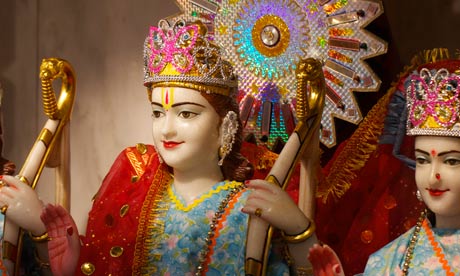
Statues at the Shree Radha Krishna Mandir, Manchester, where Anuradha Paudwal will be appearing as part of the Sacred Sites mini-festival. Photograph: Christopher Thomond for the Guardian

Sacred music in Manchester: beyond belief
A festival-within-a-festival exploring the music of different faiths sees churches, mosques, synagogues and temples throw open their doors to concert-goers
By Riazat Butt
In the back room of a Manchester church, a woman fishes a stereo and some CDs out of a carrier bag . As the evening sun streams through the frosted windows, choir leader Jacqui Allen calls to order the dozen people exchanging small talk around her. Then something extraordinary happens. The choir sings gospel songs such as Face to Face and Joyous in a way that makes the spine tingle, the heart soar and the tummy flip. The same thing happens at its rehearsals every week, but this one is different. The choir of New Testament Church of God is preparing for its biggest appearance to date – alongside US gospel singer Candi Staton – for the Sacred Sites arm of the festival, which puts international performers in places of Christian, Jewish, Hindu, Sikh and Muslim worship across the city. "I feel very privileged, motivated and encouraged to know the festival is not an in-house event," says Diane Plummer, a choir member since its inception five years ago. "It will bring the community into a place they don't normally go." Fellow singer and parishioner Cory Bernard says the choir has "never done anything like this before. I don't know what people expect. There are lots of stereotypes about gospel choirs. I think they will hear passion and something different." The church noticeboard testifies to the event's popularity, with three pages' worth of congregants requesting tickets for friends and family.
Staton says that the difference between playing a concert and singing in a church comes down to the atmosphere. "When people come to church, it's about praise, worship and reverence," she says down the phone from Atlanta, where she is rehearsing with her band, which is joining her in Manchester. "When people come to a concert, they come to party. For me, I've done the secular and sacred. But I am very excited about being part of this." Staton began her career in the 50s with the Jewish Gospel Trio. She gained mainstream success in the 70s, then returned to her gospel roots in 1982. While the audience at the New Testament Church of God won't hear her 1976 hit Young Hearts Run Free, she will perform her other smash, You Got the Love, as she says it's "an inspirational song."
For festival director Alex Poots Sacred Sites is a way to explore how God is celebrated through the arts. "We're interested in experimental theatre and offering the chance to witness performances in the most resonant setting. It shouldn't be something you could see last week." Poots was inspired by the US theatre director Peter Sellars, who told him there was a network of faith in every city. "Sellars said you could look at a city and it was a grid of sacred sites. That term stuck in my mind."
Poots originally planned to do Sacred Sites for the inaugaral festival in 2007, but couldn't make it work in tiome. "One of the earliest sensitivities was going into a situation and asking a stupid question. I wanted to do it with integrity and respect, I wanted there to be dialogue. It's not a religious service but there are religious aspects to it." Other than the performances themselves, what marks out this strand from the rest of the festival is the etiquette code. It's not enough to turn your mobile off or to refrain from rustling crisp packets. Men and women will sit in separate rooms at Manchester Central Mosque to hear Qari Sadaqat Ali recite verses from the Qur'an. Women are asked to cover their hair. Audiences are requested to observe a modest dress code at the mosque, the synagogue, temple and gurdwara. That said, Poots is keen for Sacred Sites, which he describes as a "platform within a festival", to appeal to people of all faiths and none. "One of the things we have to do is provide a doorway for people to walk through." One of those doorways is the Manchester Reform Synagogue. Its rabbi, Reuven Silverman, says there is plenty of room for everyone. "I think it's brilliant. It's like Edinburgh, where you have the big events and then you have the fringe." He calls music an "international language" and a "centrifugal force" that brings people on the perimeter together.
The artists taking part in Sacred Sites may not be widely known among UK audiences but to the congregations and faith leaders they are household names. The rabbi is a huge fan of Mor Karabasi – a singer-songwriter from Jerusalem who sings in Ladion, the ancient language and music of Jews from Portugal and Spain. "Even if someone is singing in a language you don't understand you can still be moved by it. It is so expressive."
Meanwhile, the Hindu devotional singer Anuradha Paudwal can shift 10,000 tickets in her Indian homeland, according to the genial men sitting in the administration office of Shree Radha Krishna Mandir, plastered with posters of deities. "She is very famous," says Jai Sharma, temple trustee, "and it will be her first visit to Manchester."
"She normally plays Wembley," adds general secretary Kim Gandhi.
Devotional songs are very popular in India, they point out, and Paudwal is the Lata Mangeshkar of the genre. "You know Lata don't you?" asks Sharma. "The most important Indian film playback singer. Anuradha is the Lata of bhajans and sangeets" – religious songs. "If you ask any Tom, Dick or Harry she is nothing less than a goddess."
The temple shares premises with the Manchester Indian Association, which holds non-religious events such as badminton and table tennis, in the community hall where Paudwal is performing for three nights. Festival organisers contacted a number of Hindu temples, explains Dr Gandhi, and asked questions about the venue and facilities. "They needed a stage, they needed a sacred place and they needed a PA system. We don't know why these chose us but we we were over the moon." Preparing for the event is a lot of hard work say the two men, but the temple has good people who are enthusiastic. "Singing is very important to our worship; without it we don't pray," says Gandhi. "It lifts our congregation, our spirits, and helps us to focus. It adds meaning and you can express your sentiments much better." It is this idea – that music or singing enhance prayer and devotion – that unites the five distinct religious communities taking part in the event.
Poots is keen to allay any concerns about using places of worship for purposes other than devotion. "I have friends who are not of faith and they have asked if they can go," he says. "There is a resistance to go if you're not religious."
Yet back at the church, as the choristers prepare to leave by collecting their belongings and children, these concerns seem to be unfounded. One of the singers, Trish Hall, says she thinks everyone, whether they believe or not, will also be moved by what they hear. After all, she says, "some people will acknowledge music before they ever pick up a Bible".

Sacred Sites runs 6-10 July at various venues.

Wednesday, 15 June 2011

HIDEOUSLY DIVERSE BRITAIN: FIGHTING EXTREMISM MADE EASY

From Hugh Muir's weekly column, Hideously Diverse Britain (in which he looks at diversity and race in Britain today), published in The Guardian's G2 section today.
Hideously diverse Britain: fighting extremism made easy
People who feel as if they are valued by society are far less vulnerable to radicalisation – somebody should tell the government
One of my bosses took a brutalist view of journalism. He would sit in meetings, distracted, desperate for something eye-catching on the other side of the window. And then, when the intellectual ping pong was slowing down, he would say: "Why don't we just get the facts and put them in the paper. It's not rocket science, is it?"
And he came to mind the other day as I waded through the government's new Prevent strategy for fighting extremism. Greater surveillance of universities, more intrusive surveillance of the internet as accessed in schools, libraries and colleges. No public funds for those who embrace the peddlers of doctrines that conflict with British values. Get tough and prevent the messages of radicalisation getting through to those who might be radicalised. Which makes some sense, I suppose. But wouldn't it make a lot more sense to try to find out why they might be vulnerable to radicalisation in the first place?
Here's a bit tucked away in the Home Office material. It describes what was said by focus groups. "The public generally recognise that everyone in society has a role in challenging extremism through their perception that building tolerance and integration across UK society is central to Prevent work. However, this is not top of mind for the audiences and a conclusion that is reached after detailed discussion only."
So we know the key issue is combating the alienation that makes people vulnerable to the doctrines of swivel-eyed halfwits. We know that if someone feels a valued part of society, they are less likely to tuck bolts and batteries and fertiliser into a rucksack. And we know that all the guff that says this is purely a problem for British Muslim communities — the "Oi, you, sort it out" approach – is just guff because "everyone in society has a role in challenging extremism", just as everyone in society has a role trying to combat knife crime in Black British communities and heroin smuggling involving members of the Turkish communities and the white-collar crimes of white British bankers. It's not "top of mind" but we know these are whole society problems requiring whole society solutions. It's not rocket science, is it?

Tuesday, 14 June 2011

COULD THIS BE THE CHURCH TO CALM OUR SECULAR OUTRAGE?


Very apposite and interesting article in today's Guardian by John Harris. It addresses some ongoing themes of this blog (social engagement of religious people, pan-equalities work, secularism) and it focuses on Liverpool, where I've just spent the weekend (at the first national conference of Philosophy in Pubs - PIPs).

It's part of a series of crowd-sourced articles and films called, called "Anywhere but Westminster", in which John Harris visits a different part of the UK each month to measure the gap between what politicians talk about and the reality of people's lives.
Could this be the church to calm our secular outrage?
By John Harris
Evangelical worship gets many on the left hostile or awkward. So how do we respond to believers that save the destitute?
It's a particularly remarkable feature of modern British life: the way that in certain circles even the mention of the most modest form of theistic belief is enough to bring down great torrents of hostility. Often the explanation is traceable to the liberal-left's justified concerns about the blurred relationship between religion and state. But, in keeping with the drive of militant secularism to attack the very idea of God as much as what faith means in practice, much of the shouting is usually about philosophical fundamentals. The result: an ongoing scrap between equally staunch believers and non-believers, which arguably gets nobody anywhere.
When we asked our online readers to give us a steer as to the social role played by religion where they lived, it all kicked off again. "I don't trust anyone who needs an instruction manual to tell them how to be good," offered Newbunkie. "My personal view is that all religious groups should be banned," said someone called Youbloodydidwhat.
In response there were slightly more measured claims of religion's practical benefits. "I have seen churches set up hostels for the homeless because the local vicar has encountered so many people sleeping rough in the church porch," wrote JonathanBW. "[They] establish credit unions to help people who are financially excluded … Most of this work does not involve any element of evangelism or proselytising." Similar news came from Manchester, Northampton and Glasgow – and in response, members of the Dawkins-Hitchens tribe dutifully went ape again.
If many of them set foot in Liverpool's Frontline Church, they would presumably explode. It's a standalone evangelical organisation based on the forlorn-looking borders of Picton and Wavertree. Having arrived in Liverpool in 1991, it now draws about 1,000 people – whose average age seems to be around 35 – to the three services staged each Sunday. Recent visitors have included Nick Clegg, Chris Grayling and Cherie Blair; among the first members of the congregation I met the day I visited was a local Labour councillor. Here, God is not acknowledged in that rather bashful way one associates with the tea-and-biscuits model of Anglicanism but loudly saluted. "We are amazed by you," goes one part of the apparently ad hoc liturgy. "We are in awe of you."
Now, I am an unshakeable agnostic. There is something about the unabashed nature of evangelical Christianity that unsettles my very British sensibilities – and I reach my peak of awkwardness during a Sunday service that dispenses with the fusty business of hymns and holy communion, and instead builds itself on music that suggests a grim hybrid of Snow Patrol and LeAnn Rimes. There are collection buckets rather than plates; suggesting that Rymans may have an overlooked sacramental aspect, the flock are invited to write their highest thoughts on Post-It notes, which are then stuck to flip charts.
Drawing on the Book of Joshua, the presiding pastor, a former Bristol GP named Nic Harding, advises his audience to fix their sights on metaphorical mountains, parts of society where their beliefs might be brought to bear. The examples he offers might chill any non-believer to the bone: "Education, healthcare, politics, government – these are all areas where God says, 'Who will claim that mountain?'"
In fact any mention of current affairs brings nonplussed responses from the congregation, and even the pastor tells me that politics is too "top down", and that he wants instead to work against greed and individualism one soul at a time. By way of bowing to the inevitable, I also ask him about the place his church gives to such issues as abortion and gay rights. "To me, those issues are right on the margin of the things we should be focusing on," he says. "The real issues are how we should express and find love for the outcasts and the downtrodden."
This is where he and his people direct their work, as evidenced by Streetwise, a weekly operation in which a handful of volunteers take food, tea and condoms to the city's sex workers. I watch them spend three hours in the encroaching dark as women in various states of drug-related distress flit between their van and streets where money has to be snatched from the jaws of occasionally life-threatening danger. They sometimes quietly pray for those they help, but they don't evangelise. "We're not bible-bashing," one of them tells me. "Whether these girls come to church or not, it makes no difference to how we treat them."
The next day I meet a former sex worker, now apparently off drugs, set on somehow starting college and a regular Frontline worshipper. "I was a prostitute and a drug addict for 11, 12 years – maybe more," she tells me. "God is so forgiving – he wants me to win." Wider society, she says, is "too judgmental … it's: 'That's a prostitute, that's a drug addict.' They don't want to know." And how has the church helped her? "Oh, it saved my life," she shoots back. "I would be dead if it wasn't for this church."
A question soon pops into my head. How does a militant secularist weigh up the choice between a cleaned-up believer and an ungodly crack addict? Back at my hotel I search the atheistic postings on the original Comment is free thread for even the hint of an answer, but I can't find one anywhere.

You can also watch John Harris's film that accompanies his article and contribute ideas of your own to the ongoing series, "Anywhere but Westminster" at the same site.

Tuesday, 31 May 2011

RELIGIOUS GROUPS HAVE TOO MUCH FREEDOM TO DISCRIMINATE

This article appears on the Guardian's Comment is Free (Cif Belief) website today:
Religious groups have too much freedom to discriminate
Now that faith groups are to become public service providers, the exemptions they have in British equality law must be narrowed
By Evan Harris
The Guardian has reported on those questioning the wisdom of contracting religious groups to deliver key public services. The government's "big society" initiative – it still seems too unfocused to call it policy – has, as one of its aims, the transfer of the delivery of some public services to voluntary sector providers on a greater scale than is currently the case.
It was envisaged by both this and the previous government that faith groups would be some of the new providers. It seems unjustified to argue against religious organisations providing public services, as it is discriminatory to single out those with a religious ethos for a prohibition on service provision. However, some religious organisations present extra challenges when being considered for the delivery of public services and it would be naive, foolish or perverse to ignore these.
First, they have a special exemption in equality law to discriminate against their employees narrowly on grounds of gender and sexual orientation (for priesthood and leadership roles) and more widely on the basis of religious belief. These exemptions are provided for in the European directive that underpins our anti-discrimination laws in this area. The problem is that the exemptions given in UK law by the last Labour government in the 2003 regulations and then in the 2010 Equality Act are far wider than provided for in the directive.
One of these exemptions is found in schedule 9, paragraph 3 of the 2010 Equality Act, allowing religious organisations to discriminate on the basis of religion in employment, in certain jobs and contexts. The last government faced infraction proceedings from the European Union for failing, unlike all the Catholic Mediterranean states, to properly limit these exemptions. The coalition needs to think more carefully about whether it wants to continue to fight the last government's battles. The concern is not only that workers are being required to sign up to a religious pledge when their job (say, secretary or caretaker) has no real religious element.
What is even more worrying is that staff of an existing secular provider – who make the beds in a hostel, or assist people with benefit claims – will face a faith test when the service and their employment contracts are transferred to a new provider that has a religious ethos. During the passage of the Equality Act, Liberal Democrats (that's me and Lynne Featherstone, now the equality minister) proposed an amendment that specified that religious tests were not to be permitted when delivering public services. This was vigorously opposed by religious leaders and the government. It was silently opposed by the Tories.
Second, our equality laws quite rightly prohibit the discrimination against users of public services on the ground of sexual orientation but the last government failed to extend this to religion.
When Featherstone and I proposed our amendment to prevent this, the then Labour minister Vera Baird argued that this was needed to allow Jewish care homes to function (as an example). Jewish-run care homes will appeal to the Jewish community, will cater to their needs and will fill their places – but they do not require to declare "no Muslims need apply" in order to do this.
Finally, it's not acceptable for a religious (or political) organisation to actively proselytise having been commissioned to deliver a public service, regardless of whether or not it is publicly funded. If religious organisations want to provide, for example, a hostel for the homeless, they must allow users in without needing to attend prayers, say grace or hear a sermon. Many religious organisations will not seek to discriminate or proselytise in this way but the organised lobby is fiercely protective of the latitude it has currently got.
The Liberal Democrats are not prepared to sit back and do nothing in the face of Labour and Conservative failure to protect public service workers and users from the risk of religious persecution. Grassroots members passed a motion at their last conference reiterating our call for narrower religious exemptions in the equality law and that in the meantime contracts with religious providers of public services need to have clear non-discrimination and non-proselytising clauses.

Thursday, 26 May 2011

What would Jesus cut?

Following on new earlier in the week that David Cameron had apparently credited Jesus as the originator of "Big Society" (see blog post Monday 23 May), here's a thoughtful piece from the Comment is Free (cif Belief) website of The Guardian, thinking through that notion in a wee bit more depth.
What would Jesus cut?
David Cameron claims Jesus invented the 'big society' – but the Christian message has a strong emphasis on social justice
By Savitri Hensman
Coalition politicians have recently surpassed themselves in stirring up controversy. The prime minister's recent claim that his "big society" drive follows Jesus' example has sparked strong reactions.
Many are suspicious of David Cameron's attempts to roll back the state and encourage people to take more responsibility. While few object to the idea of promoting friendly neighbourhoods and caring families and boosting volunteering, many of the projects that support these things have been slashed. Meanwhile public services are facing massive cuts, particularly affecting the most vulnerable, and the gap between rich and poor is widening.
So when it became known that Cameron told a gatehring of Christiazn guests at a reception in 10 Downing Street that Christ was "starting the big society 2,000 years ago" and that "I'm not saying we've invented some great new idea here", many were less than impressed.
Jesus did indeed encourage generosity and care for others. But he was firmly rooted in the Jewish prophetic tradition, with its strong emphasis on social justice. Occasional gifts and helpful acts could not compensate for exploitative and oppressive structures.
The Book of Isaiah warned:
"Woe to those who decree iniquitous decrees, and the writers who keep writing oppression, to turn aside the needy from justice and to rob the poor of my people of their right"

While the Jesus of Luke's Gospel declared:
"Blessed are you who are poor, for yours is the kingdom of God. Blessed are you who are hungry now, for you shall be satisfied. Blessed are you who weep now, for you shall laugh... But woe to you who are rich, for you have received your consolation. Woe to you who are full now, for you shall be hungry. Woe to you who laugh now, for you shall mourn and weep."

I doubt that this would have gone down well in 10 Downing Street, or that a cabinet of millionaires would have appreciated being told that: "it is easier for a camel to go through the eye of a needle than for a rich person to enter the kingdom of God".
Jesus reportedly told his listeners that "where your treasure is, there your heart will be also". Now, as then, it is all too easy for the most prosperous to be cut off from the realities confronting those who are less privileged. But is not benefit fraud immoral, and laziness to be deplored? Is it not good for the poor themselves, as well as society, to crack down on these?
The Gospel advice to "Give to the one who begs from you" and "Judge not, that you be not judged", may seem like an invitation to be taken advantage of. But the risks of turning away those who really are in need are serious. And while some take more than they are entitled to, others make do with far less help than they should actually receive, or struggle into work when they are badly ill or in pain, not only because of the pay but also because they want to stay busy and feel useful.
Besides, focusing too much on low-level abuses of the system can mean that large-scale rip-offs and corporate misdeeds slip by unnoticed. And challenging those on the margins to contribute more to the community is most likely to be effective when coming from those engaged at a grassroots level rather than the powerful, whose own actions are often at odds with their words.
Behind the rhetoric of the "big society", libraries, day centres and youth groups are facing closure, and the crackdown on benefit claimants is so harsh that even the dying are being condemned as scroungers. Trying to make out that the coalition government is following in Jesus' footsteps is less than convincing.
There is however one area in which Jesus might well have approved of cuts – in spending on warfare. But successive UK governments have been determined to display their military might, whatever the cost to soldiers and civilians.
"I think Churches, and religious organisations, have a huge amount to bring to the big society," said Cameron. Amid the hype, Christians, other people of faith, agnostics and atheists could perhaps bring a dose of reality.


Read this article, along with reader comments (and the opportunity to make your own) on The Guardian's cif Belief website: http://www.guardian.co.uk/commentisfree/belief/2011/may/26/cameron-big-society-jesus?INTCMP=SRCH

Tuesday, 10 May 2011

RED TAPE CHALLENGE TO ENVIRONMENT - AND EQUALITY

In today's edition of The Guardian, George Monbiot writes about the impact and implications of the Coalition placing environmental legislation on its Red Tape Challenge website. I've mentioned the Red Tape Challenge before in this blog - the shock of finding the Equality Act 2010 there, the barely controlled panic I heard in the voice of practitioners who thought that the government was wasting no time in disposing of what had been so hard won. What struck me about the section of Monbiot's article that I've reproduced below is how "environment" can fairly be replaced by "equality" and the piece not only still makes sense, but still works, for another discipline. Here's an extract from George Monbiot's piece:
But this is just the beginning of the coalition's assault on the environment. The government's Red Tape Challenge presents, on paper at last, the widest-ranging threat to environmental protection since the enclosure acts. suddenly it is asking whether environmental legislation - yes, all of it - should be "scrapped altogether". Listed as negotiable are [...] all the regulations, grand and petty, that protect us from other people's greed and selfishness.
It's a breathtaking, astonishing initiative, and the little protest it has generated testifies how punchdrunk this country has become as the government pummels every protection our forebears worked so hard to win, everything that defends us from a feral, unregulated market.
The point of the Red Tape challenge is not to scrap all this legislation but to shake the bolts looser. The government is in the process of resetting the political boundaries so that the outrageous propositions it makes in future seem unexceptional.

Wednesday, 4 May 2011

May the fourth be with you


From time to time, this blog mentions special days in the calendars of the various religions, or notes particular occasions throughout the year when something special brings different faiths together – World Religion Day, Earth Day etc.

Today has become known as Star Wars day, for obvious reasons. You can check it out on Wookieepedia: http://starwars.wikia.com/wiki/Star_Wars_Day

Those who entered "Jedi Knight" in the religion section of the 2001 Census were consigned en masse to the "No religion" category. Back then, an internet campaign encouraged people to write in “Jedi” as their religion. An email supporting the campaign urged people to declare themselves as Jedi knights, “because you love Star Wars ... or just to annoy people.” This was included in a feature on the BBC national news, the night before the 2001 Census. That probably bumped up the number a bit: 390,000 people in England and Wales did so (0.7% of population). That’s greater than national figures for these recognised faiths:

·         Baha’i 5,000 (>0.01% of population)
·         Buddhist 144,453 (0.3% of population)
·         Jain 15,000 (0.03% of population)
·         Jewish 259,927 (0.5% of population)
·         Sikh 329,358 (0.6% of population)

In Leicester 2,371 people wrote in “Jedi” as their religion in the 2001 Census. that was 0.8% of the city's population.

Now: whenever I meet someone who states proudly that they’re one of those who put their religion as “Jedi” in the 2001 Census, I tell them that if they can show me a Jedi trick, I’ll convert to it – in fact, I’ll do better than that, I’ll become their Padawan learner. Hasn’t happened – yet.

Mind you, I don’t see the point in giving people the right to declare their religious affiliation, even giving them the freedom to write in the religion of their choice, but then the government gets to say, “No, we’re not having that.”

It will be interesting to see how many people identifed themselves as Jedi in the 2011 Census. I'd predict that the number will have dropped considerably but we'll have to wait and see to what extent it was a jok or a fad - and how many have stuck with it.

There's a myth that if enough people write in something (just about anything) in the "other" section of that religion question, then the government would be compelled to classify it as a religion. There was a fiarly low key campaign this time to get Manchester United fans to put that as their religion.

Here’s a link to one of the first widespread stories about the Jedi as a religion in this country, published in the free daily paper. I searched it out on the Metro website, where the date isn’t displayed, but I recall it being some time in the summer of 2008. I’m unable to copy the text from the website but here’s the link: http://www.metro.co.uk/news/84822-brothers-build-jedi-church-in-wales

It’s not so much the article itself that I liked, so much as a reader’s response in the letters page a couple of days later. The text of that letter isn’t available online and I didn’t keep a copy. But it said something along the following lines: the writer was sorry to see the disparaging attitude that the paper appeared to be taking toward the establishment of the first Jedi church, objecting that it was male dominated, hierarchical, celebrated violence and based on a work of fiction. The writer asked, “Aren’t they all?”

Here’s an article I did manage to keep though, which was published in The Guardian, Saturday 19 September 2009.

Jedi religion founder accuses Tesco of discrimination over rules on hoods

Daniel Jones says he was humiliated and victimised for his beliefs following incident at store in Wales

By Helen Carter

Tesco has been accused of religious discrimination after the company ordered the founder of a Jedi religion to remove his hood or leave a branch of the supermarket in north Wales.

Daniel Jones, founder of the religion inspired by the Star Wars films, says he was humiliated and victimised for his beliefs following the incident at a Tesco store in Bangor.

The 23-year-old, who founded the International Church of Jediism, which has 500,000 followers worldwide, was told the hood flouted store rules.

But the grocery empire struck back, claiming that the three best known Jedi Knights in the Star Wars movies – Yoda, Obi-Wan Kenobi and Luke Skywalker– all appeared in public without their hoods. Jones, from Holyhead, who is known by the Jedi name Morda Hehol, said his religion dictated that he should wear the hood in public places and is considering legal action against the chain.

"It states in our Jedi doctrination that I can wear headwear. It just covers the back of my head," he said.

"You have a choice of wearing headwear in your home or at work but you have to wear a cover for your head when you are in public."

He said he'd gone to the store to buy something to eat during his lunch break when staff approached him and ordered him to the checkout where they explained he would have to remove the offending hood or leave the store.

"They said: 'Take it off'', and I said: 'No, it’s part of my religion. It's part of my religious right.' I gave them a Jedi church business card.

"They weren't listening to me and were rude. They had three people around me. It was intimidating." Jones, who has made an official complaint to Tesco, is considering a boycott of the store and is seeking legal advice.

Tesco said: "He hasn't been banned. Jedis are very welcome to shop in our stores although we would ask them to remove their hoods.

"Obi-Wan Kenobi, Yoda and Luke Skywalker all appeared hoodless without ever going over to the Dark Side and we are only aware of the Emperor as one who never removed his hood.

"If Jedi walk around our stores with their hoods on, they'll miss lots of special offers."


Read this article on The Guardian website, along with reader comments: http://www.guardian.co.uk/world/2009/sep/18/jedi-religion-tesco-hood-jones