Showing posts with label Prevent. Show all posts

Wednesday, 6 March 2013

MEET WILL BALDET, PREVENT COORDINATOR


At St Philip's Centre for Study and Engagement in a Multi-Faith Society this morning for a meeting with Will Baldet, Prevent Coordinator for Leicester, Leicestershire and Rutland.

I first met Will last month, at a Knowledge Exchange Seminar in the Multifaith Centre at the University of Derby on the topic of Islam and Higher Education. We've been looking for the chance to get together for this conversation since then.


I'm grateful to Will for clearing a couple of hours so close to the international conference that he's organising at De Montfort University this Saturday. "Virtual Voices, Real Lives" will consider the realities of radicalisation and the role of social media in Islamophobia, extremism and social change. As you can imagine, faithful reader, I'm excited at the prospect of social media being taken seriously in this context and am looking forward to taking part in the conference myself.


Will was appointed Prevent Coordinator for Leicester in October last year. He talks me through how Prevent has changed, what it means now and how it relates to the distinctive circumstances of our city. I, in turn, walk him through the structure, function and relevance of Leicester Council of Faiths. We map out areas of overlap between Prevent and the Council of Faiths, complementary aspects of his work and mine, particularly regarding social cohesion. It would make sense for him to meet the Board of Leicester Council of Faiths to brief them on Prevent. I hope we can make that happen soon. I also offer to help him make contact with other appropriate organisations and agencies, such as Network for Change and Leicester SACRE.


The appointment of a Prevent Coordinator at S Philip's Centre was funded by the Home Office and is designed to co-ordinate the preventative strand of the Government's counter-terrorism strategy CONTEST in Leicester. The aim of Prevent is to help communities develop the resilience to counter the national threat in all its forms, and to empower the community itself with the support of partner agencies to address these difficult challenges.

As we're wrapping up our two-hour meeting, we discover a shared interest in comics. Will favours Marvel (particularly Daredevil, the Man Without Fear), while I'm more firmly DC. Those who get such things may see what that might tell us about Will - and about how he and I could work together.


Follow Will's Twitter feed, @Leics_SafeSPACE: challenging religious and political extremism and providing the space for Leicester's communities to debate the issues online.

Follow Leicester SafeSpace on Facebook: An online forum to discuss and debate issues of political or religious extremism, share ideas on making our communities more resilient to extremist voices and publicise local and national events of interest.

Tuesday, 20 November 2012

INTER FAITH WEEK 2012, DAY 3: HIGHCROSS EXHIBITION


Second day of our week-long exhibition in Highcross for Inter Faith Week.

Last time we were in this spot, our ten banners were arranged “circle the wagons” style. That seemed good enough for a while, but palled after a bit – the arrangement appeared somewhat unstable, somewhat shabby, especially when viewed from above. This time I’ve partly followed the style we adopted last year, of putting the banners back-to-back, though this time they’re laid out in a straight line. The display is bookended by the “generic” banners for Leicester Council of Faiths itself, with Leicester University’s "Mapping Faith and Place in Leicester" and "Leicester Faith Trail" behind them.


As regards the individual banners for our faith community members, they're set back to back so that the visitor, approaching from one direction, sees the four Abrahamic religions of Middle Eastern origin in historical order (Jews, Christians, Muslims, Bahá'ís).


Approaching from the other direction, the visitor sees the four Dharmic religions, of Indian origin in historical order (Hindus, Jains, Buddhists, Sikhs).


First on this morning, John Catt (Leicester Secular Society) and Kartar Singh (Near Neighbours project). They're in the photo at the top of this post. They were joined by Scott MacDonald (Leicester Bahá'ís) shortly after I'd left.


I arrive on the stall just before 1400 to do a couple of hours myself. Dr Ruth Young (Senior Lecturer in Archaeology and Director of Distance Learning Strategy at the University of Leicester School of Archaeology and Ancient History) is photographed above, handing over to Sheila Markham (Leicester Hebrew Congregation). Sheila also took part in the philosophy panel at St Paul's yesterday, so I get a bit more info about how that went.

In the middle of the afternoon we receive a visit from Paresh Solanki of the Inter Faith Network of the UK. I'm hoping for better coverage of our Inter Faith Week activities in the national report than we received in last year's. Paresh and Sheila are pictured below.


Shortly after 1600 I leave the exhibition in the evidently capable hands of Billy Dedat and Ravinder Kaur. This is the first time that either of them have taken part in this event, the first time that I've met either of them - and the first time they've met each other. Their involvement together here today is serendipitous. Billy is Chair of the Leicestershire branch of the Association of Muslim Police and is a member of Leicestershire Police's Prevent Engagement Team, while Ravinder works for Leicestershire County Council's project LWA: Living Without Abuse. They're quickly talking about ways in which they can work together after this event. They're shown together in the photo below (Billy on the left, Ravinder on the right).


My immediate task now is to get a couple of banners and some of our free literature out to Leicestershire Police HQ in Enderby, where our Faith in Family seminar is taking place this evening. What with phone batteries running out, parking in the wrong street etc it's not quite as smooth a procedure as I'd have hoped. Eventually, Fayyaz Suleman (Vice Chair of Leicester Council of Faiths) swings by Pilgrim House to pick up the stuff and get ti to the venue on time.

I'm not attending the seminar myself. We've had no one come forward to fill the Tuesday evening slot and we can't leave the exhibition unattended during opening hours at Highcross, so I'm on duty here for a couple of quiet hours.

After Highcross closes, I head back to Pilgrim House and wait for Sughra Ahmed to drop off the banners and literature, since I'll need to use them very early tomorrow. She brings them back at 2145 - with some nice munchies left over from the seminar.

Here are some of the things that visitors and volunteers have written on the labels and hung on our little white tree today:
The earth is but one country and mankind its citizens
Hate creates hate, love creates love. May love concure [sic] over hate
It's only when we believe we can't make a difference ... will humanity end!
Multiculturality - more of it please!
For all those who are not going to get better
It's your actions that define who you are and not what labels you give yourself
I wish my grandad gets healing from spirits! Love, Tara, Sarita, Simren, Bobby xxx
God bless everyone at Christmas
I wish the peace everywhere around the world
Mutual respect and appreciation
The unexamined life is not worth living

I'd bought a set of mixed coloured Sharpies for people to use when writing on these labels. I left them in the OMG mug on the table at our display overnight. Sometime between the end of last night and the start today, someone nicked them. I can only hope that some underprivileged person will be getting a nice set of Sharpies for Christmas.

Wednesday, 15 June 2011

HIDEOUSLY DIVERSE BRITAIN: FIGHTING EXTREMISM MADE EASY

From Hugh Muir's weekly column, Hideously Diverse Britain (in which he looks at diversity and race in Britain today), published in The Guardian's G2 section today.
Hideously diverse Britain: fighting extremism made easy
People who feel as if they are valued by society are far less vulnerable to radicalisation – somebody should tell the government
One of my bosses took a brutalist view of journalism. He would sit in meetings, distracted, desperate for something eye-catching on the other side of the window. And then, when the intellectual ping pong was slowing down, he would say: "Why don't we just get the facts and put them in the paper. It's not rocket science, is it?"
And he came to mind the other day as I waded through the government's new Prevent strategy for fighting extremism. Greater surveillance of universities, more intrusive surveillance of the internet as accessed in schools, libraries and colleges. No public funds for those who embrace the peddlers of doctrines that conflict with British values. Get tough and prevent the messages of radicalisation getting through to those who might be radicalised. Which makes some sense, I suppose. But wouldn't it make a lot more sense to try to find out why they might be vulnerable to radicalisation in the first place?
Here's a bit tucked away in the Home Office material. It describes what was said by focus groups. "The public generally recognise that everyone in society has a role in challenging extremism through their perception that building tolerance and integration across UK society is central to Prevent work. However, this is not top of mind for the audiences and a conclusion that is reached after detailed discussion only."
So we know the key issue is combating the alienation that makes people vulnerable to the doctrines of swivel-eyed halfwits. We know that if someone feels a valued part of society, they are less likely to tuck bolts and batteries and fertiliser into a rucksack. And we know that all the guff that says this is purely a problem for British Muslim communities — the "Oi, you, sort it out" approach – is just guff because "everyone in society has a role in challenging extremism", just as everyone in society has a role trying to combat knife crime in Black British communities and heroin smuggling involving members of the Turkish communities and the white-collar crimes of white British bankers. It's not "top of mind" but we know these are whole society problems requiring whole society solutions. It's not rocket science, is it?

Tuesday, 14 June 2011

Harmony that gives the lie to extremist tag


Here's the "First Person" column in today's Leicester Mercury. Before I got the chance to see the paper today, the text of this article was mailed around by Suleman Nagdi, spokesman for the Federation of Muslim Organisations. The author of the article, Luman Ali, is a community volunteer and PhD student.
Harmony that gives the lie to extremist tag
Luman Ali wonders why the city is considered a hotbed of Muslim militancy
Why Leicester? That is the question we are all asking after our city was designated as a hotbed of terrorism and worthy of being singled out for significant attention as part of the Government's new Prevent Strategy. What has Leicester done to warrant such concern and worry?
Is it the "One Leicester" campaign, which has brought together the various and diverse communities to celebrate our common humanity and our collaborative achievements, exemplified in the joyful festivities held in the city after the English Defence League demonstration? Is it the work done by the faith communities, in groups such as the Council of Faiths and Faith Leaders Forum, to create the means by which all the people of Leicester may live and work together in harmony and flourish in whatever endeavours they choose to pursue?
Is the launch of a recent Muslim Burial Council of Leicestershire book, "Discovering through Death – beliefs and practices", which was written with all faith and non-faith communities to examine how death is dealt with by all, an indicator that Leicester is a rampant hotbed of extremism? Moreover, does it worry the Government that representatives from all faith and non-faith groups came together for the launch of this book in an atmosphere of warmth and conviviality?
Is the Government worried about the way in which the various communities of Leicester came together last October to work with the police and local authority to combat the public disorder that was visited upon our great city? Is the Government concerned that the event passed with such minimal disruption that the strategies implemented by the police, local authority and various communities surrounding the event, have been used by other cities as a model of good practice?
If the Government is concerned about what has been noted here then it is pertinent to ask, why exactly have we been cited as a hotbed of extremism? Furthermore, if the inter-faith and community work that has been done in this city, work which has led to us being cited as a reference point for exemplary community work by other European cities, has not been enough to move Leicester away from being a hotbed of extremism, then what more can we do to help foster excellent community relations?
On our part we will continue to work with our partners to consolidate our strong relationship fostered through years of collaborative hard work. We also invite policy makers to view the work in Leicester to see why a church, Hindu Temple, mosque and synagogue stand yards apart in the Highfields area in peace and harmony. Why Leicester as a hotbed of extremism? No, the fact is "why not" Leicester.

Read this article, along with reader comments (and the opportunity to make your own) on the Leicester Mercury website: http://www.thisisleicestershire.co.uk/Harmony-gives-lie-extremist-tag/story-12766987-detail/story.html

Wednesday, 8 June 2011

LEICESTER TO RECEIVE HOME OFFICE CASH TO TACKLE EXTREMISM

Here's an interseting article from today's Leicester Mercury. As has been mentioned previously on the blog, Leicester Council of Faiths has never been invited to participate directly in any activities related to the Prevent agenda, nor has it ever received any money from the funds available for that purpose.
Leicester to receive Home Office cash to tackle extremism
A Government anti-terrorism strategy has identified Leicester as a potential hotspot for extremism.
The city will now be eligible for a slice of the Home Office's £63 million-a-year Prevent fund to set up projects and schemes to counter extremism.
Home Secretary Theresa May said: "Prevent aims to stop people from becoming terrorists or supporting terrorism.
"Our new strategy will challenge extremist ideology, help protect institutions from extremists and tackle the radicalisation of vulnerable people.
"Above all, it will tackle the threat from home-grown terrorism."
The original Prevent strategy was set up in the wake of the July 7, 2005, London bombings.
However, the Government said it had been ineffective and wasteful and that some of the cash had ended up in the hands of extremists.
Under the new scheme, Leicester City Council will have to appoint a dedicated Prevent co-ordinator, funded by the Home Office.
The co-ordinator will have to set out "clear, focused activities" and councils will have to set up a partnership, involving police, children's services and other agencies.
It could run projects working with schools, universities or community groups to identify and support individuals at risk of radicalisation or promoting mainstream leaders in communities so that moderate voices are heard.
Suleman Nagdi, of the Leicester Federation of Muslim Organisations, welcomed the strategy but said he was concerned it was just aimed at Muslims.
He said: "Violent extremism is an unfortunate phenomenon that is a feature of various groups and any counter-terrorism measures need to take this into consideration.
"In failing to acknowledge the presence of violent extremism in other communities and presenting it as an Islamic phenomenon, the Government has wantonly ignored the threat posed to the security of the UK from other groups.
"This is particularly pertinent as we have seen people from the far-right charged and convicted for acts of terrorism.
"By singling out one group so starkly, the Government may have risked alienating further, people who feel that they are on the margins of society.
'The federation remains committed to remaining at the forefront in the war against violent extremism in all its guises."
City mayor Sir Peter Soulsby said: "I have no doubt we will be able to use the money to promote community cohesion, though we are all a bit wary about money that is targeted at one section of the community."
Leicester Council of Faiths chairman Manjula Sood said: "We are lucky in Leicester that we have harmonious relations but we cannot be complacent.
"Extremists target the young and the vulnerable. I hope some of this money will help young people get jobs and stability so they are not tempted down the wrong path."

Sunday, 5 June 2011

PM WINS ROW WITH NICK CLEGG OVER CRACKDOWN ON MUSLIM EXTREMISTS


Here's a piece from today's Observer. Leicester Council of Faiths has never been directly involved in the Prevent agenda, nor have we ever received funding for it or similar activities. We'd like to think that we might be considered for funding in our capapcity as an organisation that promotes community cohesion, as mentioned at the end of this article.
PM wins row with Nick Clegg over crackdown on Muslim extremists
Counter-terrorism review insists groups must reflect British mainstream values to get funds
By Mark Townsend & Hannah Olivennes
David Cameron will emerge as the victor from a bitter cabinet battle over multiculturalism this week as the government unveils a hardline approach to tackling Islamist extremism.
Home Office sources say that Cameron has quashed Nick Clegg's argument for a more tolerant attitude to Muslim groups by insisting on a strategy centred upon the notion that violent extremism is incubated within the ideology of non-violent extremism.
The shift in approach will be outlined when the government's counter-terrorism strategy is unveiled by the home secretary, Theresa May, on Tuesday. Central to the Prevent strategy is a broader definition of extremism that will be extended beyond groups condoning violence to those considered non-violent but whose views, such as the advocacy of sharia law, fail to "reflect British mainstream values".
A Home Office source said: "There will be a direct challenge to these [non-violent] groups."
The Prevent review has been delayed for five months because of disagreements within the coalition cabinet. In his view that engaging with non-violent extremists can be used as a bulwark against violent extremists, Clegg has been joined by the attorney general, Dominic Grieve, the Tory chairman, Baroness Warsi, and others including Charles Farr, the head of the office of security and extremism. They argue it is crucial to maintain a distinction between violent and non-violent extremism and that it is necessary to engage rather than alienate.
Warsi, who sits on the cabinet subcommittee dealing with integration, is understood to disagree strongly with the new direction of Prevent but has been dissuaded from publicly criticising the strategy.
Among those supporting the prime minister on a crackdown on Muslim groups was the education secretary, Michael Gove, and Lord Carlile, who is in charge of the Prevent review.
Ostensibly the strategy echoes Cameron's contentious speech to an international counter-terrorism conference in Munich last February when he suggested that "state multiculturalism" had failed.
During the speech the Tory leader categorised those who espoused an ideology of Islamic extremism alongside those who supported violence. He said: "Move along the spectrum, and you find people who may reject violence, but who accept various parts of the extremist world view, including real hostility towards western democracy and liberal values."
A Home Office source said: "When a prime minister states something so unequivocally, it is unlikely they will be allowed to deviate from that."
The strategy will warn Muslim groups that they will only receive public funding under certain conditions. Groups would be allocated funding on short-term projects but only after proving they do not promote or support extremist views.
"Under the old Prevent strategy we sprayed a lot of cash willy-nilly and the new strategy is opposed to that," said the source.
Haras Rafiq, director of Centri, a counter-extremism consultancy, welcomed the strategy, but said the main challenge was implementation.
"They need to build a criteria to establish which organisation they fund has extremist views, which one doesn't, and ensure extremist groups do not receive funding from other pots."
One group, the Mosques and Imams National Advisory Board, which has links to the hardline Muslim Association of Britain, received £250,000 in the year up to April but has already had its annual public funding withdrawn, the Observer has learned.
During the Munich speech Cameron said it was "nonsense" to fund groups with extremist elements, adding: "Would you allow far-right groups a share of public funds if they promise to help you lure young white men away from fascist terrorism? Of course not."
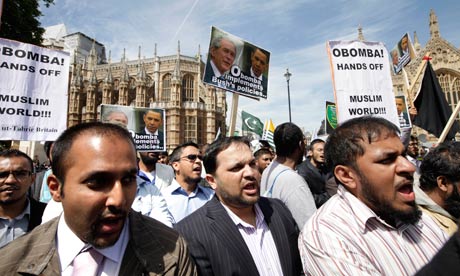
The strategy, however, will shy away from naming groups, effectively dismissing speculation that the initiative will proscribe non-violent, extremist Islamist groups such as Hizb ut-Tahrir, a step which Cameron has publicly supported but which legal sources advise is not possible.
The Conservative manifesto named Hizb ut-Tahrir as a group it wanted to proscribe; in 2009 the then shadow home secretary, Chris Grayling, promised to "immediately ban" the group if the Tories were elected.
The strategy to be unveiled this week will explain that the issue of funding groups that promote community cohesion will be left to the Department for Communities and Local Government. Sources say that under the previous system community groups had to apply for support from counter-terrorism funding, which succeeded only in stigmatising them.

Photo above shows protesters from Hizb ut-Tahrir demonstrate during the recent visit by Barack Obama. The Prevent review has backed away from proscribing the group. Photograph: Lefteris Pitarakis/AP

Friday, 31 December 2010

Faith groups will not fill gaps left by spending cuts, warns Anglican bishop

Maybe I'm feeling lethargic and slapdash, what with it being the end of the year and all, but after having succumbed to temptation yesterday by copying into the blog an interesting article from that day's Guardian, here I go with another one today. I know that I do cut'n'paste in this way from time to time, but two days in a row from the same source does seem rather lazy of me! This one makes extended reference to comments by the Bishop of Leicester, the Right Rev. Tim Stevens (who is the Patron of Leicester Council of Faiths). I've reproduced the article as it appears on the Guardian website, in full below. The four paragraphs at the end don't appear in the version printed in today's paper. 
Faith groups can't fill gaps left by state, warns bishop
Riazat Butt, Religious affairs correspondent

Bishop of Leicester says it would be 'completely irresponsible' for government to roll back on its responsibilities to the needy

A senior Church of England bishop has warned that faith groups will not step in to fill the gap left by state spending cuts, saying it would be "completely irresponsible" to leave the care of the vulnerable in the hands of "amateurs".

The bishop of Leicester, Tim Stevens, who has spoken forcefully about David Cameron's proposals for a "big society", said that although faith groups were ready and willing to play a greater part in community life, their enthusiasm and engagement should not mean the government rolled back on its responsibilities to the needy.

The warning follows fears expressed by a leading charity figure this week, David Robinson of Community Links, who said massive public spending cuts threatened to undermine the big society project.

Government ministers have stressed that faith groups are vital to the success of the big society, the flagship policy of the Conservative party's election manifesto, aiming to empower local people and communities to play a greater role in public life.

But Stevens said faith groups should not be a fig leaf for dismantling vital services. "We stand ready to co-operate and play our part but we will not collude in government neglect. We can't simply take the weight of all those areas of responsibility. If there is the assumption that the church will carry that load, we will have to speak out.

"This can't be the throwing of a switch and saying the state walks out and the church walks in. It is completely irresponsible to say these people will be cared for by amateurs."

He said there was a "big question" about whether the big society was in fact a "veil for covering up a massive contraction of public support for the neediest people".

Stevens also urged faith groups to show caution, especially after communities secretary Eric Pickles said faith groups would not receive additional funding for projects. "They must be realistic and not raise expectation that they can take on the care of the elderly, children and asylum seekers. It's not going to work," said Stevens.

One example of how the church wants to play its part is Near Neighbours, a £5m project to promote community cohesion. The church has already claimed it will be more effective than the government's £61m "Prevent" programme.

Near Neighbours would focus on four areas with large Muslim populations – the M62 mill towns corridor, east London, Leicester and east Birmingham – with the aim of enabling "Mr and Mrs Smith, Mr and Mrs Patel, and Mr and Mrs Hussain" living in the same neighbourhood to relate more "positively" to each other.

Stevens said the big society offered the church an opportunity to showcase what it was doing and talk proactively to government and local government to develop its role in national life. "The church can't do it all on its own. It can have a role, not an imperialist one, but in bringing others to train, create and co-ordinate."

He pointed to the thousands of buildings, volunteers, institutions and staff that formed the Church of England network, saying no other group had such reach.

The government proposals were a chance for the church to strengthen its place in the "heart of the community".

"The big society is a description of what we do. It could well be a productive moment for the church."

Christian groups and leaders have been the most vocal in their support for the government's plans to empower communities.

In his Christmas reflection, the Roman Catholic archbishop of Westminster, Vincent Nichols, said the Christian faith gave society a chance to act for the common good.

Nichols told the congregation at Westminster Cathedral that British society was "capable of great generosity in the face of adversity" and that a sense of solidarity arose from disaster.

He, along with the archbishop of Canterbury, Dr Rowan Williams, and the chief rabbi, Jonathan Sacks, have already met the prime minister to discuss the big society and the contribution of faith groups.
Read the article in context and comments left by readers:
http://www.guardian.co.uk/society/2010/dec/30/bishop-big-society-faith-groups?INTCMP=SRCH