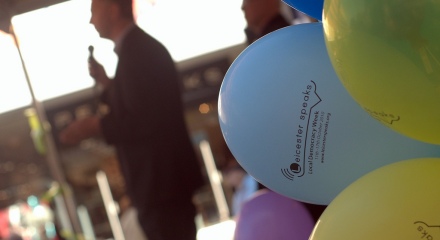
Showing posts with label LASALS. Show all posts

Thursday, 24 November 2011

INTER FAITH WEEK, DAY 5: JUDAISM 101


At 1200 today we have number seven in a series of ten public meetings for Inter Faith Week. These hour-long introductions to “Communities of Faith or Belief in Leicester" are being held in Leicester Adult Education College (or, more precisely, in Leicester People's Photographic Gallery, which is part of the Adult Ed College). Leicester Council of Faiths is hosting these meetings in association with Leicester Adult Skills and Learning Service (LASALS).

The speaker for this Beginners’ Guide to Judaism – or Judaism 101 - is Dr Martin Stern, of Leicester Hebrew Congregation.

The photo above is one of two images representing the Jewish community in the Favourite Faiths Photo exhibition, launched at Leicester People's Photographic Gallery during Inter Faith Week. The picture shows a detail of the Town Hall Square Fountain, a gift to the people of Leicester in 1878 from Sir Israel Hart (1835-1911), prominent member of the city's Jewish community and four times Mayor of Leicester (photo sourced from Kiran Parmar, with permission).

Wednesday, 23 November 2011

INTER FAITH WEEK, DAY 4: FAVOURITE FAITHS PHOTO EXHIBITION


You may be wondering, faithful reader, what's become of the Favourite Faiths Photo Exhibition at the Leicester People's Photographic Gallery. This is part of our fourfold presentation for Inter Faith Week (and the gallery is also the venue for the afternoon introductory talks that we're presenting in association with Leicester Adult Skills and Learning Service under the banner, "Discover Communities of Religion or Belief in Leicester").

Due to a technical hitch or two, it's taken longer to get the photos printed than we'd hoped. Then Ian Davies, Director of the Leicester People's Photographic Gallery, was rushed into hospital by ambulance on Monday afternoon with sever chest pains. That threw everything out of kilter at the gallery, including our display. So I'm glad (indeed, relieved) to get a message this morning from our contact at John E Wright (the digital printing company which produces everything displayed in the gallery) that our pictures are ready and have been delivered to the gallery. I ask Arthur Winner (who's come along to help out at the exhibition in Highcross) to come up to the gallery and cast his professional photographers' eye over the pictures. I haven't decided on how the photos are going to be displayed, which ones should go together and so on. But after th ten minute walk up to the gallery, we're greeted by Rob Howden, who tells us that the photos haven't shown up there. So Arthur and I take another ten minute walk over to John E Wright in Marble Street, only to be told that the pictures aren't there, that they were definitely delivered to the Adult Education College this morning. Ah, right so ... this is part of the problem with this new venue. No one knows what it's really called (or what it's supposed to be called, since no one wants to refer to it as the Old Central Lending Library - which is the way you end up describing it when you have to accept that no one knows where it is or what you're talking about!). So Arthur and I head over to the Adult Education College in Wellington Street where - lo and behold - our photos are sitting waiting for us, protected by the biggest swathe of bubble wrap I've ever seen *POP!*


We carry the collected 16 photos (printed on board which is rather too big and unwieldy to carry through the streets) up to the gallery, unwrap them and lay them out along one of the walls, so we can judge how they can be displayed (as in the photo above). I have to say that I'm disappointed in how a few of them have turned out. I'd hoped for better results to be honest (Arthur describes the colour in some of them as "punchy" - I'm not sure what that means, but it doesn't sound positive). In the end, I leave decisions about the order of display in the capable hands of fellow Scot John Toye.


When I come back round to the gallery later this afternoon (to meet the speaker for the Jain slot at 1500), John has been trying to hang the pictures, but tells me that all but one of the larger ones just don't fit! Rather than the whole area of the photo plus white space around it being A2, the picture alone has been printed A2 then additional white space added around. This makes them too big to fit in any of the allotted spaces at the gallery. This is strange and somewhat inexplicable, as the printer (John E Wright) does all the production of these prints for the gallery and should have been working to a set standard. John asks me to leave it with him to contact the printer and talk it over. By the end of the afternoon, John E Wright has committed to printing again the anomalous pictures, to the right size this time, at no extra cost to us. Since the bigger versions are now going spare, I take them down to the exhibition at Highcross, where we can use them to add a splash of colour to the display.

Monday, 21 November 2011

INTER FAITH WEEK 2011, DAY 2: BAHÁ'Í 101


At 1200 we have the first of ten public meetings for Inter Faith Week, under the series title, “Communities of Faith or Belief in Leicester". These hour-long introductions are being held in Leicester Adult Education College (or, more precisely, in Leicester People's Photographic Gallery, which is part of the Adult Ed College).

Leicester Council of Faiths is hosting these meetings in association with Leicester Adult Skills and Learning Service (LASALS). Chris Minter, Head of Service at LASALS, expressed an interest in supporting Inter Faith Week this year and we agreed that this would be an appropriate way for LASALS to do so, by allowing free use of its venue and facilities.

The speaker for this Beginner’s Guide to the Bahá'í Faith – or Bahá'í 101 – is Rod Duncan. I say a few words at the start, setting this talk in context with the ones to follow and with our other activities for Inter Faith Week. I leave a bunch of leaflets, then hightail it back to our exhibition in Highcross. When I leave, three people have turned up to listen to Rod. Another couple turn up a little later. I don't think that's a bad turnout for this sort of event: an old fshioned public meeting in the middle of the day in the city centre.

The photo above is one of two images representing the Bahá'í community on show in the Favourite Faiths Photo exhibition, launched at Leicester People's Photographic Gallery during Inter Faith Week. The picture shows the Shrine of the Báb on Mt Carmel, Haifa (sourced from Bahá'í World Centre Media Bank, reproduced with permission).

Tuesday, 6 September 2011

LEICESTER PEOPLE'S PHOTOGRAPHIC GALLERY PREVIEW


A few minutes after leaving Leicestershire Centre for Integrated Living, where I'd been attending the regular monthly Core Partners meeting of the Regional Equality and Diversity Partnership, I stop at the top of King Street, to put on my coat. As I do so, I hear someone calling my name. A few yards down Wellington Street, sitting on the low windowsill outside the old record lending library, Ian Davies and Chris Minter are waving to me. Chris is Head of Leicester Adult Skills and Learning Service (LASALS). Ian is a community activist and photographer whom I got to know through CreativeCoffee Club at Phoenix Square.

As I cross Wellington Street toward them, they stand up and beckon me into the building, through the open fire exit door and up the stairs inside. The old Central Lending Library is in the final stages of conversion into a new venue for community education and cultural use. Its main feature in this new form will be the Leicester Peoples Photographic Gallery. So here I am getting a sneaky peek at the new gallery space and some of the pictures that will feature in the opening exhibit there. Ian's devoted himself to this project over the last several months and his hard work is clearly paying off. It's two weeks till the building opens to the public, but already it's an impressive sight. It's going to be a very attractive and busy venue, I've no doubt about that.

There's an offer of a public display of photographs for Leicester Council of Faiths during National Inter Faith Week in November. This is something I'm hoping to persuade our Board of Directors to get behind as part of the celebration of the Council of Faiths 25th anniversary.

I've joined the Leicester People's Photographic Gallery with a personal subscription of only £5 per year (which brings a number of benefits). Ian thinks I'm member No. 22.

I'd have liked to have stayed longer and had more of a look around, but I'm supposed to be at the Quaker Meeting House in just a quarter of an hour.

I hope that Ian can maker it to CreativeCoffee Club tomorrow morning. If he does, I'll give him the chance to say a bit about the Gallery .

The Leicester People's Photographic Gallery is the beneficiary of generous sponsorship and support from Jon E. Wright & Company, the long-established and well-respected digital printing business. And the Gallery has a well-subscribed Facebook page.

In the photo above, Ian is in the foreground, Chris is in the background.

Tuesday, 24 May 2011

CONNECTED COMMUNITIES: HEALTHCARE, MARKETS AND SERVICE DELIVERY


At Leicester Adult Education College today, for “Connected Communities: Healthcare, Markets and Service Delivery”. The workshop is being held in the college's Hansom Hall. This part of the college was recently renamed in honour of Joseph Aloysius Hansom (1803–82), the prolific architect who designed buildings that were to become the city's New Walk Museum & Art Gallery and part of Leicester Adult Education College. He's best known for inventing the Hansom Cab, a ubiquitous feature of 19th Century streets in several countries, which made its first journey on Hinckley's Coventry Road in 1835.

The Coalition Government envisages the future NHS as “the largest social enterprise sector in the world”. Part of this vision involves drawing the non-profit or ‘third sector’ into the welfare mix as a provider of care alongside statutory services. This workshop will clarify the nature and role of current and new relationships that will be needed for the “Big Society” to succeed.

This study is concerned with how diverse groups, communities and organisations hope to work and collaborate in order to play a productive and effective role in the fast-changing healthcare and social policy landscape. The aim of today's workshop is to provide a conducive environment and a safe forum for discussion of issues of common concern and so that further research can be conducted. 

The workshop is funded by the Arts and Humanities Research Council (AHRC), in partnership with other leading UK research councils. It is part of a scoping study and review on the theme, Connected Communities”.

The researchers aim to present the views of participants at workshops and other events in an impartial manner to that future research agendas can be established on sound evidence and practice. The research findings will be written up as academic journal papers, a report to the AHRC and will be presented at seminars and conferences.

We’ve been told beforehand that the research project has the following aims:
  • To identify what connections and partnerships work in the sector at present and are likely to work in the future.
  • To discover what kinds of new connectivities will be developed in the new markets for healthcare delivery.
  • To examine what new sacrifices and new benefits the new environment will bring for patients and local communities. 

And that our participation will bring the following benefits to our communities of interest:
  • Presentation of leading-edge research into what connections and partnerships matter for effective service delivery.
  • Practical group exercises to identify key partnerships that currently work.
  • Concrete ideas on next-generation connections and partnerships.

I get to display the Council of Faiths pop-up banner at the back of the hall. I was hoping that more of the community-based organisations represented today would want to display themselves in this way, but we’re the only one. We'd like to think that the Council of Faiths would be high up on the team sheet when this kind of event is being organised or this kind of project is being planned. We hope it could be said that the faith communities of Leicester are able to demonstrate a special kind of connectedness that can inform – and be informed by – such an event and project. On the other hand, when we put our minds to it we can also show a kind of disconnectedness – from each other and from society at large – that would probably beat virtually all others hands down!

Attendees are distributed around five tables, six people of mixed background, experience and interest round each one. I’m seated with Chino Cabon from The Race Equality Centre (TREC), Dee Martin from Leicestershire Centre for Integrated Living (LCIL) both of whom I work with on a regular basis in the Regional Equlity and Diversity Partnership (REDP) and Parmjit Basra from Leicester Adult Skills and Learning Service (LASALS) with whom I've worked most notably on Leicester Speaks. Some of us wonder if we’ve been corralled, so that we’re not able to mix our opinions in with others whom we don’t work with on a regular basis – a cynical notion that doesn’t stand up to scrutiny, I hope! The facilitator on our table is Prof. Carlo Ruzza, Co-investigator, AHRC Funding Award on "Connected Communities" at the University of Leicester’s Department of Sociology.

The session is opened by Dr Ming Lim, Lead Investigator, AHRC Funding Award on "Connected Communities" at the University of Leicester’s School of Management. She directs us to two icebreaker questions for each table. Firstly: “If you were to describe the NHS as an animal, which animal would you choose and why?” Here are some of the answers that we came up with around our table:
  • Gazelle: beautiful to behold, elegant and at home in its natural environment, blissfully unaware that just out of shot, a hungry lion is racing toward it, greedy death in its jaws.
  • Ostrich: with its head in the sand, hiding from reality.
  • Duck billed platypus: a bit of this and a bit of that, stitched together in an improbable unlikely and unconvincing manner.
  • Giraffe: head in the clouds, with only a tenuous relationship with reality.
  • Human being: claiming allegiance to one set of principles, but acting in a contrary way.

And secondly: “If the NHS’s service delivery was a form of transport, which one would it be and why?” Here are some of the answers that were offered around the tables:
  • Edinburgh's ill-fated tram system: they’ve spent most of their budget laying the foundations of a new system and now find that it’s been ruined by having normal traffic drive over the rails. Now they don't think there's enough money left in the coffers either to finish it or to scrap it – which would cost more than the former! (oops – is my Glaswegain schadenfreude showing through?)
  • Bus: involves queuing, sometimes not being able to get a seat and it not going all the way to where you want to go (amongst other drawbacks).
  • Oil tanker: hard to manoeuvre, hard to change course, disastrous consequences if it sinks or runs aground.
  • Bus in rural Africa: no timetable, no fixed route, too many people in too small a vehicle – but still it does the job.
  • UFO: some people report having had a close encounter with it, others are sceptical about its very existence (a stage whisper mentioned something about both involving people being subjected to undue amounts of “probing” but it went by unremarked upon).
  • Bennie railplane: a revolutionary system that was supposed to be the future of public transport, abandoned by the diversion of resources into war and eventually scrapped.
  • Earliest motor car: capable of going much faster than it did, held back by the requirement that it be preceded by a man waving a red flag.

After the icebreakers, we’re invited to take part in group discussions to help further this study. Each table is asked to consider three questions:

Question 1 In 2010, the government released a White paper on proposed reform to the NHS. One of its key proposals is that, for patients thee should be “no decision about me without me.” What is the significance of this focus on patient and user engagement for your organisation? 

Question 2 How do you think you can improve relations with your users and the community you serve in this time of change in the NHS?

Question 3 How have financial pressures over the last couple of years affected your organisation and your level of service delivery? 


I’m just putting the questions themselves in this blog entry, rather than picking and choosing from the wide range of responses. Perhaps you may be able to think of what some of the responses might have been, faithful reader – and to come up with a few of your own.

During the lunch break, members of the research team take the notes from the five tables off into another room, identify some headline themes, topics and comments from them and compile them into some slides that Dr Lim presents to us all after lunch. There’s speed and efficiency for you! So the afternoon session comprises Dr Lim debriefing us all from slides, followed by a “roving mic”session, in which attendees respond to the content of these slides and whether they represent fairly the things we discussed earlier in the day.

After the formal end of the workshop, several attendees stay behind to be interviewed for the study individually or in small groups (anonymously).

This would appear to be an interesting, timely useful project. I hope that Leicester Council of Faiths has the opportunity to be involved in the long term and to contribute positively to its progress and outcomes. There are ways in which it would appear to be complementary to our Faith Communities Health Champions initiative. We'd hope that our involvement in each of these projects would offer some crossover experience and learning, by which could inform the other.

In the photo above: Prof. Carlo Ruzza (left) and Dr Ming Lim (right).

Friday, 14 January 2011

Leicester Speaks again!


Leicester Adult Education College is the venue for the first planning meeting for Leicester Speaks 2011. I'm only able to get there for the second hour of a two-hour meeting and arrive just as John Coster (from Citizens' Eye) is leaving. John and I were co-chairs for the first Leicester Speaks event last year and Leicester Adult Skills and Learning Service, which sponsors the it, has asked us both to do the same again this year.

We're not sure of national dates for Local Democracy Week yet, but we're planning on running it in Leicester over two weeks: a pre-launch week (beginning Mon 10 Oct) concentrating on schools and colleges, then the week proper (beginning Mon 17 Oct). That second week is Half Term, which will hopefully allow us greater participation from young people.

We've all got our thinking caps on. What can we do for 2011 that will be new and innovative, that can build on what we achieved last year?

We'll probably extend the public launch event throughout the day, rather than run it for an hour or so, as we did last year. We might have (say) three sessions: morning, lunchtime and late afternoon, perhaps with themed groups taking part in certain slots.

We're also commissioning our own mobile Speakers' Corner, to replace the one we borrowed from Speakers' Corner Trust last year.

There's also the possibility of linking up with Birmingham and Nottingham, to give the week some stronger coverage across the Midlands. Leicester Council of Faiths might be able to do something in association with inter faith organisations in those cities.

A promotional event, introducing Leicester Speaks to potential new stakeholders, is being planned for next month. A six-page brochure (with DVD) will be published then, showcasing what was done last year and promoting what can be done later this year.

With withdrawal of funding for our role as Host Organiation from 31 March, this is one of the activities we may not be able to continue after that date. I've made that known to the group.

Find out what happened in Leicester Speaks 2010:
http://leicesterspeaks.wordpress.com/2010/11/04/thus-spake-leicester/

Wednesday, 8 December 2010

CreativeCoffee Club


After participating in the taining event for LASALS staff at the Adult Education College, I get to CreativeCoffee Club (at Phoenix Square Film and Digital Media Centre) a bit late this morning, with only half an hour to go. It's always worthwhile no matter what time you turn up and it's good to refresh my networking chops.

I persuade a few of those attending to step in front of my Flip video camera, to speak for a minute or so about CreativeCoffee Club: Jane (who co-ordinates it), Farhanah (a veteran of sorts - though not when compared to me, of course) and Tara, Charlie and Magda (speaking as newcomers). I do a few more shots, but background noise makes them unsuitable for uploading to our YouTube channel.

Magda, whom I've only met once before, said the nicest thing to me. She's from Poland and she'd been trying to tell her friends and relatives back home what Christmas is like in Leicester. Rather than describe it, she has been directing them to the two videos I shot just the other night of the Christmas decorations in Town Hall Square and posted on YouTube :^)

training event for LASALS staff


This morning, I'm taking part in a training event for staff in Leicester Adult Skills and Learning Service (LASALS) at Leicester Adult Education College (LAEC), Wellington Street.

When I was a Basic Skills tutor at the Adult Education College (2003-05), "staff training" used to involve no more than a dozen of us, fitted snugly into the resource room on the third floor. Today's event is being held in the Hansom Hall and there are 80-odd people here.

Our route into this event is through the Council of Faiths having participated in "Leicester Speaks" (AKA Local Democracy Week) in October. Some of the groups that joined in that event are here today - most notably ourselves, Citizens' Eye Community News Agency and TouchRainbow Productions.

First speaker is Chris Minter (Head of Service), then Parmjit Basra (Project Officer) introduces Leicester Speaks and after a few minutes he hands the mic to me. I go up on the stage and speak for a quarter of an hour. I can't help but mention my own experience as a tutor in this building and the degree of a\ffection in which I hold the Adult Education College. When I started working here, it was the last few months in which the college enjoyed some degree of independence from the City Council. Coming within the system assured LAEC's continued survival and support, but it had to give up a lot in the process.


When the Leicester Speaks DVD is shown later, just before the break at 1100, I must confess to watching it beaming with pride. As soon as it's over, I nip back to Pilgrim House for a few more freebies - leaflets, flyers, keyfobs etc - for the attendees (I underestimated the number I thought might be here today).

I take advantage of the break to dash off to Phoenix Square for the last half hour of CreativeCoffee Club.

Find out more about Leicester Adult Skills and Learning Service:
http://www.lasals.co.uk/