Showing posts with label British Hindu Voice. Show all posts

Friday, 24 May 2013

BRITISH HINDU VOICE STATEMENT RE WOOLWICH INCIDENT

As you can imagine, faithful reader, many comments and statements will be made regarding the incident in Woolwich, Wednesday 22 May 2013. I'm posting a selection of these on the blog, limited to relevant organisations with which Leicester Council of Faiths is involved to some extent. Below is a statement by British Hindu Voice ("a think tank and a single voice for the Hindu and Jain Communities in Leicester and Leicestershire") issued today in the name of the Chair, Mr Vinod Popat:
The British Hindu Voice (BHV) today condemned the murder of a serving British Officer. The Chair of BHV Vinod Popat stated “I am shocked by the news of the murder that happened in  broad daylight on a British street. The gruesome nature of the murder and the gloating that followed should be condemned in the strongest terms. Our thoughts and prayers are with the brave British soldier’s family”BHV urges calm at these difficult times. It is now known that the perpetrators were both Muslims and whilst we support the Islamic community in their efforts to distance from the individuals, the worry is that faiths and religion could be confused and innocent communities could be targeted. BHV will continue to work with other faiths in Leicestershire to ensure that the good harmony is maintained.

Tuesday, 13 September 2011

FIRST SIGHT OF NEW BAPS SWAMINARAYAN MANDIR


Following our meeting with representatives of British Hindu Voice at Shree Sanatan Mandir, I suggest to Minou Cortazzi that we take a quick trip up Catherine Street to see the new BAPS Swaminarayan Mandir.

Despite having heard so much about the temple and having seen various articles and letters about it in the Leicester Mercury, this is the first time I've actually clapped eyes on it. I have set out to see it on foot at least twice already, but never quite made it (thank you Google Maps!)

This will be the biggest Hindu temple outside of Neasden. In a word: impressive!

Wednesday, 9 March 2011

THINKING THE UNTHINKABLE - WHY ASIAN LEADER SPOKE OUT ON IMMIGRATION

This article appears in today's Leicester Mercury:
Thinking the unthinkable - why Asian leader spoke out on immigration
Immigrants, eh? Coming over here, taking our jobs... it's time the Government did something. That was the general gist. It's hardly newsworthy now; the kind of opinion you can hear being bandied across pub tables every night of the week.
Sometimes, though, it's not what's been said, but who has said it.You don't expect a banker to have a go at bonuses and you don't expect an Asian community leader to question the wisdom of Britain's immigration policy.
Yet last week, in the pages of this newspaper, Suleman Nagdi – spokesman for the Federation of Muslim Organisations, chairman of the Muslim Burial Council, Deputy Lieutenant of Leicestershire, MBE – did just that.
It felt like a watershed moment; an immigrant – Mr Nagdi arrived in Britain in 1976 – calling for tighter immigration controls.
To some, it was an example of towering hypocrisy; an ill-judged comment by someone who should know better, that could only blow wind into the sails of the far-right.
"People have said, 'It's okay for Suleman. He's here, he's got himself a good life. Now he wants to stop other people doing it'," says Mr Nagdi.
"The other side of it is, 'I agree with you. We don't have the resources here at this moment to deal with these people'."
Mr Nagdi made his original remarks after being asked to comment on a survey which found 39 per cent of British Asians – compared with 34 per cent of whites and 21 per cent of blacks – wanted all immigration into the UK to be stopped permanently.
Those figures were greeted with raised eyebrows, but they weren't altogether surprising, says John Benyon, a professor of political studies at the University of Leicester.
We tie the label "immigrant" to all new arrivals.
Yet what do Somali refugees have in common with Eastern Europeans or Indians who came here from Uganda and Kenya in the 1970s?
The answer, Prof Benyon points out, is not a great deal – beyond the desire to build themselves better lives.
He says: "A lot of generalisations about immigrants are made without any attempt to distinguish between the different motivations of people for wanting to come here. Some are economic migrants, some come here for security."
Mr Nagdi finesses his comments of last week, but he doesn't row back from them.
Mukesh Naker, a spokesman for Leicester pressure group British Hindu Voice, said similar things in that story. He, though, has not responded to our requests for an interview.
So, fair play to Mr Nagdi.
"I'm just being practical," he says. "Look at the situation we now find ourselves in. We are in the grip of a worldwide economic recession.
More people are losing their jobs.
"We need to look at the demands made on housing and education.
There are far-reaching consequences if you have large numbers of people coming in.
"I'm not talking about a total ban on immigration. I'm talking about more control over immigration."
The far-right is always looking to scapegoat certain groups for social and economic problems, he argues. If we don't take the issue of immigration seriously, then we run the risk of playing into their hands.
It's a point, but does the Leicester of today look so very different to one Mr Nagdi moved into in the 1970s?
We had a three-day week back then, an oil crisis, a recession and the National Front were on the march.
Yet Mr Nagdi, like so many others who had little luggage and a lot of ambition, made a go of things. He worked hard, he set up his own business and, along with many others, he helped reinvigorate this city's spluttering economy.
"There are some major success stories relating to minority communities," says Mr Nagdi, seemingly trampling on his own argument. "If you look at Leicester, some of the richest people in this city are from minority communities. They have contributed to the wealth of this city."
The Asian immigrant success story has been told so often it teeters on the brink of cliche.
Manjula Sood, Leicester's first Indian lady mayor and first woman chairman of the city's council of faiths, came to Leicester on December 18, 1970.
Home, back in India, had been a 25-room house with servants. She swapped that for a one-bedroom place in Highfields with no carpets or central heating.
Manjula wanted to go back to India, but her grandfather told her to stick it out with her new husband. She did, and the rest, as they say, is history.
"This city gave me the support to bring up my children and live with dignity," says Manjula.
It is a debt Manjula has undoubtedly paid back with interest – just as today's new arrivals will do, she believes.
When Manjula sees Eastern Europeans cleaning cars, opening shops and working on building sites for the minimum wage, she sees the same determination to succeed she saw in Indian immigrants 30 and 40 years ago.
Lazy people don't cross continents. If someone leaves their country, they do it because they want to build themselves a better life.
Given time, they too will be part of Leicester's establishment, says Manjula. You can't pull the shutters down on immigration. Try to do that and society stagnates.
That's not to say she doesn't understand people's concerns, particularly in the Indian community.
People mortgaged their lives to buy into the British dream, and now, they can see it evaporating before their eyes.
Is it any wonder if people have concerns about new arrivals, she asks. The recent English Defence League rally brought back unhappy memories for lots of people.
There is a fear that minority communities could bear the brunt of any backlash if immigration concerns are not addressed.
"I can stand on a rooftop saying I'm British, but others don't see me as that. It's not what I say, it's what others think," says Mr Nagdi.
There is a fear in the Asian community, says Manjula, that they "could be the first targeted if anything goes wrong".
"Go into the communities and you will find this is the talk at the moment."
Such concerns are perfectly understandable, says Prof Benyon. People who come to a country for a better life are often less likely to take that life for granted.
There is another factor at work, too, he says.
"Immigrants are often fiercely proud and loyal of their new country, much more so sometimes than people who have been here for generations," says Prof Benyon.
As far as Mr Nagdi is concerned, he's not saying the unsayable. We have to talk about such things, he believes.
"Immigration is a debate we all should be having," he says. "I'm the first one to say I don't have all the answers.
"If you had asked me about this 20 years ago, my answer may have been different. I think more about being a British citizen than an Asian citizen. My focus has changed."

Just to set the record straight: this article describes Cllr Manjula Sood as "first woman chairman of the city's council of faiths". The first woman Chair of Leicester Council of Faiths was actually Minou Cortazzi (2007-9).

Tuesday, 1 March 2011

CALLS FOR CAP ON IMMIGRATION

This article appears in today's Leicester Mercury:
Calls for cap on immigration
Asian leaders in Leicester are calling for restrictions on immigration to help make it easier for the unemployed to find work.
They spoke out after a survey showed more Asians are now opposed to immigration than white Britons.
Research commissioned by anti-fascist charity Searchlight Educational Trust found 39 per cent of Asians, 34 per cent of white people and 21 per cent of black people believed immigration should be halted permanently or at least until the UK's economy was back on track.
Mukesh Naker, spokesman for the Leicester-based pressure group British Hindu Voice, said: "Most British Hindus in Leicestershire would subscribe to the view that considering the state of the UK's economy, it is unwise to have uncontrolled immigration.
"British Hindus are concerned that if immigration and extremism are not managed and controlled properly, groups with far right extremist views will make advances which could lead to more difficulties for everyone."
Mr Naker said he was not surprised more Asians opposed immigration than white Britons.
"The number of Asians holding this view may be higher because most new arrivals tend to settle in large cities which normally have a higher Asian population, and the impact on jobs and the availability of resources would be that much greater on those communities," he said.
Suleman Nagdi, of Leicester, is spokesman for the Federation of Muslim Organisations. He agreed the number of immigrants should be controlled.
"We believe that in the economic downturn, when jobs are hard to come by, it would be very difficult to absorb many more people into this country," he said.
"However, we do recognise there are some skills that certain industrial sectors need, so it would be difficult for the Government to halt immigration completely.
"The other area of concern is a rise in immigration would play into the hands of far-right groups for whom immigration is the only issue."
More than 5,000 individuals were questioned for the immigration survey, including 455 respondents from the East Midlands.
The subsequent report, titled Fear and Hope: The New Politics Of Identity, reveals a large proportion of voters, across all races and communities, now have immigration concerns.
The level of net migration into the UK rose by 36 per cent last year, according to the Office for National Statistics.
An estimated 572,000 people entered the UK on a long-term basis in the year to June 2010 while 346,000 emigrated.
Ministers want to reduce net migration levels, the difference between the two figures, to tens of thousands by 2015.
To help do this, the coalition Government plans to cap immigration from outside the European Union.

Saturday, 19 February 2011

LEICESTER'S HINDUS ASKED TO HELP FAMILY STAY IN BRITAIN

This article appears in today's Leicester Mercury:
Leicester's Hindus asked to help family stay in Britain
Members of Leicester’s Hindu community are supporting an Afghan family’s battle to stay in this country.
Arti Kumar and her two sons, Akash and Ravi, fled the war-ravaged country in September, 2007 after being targeted by the Taliban.
The Hindu family claimed asylum in Britain but have now been told they face being deported back to Afghanistan.
A meeting is being held in Leicester tonight to raise awareness of the family’s plight.
Mukesh Naker, spokesman for the Leicester-based British Hindu Voice, said: “We are very surprised at how the Government has treated this family because all religions – Sikh, Hindu and Christian – face persecution in Afghanistan.
“We want people in Leicester to sign a national petition opposing the family’s deportation, and we also need to raise money to help pay the family’s legal challenge.”
The Kumars say their lives in Afghanistan were torn apart when 16-year-old daughter Rekha was abducted by Islamic extremists and her kidnappers brutally assaulted eldest son Ravi, who was left with brain damage and behavioural difficulties.
Arti, 42, had to leave her husband Ram behind. She has not heard from him since.
Arti, Akash, 18, and Ravi, 21, who are living in Middlesbrough, had their asylum status withdrawn following a review by the authorities.
The British Hindu Voice’s meeting takes place at the Shree Wanza Community Hall, Pasture Lane, Leicester, tonight at 7.30pm. It will be attended by the Baroness Sandip Verma, of Leicester.

Sunday, 22 August 2010

AXIS BOLD AS LOVE


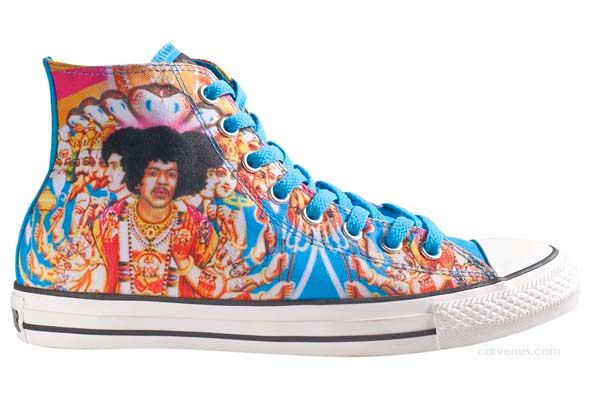
Shortly before midnight I receive an email from Manjula Sood (Chair of Leicester Council of Faiths) forwarding a message from British Hindu Voice - an organisation new to me. Their message is entitled "Insult to Hindu Faith - Hindu god images on shoes". At first sight this is utterly baffling - but after a moment's investigation, all becomes clear (if weirdly so).

18 September 2010 marks the 40th anniversary of the death of Jimi Hendrix, found dead in his flat at 22 Lansdowne Terrace, London. This anniversary is being commemorated in a variety of ways. Converse has produced a range of three special editions of its All Star training shoe, celebrating Hendrix in different ways. Two of them reproduce artwork from classic Hendrix albums ("Electric Ladyland and "Axis Bold as Love" respectively) while the other shows a detail from an iconic bandsman's jacket that Hendrix wore at some of his most memorable live performances.

Converse has made other shoes in honour of rock stars past and present, including the Grateful Dead, Janis Joplin, and The Who. None of those, however, has the associations that comes with the cover artwork of the second album by the Jimi Hendrix Experience: "Axis Bold as Love" (released in the UK, Dec 1967).

According to Wikipedia, Track records art department had independently chosen to follow the contemporary fad for all things Indian to provide the album's cover, which has a photographed copy of a mass produced religious poster of the Hindu devotional painting known as Viraat Purushan-Vishnuroopam with a small, superimposed painting of the three members of the Jimi Hendrix Experience themselves by Roger Law (from a photo portrait by Karl Ferris) blended in.

It was 1967 after all; there was a fad for all things Indian; it was all part of the psychedelic mystical mix of the time. In more than four decades that have passed, Hendrix has, of course become one of the greatest icons of that whole period, adaptable to many diverse purposes - and the cover artwork from "Axis Bold as Love" has been one of the most popular images associated not only with Hendrix himself but with that whole cultural milieu. In poster form, it has adorned innumerable bedrooms, clubs and record shops for over 40 years. I hope that no one is going to go all retroactive and think any good could come from protesting about the album artwork at this remove! From the forwarded email, I don't get the impression that the correspondent from British Hindu Voice knows either the pop historical context or the cultural status of Jimi Hendrix (or, for that matter, the economic clout of Converse). But the least that can be said is that times have changed since 1967 and I think it only proper that something should be said about the reproduction of these images from this popular Hindu devotional painting - on a shoe, of all things.