Interesting article in today's
SocietyGuardian about a new exhibition exploring the significance of the turban for Sikhs. I must make time to go and see this exhibition myself - it sound tremendous!
Reclaiming the turban's relevance
By Safraz Manzoor
British Sikhs' religion requires them to leave their hair uncut, and the turban is the most popular way for men to encase this long hair. But the turban has increasingly come to be associated with violent Islamic jihadism because members of the Taliban in Afghanistan wear turbans, as have some British Muslim terrorists in their suicide videos.
A new exhibition, Turbanology: Sikhs Unwrapped, which opens in Birmingham on Friday, is seeking to raise awareness about the true history of the turban and its significance for Sikhs. In addition to specially commissioned films and talks, the exhibition hopes to provide knowledge and perspective on the turban's spiritual importance and will provide hands-on demonstrations on how a turban is tied. Exhibition director Jay Singh-Sohal hopes that the exhibition will counter negative preconceptions of the turban.
"A survey for the exhibition suggests that 33% of turban-wearing Sikhs have received verbal abuse and a further 14% have faced racial discrimination because of their turban," he says.
Sikhs and their turbans have been in Britain since the 1860s and have historically been associated with bravery, loyalty and acts of courage as they fought for Britain during two world wars, and all over the empire. Their turban was representative of their identity and protection. In the immediate aftermath of 9/11, however, Sikhs came under attack from people who assumed their turbans meant they were Muslim radicals.
Singh-Sohal wants the exhibition to challenge this assumption that the turban represents something to fear. "The aim of the exhibition is to tackle these preconceptions in a fresh and fun way by focusing on the aesthetic, the symbolism of the turban and the things that British Sikhs have done to earn their place as respected members of our society," he explains.
The exhibition will travel to Derby, Slough and Leeds and at each location schools will be invited to participate so that young people can learn about the history and relevance of the turban.
In Britain, according to Singh-Sohal, the turban is seeing a revival among young British Sikhs who are finding new ways to wear their hair long. In India, however, the turban is in decline as more Sikhs cut their hair in order to fit in or to get jobs and avoid abuse. "All too often it is those Sikhs that come to Britain from India who cut their hair in order to be more western," says Singh-Sohal, "despite the fact that wearing the turban is protected by law in the UK."
Turbanology will be reminding visitors of the journey that British Sikhs have taken to ensure that the turban is accepted. Singh-Sohal says: "It will show it has an exciting future ahead as well as an illustrious history."
Turbanology opens at the Nishkam Civic Association, Birmingham on 10 June. Tour details at www.turbanology.info
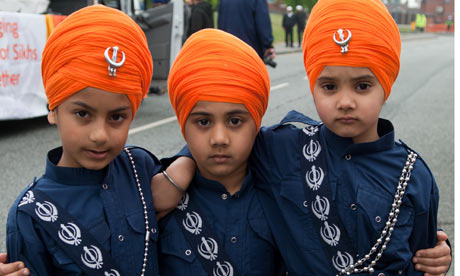
In the photo above: Young Sikh boys wearing traditional dress and turbans for the Sikh new year festival of Vaisakhi (photograph: Jaskirt Dhaliwal)
Read this article, along with reader comments (and the opportunity to leave your own) on the
Guardian Society off diary website:
http://www.guardian.co.uk/society/2011/jun/07/turban-exhibition-sikh-history?INTCMP=SRCH