Showing posts with label Spring Equinox. Show all posts

Sunday, 20 March 2011

A PRAYER FOR NAW-RÚZ


Sunset this evening is the end of the fasting period for Bahá'ís, who are obliged to abstain from food and drink between sunrise and sunset 2-20 March, inclusive. This fast is an annual occasion, leading up to Bahá'í New Year. For Bahá'ís in or from Iran, where the Bahá'í Faith originated in the middle of the nineteenth century, this is combined with the traditional celebration of Naw-Rúz ("New Day"), observed at the time of the Spring Equinox.

Leicester Bahá'ís are gathered together this evening to mark the end of the Fast and start of the New Year - the year 168 BE ("Bahá'í Era"). Below is one of the prayers of Bahá'u'lláh (1817-92) for this special occasion. This would typically be read at this time, either in community gatherings, in families are by individual Bahá'ís on their own, in quiet meditation.
Praised be Thou, O my God, that Thou hast ordained Naw-Rúz as a festival unto those who have observed the fast for love of Thee and abstained from all that is abhorrent unto Thee. Grant, O my Lord, that the fire of Thy love and the heat produced by the fast enjoined by Thee may inflame them in Thy Cause, and make them to be occupied with Thy praise and with remembrance of Thee.
Since Thou hast adorned them, O my Lord, with the ornament of the fast prescribed by Thee, do Thou adorn them also with the ornament of Thine acceptance, through Thy grace and bountiful favor. For the doings of men are all dependent upon Thy good-pleasure, and are conditioned by Thy behest. Shouldst Thou regard him who hath broken the fast as one who hath observed it, such a man would be reckoned among them who from eternity had been keeping the fast. And shouldst Thou decree that he who hath observed the fast hath broken it, that person would be numbered with such as have caused the Robe of Thy Revelation to be stained with dust, and been far removed from the crystal waters of this living Fountain.
Thou art He through Whom the ensign “Praiseworthy art Thou in Thy works” hath been lifted up, and the standard “Obeyed art Thou in Thy behest” hath been unfurled. Make known this Thy station, O my God, unto Thy servants, that they may be made aware that the excellence of all things is dependent upon Thy bidding and Thy word, and the virtue of every act is conditioned by Thy leave and the good-pleasure of Thy will, and may recognize that the reins of men’s doings are within the grasp of Thine acceptance and Thy commandment. Make this known unto them, that nothing whatsoever may shut them out from Thy Beauty, in these days whereon the Christ exclaimeth: “All dominion is Thine, O Thou the Begetter of the Spirit (Jesus)”; and Thy Friend (Muḥammad) crieth out: “Glory be to Thee, O Thou the Best-Beloved, for that Thou hast uncovered Thy Beauty, and written down for Thy chosen ones what will cause them to attain unto the seat of the revelation of Thy Most Great Name, through which all the peoples have lamented except such as have detached themselves from all else except Thee, and set themselves towards Him Who is the Revealer of Thyself and the Manifestation of Thine attributes.”
He Who is Thy Branch and all Thy company, O my Lord, have broken this day their fast, after having observed it within the precincts of Thy court, and in their eagerness to please Thee. Do Thou ordain for him, and for them, and for all such as have entered Thy presence in those days all the good Thou didst destine in Thy Book. Supply them, then, with that which will profit them, in both this life and in the life beyond.
Thou, in truth, art the All-Knowing, the All-Wise.

That line at the start of the prayer, "Thou hast ordained Naw-Rúz as a festival unto those who have observed the fast for love of Thee and abstained from all that is abhorrent unto Thee" always gives me pause for reflection. Having been diagnosed with Type 1 Diabetes in 1996 and being dependent on insulin since then, I'm unable to fast. I did it religiously (if you'll pardon the pun) from 1979 until 1996 and felt the benefit. I miss fasting. Thankfully, there's much in the Bahá'í writings about the symbolic, metaphorical nature of fasting and - thankfully - I appreciate symbolism and metaphor.

Sunday, 21 March 2010

spring has sprung!


Today, Sunday 21 March, is the Vernal Equinox - the first day of spring. It may be stating the obvious to say that this day has long been an auspcious day in many faiths and cultures - but it may also be acknowledging something normally taken for granted. I thought I'd devote an entry to going below the surface of how we see this day, from a number of different but related religious or spiritual perspectives.

The UN General Assembly in 2010 recognized the International Day of Nowruz, describing it a spring festival of Persian origin which has been celebrated for over 3,000 years. During the meeting of The Inter-governmental Committee for the Safeguarding of the Intangible Heritage of the United Nations, held between 28 September – 2 October 2009 in Abu Dhabi, Nowrūz was officially registered on the UNESCO List of the Intangible Cultural Heritage of Humanity. Since 2010, the United Nations General Assembly recognizes March 21 as the "International Day of Nowruz".

Naw Rúz is one of nine holy days for adherents of the Bahá'í Faith worldwide. The Bahá'í calendar is composed of 19 months, each of 19 days (with four "Intercalary Days" added in to make it up to 365 days), and each of the months is named after an attribute of God; similarly each of the nineteen days in the month also are named after an attribute of God. The first day and the first month are given the attribute of Bahá, an Arabic word meaning splendour or glory, and thus the first day of the year is the day of Bahá in the month of Bahá. Naw Rúz comes at the end of 19 days of fasting from sunrise to sunset, which takes up the last month in the Bahá'í calendar. Bahá'u'lláh wrote, "Praised be Thou, O my God, that Thou hast ordained Naw Rúz as a festival unto those who have observed the fast for love of Thee". As with all Bahá'í holy days, there are few fixed rules for observing Naw-Rúz, and Bahá'ís all over the world celebrate it as a festive day. Bahá'ís of Persian origin or background still observe many of the Iranian customs associated with Naw Rúz such as the Haft Sín, but Bahá'í communities would exemplify the diversity in their customs and practices today. Some may have a potluck dinner, perhaps with music or other live entertainment, along with prayers and readings from Bahá'í scripture. Bahá'ís in Leicester got together at Feast India on Melton Road for their New Year celebration today.

The calendar followed by Bahá'ís is a solar one, so the dates on which feasts and festivals etc are marked stay the same each year in relation to the Gregorian calendar. Each day in this calendar begins at sunset, so Naw Rúz begins (and the month of fasting ends) at sunset on 20 March. The first year in this calendar dates from 1844 CE, the year in which the Bahá'í era begins. So this Naw Rúz celebrates the start of the year 166 in the new calendar followed by the Bahá'í community.

The day is also used to symbolise the renewal of time in each religious dispensation. 'Abdu'l-Bahá, Bahá'u'lláh's son and successor, explained that significance of Naw-Rúz in terms of spring and the new life it brings. He explained that the equinox is a symbol of the messengers of God and the message that they proclaim is like a spiritual springtime, and that Naw-Rúz is used to commemorate it.

Read messages from Prime Minister Gordon Brown and Leader of the Opposition David Cameron to the UK Bahá'í community on the occasion of their New Year:
http://bahainews-uk.info/2010/03/20/prime-minister-sends-uk-bahais-naw-ruz-greetings/

Read a report of Bahá'í New Year being celebrated in the Houses of Parliament, sponsored by the All Party Parliamentary Friends of the Bahá'ís:
http://bahainews-uk.info/2010/03/23/bahai-new-year-celebrated-in-uk-parliament/

It's the first day of the new year ("Norooz") for Zoroastrians and Parsees, for whom it's the most important day of the year. Zoroastrian customs for Norooz include wearing new clothes, giving gifts, and settling disputes. Zoroastrians of Iranian origin generally put up a Haft Sin table as is tradition for Iranians.

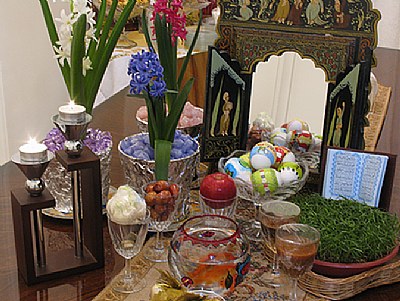
Haft Sín (Persian: هفت سین) or the seven S's is a major tradition of Nowruz. Today the haft sin table includes seven specific items, all starting with the letter S or Sín (س in the Persian alphabet). The items symbolically correspond to seven creations and holy immortals protecting them. Originally called Haft Chin (هفت چین), the Haft Sín has evolved over time, but has kept its symbolism. Traditionally, families attempt to set as beautiful a Haft Sín table as they can, as it is not only of traditional and spiritual value, but also noticed by visitors during Nowruzi visitations and is a reflection of their good taste. The Haft Sín items are:
  1. sabzeh (سبزه) wheat, barley or lentil sprouts growing in a dish, symbolising rebirth;
  2. samanu (سمنو) a sweet pudding made from wheatgerm, symbolising affluence;
  3. senjed (سنجد) the dried fruit of the oleaster tree, symbolising love;
  4. sír (سیر) garlic, symbolising medicine;
  5. síb (سیب) apples, symbolising beauty and health;
  6. somaq (سماق) sumac berries, symbolising (the colour of) sunrise;
  7. serkeh (سرکه) vinegar, symbolising age and patience.

     
A slightly less traditional Haft Sín may also include:
  • sonbol (سنبل) the fragrant hyacinth flower, symbolising the coming of spring;
  • sekkeh (سکه) coins, symbolising prosperity and wealth;
  • sekanjabin, a sweet mint syrup;
  • decorated eggs, sometimes one for each member of the family (fertility);
  • a bowl with goldfish, symbolising life (and the sign of Pisces which the sun is leaving);
  • a bowl of water with an orange in it, symbolising the earth floating in space;
  • A poetry book, such as the Shahnameh or the Divan of Hafez, and/or a holy book such as the Quran or the Bible (or a compilation of Bahá'í prayers if appropriate).
Zoroastrians of Parsi (South Asian) origin do not traditionally use a Haft Sin. They set up a standard "sesh" tray - generally a silver tray, with a container of rose water, a container with betel nut, raw rice, raw sugar, flowers, a picture of Zarathustra the prophet, and either a floating wick in a glass filled with water topped with oil for fuel, or an "afargania", a silver urn with a small fire nourished by sandalwood and other fragrant resins.

Find out more about how people of Persian origin all over the world are celebrating Norooz, first day of their national and cultural calendar:
http://payvand.com/blog/1389/2010/02/07/new-year-norouz-1389-2010-times-%D8%AA%D8%AD%D9%88%DB%8C%D9%84-%D8%B3%D8%A7%D9%84/

The Vernal Equinox is celebrated today by our Pagan friends. Find out more about the Pagan celebration of Ostara in the Northern Hemisphere:
http://web.grinnell.edu/groups/pagan/pagan-home-ostara1.html

I'd like to acknowledge Wikipedia as the source for most of this information.