Showing posts with label Faith Communities Health Champions. Show all posts

Monday, 21 May 2012

INTRODUCTION TO AYURVEDA 2: DISCOVER YOUR MIND-BODY TYPE


At Christchurch, Clarendon Park, for the second session in the course, "Introduction to Ayurveda", offered by Christians Aware as part of their Faith Awareness programme.

This evening, course leader Neena Joshi is joined by Dr Dave (photo above), who presents most of the session. Dr Dave worked within the NHS as a gynaecologist at Leicester Royal Infirmary for ten years, then as a GP with a practice off the Narborough Road. Now retired, he's following in the footsteps of his father, who was an Ayurvedic practitioner. Dr Dave's lengthy professional experience and deep knowledge allow him to make meaningful comparisons between allopathic and Ayurvedic medicine.

The goal of Ayurveda is to establish and maintain internal equilibrium. There are three ways in which this desired equilibrium may be disturbed: of external physical origin; of internal physical origin; and of mental origin. In Ayurveda, the mind is the root, seat and origin of all conditions, good and bad. Therefore, control of the mind is the first and most effective step in controlling the body. The mind cannot be controlled by the mind itself, but it can be influenced by control of the breath. At the end of the session, Neena leads us through a short exercise of alternate nostril breathing to demonstrate this effect on the mind. She also gives us homework: a sheet listing characteristics, internal and external, which would help each of us determine our own dosha - our mind-body type. We should all have a go at this before we meet up again for the next session.

As we're breaking up, I make an appeal for volunteers to take part in our Faith Communities Health Champions project with Leicestershire Partnership NHS Trust. I'd like to have a few people who have a lively personal interest in non-conventional medical treatment. It seems like I might have a few willing participants from this evening's group.

Friday, 27 April 2012

FAITH COMMUNITY HEALTH CHAMPIONS

In recent months, Leicester Council of Faiths has been working with Leicestershire Partnership NHS Trust on a few interesting projects.

One we're working on now is called "Faith Community Health Champions". This project is intended to help local NHS staff understand how the religion or belief of individuals impact on their experience of health, illness and well-being and how it influences their access and attitude to health care services locally.

This is being done by means of short video interviews, which will be used for internal training purposes.

Leicestershire Partnership NHS Trust has asked me to film a number of these video interviews with individuals from a variety of religions or beliefs living in Leicester, Leicestershire or Rutland. That includes Secular Humanists and people of no particular beliefs.

We're not necessarily looking for dramatic, life-threatening medical conditions. While that would be interesting of course, we're also keen to talk with those living with conditions such as insomnia, gastric reflux, flat feet - the kind of everyday niggling things that don't grab the headlines but can still make life miserable. They are all of interest in this project. If you have any kind of medical condition, have experienced illness or are in recovery from a medical procedure, then you could help.

The interview should last no more than ten minutes. The whole experience should take no longer than half an hour. Respondents are asked to sign a Release Form, giving Leicestershire NHS Partnership Trust permission to use the video interview for internal training purposes.

There's a set of seven simple questions which everyone will be asked. Nothing personal or confidential is involved:

  1. What’s your name?
  2. Do you identify with any particular religion or belief?
  3. Do you have any kind of medical condition?
  4. How does your religion or belief impact on your health needs and how you access health care services?
  5. Would you like to say something about your experiences with the local health service (good or bad)?
  6. Has anything happened to you with the local health service that you found either frustrating or supportive?
  7. If you could change one thing in your relationship with the local health service, what would that be?

Abida Hussain and I film the first of these interviews with one of our respondents this afternoon. We're hoping to do a dozen or so within the next two weeks. Any offers from volunteers will be gratefully considered.

Tuesday, 24 May 2011

CONNECTED COMMUNITIES: HEALTHCARE, MARKETS AND SERVICE DELIVERY


At Leicester Adult Education College today, for “Connected Communities: Healthcare, Markets and Service Delivery”. The workshop is being held in the college's Hansom Hall. This part of the college was recently renamed in honour of Joseph Aloysius Hansom (1803–82), the prolific architect who designed buildings that were to become the city's New Walk Museum & Art Gallery and part of Leicester Adult Education College. He's best known for inventing the Hansom Cab, a ubiquitous feature of 19th Century streets in several countries, which made its first journey on Hinckley's Coventry Road in 1835.

The Coalition Government envisages the future NHS as “the largest social enterprise sector in the world”. Part of this vision involves drawing the non-profit or ‘third sector’ into the welfare mix as a provider of care alongside statutory services. This workshop will clarify the nature and role of current and new relationships that will be needed for the “Big Society” to succeed.

This study is concerned with how diverse groups, communities and organisations hope to work and collaborate in order to play a productive and effective role in the fast-changing healthcare and social policy landscape. The aim of today's workshop is to provide a conducive environment and a safe forum for discussion of issues of common concern and so that further research can be conducted. 

The workshop is funded by the Arts and Humanities Research Council (AHRC), in partnership with other leading UK research councils. It is part of a scoping study and review on the theme, Connected Communities”.

The researchers aim to present the views of participants at workshops and other events in an impartial manner to that future research agendas can be established on sound evidence and practice. The research findings will be written up as academic journal papers, a report to the AHRC and will be presented at seminars and conferences.

We’ve been told beforehand that the research project has the following aims:
  • To identify what connections and partnerships work in the sector at present and are likely to work in the future.
  • To discover what kinds of new connectivities will be developed in the new markets for healthcare delivery.
  • To examine what new sacrifices and new benefits the new environment will bring for patients and local communities. 

And that our participation will bring the following benefits to our communities of interest:
  • Presentation of leading-edge research into what connections and partnerships matter for effective service delivery.
  • Practical group exercises to identify key partnerships that currently work.
  • Concrete ideas on next-generation connections and partnerships.

I get to display the Council of Faiths pop-up banner at the back of the hall. I was hoping that more of the community-based organisations represented today would want to display themselves in this way, but we’re the only one. We'd like to think that the Council of Faiths would be high up on the team sheet when this kind of event is being organised or this kind of project is being planned. We hope it could be said that the faith communities of Leicester are able to demonstrate a special kind of connectedness that can inform – and be informed by – such an event and project. On the other hand, when we put our minds to it we can also show a kind of disconnectedness – from each other and from society at large – that would probably beat virtually all others hands down!

Attendees are distributed around five tables, six people of mixed background, experience and interest round each one. I’m seated with Chino Cabon from The Race Equality Centre (TREC), Dee Martin from Leicestershire Centre for Integrated Living (LCIL) both of whom I work with on a regular basis in the Regional Equlity and Diversity Partnership (REDP) and Parmjit Basra from Leicester Adult Skills and Learning Service (LASALS) with whom I've worked most notably on Leicester Speaks. Some of us wonder if we’ve been corralled, so that we’re not able to mix our opinions in with others whom we don’t work with on a regular basis – a cynical notion that doesn’t stand up to scrutiny, I hope! The facilitator on our table is Prof. Carlo Ruzza, Co-investigator, AHRC Funding Award on "Connected Communities" at the University of Leicester’s Department of Sociology.

The session is opened by Dr Ming Lim, Lead Investigator, AHRC Funding Award on "Connected Communities" at the University of Leicester’s School of Management. She directs us to two icebreaker questions for each table. Firstly: “If you were to describe the NHS as an animal, which animal would you choose and why?” Here are some of the answers that we came up with around our table:
  • Gazelle: beautiful to behold, elegant and at home in its natural environment, blissfully unaware that just out of shot, a hungry lion is racing toward it, greedy death in its jaws.
  • Ostrich: with its head in the sand, hiding from reality.
  • Duck billed platypus: a bit of this and a bit of that, stitched together in an improbable unlikely and unconvincing manner.
  • Giraffe: head in the clouds, with only a tenuous relationship with reality.
  • Human being: claiming allegiance to one set of principles, but acting in a contrary way.

And secondly: “If the NHS’s service delivery was a form of transport, which one would it be and why?” Here are some of the answers that were offered around the tables:
  • Edinburgh's ill-fated tram system: they’ve spent most of their budget laying the foundations of a new system and now find that it’s been ruined by having normal traffic drive over the rails. Now they don't think there's enough money left in the coffers either to finish it or to scrap it – which would cost more than the former! (oops – is my Glaswegain schadenfreude showing through?)
  • Bus: involves queuing, sometimes not being able to get a seat and it not going all the way to where you want to go (amongst other drawbacks).
  • Oil tanker: hard to manoeuvre, hard to change course, disastrous consequences if it sinks or runs aground.
  • Bus in rural Africa: no timetable, no fixed route, too many people in too small a vehicle – but still it does the job.
  • UFO: some people report having had a close encounter with it, others are sceptical about its very existence (a stage whisper mentioned something about both involving people being subjected to undue amounts of “probing” but it went by unremarked upon).
  • Bennie railplane: a revolutionary system that was supposed to be the future of public transport, abandoned by the diversion of resources into war and eventually scrapped.
  • Earliest motor car: capable of going much faster than it did, held back by the requirement that it be preceded by a man waving a red flag.

After the icebreakers, we’re invited to take part in group discussions to help further this study. Each table is asked to consider three questions:

Question 1 In 2010, the government released a White paper on proposed reform to the NHS. One of its key proposals is that, for patients thee should be “no decision about me without me.” What is the significance of this focus on patient and user engagement for your organisation? 

Question 2 How do you think you can improve relations with your users and the community you serve in this time of change in the NHS?

Question 3 How have financial pressures over the last couple of years affected your organisation and your level of service delivery? 


I’m just putting the questions themselves in this blog entry, rather than picking and choosing from the wide range of responses. Perhaps you may be able to think of what some of the responses might have been, faithful reader – and to come up with a few of your own.

During the lunch break, members of the research team take the notes from the five tables off into another room, identify some headline themes, topics and comments from them and compile them into some slides that Dr Lim presents to us all after lunch. There’s speed and efficiency for you! So the afternoon session comprises Dr Lim debriefing us all from slides, followed by a “roving mic”session, in which attendees respond to the content of these slides and whether they represent fairly the things we discussed earlier in the day.

After the formal end of the workshop, several attendees stay behind to be interviewed for the study individually or in small groups (anonymously).

This would appear to be an interesting, timely useful project. I hope that Leicester Council of Faiths has the opportunity to be involved in the long term and to contribute positively to its progress and outcomes. There are ways in which it would appear to be complementary to our Faith Communities Health Champions initiative. We'd hope that our involvement in each of these projects would offer some crossover experience and learning, by which could inform the other.

In the photo above: Prof. Carlo Ruzza (left) and Dr Ming Lim (right).

Saturday, 21 May 2011

JEHOVAH'S WITNESSES ON THE DOORSTEP

This morning, there's a knock on the door from two Jehovah's Witnesses, two very nice ladies named Annette and Kelsey. I get the chance to talk with them about some of the work Leicester Council of Faiths is doing with the diverse faith communities in the city and ways in which local Jehovah's Witnesses might get involved.

The most relevant one would be the projects coordinating with Leicestershire Partnership NHS Trust. One is a set of guidelines regarding first presentation or admission from patients of different backgrounds, beliefs, practices or traditions; the other is the Faith Communities Health Champions Initiative.

They sound interested and ask me to step out into the street to talk with Steve, one of their elders who is out with them today. He's going to pass my card on to their local Hospital Liaison Committee and ask them to get in touch with me.

Steve and I talk for a few minutes about their local congregation, which sounds like it reflects the diversity of Leicester in miniature. I'd like the chance to meet with them and do a little feature about their community for the blog.

Thanks Steve, Kelsey and Annette - I'm looking forward to meeting you all again and making something positive come out of this serendipitous contact!

Friday, 10 December 2010

TO THE TOWERS


To the Towers, Gypsy Lane, this afternoon, for a meeting with Abida Hussain, Equality and Human Rights Officer with Leicestershire Partnership NHS Trust.

The possibility of a working relationship between Leicester Council of Faiths and the local health service was mooted at the first ever meeting of the Council of Faiths I attended after taking up this post. Back in July 2007, at that meeting where I was introduced to the members, Philip Parkinson (then Chair of the Primary Care Trust) and Tim Rideout (Chief Executive) were there to speak about recent changes in local health provision and the establishment of a Department of Equalities and Human Rights. From that time on, we’ve slowly spiralled around doing work for the Primary Care Trust (as it then was), then NHS Leicester City, and now Leicestershire Partnership NHS Trust. We do have a Service Level Agreement with them, but internal reorganisation and turnover of staff mean that we still haven’t really go this relationship in good order. The recent proposal of us supporting the "Faith Communities Health Champions" initiative has focused the need to straighten out our working arrangements.

At this late stage of the game, we're looking to show some quick wins, so Abida and I agree on a few pieces of work that could be done and dusted before Christmas.

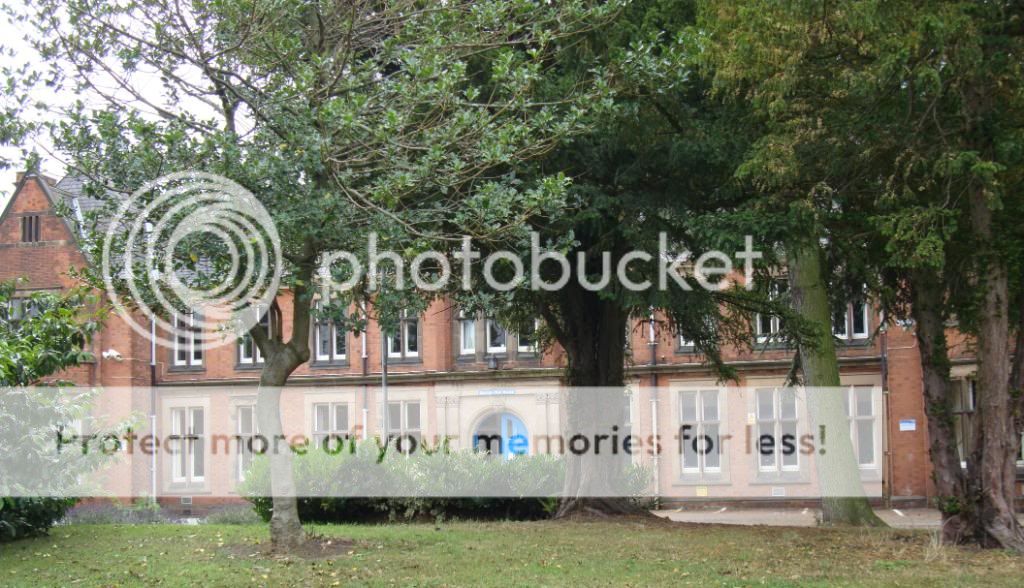
I can't allow my account of this meeting to go by without saying a little bit about the Towers itself. It was founded in 1869 as the Leicester Borough Asylum, then served as the Towers Hospital (as it was rneamed in 1947) until its closure as a treatment facility in 2005. Without really knowing anything about it (or even where it was) I was aware of it from my earliest times living around here as a place with a grim reputation. Occasionally it would feature in unpleasant and unfortunate news stories in the local media. Having taught for a few years inside the mental health service, many of the clients I’ve worked with would freeze at the mention of it – whether or not they’d ever been inside it themselves.

When I came to my fist meeting here, a few years ago, the person who received me then remarked, as we walked through the long, echoing tiled corridors, that you just knew that this place was originally established as an asylum, not a hospital. Hard to put into words exactly why that was so, but it most certainly was.


For an unsual vew of the Towers, visit the Urban Exploration Forum.