Friday, 8 April 2011

CREATIVE GARDEN HAS BLOSSOMED

This article appears in today's Leicester Mercury:
Creative garden has blossomed
Phoenix Square Film and Digital Media Centre recently hosted "Creative Garden" – a day-long event celebrating the wealth of creativity on the local scene, writes George Ballentyne.
Just about every available bit of space in the venue was packed with people showing their wares, demonstrating their skills and promoting the arts in business. The inside of the building was filled with stalls.
Visitors were treated to a variety of talents on display: fashion designers, film makers, jugglers, musicians, photographers, poets, writing services – even designers of apps for smart phones.
There was also a variety of talks, workshops and seminars on how to identify,nurture and promote creative talent and practical advice on how to use it to make a living.
Creative Garden was put together by the team behind "From Dawn to Dusk" [sic] with the collaboration of the LCB Depot in Rutland Street. The event drew on a wide range of contacts and contributors, showing how a successful network of imaginative and artistic individuals and businesses has become well established in and around Leicester over the past couple of years.
With events like this (alongside other activities such as CreativeCoffee club and Amplified Leicester), Phoenix Square continues to establish itself as a centre which attracts creative people from the city, county and further afield – and as a hub from which that creativity flows back out into the wider community, touching schools, colleges and the universities, offices and businesses, shops and public spaces.

Wednesday, 6 April 2011

PHILOSOPHY IN PUBS


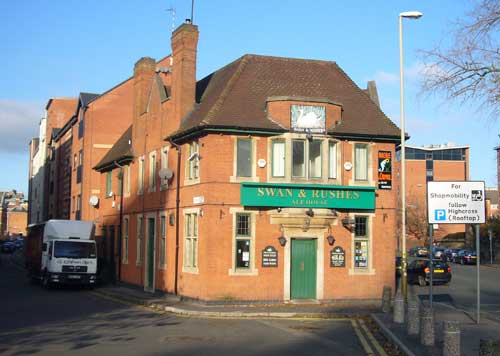
First Wednesday of the month means Philosophy in Pubs (PIPS) at the Swan & Rushes, Infirmary Square. We have a decent number for this meeting: we're in double figures!

Our stimulus this evening is a press release from the Department of Education about keeping order and discipline in schools.

CAMPAIGN AIMS TO DRIVE HOME TRUE MESSAGE OF ISLAM


This article appears in today's Leicester Mercury. After Leicester Secular Society ran their campaign encouraging people to tick the "No religion" box in the recent Census using bus posters, here's another example of that medium employed in a religious context.
Campaign aims to drive home true message of Islam

An advertising campaign to tackle Islamophobia will be coming to Leicester.

Last week, 160 buses in London and Glasgow began carrying the message "Muslims for loyalty, peace and freedom'', paid for by the Ahmadiyya Muslim Association.

The UK group hopes it will educate people about Islam and stop people connecting Islam with terrorism.

During the next six months the campaign is due to be rolled out across Leicester, Birmingham, Leeds and Bradford.

Volunteers will also distribute leaflets door-to-door throughout the UK explaining the peaceful and positive principles of the faith.

Rafiq Hayat, the Ahmadiyya Muslim Association's national president, said: "Through this campaign we are trying to clarify the true teachings of Islam, to speak out against injustices, suicide bombings and terrorism."

Last year, a YouGov poll of 2,152 people found that 58 per cent of those questioned linked Islam with extremism, while 69 per cent believed it encouraged the repression of women.

In a recent speech in Leicester, Baroness Warsi, the co-chairman of the Conservative party, said anti-Muslim prejudice had passed the "dinner table test" to become uncontroversial and socially acceptable by Britons.

Eagle-eyed readers will see, from the above photo of a London bus, that the poster also features that phrase that has come to be so strongly associated with the Ahmaddiya Muslim Association: "Love for all. Hatred for none".

I don't know; are we missing a trick here? Should Leicester Council of Faiths do something like this for our 25th anniversary? "We have faith in Leicester!" could make a real impact if used like this.

Oh and can you see what they did there? "Drive home" - on a bus? Good one, Mercury.

MAKE TIME FOR CAKE TIME


Phoenix Square is one of a number of venues joining in with Cake Time, fundraising for Shelter during 2-8 April. I'm always keen to support a good cause. I bought some white choc chip and banana loaf off of this table.


A little later, in Gallowtree Gate, I'm approached by fundraisers for Shelter, so I take the opportunity to show them the blog entry I wrote earlier today with the photo above, give them my card so they can read more of the blog at their leisure - and take their photo so I can put it on here and give more of a big up to Shelter. So that's Craig and Jasmine then, in the photo below.


Shelter can never get too much publicity or support as far as I'm concerned. In a former life, I used to teach adult literacy in some of the homeless hostels in Leicester. That's the kind of experience that would leave a lasting effect on anyone. I don't believe that there's any excuse for our society to allow, permit or tolerate homelessness. It's a stain on our national life - even the fear of homelessness should have no place in Britain today. But every two minutes, someone in Britain today has to face up to losing their home.

Tuesday, 5 April 2011

INTERNATIONAL GOLDEN RULE DAY


It’s International Golden Rule Day. I have to confess, I didn't know anything about this until today. Although the so-called Golden Rule is a staple for those involved in inter faith work or with an interest in comparative religion, I had no idea that a day had been marked for its annual celebration.

Here's how this recent addition to the calendar of United Nations observances and international days came about: in 2009 (International Year of Reconciliation) religious leaders in Ethiopia proclaimed 5 April to be Golden Rule Day. Ambassador Mussie Hailu (Chairman of the Interfaith Peace-building Initiative and representative of the United Religions  to the United Nations Economic Commission of Africa) had Golden Rule Day endorsed by the United Nations  (though I don’t know what that means, since it doesn't appear in the list of current United Nations Observances). It is now recognized by numerous organisations around the world. I'm not aware of anything being done to mark it in this country. So it's fitting that it find a place in in this blog.

For those of you who may be unfamiliar with the Golden Rule, it is generally regarded as a kind of moral constant, expressed in a verity of forms, different yet similar, across cultures and throughout history. It is to be found in the teachings of most, if not all, religions, faiths and belief systems and in many forms of philosophy, as can be seen in the examples below:

“And if thine eyes be turned towards justice, choose thou for thy neighbour that which thou choosest for thyself.” (Bahá'í: The Hidden Words)

"Hurt not others with that which pains yourself." (Buddhism: Udanavarga 5:18)

“In everything do to others as you would have them do to you.” (Christianity: Matthew 7:12)

"What you do not want done to yourself, do not do to others." (Confucianism: Analects 15:23)

"This is the sum of duty. Do not unto others that which would cause you pain if done to you." Hinduism: Mahabharata 5:1517)

“Hurt no one so that no one may hurt you.” (Islam: from the prohpoet Muhammad’s Final Sermon)

"One should treat all beings as he himself would be treated." (Jainism: Agamas, Sutrakrtanga 1.10, 1-3)

"Thou shalt love thy neighbour as thyself." (Judaism: Leviticus 19:18)

"We obtain salvation by loving our fellow man and God." (Sikhism: Guru Granth Sahib, Japji XXI)

"Do not do to others that which would anger you if others did it to you." (Socrates)

"Regard your neighbour's gain as your gain and your neighbour's loss as your loss." (Taoism: Tai-shang Kang-ying P'ien, c. 500 BCE)

"Whatever is disagreeable to yourself, do not do unto others." (Zoroastrianism: Shast-na-shayast 13:29)


Clearly, this is just a modest selection of such quotations. You can find many more, faithful reader, by the normal means online.

Monday, 4 April 2011

MINDFULNESS & MORALITY 12: FINAL SESSION

It's the twelfth and final session in the Mindfulness and Morality course, offered by Christians Aware as part of their Faith Awareness programme. It's the time for summing up and reflection, looking back over the course and thinking about what might come next.

Since we got into morality via the springboard of mindfulness, we start with a little bit pf practice: five minutes of silence, during which we're supposed to be open to thoughts popping up unbidden about what we've heard and discussed throughout these twelve weeks. Funnily enough, after having the rear part of the building to ourselves all these Monday evenings, the first time we try to sit in silence, the corridor outside our room is like Sauchiehall Street on a Saturday night! (Well, I could hear three different loud voices, anyway).

Kevin Commons and Ian Grayling (of the Zen Serene Reflection Meditation Group), who have been facilitating the course as a whole, ask us to talk in pairs, then mention to the group one thing that we found positive, negative or neutrally interesting. Ian wrote these up on the flipchart - my categorisation below isn't necessarily the same as his. Some of those things that the group seemed to find positive, negative or just "interesting", I thought should go elsewhere.
Positive
Speakers have been excellent throughout; they focused on the theme, rather than merely giving an introduction to their own faith or belief system (which has often bedevilled this kind of course in the past); most of the speakers were honest about the gap between ideal and practice.

Commonality: how much each speaker demonstrated the interest of their belief system in the needs of others; each of the speakers and the cultures, traditions or systems from which they came, clearly support the assertion that, "the smallest deed is greater than the grandest intention".

The dilemmas presented to us were genuine, contemporary and uncontrived; they were about the quotidian rather than the cosmic; they were not "either / or" questions, but recognised (even sometimes revelled in) grey areas and the middle ground.

Negative
We were always short of time!

Some of the dilemmas could be said to arise more from particular cultural backgrounds than from belief systems per se - maybe showing how cultures are shared or cross over between two or more religions (e.g. the "dharmic" faiths, arising geographically and historically in India); some of the dilemmas weren't so much ethical in nature as cultural (sometimes arising from the clash of cultures - e.g. between more traditional value and those encountered in the west).

Perhaps, occasionally, we could (or should) have been tougher on a speaker, pushing them farther than we did. We should have had the courage of our convictions and maybe said, "I don't understand how you come to that conclusion, can't appreciate the meaning of it - and I would say it's just plain wrong". Not arguing for confrontation, or that such an approach should have dominated, but it was noticeable by its absence. Perhaps we should consider ways of challenging beliefs, concepts and practices without making it seem an ad hominem challenge to the person. But it might make future courses more enjoyable and rewarding if we were to toughen up a bit.

There's an ever present danger of over-intellectualising; our responses to dilemmas are often determined or driven by our emotions and feelings as much as by the mind (if not more so); we don't always have the luxury of discussion in small groups and whole class feedback before making such decisions!

Interesting
More difficult than expected to get into the mindset of someone from a different culture.

Discussion of the dilemmas made us aware of a huge burden of self-reliance. While this inspired some, it made others want to flee the need to make their own decisions.

Some of the dilemmas could have come from more than one of the speakers - not so much about belonging to a particular belief system as about being human.

If we really believe that choice is good, then we should look on dilemmas as offering choices.

Some of the belief systems represented (e.g. Bahá'ís, Quakers) described means or mechanisms within their community practice to help individuals and/or groups resolve dilemmas (in the case of the former, a particular kind of consultation; in the latter, "meetings for clearness").

To close the session, we have another handout reminding us of Kohlberg's stages of moral development. We first encountered these in the second session and they occasionally surfaced throughout the rest of the course. I'm not sure to what extent we've really got to grips with this by the end. Maybe the group as a whole is too tired to engage meaningfully with Kohlberg at this late stage.

In terms of what we do after this, the next course offered by Christians Aware goes under the title, "Meeting and Meditation". Starting Monday 23 May, we'll be going out to various places of worship around Leicester and joining in devotional and meditative sessions. Hopefully, that will build on some of what we've done in the course just finishing this evening.

At this final session, I record a few short video interviews with some of the participants, saying a little bit about what they've made of the course. Earlier in the evening, one attendee pointed out that the number of men who were speaking (and the amount of time they were taking to do so) far outweighed the women. In connection with that observation, I should say that I asked every person here this evening if they would say something short that I could video. The ones you see on the Council of Faiths YouTube channel were the only ones who consented. You can see the videos on our Mindfulness & Morality playlist.

NEW STATESMAN: WHO ARE THE ENGLISH?


This week's New Statesman is a special issue on Englishness in which we look at a nation in the grip of an identity crisis. Dominic Sandbrook provides a history of English radicalism, Mehdi Hassan disputes the claim that multiculturalism has failed, and Jon Cruddas argues that Labour must rediscover a politics of English virtue.

Saturday, 2 April 2011

EMMANU'-EL APOSTOLIC GOSPEL ACADEMY


This afternoon the Emmanu'-El Apostolic Gospel Academy (based at De Montfort University) is performing at the Clock Tower in Leicester city centre. I last saw them here late at night on 15 December last year (see blog entry for that date). That night they were relatively few in number (as were their listeners), wrapped up against the unusually severe cold ten days before Christmas. Still it made a nice addition to our YouTube channel.

In contrast to that last time, today is bright, sunny and warm and the choir has gathered a fair-sized audience, many of whom join in, clap or dance along. The singers and other members of their congregation are wearing striking red and black floor-length outfits that really add to the special nature of their appearance here today (pity I didn't think to get a close up of one of them). I'm without my flip camera today, but use my iPhone to video them performing two songs for our YouTube channel (all done with permission of course). I don't know how good the sound quality might be or even the amount of time I can record on the iPhone; but I don't want to miss capturing something of the performance here today, no matter how short, no matter the quality of reproduction.

Watch the videos of the choir shot just before Christmas 2010 on the Council of Faiths YouTube channel.

MINDFUL WAYS TO USE SOCIAL MEDIA

An interesting article combining two big themes of this blog: mindfulness and social media. This is written by Lori Deschene (founder of tiny buddha, a multi-author blog that features wisdom and stories from people all over the world) published online by Tricycle magazine. In the Buddhist parlance, Lori Deschene describes the practices she lists as "right tweeting" (and you can follow hers @tinybuddha)

I don't necessarily agree with every one of these points, nor do I practise all of them, but I think it's an interesting set of principles which deserves to be mentioned here.
1. Know your intentions
Doug Firebaugh of SocialMediaBlogster.com has identified seven psychological needs we may be looking to meet when we log on: acknowledgement, attention, approval, appreciation, acclaim, assurance, and inclusion. Before you post, ask yourself: Am I looking to be seen or validated? Is there something more constructive I could do to meet that need?

2. Be your authentic self
In the age of personal branding, most of us have a persona we’d like to develop or maintain. Ego-driven tweets focus on an agenda; authenticity communicates from the heart. Talk about the things that really matter to you. If you need advice or support, ask for it. It’s easier to be present when you’re being true to yourself.

3. If you propose to tweet, always ask yourself: Is it true? Is it necessary? Is it kind?
Sometimes we post thoughts without considering how they might impact our entire audience. It’s easy to forget how many friends are reading. Two hundred people make a crowd in person, but online that number can seem insignificant. Before you share, ask yourself: is there anyone this might harm?

4. Offer random tweets of kindness
Every now and then I ask on Twitter, “Is there anything I can do to help or support you today?” It’s a simple way to use social media to give without expectations of anything in return. By reaching out to help a stranger, you create the possibility of connecting personally with followers you may have otherwise known only peripherally.

5. Experience now, share later
It’s common to snap a picture with your phone and upload it to Facebook or email it to a friend. This overlaps the experience of being in a moment and sharing it. It also minimises intimacy, since your entire audience joins your date or gathering in real time. Just as we aim to reduce our internal monologues to be present, we can do the same with our digital narration.

6. Be active, not reactive
You may receive email updates whenever there is activity on one of your social media accounts, or you might have your cell phone set to give you these types of alerts. This forces you to decide many times throughout the day whether you want or need to respond. Another approach is to choose when to join the conversation, and to use your offline time to decide what value you have to offer.

7. Respond with your full attention
People often share links without actually reading them, or comment on posts after only scanning them. If the greatest gift we can give someone is our attention, then social media allows us to be endlessly generous. We may not be able to reply to everyone, but responding thoughtfully when we can makes a difference.

8. Use mobile social media sparingly
In 2009, Pew Research found that 43 percent of cell phone users access the Web on their devices several times a day. It’s what former Microsoft employee Linda Stone refers to as continuous partial attention—when you frequently sign on to be sure you don’t miss out anything. If you choose to limit your cell phone access, you may miss out online, but you won’t miss what’s in front of you.

9. Practise letting go
It may feel unkind to disregard certain updates or tweets, but we need downtime to be kind to ourselves. Give yourself permission to let yesterday’s stream go. This way you won’t need to “catch up” on updates that have passed but instead can be part of today’s conversation.

10. Enjoy social media!
These are merely suggestions to feel present and purposeful when utilising social media, but they aren’t hard-and-fast rules. Follow your own instincts and have fun with it. If you’re mindful when you’re disconnected from technology, you have all the tools you need to be mindful when you go online.

Friday, 1 April 2011

This week's visitors

Here's the update on the number of pageviews the blog has received from different parts of the world in the week just ending.
  1. United Kingdom 292
  2. United States 112
  3. Germany 92
  4. Russia 50
  5. Slovenia 42
  6. Ukraine 28
  7. China 11
  8. Iran 11
  9. Netherlands 11 
  10. India 10

This week's total: 669 (last week's: 756)  These are aggregates of figures from the top ten countries only. Blogger's stats software doesn't show me numbers of pageviews below the tenth-ranking country.

Not bad for what's been a rather quiet week for new posts (recovery from the cataract operation is still slowing me down a bit).

If you're one of the visitors to the blog from one of these countries, why not leave a comment? Tell me something about yourself - and what you think of what you've been reading here.