We have a full meeting of the Council of Faiths in the Welcome Centre this evening. Seven of our eight member faith communities some of them in a variety of denominations.
Our topic this evening is a Code of Conduct for members. A Code of Conduct for Directors / Trustees has already been agreed - at this meeting we're discussing how this can be adapted to fit members of the wider Council.
Some members of longer standing, some past office bearers in years gone by, refer to a Code of Conduct produced by the Inter Faith Network of the UK, that had been agreed and adopted in the past. Not only that, Leicester Council of Faiths has played its part in developing this code and is a signatory to it on a printed list on the published version of the code itself (which is available in a variety of community languages). At some point, the fact that we'd signed up to this dropped off our radar and when it was felt again that such a thing was necessary, a new one was created, based on good practice among charities and and voluntary organisations, rather than turning to this one.
Rahter than simply junk this recently written one in favour of the existing code by the Inter Faith Network (which seemed like an option at one point), we discussed how to use them in a complementary way, recognising the special nature of our institution and our work in Leicester. We had a similar discussion about the relation between a Code of Conduct and our Articles of Association.
By the end of the evening, we'd collectively read through the proposed Code of Conduct, trimming and refining it, and agreeing on its wording. I think we were all pleased with how this evening went. The meeting was conducted in an affable, supportive way, with a lightness of touch.
When we're provided with the accepted form of this Code of Conduct, I'll publish it here.
Tuesday, 18 January 2011


networking at Network for Change

The Management Committee is having a special session today on sustainability and identifying new funding streams. I've been asked to take half an hour to present something about how I've made my own post at Leicester Council of Faiths sustainable way beyond the end of initial funding from central government (which ran out in March 2008). Of course, I've only had to bring in enough revenue to keep my own post alive, while Network has much grater and more complex needs. I hope that some of what I say proves useful and adaptable though.
Find out more about Network for Change:
http://www.networkforchange.org.uk/
Monday, 17 January 2011
MINDFULNESS & MORALITY 1: EXPECTATIONS, GROUND RULES, PROCESSES

At Christchurch, Clarendon Park, this evening for the first session in a new course, "Mindfulness & Morality", offered by Christians Aware as part of their Faith Awareness programme.
The 12-week course has been devised by Ian Grayling and Kevin Commons (photo above) from the Leicester Serene Reflection Meditation Group. There are 24 people present this evening, half of whom are new faces to me.
Now I swear that the first two words I heard as I entered the room were "blog" - and "blog". Ian, Kevin and Barbara Butler (who runs Christians Aware) were standing talking together as I came in and they asked me right away if I'd be writing up this course. As if I'd be doing anything else!
This time last year, Ian and Kevin facilitated a course of similar length on Mindfulness Through the Senses. I blogged extensively throughout that course (see entries passim). I found it a very interesting and rewarding experience and am only too glad to have signed up for this new course. There were a number of issues raised in that course that couldn't be addressed then - so this course is something of a follow-on although it will still be accessible to newcomers. One such question brought up this evening, regards the nature of a mindful sniper. From a Buddhist perspective, the moral dimension emerges from "right mindfulness" not just mindfulness alone.
The first two introductory sessions are described as being "faith-neutral", serving as a launchpad for the "faith-specific" presentations to follow. The Council of Faiths leaflets for the faiths involved are being given to attendees, as a way of saving presenters from having to do a basic introduction to their respective faiths and get right into the moral issue in question.
In this first session, we're considering groundrules. To help us in our reflection and discussion, we're given a handout with some "exemplars" (adapted from the work of P. Senge):
Suspending assumptions and agendas
Typically people take a position and defend it, holding to it. Others take up opposite positions and polarization results. In this session, we could like to examine some of the assumptions underlying our direction and strategy and not seek to defend them.
Acting as colleagues
We are asking everyone to leave his/her position at the door. There will be no particular hierarchy in these meetings, except the facilitator who will, hopefully, keep us on track.
Spirit of inquiry
We would like to have people feeling able to explore the thinking behind their views, the deeper assumptions they hold, and the evidence they have that leads them to these views. So it will be fair to begin to ask other questions such as "What leads you to say or believe this?" or "What makes you ask about this?"
Expectations & concerns
We're given a few minutes to discuss these in small groups, then speak up to have them added to the flipchart.
- is it limited to human beings?
- relation between law and morality
- not just knowing but the power to do good
- will representatives of the different faiths be fundamentalist or liberal
- religious correctness or morality
- the idea of decency as a moral construct
- how much common ground will we actually find among the religions?
- which is more important: the individual or the group?
- who decides?
- can a coerced action be a moral action?
- place of compassion and concern for other people
We're given an exercise to carry out, once again in small groups before reporting. back to the whole class.
Cave Rescue
The Abbeydale National Park has recently opened up a new show cave to the public. Although great care was taken to ensure the safety of this attraction, extreme weather conditions have caused a roof-fall, blocking the main entrance and exit and partially blocking a service tunnel which now the only route out. Thirteen visitors together with the cave's resident guide have now been trapped in the main chamber of the cave for six hours - two other died instantly in the rock-fall. The cave is now in total darkness and the survivors are cold, wet and beginning to show signs of shock.
You are the local cave rescue team
The guide's two-way radio has enabled you to talk to the survivors whilst two of your team have been clearing their way through the service tunnel. They have just returned with the worst news of all - the severe rain coupled with the rock-fall is causing the cave to flood.
All of the trapped visitors are local villagers who won tickets to the attraction in a raffle organised by the Abbeydale Natural History Society. As local people yourselves, you have got together with the Site Director and her staff to produce some brief profiles pooling what you know about the individual survivors.
Because of the damage to the service tunnel, you are only able to rescue one person at a time and it will take 30 minutes per person. You calculate that the cave will completely flood in three to three-and-a-half hours and you will have to decide who you will rescue and in what order.
Your decision will determine who will live and who will die.
We're presented with a list and biographical sketches of 14 people trapped below and we have to pick the ones to save: and we can only save, at most, half the people down there.
Winston Barnes (38) Official Cave guide: ex SAS - very fit and cool under pressure. Has had difficulties adjusting to civilian life after being caught behind enemy lines and tortured during the Gulf War. His wife has left him following repeated bouts of unpredictable behaviour and violent outbursts.
Humphrey St John-Smythe (68) Ex MP and leader of the local Hunt. Owns a factory employing 72 local people which is unlikely to keep going once he has gone. The factory is the major employer in the nearby village.
Edwina St John-Smythe (64) Wife of Humphrey. Well known for her charitable work - has raised many thousands of pounds for good causes over the last five years.
Paul Gallimore (19) Mildly autistic. Attends nearby special day centre with Molly. Both he and Molly were chosen to join Stanley Walker (their care worker) for what was to be a very special day out.
Molly Croft (22) Severely learning disabled. Attends nearby special day centre (same as Paul). It has recently been discovered that she is three months pregnant.
Stanley Walker (38) Married with five children (8 months to 14 years). Popular with both staff and service users. He is thought to be having an affair with a colleague at work.
Prakesh Acharia (49) Unmarried. Religious leader for the small local Hindu community. He did a great deal to help integration and ease tensions after a spate of racially motivated arson attacks on Asian businesses during the late 1980s. He is the new Labour candidate for the constituency.
Katie Carre (22) Local singer and dancer. Has recently been spotted by a record company talent scout and is about to sign a recording contract.
Brian Conroy (54) Brilliant research scientist. A bit of a loner - convicted of a relatively minor sexual assault on a young boy 15 years ago and was forced to resign as the local scout leader. He is thought to be close to making a breakthrough in cancer research.
Leanne Drury (39) Unmarried, single parent of three children (16, 18 and 22 years). She seems to be winning a long battle with an alcohol problem and now attends adult literacy classes. Her 16-year old daughter has just given birth to twins.
Baz Baker (19) Baz has a criminal record starting when he was 12 years old - including a serious assault on a pensioner. He appears to have turned over a new leaf since starting community service at the nearby day centre for young people with learning disabilities. He now wants to get an NVQ in Care.
Madge Byers (72) "Super Gran" - has been campaigning for better leisure opportunities for the elderly. She promotes an active lifestyle, by example - she recently parachuted from a balloon to raise money for Age Concern.
Richard "Blinkey" Byers (78) Madge's husband - a Second World War hero. Repeatedly risked his life to save trapped and wounded civilians and soldiers, whilst under heavy enemy fire and having been wounded twice. He is well known for his generosity and kindness.
Gary Needham (27) Local gay rights campaigner. He gives up a lot of his spare time working for the Samaritans and visiting a nearby Hospice for terminally ill children.
Well, faithful reader: it's the Kobayashi Maru, isn't it? I'm sure you can imagine what sort of calculations and deals were made as we tried to decide who should be saved and who left behind. Some favoured the elderly, some the young, some held to that old-fashioned British way of doing thins, "Women and children first!" Some complained that it was an impossible task, some refused to take part, some protested that it was unfair to be asked to make our choices in just 15 minutes and that we should have been given this as homework so that we had more time to decide. Some tried to work out who should be left behind, rather than who should be saved - but by the time that would have been done, everyone would have died and no one would have been rescued. We made our choices, in our group of five. Basically, we just went round and picked one each. When one member of the group couldn't pick, the next one in turn got to pick two. We completed our task as a matter of expediency. The group[ next to us couldn't decide, so ended up picking no one. Another group put the names form the list into a hat and picked them out at random. Ian, facilitating this activity, asked if that was a moral choice or whether it was a way of avoiding a moral choice. I felt it was moral, inasmuch as it would have spared the rescuers from sleepless nights worrying whether they'd made the right decisions and what would if happened if ... (analogous to a firing squad being given one blank bullet, so that each soldier could convince himself that he was not one of those who fired a fatal shot). What we couldn't account for, of course, was the attitude and behaviour of those who were supposed to be trapped and in need of rescue. Would they have been moved by acts of heroism, sacrifice or selfishness? it would be a very different sort of game if we had been asked to play it from their side.
I'm sure you see the point of this game in the context of this course. It helps make us aware that there are processes, prejudices behind how we make choices, decisions, judgements - and how other people may be led to make different ones from us by processes and prejudices of their own.
Sunday, 16 January 2011
THE BIG QUESTIONS, LIVE FROM LEICESTER

The Big Questions (series 4, episode 2) is broadcast live from Samworth Enterprise Academy, Leicester, at 1000 this morning. Harry and I crane our necks to spot the BBC Outside Broadcast trucks at the back of the school, as we go past on the way to St Thomas the Apostle Church, just before 0930.
I'm no fan of this kind of show. I wouldn't fancy going on one and I don’t like watching or listening to them either. I've seen a few, of course, enough to know they're not my cup of tea. I’m all in favour of open, honest discussion, but I favour the statement attributed to 'Abdu'l-Bahá, that “if two people quarrel over some religious subjects, both of them are wrong.” No good ever comes from arguing about religion.
I make an exception for today’s broadcast, because Leicester Council of Faiths has been asked to put forward someone who can make a contribution to the programme, speaking about how the religion they follow is a guide for daily living. I’ve had several phone calls to and from the production office for the show, asking if we could provide someone to fill that role. We were asked if that person could be an evangelical Christian, but I sought to persuade them that such a person wouldn’t rally represent the religious diversity of Leicester and that it would be better to have a Hindu or Sikh. So that person is our own Resham Singh Sandhu. In the event, though, he's not called on to speak. That's disappointing. The show could have done with a voice of reasonable, calm authority at that point. What we get instead is a spokesman for Messianic Judaism, probably in the interest of stirring things up a bit more.
Nicky Campbell hosts the programme. I like Nicky Campbell and think he's good at this sort of thing, both on TV and on radio (though he doesn't need me to tell him that). Special guests are DameAnn Leslie, journalist and broadcaster; Jonathan Bartley, Director of the Christian think tank Ekklesia; and Myriam Francois Cerrah, Oxford UniversityIslamic Society.
I count 68 people in the studio audience (not including the host and the three special guests out front). Apart from Resham, I recognise Allan Hayes, Mike Burden and Richard Hopper (all three of Leicester Secular Society) and ... well, that's all actually. When Nicky Campbell names one of those making a number of contributions as David Jennings, I can add another to the list (Rev. Canon David Jennings, Vicar of St Catherine's Church, Burbage; I knew the name but not the face until today).
Three "big questions" are discussed today:
- Will bankers go to heaven?
- Would pre-nups undermine marriage?
- Is Islam a better guide for life?
In connection with that first question (which many of those involved seem to take literally rather than metaphorically), one contributor states that, "There are 2,350 verses in the Bible about misuse of wealth and property and only 500 on prayer and faith." The segment addressing the third question gets a bit testy and shouty. That part pretty much exemplifies the things I don't really care for in this type of show. When I speak to Allan Hayes the next day and ask him his impression of having been there, he says it was like "observing a family row".
I'm unhappy how the show gives the impression that these people are from Leicester, that these are the topics exercising us and that this is how we conduct our relations here. Most of them are not from round here, we're not knocking ourselves out over these issue and we don't go about our business like this. I'm not sure that giving such an impression is good for Leicester or its image nationwide.
CELEBRATING WORLD RELIGION DAY IN LOUISVILLE KENTUCKY
Today (third Sunday in January) is World Religion Day. Established in 1950 by the National Spiritual Assembly of the Bahá'ís of the United States , World Religion Day has been increasingly taken up in other countries - at first by national and local Bahá'í communities in different parts of the world, although it has also become an event widely recognised and keenly celebrated by people of other faiths too. Its purpose is to bring together people of various faith communities, to celebrate the unifying power of religion, to promote inter faith understanding and to encourage religious leaders and adherents to acknowledge the similarities between their faiths and work together for the common good.
There's no celebration of World Religion Day in my neck of the woods today; but I wouldn't want it to pass unmarked (here in the blog, at least). So I thought I'd cast my net a little further afield and blog about the first thing I could find on this event, anywhere in the world. And here is the first mention that I found, from the pages of the Courier-Journal, in Louisville, Kentucky, USA (which came to me via Twitter, through @ReligionUpdate).
Bahá'ís holding "drop-in" prayer
Religion Day vigil open to all
A 24-hour prayer vigil to observe today as World Religion Day began Saturday night at the Louisville Bahá'í Center.
Organizers invited people of all faiths and beliefs to come to the center, at 3808 Bardstown Road, at any hour to participate.
“Stop by after you get off work at midnight, or 7 a.m., or after church or after a movie, or before you start your Sunday activities. This is a participatory prayer gathering,” said Nancy Harris, a member of the administrative body of the local Bahá'í community.
The Bahá'í faith is a monotheistic religion founded in Persia that emphasizes the spiritual unity of all humankind, and seeks to “unite people of the world and establish world peace,” Harris said. There are an estimated 200 followers of the faith in the Louisville area, and an estimated 6 million around the world.
Harris said the vigil grew out of the faith's efforts to end the persecution of its followers in Iran. Bahá'í is the largest minority religion in Iran, but it is not recognized as one and its followers have been arrested and imprisoned by the government.
“But we also recognize that people of many faiths around the world are often persecuted when they are in the minority. Whether instigated by governments, organizations or individuals, oppression and persecution are rampant in many countries,” Harris said.
At the conclusion of the prayer vigil at 7 p.m. today, the center will host a free talk by Terry Taylor, executive director of Interfaith Paths of Peace on “Reclaiming Religion and Freedom of Conscience.” The program is open to the public. Directions and additional information can be found at http://www.louisvillebahai.org/
As with all such online articles, reader comments are invited and published on the site. When I looked at the page, there were two - both of which I've reproduced below.
fnal11860 wrote:
Yeah! Another useless day of prayer for world peace. What a racket! If this is an interfaith activity, which "God" is prayed to and which one actually does something for world peace?
If I was at Terry Taylor's speech I would ask him what exactly he is trying to re-claim religion from? As long as everyone clings to their respective texts (most of which encourage violence and hatred) there isn't much one can do.
How about you all go out and lobby your congressmen and women for peace? How about meet with people at the UN and talk peace?Praying to imagined, invisible beings in the sky never has and never will accomplish anything.
while willie01 wrote:
Good luck. The world needs all of the prayer, peace, and unity it can get.
How's that for good old-fashioned journalistic balance? Though sorry if I misled you, faithful reader, into thinking that I was actually celebrating World Religion Day in Louisville, Kentucky myself (chance would be a fine thing!)
Saturday, 15 January 2011
CITY'S CHRISTMAS DECORATIONS HANGING ON
.JPG)
Although Twelfth Night – the traditional time to take them down – was more than a week ago, some of the city council's festive displays are still hanging.
Leicester City Council has yet to remove decorations from near the Highcross shopping centre, Humberstone Gate and Belvoir Street. Clear-up work also remained incomplete yesterday in the High Street and the Lanes.
A council spokesman said: "The majority of the city centre decorations were switched off on twelfth night – January 6, but we always leave some on in the Town Hall Square for the Eastern Rights Christmas celebrations.
"We are in the process of taking the rest of them down but, as they are put up over a two-month period, we can't take them down instantly.
"We are taking them down overnight or on Sundays to keep disruption to pedestrians and traffic to a minimum, and expect them to be all removed by the end of next weekend."
Yesterday, shoppers in the city centre were still noticing the decorations.
Glenfield resident Karen Edeson, 49, said "I suppose these things just take time. The council will probably get around to it eventually."
But Steve Brookes, 63, said: "It's completely inappropriate to have them up after the Christmas period. Some residents, however, have taken a much more patient view."
Friday, 14 January 2011
another chat with Dr Chapman

Today, Rachel is here to interview me for a research project she's currently involved in, entitled, “Faith in Partnership: The Scope, Challenges and Methods of Effective Partnership Working Between Local Government and Faith and Belief Groups”. This is described below.
Religion and belief has become increasingly significant for local authorities through, for example, their inclusion in the Equality Act, a greater recognition of a positive contribution faith and belief groups can make in the public realm, and increasing religious diversity. New opportunities and expectations for partnership working between local government and faith communities have subsequently emerged. These include representation on partnership bodies (e.g. Local Strategic Partnerships), consultations and the provision by faith-based organisations of state funded welfare services and programmes. Their engagement is valued in terms of enhanced policy responsiveness and service performance as well as enhancing democratic participation by widening representation and accountability. More recently, a role for such groups has been identified in connection with realising and shaping the “Big Society”.
Previous research and stakeholder scoping highlights a number of key challenges for local authorities in working with faith and belief groups. These can include lack of experience and/or knowledge about who best to work with and how to assess and facilitate representativeness and accountability, together with a lack of capacity and resources (particularly in light of public sector cuts). Little research has been done to identify how these challenges are being addressed at a local level and to identify transferable knowledge, good practice and learning.
In the context of a limited evidence base, the research will explore partnership working between local government and faith and belief groups (inc. humanist groups). The objectives of the research are to:
In the context of a limited evidence base, the research will explore partnership working between local government and faith and belief groups (inc. humanist groups). The objectives of the research are to:
- examine the level, nature and models of engagement and representation;
- identify the opportunities from engagement via local authorities;
- highlight the challenges faced by local authorities and faith/belief groups in working together, and identify ways of addressing these;
- identify the impacts of engagement/representation and approaches to evaluating effectiveness;
- explore the role and significance of religion and belief in shaping the actions of representatives, elected members and officers;
- identify good practice and opportunities for policy learning.
The project is funded by the Local Government Improvement and Development Agency, and is supported by the Department for Communities and Local Government. A summary of findings will be circulated to all research participants, and will be made more widely available to practitioners, policy-makers and researchers.
This will be a thematic report, with four case study "vignettes":
- Barnet
- Leicester
- Pendle
- Watford
See Dr Rachel Chapman's profile on the website of Northumbria University:
http://www.northumbria.ac.uk/sd/academic/sass/about/socscience/deptstaff/rchapman/
Leicester Speaks again!
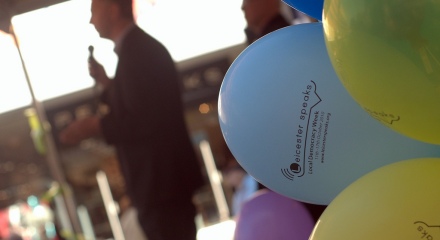
We're not sure of national dates for Local Democracy Week yet, but we're planning on running it in Leicester over two weeks: a pre-launch week (beginning Mon 10 Oct) concentrating on schools and colleges, then the week proper (beginning Mon 17 Oct). That second week is Half Term, which will hopefully allow us greater participation from young people.
We've all got our thinking caps on. What can we do for 2011 that will be new and innovative, that can build on what we achieved last year?
We'll probably extend the public launch event throughout the day, rather than run it for an hour or so, as we did last year. We might have (say) three sessions: morning, lunchtime and late afternoon, perhaps with themed groups taking part in certain slots.
We're also commissioning our own mobile Speakers' Corner, to replace the one we borrowed from Speakers' Corner Trust last year.
There's also the possibility of linking up with Birmingham and Nottingham, to give the week some stronger coverage across the Midlands. Leicester Council of Faiths might be able to do something in association with inter faith organisations in those cities.
A promotional event, introducing Leicester Speaks to potential new stakeholders, is being planned for next month. A six-page brochure (with DVD) will be published then, showcasing what was done last year and promoting what can be done later this year.
With withdrawal of funding for our role as Host Organiation from 31 March, this is one of the activities we may not be able to continue after that date. I've made that known to the group.
Find out what happened in Leicester Speaks 2010:
http://leicesterspeaks.wordpress.com/2010/11/04/thus-spake-leicester/
Thursday, 13 January 2011
small request for The Big Questions

I take a call this afternoon at the Welcome Centre from Amanda Egbujo. She's a Producer with Mentorn TV, working on the religious affairs programme "The Big Questions", in which Nicky Campbell (photo above) hosts a series of religious, moral and ethical debates. The next edition will be broadcast live from Samworth Enterprise Academy in Leicester this coming Sunday (16 Jan). The show goes out on BBC1 at 1000.
The programme will focus in part on Islam as a guide for daily living. Amanda asked if the Council of Faiths could provide someone from another of the city's faith communities to speak about how their own faith guides them in daily life. She agrees that a Hindu or Sikh would be appropriate, being Leicester's next largest "minority" faith communities. If we're unable to offer anyone from either of those two communities, I'm sure she'll be happy to have someone from another faith background, as long as they can do the business on live TV.
I tell Amanda that if we are able to offer someone, then it would not be for purposes of argument, dispute or controversy – that the Council of Faiths is not in the business of promoting division or dissension between the faith communities. She told me she's happy with that.
When Amanda gives me her office number, I realise that she’s calling from Glasgow. She has a Scots accent and remarks upon mine (and my guid Scots surname). So I take the opportunity to tell her a wee bit about my having started inter faith work in Glasgow when I was 19 (!) and how I still keep in touch with how that sort of thing is going up there. Of course I ask her to read the blog – I’m sure she recognises that well-worn phrase (well-worn by me, anyway), “Not backwards at coming forwards”.
I’ve sent out an email asking for someone suitable to come forward; now waiting to see what kind of response will be forthcoming. By coincidence, at that very time on Sunday mornings (well, every other Sunday, including this one) I'm sitting in the cafe of TESCO, South Wigston, reading the Observer or marking assignments from my Open University students, after dropping off Harry at St Thomas the Apostle where he sings in the choir. That's only half a mile or so from Samworth Enterprise Academy.
Image Source Page: http://www.mentorn.tv/
The programme will focus in part on Islam as a guide for daily living. Amanda asked if the Council of Faiths could provide someone from another of the city's faith communities to speak about how their own faith guides them in daily life. She agrees that a Hindu or Sikh would be appropriate, being Leicester's next largest "minority" faith communities. If we're unable to offer anyone from either of those two communities, I'm sure she'll be happy to have someone from another faith background, as long as they can do the business on live TV.
I tell Amanda that if we are able to offer someone, then it would not be for purposes of argument, dispute or controversy – that the Council of Faiths is not in the business of promoting division or dissension between the faith communities. She told me she's happy with that.
When Amanda gives me her office number, I realise that she’s calling from Glasgow. She has a Scots accent and remarks upon mine (and my guid Scots surname). So I take the opportunity to tell her a wee bit about my having started inter faith work in Glasgow when I was 19 (!) and how I still keep in touch with how that sort of thing is going up there. Of course I ask her to read the blog – I’m sure she recognises that well-worn phrase (well-worn by me, anyway), “Not backwards at coming forwards”.
I’ve sent out an email asking for someone suitable to come forward; now waiting to see what kind of response will be forthcoming. By coincidence, at that very time on Sunday mornings (well, every other Sunday, including this one) I'm sitting in the cafe of TESCO, South Wigston, reading the Observer or marking assignments from my Open University students, after dropping off Harry at St Thomas the Apostle where he sings in the choir. That's only half a mile or so from Samworth Enterprise Academy.
Image Source Page: http://www.mentorn.tv/
Service Level Agreement with NHS Leicester City
Meeting this morning at St John's House, East Street, with Abida Hussain, Equality and Human Rights Officer with Leicestershire NHS Partnership Trust. We're discussing the Service Level Agreement with Leicester Council of Faiths. It took us a long time to get this agreement, now we're looking at pieces of work that need to be done before the end of the current financial year. Most relevant among these is a booklet which addresses needs of patients and their families when individuals of diverse backgrounds first present for examination or treatment. It coves some of the standard topics for this sort of publication (diet, dress code, modesty, end of life care) but in a very succinct form (and, in this "field trial" version, on laminated, wipe-clean pages). There are many versions of this sort of thing out there, of course, but more often than not, they're over-complicated with much too much information in them. Sometimes, you can't see the wood for the trees - and those compiling such guidance them don't know where to stop, as they're often fearful that the thing they omit will be the thing that catches them out!
I'll be helping bring it up to date, ensure an accurate list of local contacts, and import whatever learning may be relevant from other projects, such as the booklet series, "Engaging with Faith Communities in Leicester".
I'll be helping bring it up to date, ensure an accurate list of local contacts, and import whatever learning may be relevant from other projects, such as the booklet series, "Engaging with Faith Communities in Leicester".
Subscribe to:
Posts (Atom)