Friday, 18 June 2010

US ROTARIANS VISIT GURU NANAK GURDWARA


A group of Rotarians from South Carolina, USA, are on an exchange visit to the East Midlands. At lunchtime today, they're visiting the Guru Nanak Gurdwara in Holy Bones. Mrs Surinder Sandhu has asked me to come to the gurdwara and be part of the small group receiving the visitors there.

The Guru Nanak Sikh Museum, which occupies the first floor of the building, was the first Sikh Museum in Europe. It opened in 1992 and its tenth anniversary was marked by a visit from the Queen – her first visit to any gurdwara on British soil. The museum recounts the narrative of Sikh history and the most important and influential figures in that narrative, mostly through paintings and photographs. So many people in these pictures, all of them important to the people here – and I know nothing about them. Humbling, really, to recognise such a big blank in my own knowledge; rather the way I felt when I saw the Fluying Sikhs documentary.

Also on display are models of The Golden Temple at Amritsar, Nankana Sahib (birthplace of Guru Nanak, founder of Sikhism) and five other distinguished Sikh shrines in different parts of India, known as Takhats (Seaats of Authority). The photographic gallery displays photographs dating from as early as the 1840s of those people who took part in the struggles faced by the Sikh Nation and also commemorates the role played by Sikh servicemen in both World Wars and in the struggle for India's freedom. A selection of Panjabi handcraft (Phulkaris), ancient Sikh coins, hand-written manuscripts and more are also on show.

Surinder has asked for me to provide copies of the leaflets on the Sikhs which have been produced by Leicester Council of Faiths. I also bring along the banner from our (newish) exhibition, which I get to put up in the gurdwara (and leave on show over the weekend).

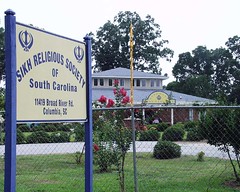
I'm honoured to be asked to be present for this visit, although the visitors don't get to stay very long and don't have the chance for much interaction. We receive langar together; a table is set out for our American friends, who dine together, separate from their hosts, most of whom sit on the floor to eat. I'm not very good at sitting on the floor, so I take the chance to push in (politely) and chat with a few of our guests over the vegetarian meal. I discover that they represent six Rotary Clubs from different districts around the state of South Carolina. I ask if they're aware of a Sikh community in their own neck of the woods. They rell me that there's a gurdwara or Sikh centre in the state capital, Columbia (later, I google this and find a very interesting link, that I've included below – as well as the picture above, reproduced from the website of the the Pluralism Project at Harvard University).

I get the feeling that our visitors today are rather disoriented. On tours like this, a lot gets crammed in, but the few I speak to – it really seems like their heads are spinning! Or maybe that's just Leicester ...

Today, for the first time, I get to meet a couple who are frequently namechecked at places I go to or events I attend. Freda Hussain, MBE, former High Sheriff of Leicestershire and retired Principal of Moat Community College in Leicester, is here. The itinerary for this group of visitors has been organised by her husband, Asaf Hussain, Chair of the Scoeity for Interculutural Understanding in Leicester. He's calling this programme a "safari". I don't know how our paths haven't crossed before, but I'm glad to meet them both here today.

Find out more about Sikhs in South Carolina (and in the US in general).

Thursday, 17 June 2010

stamp it out!


To Leicestershire Constabulary HQ in Enderby this morning, for the launch of "Stamp It Out!" This is a community led partnership bringing together different groups and organisations all committed to challenging, tackling and stamping out hate within Leicester, Leicestershire and Rutland.

In today’s Britain no one should ever feel under threat of verbal or physical violence just of their disability, transgender (gender identity), race, religion or belief, or sexual orientation. The risk of being attacked or abused on the street, at work or in their own home just because of who they are remains and everyday reality for many people. If hate incidents go unreported this fear will increase and affects people’s ability to live open and happy lives.

According to Leicestershire Police, 1,150 people were victims of racist crimes last year, 133 were targeted because of their religion, while 70 disabled people and around 200 people were targeted because of their sexuality. Leicester council of Faiths obviously has a stake in there being more accurate recording and monitoring of religious hate crime - and the fostering of an environment where victims of such crime feel more confident that the police will take their concerns seriously and will deal with incidents and their perpetrators promptly, efficiently and consistently.

On arrival at Police HQ in Enderby, I'm a little unsure just where I am meant to be going. I've visited the site a couple of times before, but it's always been to one particular building. So I stop the first official-looking person I meet, to ask where the meeting might be. And who should be the first "official-looking" person I see? None other than the newly-appointed Chief Constable, Simon Cole. Of course I take the opportunity to introduce myself and the Council of Faiths and give him my card as he directs me to the right place. After he's done so and he walks on, I realise I stopped him just in front of a blooming big sign with an arrow on it! Still, let's say that it's a little moment of serendipitty.

In his opening remarks to the audience, the Chief Constable tells us that "Stamping out hate crime and the kind of vulnerabilities it creates is the reason why I joined the police." Several community organisations have expressed their support already for Stamp It Out! I'm asked here today if the Council of Faiths would do the same. That kind of decision is above my pay grade obviously, but I'll be passing the request on to the officers of the Council of Faiths.
Find out more about Stamp It Out!
http://www.stamp-it-out.co.uk/

Here's how the launch was covered on the Leicester Mercury website:
http://www.thisisleicestershire.co.uk/news/Police-aiming-stamp-hate-crime-new-website/article-2322445-detail/article.html

Wednesday, 16 June 2010

Amplified Leicester: Songlines


It's the fortnightly meeting of Amplified Leicester this morning at Phoenix Square Digital Film and Media Centre. Prof Martin Rieser (photo above) presents "Songlines - An Experiment in Social Media Mapping".
Songlines is a communal mapping project based on GPS technologies, collectively creating updated routes across Leicester for walkers and cyclists based on local knowledge. It is supported by the DMU transport group and Leicester City Council. The maps can be accessed and updated on mobile phones. A second phase of the project will place user-generated artworks on routes,designed to be consumed while walking or riding and related to the landscape (poetry, music etc). They will be triggered by user location.

Professor Rieser has always been fascinated by the possibility of creating fragmentary narrative structures and interactive stories using digital technology. This has led him into explorations using mobile sensing and large-scale interactive video experiences. His art practice has been seen around the world including Cannes , Paris; Vienna, Thessaloniki, London, Belfast, Milan and Melbourne. Author of numerous essays on digital art including New Screen Media: Cinema/Art/Narrative (BFI/ZKM, 2002), he has recently edited The Mobile Audience, a book on locative art due out this year from Rodopi. He is Joint research Professor between the Institute of Creative Technologies and The Faculty of Art and Design at De Montfort.

Text and photo on this blog entry taken from Amplified Leicester's ning.

Find out more about Amplified Leicester:
http://ampleic.ning.com/

Find out more about Songlines:
http://www.pervasive.org.uk/projects/songlines

inspiration postponed

Phone call from Ramila Chauhan, who has been my main contact with the organising team behind Get Inspired 2010, the Hindu-focused festival planned for the middle of August this year at Leicester Racecourse. She tells me that they've decided to postpone the event by twelve months, because the more work they've done on it, the more opportunities have opened to them to hold a bigger and better event but they they wouldn't be able to do justice to all those new kinds of input if they were to go ahead on the dates as planned. I think this is a good decision and shows real vision and forward thinking on the part of the organisers. I'm going to stay involved and ensure that the people I've introduced to the project and the organising team stay in the loop.

Tuesday, 15 June 2010

focus group for Durham University

Phone call around 1530, asking if I could help out with an event at St Philip's Centre early this evening. Some kind of focus group, from which a couple of people have unexpectedly dropped out; can I help fill those spaces? The event starts in just two hours. A bit short notice to pull in anyone else, but I offer to go myself.

I'm not awfully sure what this is, or what I'm supposed to do to help; I think that my mild confusion might come across when I arrive at the St Philip's Centre. But it doesn't take long to catch on. This is part of a research project being carried out, in various sites around the country, by the University of Durham. The purpose of the research is to find out what sort of effect "anti-terror" legislation has had on the public image (and our private perception) of the Muslim community. This meeting in Leicester this evening is the only focus groups which are not exclusively Muslim. There are six of us in the meeting room; another group of the same size is ushered into the library. Our 90-minute (digitally recorded) discussion is facilitated by Sugra Ahmed, research fellow at the Islamic Foundation. Do my ears deceive me, or does she really greet me with "Hello Georgie" as she arrives?

Here are some of the questions that Sughra asks us (starting with some general ones about our feelings on crime and disorder, before moving on to ones more related to anti-terror legislation and its effects):

"What are your main concerns about crime and disorder in your neighbourhood?"

"How likely are you to report a crime to the police?"

"Have any of you reported a crime in the past year?"

"How much of a threat do you feel there is to the country at the moment from terrorism?"

"Do you think that any particular legislation or policy has had an impact on your neighbourhood or on you personally?"

"Does this kind of 'anti-terror' legislation make you feel differently about other people in your neighbourhood or city?"

"How do you feel about other people in your neighbourhood or city in the light of this kind of legislation?"

"How do you feel about people in your own community (however you want to define that) in the light of this kind of legislation?"

"Are there any changes that you'd like to see in this kind of legislation or policy?"

REDP delivery group (1)

At Leicestershire Centre for Integrated Living (LCIL) this morning, for the revivified delivery group of the Regional Equality and Diversity Partnership (REDP). As well as me, there's Chino Cabon (The Race Equality Centre - TREC), Tonia Frew (Community Development Officer, LGBT Centre), Liz Harrison (Equality Officer, LCIL/REDP), Kelly Jusab (REDP) and Carolyn Pasco (Researcher, REDP). We work on main items in particular: a response to the East Midlands Ambulance Service Community Engagement Strategy; a programme of training based on the Equality Act 2010; and the latest statistical-based research on issues of equality, diversity and human rights in the region, carried out by Carolyn.

After lunch, we swap Chino for Iris Lightfoote, Carolyn for Laura Horton - and we concentrate on Terms of Reference, Code of Conduct and Criteria for Membership of REDP's Core Reference Group.

Monday, 14 June 2010

faith in the planet


Back at Christchurch, Clarendon Park Road, this evening. I attended - and thoroughly enjoyed - the courses that were run here by Christians Aware, "Celebrating the Diversity of Hinduism" (autumn 2009) and "Mindfulness" (spring this year). The course this time is entitled "Faith in the Planet". I've not been able to attend this one, much to my regret, but I am here tonight as speaker. My topic is printed in the programme as "The Bahá'í Green Movement". Strictly speaking, there's no such thing of course. While it would be ridiculous to claim that whatever we might call "the green movement" originated in the Bahá'í teachings, it would be fair to say that it's been integral to the Bahá'í way of thinking and acting since day one. I would find it hard to see how anyone seriously could claim to be Bahá'í and not be green. Those who know Bahá'ís well enough get the fact that there aren't really any "movements" within the Bahá'í  Faith and that Bahá'ís themselves take great care that no one gets the impression there are any significant divisions within their community. When I was asked to speak on this topic, my title was given as "Bahá'ís and the Green Movement" which makes a wee bit more sense.

Speakers in this series before me have been: Andrew Reeves from Transition Leicester; Barbara Butler ("A Gandhian Approach"); Ziyaa Lorgat from Earth Guardians ("Green Movement in Islam"); Caroline Brazier ("Green Buddhism"); Allen Hayes from Leicester Secular Society ("A Humanist View"). Next week, Alan Stead of Christchurch will speak on "An Eco-Congregation".

A small group tonight (of seven) but a lovely supportive atmosphere. I begin with some extracts from the book Sacred Earth: The spiritual nature of our material world. This compilation of extracts from the writings and traditions of many religions was produced to accompany a reception at Canada House, Traflagar Square, London in May 2001, honouring the life of Madame Ruhiyyih Rabbani, preeminent international dignitary of the Baha'i Faith at the time of her passing. In attendance at the event, organised by the Arts for Nature, were some 150 prominent people, including HRH The Prince Philip, Duke of Edinburgh. I want to give a name check here to my old mucker, Pete Maguire, who worked long into many nights to design this book. I know this because on most of those nights, I was sitting beside him, working on the text! The book has a haunting, ethereal quality which readers have always remarked upon, and they do so, even tonight.

After allowing the extracts to set the tone, I present my talk, built around a series of quotations, as laid out below. We read these together then discuss them as a group.

"We cannot segregate the human heart from the environment outside us and say that once one of these is reformed everything will be improved. Man is organic with the world. His inner life moulds the environment and is itself also deeply affected by it. The one acts upon the other and every abiding change in the life of man is the result of these mutual reactions." (From a letter written on behalf of Shoghi Effendi, Guardian of the Bahá'í Faith, 1933)
"Nature in its essence is the embodiment of My Name, the Maker, the Creator. Its manifestations are diversified by varying causes, and in this diversity there are signs for men of discernment. Nature is God's Will and is its expression in and through the contingent world." (From the writings of Bahá’u’lláh)

"Every man of discernment, while walking upon the earth, feeleth indeed abashed, inasmuch as he is fully aware that the thing which is the source of his prosperity, his wealth, his might, his exaltation, his advancement and power is, as ordained by God, the very earth which is trodden beneath the feet of all men. There can be no doubt that whoever is cognisant of this truth, is cleansed and sanctified from all pride, arrogance, and vainglory." (From the writings of Bahá’u’lláh)

"The vast forces of science and technology must be harnessed to serve the material, intellectual, emotional and spiritual needs of the entire human family. This will require that all peoples be involved in generating scientific knowledge and determining its applications. As participation increases, technologies which have tended to desensitize and alienate, to make satisfying work and crafts redundant, to destroy the environment, and to cause sickness, infirmity or death, will, no doubt, be reconsidered, redesigned or abandoned."  (Bahá'í International Community, Sustainable Communities in an Integrating World - 1997)

"The changes required to reorient the world toward a sustainable future imply degrees of sacrifice, social integration, selfless action, and unity of purpose rarely achieved in human history. These qualities have reached their highest degree of development through the power of religion. Therefore, the world's religious communities have a major role to play in inspiring these qualities in their members, releasing latent capacities of the human spirit and empowering individuals to act on behalf of the planet, its peoples, and future generations." (Bahá'í International Community, Earth Charter - 1997)
Here's a link to the archives of the Bahá'í World News Service, reporting the special occasion at Canada House in 2001 for which the book Sacred Earth was produced:
http://news.bahai.org/story/124

Find out more about Christians Aware:
http://www.christiansaware.co.uk/

community media week

John Coster, of Citizens' Eye Community News Agency, pops into the Welcome Centre for a chat about Community Media Week in November. We agree jointly to facilitate, during that week, a workshop on "How to Start Your Own Newsletter" at the Unitarian Church, for faith groups across the city and county.

Friday, 11 June 2010

"WOMEN-FRIENDLY" MOSQUES PRAISED

This article appears in today's Leicester Mercury:
"Women-friendly" mosques praised
Two mosques have been included in a UK directory of "women-friendly" Islamic places of worship.
Both in the Highfields area of the city, they were highlighted in a report published yesterday by Faith Matters, a national group which aims to build bridges between faith groups and to improve the position of women in Islam.
The group's researchers asked mosques across the country whether they provided space for women to pray, services such as childcare, access to an imam or female scholar, a role in decision-making and positions within the mosque's governing committee.
The Islamic and Community Centre, in Conduit Street received the maximum five-star grading because it satisfied all five criteria.
The Leicester Mosque and Islamic Centre in Sutherland Street was awarded four stars, dropping down a grade because it did not have any females on its governing body.
The report author stressed the list was only a guide to "good practice" because only around 500 of the UK's estimated 4,500 mosques were asked to take part in the research.
Fiyaz Mughal, founder of Faith Matters, said: "Such is the nature of the work, some individuals will be unhappy that their mosque wasn't included.
"It's not to say these are the only 100, but that they provide a snapshot of the ones who are providing these core areas.
"The long-term view is for other mosques and religious institutions to see the need for good service delivery and, within that, the importance of serving half of the population in the best possible way."
Sughra Ahmed, a research fellow in the policy research centre at the Islamic Foundation, in Markfield, said: "Reports like this are a good start in exploring the whole area of mosques. It's good to see mosques being appreciated for the work they are doing, but there is more work to be done."
Suleman Nagdi, spokesman for the Leicestershire Federation of Muslim Organisations, which represents the majority of mosques in the city and county, said: "There are more than two in Leicester which would satisfy these criteria and I have never come across any mosque that says 'we should exclude women'.
"Some places of worship have restrictions on space because of the size of the building, for example, but overall this is still a good debate to have."
The Faith Matters research was supported by the Department of Communities and Local Government.

Thursday, 10 June 2010

Equality Act 2010 event


REDP's event at Walkers Stadium. Great attendance, good contributions, positive and supportive atmosphere. For the first time in REDP's public events this year, I take a back seat. I facilitate on tables in the two afternoon workshops, but otherwise get a fairly quiet time of it today - which means that I get lunch this time, unlike the last day REDP hosted at this venue!

My particular function today, though, is to keep feeding REDP's twitterstream throughout the event. Our twitter name, for those who would like to follow us, is @REDPartnership.

Here's how we've described the event, for publication in the local media:

City takes lead on new Equality Act
Leicester City’s Walkers Stadium was the venue for a high-profile regional conference promoting the new Equality Act.

The Act, which became law just before Parliament was dissolved for the General Election, protects people from discrimination on grounds of age, disability, gender and gender identity, race, religion or belief, and sexual orientation.

Around a hundred people attended the conference, drawn mostly from the Voluntary and Community Sector and the Public Sector from right across the East Midlands.

The event was hosted by the Regional Equality and Diversity Partnership, which works across the East Midlands to strengthen the voice of the Voluntary Sector on these important issues. REDP has grown out of a successful collaboration of a number of Leicester-based organisations that have worked together in a variety of combinations over the past decade.

Sheila Lock, Chief Executive of Leicester City Council, officially opened the day, welcoming delegates to the event and to the city. She said that it was right for the conference to be happening in Leicester as the city is widely celebrated for its diversity and has a history of speaking up for equality. Sheila further said, “The Third Sector has been instrumental in bringing about improvements in equalities. … colleagues [in the public sector] have much to learn from the experiences of colleagues in the voluntary sector when it comes to challenging established systems and practices. I welcome that challenge, it is what helps people improve.”

A trio of nationally prominent speakers addressed the morning session , each one speaking about one important aspect of the new Act: Alison Pritchard (Head of Strategy at the Government Equalities Office), Amanda Ariss (Chief Executive at the Equality and Diversity Forum) and Anthony Robinson (Director of Casework and Litigation at the Equality and Human Rights Commission). The speakers also took part in panel discussions; workshop sessions in the afternoon helped attendees focus on major issues that affect them now and that will arise in the future.

Iris Lightfoote, Chair of the Regional Equality and Diversity Partnership, said, “The number of people that felt this event was important enough to attend demonstrates the continuing significance of work to bring about equality of outcomes across the East Midlands. The profile of the contributors demonstrated the support that REDP is able to bring to this work and, hosting it in Leicester shows how much the voluntary sector’s contribution to this work should be valued.”
Sad to report though that the Leicester Mercury didn't publish anything about this event.

Find out more about the Equality Act 2010:
http://www.equalities.gov.uk/equality_act_2010.aspx

Find out more about the Equality & Diversity Forum:
http://www.edf.org.uk/

Find out more about the Equality and Human Rights Commission:
http://www.equalityhumanrights.com/

Find out more about the Government Equalities Office:
http://www.equalities.gov.uk/

Find oput more about the Regional Equality and Diversity Partnership:
http://www.redp.org.uk/