Monday, 1 March 2010

Alexei Sayle in conversation


At the Clephan Building, De Montfort University, early evening for this event, part of DMU's annual Cultural eXchanges festival.

There's around 120 people in lecture room 2.13 for "Alexei Sayle in Conversation". If you don't know who Alexei Sayle is, I'm not going to do a big intro to him here. He's eminently googleable (that's a word I've never used before and one I may well have made up. I should google it to see if anyone else has used it). I've been a fan of Alexei since his first appearance on national television (I'm sure he was in the first ever BBC2 show to feature the new rising "alternative" comedians - "Boom Boom, Out Go the Lights" in the late 70s), then through the years in "The Young Ones" (1982-84), frequent appearances in "The Comic Strip Presents ..." (1985-93); "Alexei Sayle's Stuff" (1988-91), "The All New Alexei Sayle Show" (1994-95), "Alexei Sayle's Merry Go Round" (1998), "Paris"  (1994). He even did a memorable turn in a Doctor Who story during the otherwise lamentable Colin Baker era ("Revelation of the Daleks", 1985).

He's always embodied a genuine "outsider" persona, though paradoxically, his shows in the late 1980s and eraly 90s were broadcast on BBC2 at peak time, and pulled in audiences of around five and six million - which would be amazing viewing figures in today's multi-channel TV environment.

In more recent years he's become Britain's most succesful writer of short stories since the Second World War. For a while, I used his short story, "Barcelona Plates" (from his first collection of short stories, of the same title) in Creative Writing classes I was teaching as a virtually perfect example of the genre. It was the only book of short stories that I recommended students buy and read - and some of them did, though to mixed response as I recall.

Well, alright then; it seems like I am doing an intro to Alexei for the uninitiated - of sorts.

Alexei's from Liverpool, of Lithuanian Jewish descent, raised in a fairly hardline communist family. The distinctive mix of radical politics and the heritage of his religion have always featured in his comedy and now in his wiriting. If I had to justify why this event would turn up in my Council of Faiths blog, I guess this would be the hook. He talks about his upbringing in the kind of terms one might use to speak about being raised by missionaries or in a household of evangelicals. He talks about the beliefs and values that motivated his parents as being akin to those of a cult. I have always loved the heightened self-awareness that pervades his work - and his heightened awareness of the forces that shape our lives around us. Which he makes funny, of course. And his skill at pulling the rug out from under the expectations you build up in his routines (which of course is a great skill for a writer of short stories).

Alexei keeps an informative and entertaining blog:
http://www.alexeisayle.me/

Friday, 26 February 2010

Cultural eXchanges festival launch event


At the Leicester Creative Business Depot, Rutland Street, early evening for the Cultural eXchanges festival launch event, hosted by Dean of Humanities at DMU, Prof. Heidi Macpherson and Festival Patron Lars Tharp (that's him addressing attendees in the photo above).

Of the festival events, I have tickets for Alexei Sayle (Monday afternoon), Ken Loach (Thursday evening) and Prof. John Williams' "Football Nation" (Friday afternoon). I was told I'm lucky to have got places for the first two of these, as both of them sold out quickly.

Interesting chats with Tony Graves (Festival Director); Kathleen Bell (Programme Leader for Creative Writing at DMU) who was also promoting "States of Independence" an independent publishers' day at the university on Saturday 20 March; and Rakesh Parmer (Head of Marketing at Phoenix Square Digital Film and Media Centre and follower of this blog). Phoenix Square is showing "Flying Sikhs" next Sunday - a short documenatary which provides an intimate portrait of the Sikh pilots who valiantly contributed to British success in both world wars. He talked with me about some interesting and unusual challenges he's faced when promoting this film within Leicester's Sikh community.

Find out more about Cultural eXchanges 2010:
http://www.dmu.ac.uk/faculties/humanities/cultural-exchanges/

Find out more about Lars Tharp:
http://www.tharp.co.uk/

Thursday, 25 February 2010

REDP INVOLVEMENT EVENT: NORTHAMPTON


To Northampton, for the seventh in the series of "Involvement Events" hosted across the East Midlands by the Regional Equality and Diversity Partnership. Dee (from LCIL) drives Taherah (from TREC), Dennis (from Leicester LGBT Centre) and me down from Leicester. We're getting on familiar terms with Dee's SatNav and now all talk back to it.


The meeting is held in the King's Park Centre. When we arrive, a group is setting up in the smaller room next to ours. Before long, they start singing - in tongues. First time we've encountered anything like that on one of our days out and about.


It takes a while for our attendees to begin showing up and there are a few moments of anxiety about our support today. One East Midlands is running a health equality event in Northampton today, which has drawn away some of the people who'd said they'd be joining us. REDP has a good working relationship with One East Midlands and we'd normally have been able to avoid this sort of clash, but it was the health sector which set the date, time and place.


I chair the first part, Dee does the "Beginner's Guide to REDP". She describes the current lineup of REDP as being a "catalyst". Nice analogy, but only partly true. A catalyst promotes change, but remains unchanged itself in the process: the four core partners are certainly changing and learning as we go along.


On the floor, there's general assent that the reason why previous attempts to establish a regional partnership on equalities have come to grief is because they have been "top down" operations rather than "bottom up".


Guest speakers this afternoon are Patrick Devine and Jagdish Singh Shemare, from the Equality and Human Rights Commission. They're both Regional Advisers for EHRC - Patrick for the East Midlands, Jagdish for the West. They give a deep and knowledgeable presentation about the Equality Bill and the Non-Statutory Guidance that will accompany it (as you'd expect). The photo at the top of this entry was taken during their joint presentation.


I have the last half hour or so to present Carolyn's statistical profile of Northampton and Northamptonshire. I haveen't done this before, but have seen Carolyn do it at the six previous events. Mind you, that's a bit like having been to the circus half a dozen times and thinking you can have a go on the flying trapeze. I seem to carry it off alright - with a smattering of trapeze-themed jokes as I go along.

Wednesday, 24 February 2010

Engaging with Faith Communities in Leicester (2)


At the Schools Development Support Agency this afternoon, for a third meeting on a new series of texts for schools, with the overall title, "Engaging with Faith Communities in Leicester". First in the series is a text on the Muslim community; we're hoping to agree a final version of the content today. There are four of us meeting today: Jill Carr (Secretary of Leicester SACRE); Fiona Moss (of RE Today Services), Robert Vincent (of the Schools Development Support Agency) and me. Jill has printed out a version of the second booklet in the series, on the Sikh community, ready for us to start work on just as soon as we can sign off on the Muslims text.

Glad to recognise a kindred spirit in Robert, as far as caring about good writing goes!

REDP training @ LASS

At the LGBT Centre, Wellington Street, this morning to deliver a half-day's training on equality, diversity and human rights to staff and volunteers of the LeicesterShire Aids Support Service (LASS). We in REDP received a half-day's training in HIV and Aids awareness from LASS last year, so here we are returning the service.

This is the first time we've ever done this: all four of the Core Partners jointly delivering a session together. And it is just four of us - Dee, Ian, Iris and me - without support on the spot from of any of the office staff. We have become perfectly comfortable doing this sort of joint presentation now, having honed our shctick over the last few weeks at out regional Involvement Events and we feel secure with one another, even if we have to think on our feet and make last-minute changes. Dee and Iris have been doing this sort of thing together for years, I'm a relative newcomer and Ian's the latest additon, but we seem to work well together as a team in public.

The aims and objectives of our session are: to review the equality focus of the organisation; identify the protected characterisitcs within the equality legislation; define the equality terms located within the legislation; indicate the development of action plans (organisational and personal). None of these are peculiar to LASS of course and could be readily adapted for just about any organisation with which we'd be asked to work.

My particular contribution to the day is to lead an hour or so on our "Good Practice Equality and Diversity Healthcheck". For today's purposes, we've split that into six parts, each being one section related to what we're being encouraged to call the "protected characteristics": age, disability, gender and gender identity, race, religion or belief, sexual orientation. We distribute this to the attendees and get them to work through one section, in groups of three. Their responses to this form the basis of an Action Plan which will more firmly embed equality, diversity and human rights within their organisation.

LEICESTER CATHEDRAL PLANS "WILL WIPE OUT HISTORY"

This article appears in today's Leicester Mercury:
Leicester Cathedral plans "will wipe out history"
Conservation experts say plans to create a square outside a cathedral would remove "everything of historical importance" from the area.
The Diocese of Leicester wants to develop the space around Leicester Cathedral into a public square able to hold concerts for more than 1,000 people.
The project has been recommended for refusal by Leicester's conservation advisory panel, an independent body which advises the city council on planning applications.
Its two main objections centre on the removal of headstones and fears that ancient pathways, such as St Martin's Walk East and West, will be "lost in the proposals".
Richard Gill, chairman of the panel, said: "The headstones are characteristic of the area and some of the examples, I'm told, are originals.
"The walkways are ancient routes and we cannot lose that."
A spokesman from the Leicestershire Archaeological and Historical Society said: "We have some major concerns about these proposals, particularly the loss of headstones and the loss of ancient pathways."
A report of the panel's meeting to consider the plans, which took place last month, reads: "The panel felt that the proposed scheme did not enhance or preserve the area as it was destroying everything that is aesthetically and intrinsically pleasing.
"How can it possibly preserve or enhance the historic environment when everything of historical importance is being swept away?
The panel also voiced concerns that underlying archaeology and burials would be compromised.
The diocese says the headstones would be replaced by an alternative memorial.
The diocese wants to spend £12m on the three-stage project – which involves creating a Cathedral Square, turning the former Leicester Grammar School buildings into St Martin's House for social outreach work and changing the cathedral so it lets in more light.
Earlier this year, the city council indicated it could not help with the £2m needed for Cathedral Square, so the project is believed to be in limbo.
The Ven Richard Atkinson, Archdeacon of Leicester, said: "The diocese is continuing to progress plans for the square.
"We note the observations of the Conservation Panel and believe the emerging plans will provide a public space of high quality that respects the past and opens up the future."
Leicester Civic Society has previously said it has no objections to the plans.
The conservation advisory panel has no powers of determination but about 80% to 90% of its recommendations are agreed by the planning committee's final decision.
The plans also need approval from the Cathedrals' Fabric Commission for England, which is discussing them but is thought to be supportive.

Tuesday, 23 February 2010

A Single Man


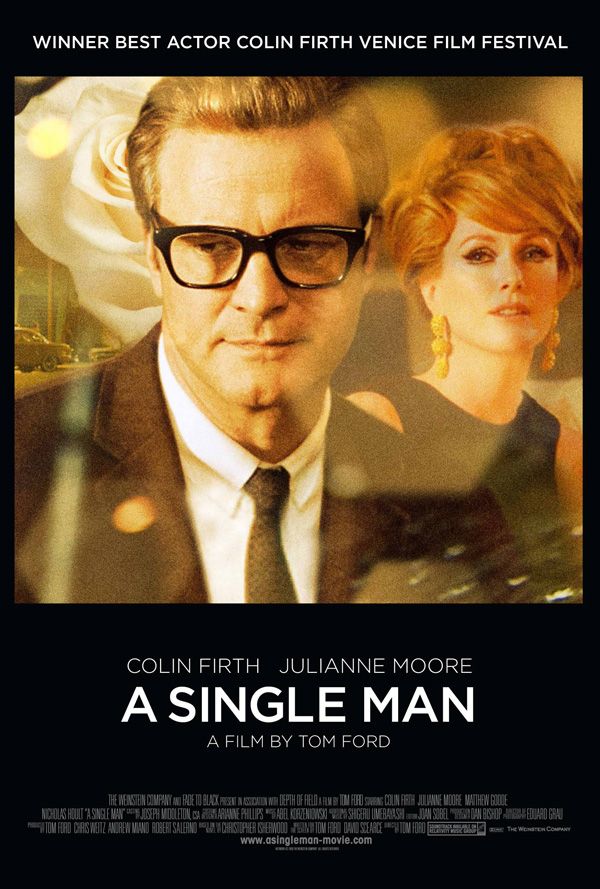
To Phoenix Square this evening, to see "A Single Man". The film (or rather, fashion designer director Tom Ford) has been criticised for being obsessed with its look, to the detriment of other cinematic aspects; as if it's nothing more than a series of high fashion tableaux vivant. I found the visuals alluring, but not at the expense of other kinds of engagement we'd want with a well-crafted movie.

Colin Firth (who well deserves his BAFTA for the role, I'd say) plays a fastidious man, a professor of English Literature in California in 1962 who has lost his partner of 16 years, dead from a car accident some months before. He is consumed with grief, loss and loneliness. We are introduced to him on the day that he has decided to end it all by shooting hmself. The reason I'm giving this space in my blog is because the film made a very strong and lively link with what I've been learning on the Monday evening course in "Mindfulness". Because this is the central character's last day on earth, he experiences everything as if it is his first. The film shows him engaging in a new, different and special way with all aspects of his existence, of his interaction with the world around him. He sees, hears, smells, tastes and feels everything anew and fresh - the last of these related to both the outer sensation of touch and the inner feelings to do with selfhood and relations with others, personal integrity as well as openness.

Near the end of the movie, we hear Firth's character's inner monologue, as he approaches some kind of resolution to his situation: "A few times in my life I’ve had moments of absolute clarity. When for a few brief seconds the silence drowns out the noise and I can feel rather than think … and things seem so sharp and the world seems so fresh. I can never make these moments last. I cling to them, but like everything they fade. I have lived my life on these moments. They pull me back to the present and I realize that everything is exactly the way it was meant to be." I'd say there were some genuine spiritual principles operating here, which took "A Single Man" beyond the superficial debate over anything to do with its fashion conscious look.

As we sat through the closing credits, one member of the audience, who had spotted a friend sitting in our row, came along, leaned over and said, "Oh my God, that was so depressing." Her experience of the film and mine were clearly very different!

ANGLICAN CHURCH CONGREGATION IN LEICESTER CONSIDERS CONVERTING TO CATHOLICISM

This article appears in today's Leicester Mercury:
 
Anglican church congregation in Leicester considers converting to Catholicism
The congregation at one of the oldest Anglican churches in Leicester is considering converting to Catholicism.
About 50 members of St Mary de Castro's congregation met Catholic leaders yesterday to discuss the move.
It followed the Pope's invitation last year to disaffected Anglicans, who feel their Church has become too liberal, to convert to Roman Catholicism.
Pope Benedict XVI's decree would allow traditionalist Anglicans to accept all Roman Catholic doctrine and teachings while maintaining aspects of the Anglican tradition.
Nine-hundred-year-old St Mary de Castro, in Castle Street, near St Nicholas Circle, is already an Anglo-Catholic church.
Anglo-Catholics agree with most the Roman Catholic church teachings, but use the Church of England's Book of Common Prayer and hold Evensong. They would still be able to do if that, if they moved to the Catholic church.
Terry Doughty, from Leicester's West End, organised yesterday's meeting.
He said he believed that if a vote took place now, the majority of the congregation would stay as they are, but added there was lots more to discuss before a decision was reached.
"The Church of England has deviated from traditional beliefs and has become more liberal in its way of looking at things – for some it has become too liberal," said Mr Doughty.
"Women as bishops is one of the reasons traditionalists are unhappy."
He said there were "certainly members of this congregation who would want to take up the Pope's generous offer".
"It's hard to say what could, or might happen until more discussions are held at a higher level," added Mr Doughty.
He said if the congregation did convert, he believed the church building would "in all probability remain with the diocese and those who wanted to become Catholic would have to worship elsewhere".
The Church of England's ruling General Synod voted in 2008 to consecrate women as bishops.
Churchwarden Joyce Levell and her husband, Frank, from Groby, both said they were against female bishops and would support a move to Catholicism if a vote took place.
Mr Levell, 78, said: "There's not a lot of difference between Anglo-Catholic and Roman Catholic.
"I wouldn't be opposed to joining up with the Catholic church if things continue and I think a lot of people within the church share my views."
Father Leon Pereira, prior at the Catholic Holy Cross Priory, in Leicester, was at yesterday's talks and answered questions.
He said: "Recent developments have made them sit up and think their church is not Catholic, whereas they have always had this mindset they were very much linked to Catholicism."
The Archdeacon of Leicester, the Ven Richard Atkinson, said he valued the Catholic church but hoped Anglo-Catholics would remain within the Church of England.
He said: "The invitation is a fundamental shift in identity. It's not that simple.
"Our focus is working closely with our Roman Catholic brothers and sisters in the county but I'm surprised by the Pope's offer, which I believe is untimely and unhelpful.
"The whole church is in a careful process of deciding how we can respect and celebrate the role of women."

Monday, 22 February 2010

mindfulness (5)

After a one-week break for half term, it's back to the course on Mindfulness, offered by Christians Aware at Christchurch, Clarendon Park Road. Leading the session is Ian Grayling (backed up by his colleague, Kevin Commons) from the city's Serene Reflection Meditation Group. I know it's still winter so I probably shouldn't complain, but I must say it's bloomin' freezing tonight! I'm wearing two jumpers, that's how cold it is. the walk from my house to Clarendon Park Road and back is crisp!

This evening is our fifth session and the theme this time is "Thoughts and Feelings". We begin with a quick recap in small groups. We share our varied experiences, listen to diverse understanding and apprecitions of what has happened so far. One of the most intersting, from my point of view (or perhaps, one suited to my taste) is how the practice of mindfulness brings an enhanced awareness of the body, an acceptance of the physical. It's not an attempt to deny our bodily nature or flee the material world. We spoke about how mindfulness may be seen as a state of reverence toward creation and our place in it. This appears to sum up our first four sessions and offers a bridge into the second part of the course. So far, we've been trying to be mindful of the world around us, mediated by our senses. Now we're going to begin to look within.

Ian asks us to consider how we think: "What is the stuff of thought?" Why is it so hard to express in terms that are comprehensible or meaningful to ourselves or to other people the nature of our constant experience of thinking?

Is it visualising - seeing images inside our head? Is it hearing a voice or voices? Is that voice our own, someone elses's or does it vary? Do ideas exist independent of words? Are they in a place that is somehow pre-langauge? If so, then by what means do we access them? Do different people think in different "sensory modalities" - an internalised version of the senses that mediate our external experiences? Is it all random and uncontrollable?

We try a number of thought experiments, imagining some everyday sensory experiences. While some of those present appear to be reacting as if they are undergoing those experiuences inside their heads, to me they are felt at arm's length. It's not too hard to imagine my favourite song (the one that leaps up, unbidden, is XTC's "Life Begins at the Hop") or to see a nice garden, but I can't feel the taste of lemon juice, the touch of sandpaper on my skin or the smell of freshly cut grass. This leads us back to something we discussed at the alst session, how the senses of taste, touch and smell or invasive, how they take place inside the body, as distinct from sight and hearing, which show us things that are "out there". Other interesting questions arise from this exercies: when you imagine a piece of music in your head, are you the performer or are you listening to a performance? Are you originiting something or remembering something - and what's the difference between the two?

Arguably, there are only two ways in which people can think: through "internalised senses" and verbally. Once we become aware of how we think, we become more aware that we can be the author of what we think. This reminds me of that phrase in the Council of Faith's Buddhist leaflet: "that mind can be cultivated".

We're asked to go back into the small groups in which we started the evening and to make a list of as many emotions as we can. We come up with 34. Ian starts to make a list of some of these on the flipchart (no more than half a dozen though) under two columns: "good" and "bad". But that's too simplistic, too value-laden (deliberately on his part, I'm sure). We plump for a list of emotions that we like to have and emotions that we con't like to have. But there's general agreement that we can't have the former without experiencing the latter. That would be like never being asble to experience the pleasure, contentment of satisfaction of eating if we hadn't known hunger or emptiness.

We spend the last quarter hour or so considering the triune model of the brain, which we touched on at the end of session four: the reptilian part, which deals with the basic functions of life, is rigid and compulsive; the limbic, shared by all mammals, which deals with memories and emotions, is the basis of value judgments in humans and has unconscious influence over behaviour; and the neo-cortex, which deals with language, thought and imagination and is the seat of planning and intentional behaviour and problem solving.

visit of Swedish MP


An unexpected meeting this afternoon at the Welcome Centre with a couple of visitors from Sweden. Suzanne Eberstein is a Member of the Sveriges Riksdag - the Swedish Parliament. Among the many posts and portfolios she holds, she is Deputy Chair of the Committee on European Union Affairs and a Judge in the Administrative Court of Appeal. Accompanying Mrs Eberstein is her Political Adviser, Margareta Fallman-Strandberg.

Mrs Eberstein talks about having seen a programme on Swedish television (as long ago as two years, I think) about Leicester as a model of a multicultural city. She's made the trip to Leicester to find out first hand how we do things.

I'd been invited to meet our visitors in the evening and hadn't expected to see them in the afternoon, but found myself in the office when they arrived and it was a good opportunity to make them a cup of tea and for Ajay and me to speak with them while we await the arrival of our Chair and of Hashim Duale. Hashim is a representative of Leicester's Somalian community and our visitors are particularly interested in finding out how that group has settled here and to compare their situation with those of Somalians in Sweden.

At the end of our chat, there's an exchange of gifts - Manjula gives Mrs Eberstein a sari, which says she'll try and wear at the next Nobel Prize award ceremony dinner. That'll be one up for Leicester!

In the photo (l-r): Margareta Fallman-Strandberg, Suzanne Eberstein, Cllr Manjula Sood (Chair of Leicester Council of Faiths), Ajay Aggarwal, Hashim Duale