Tuesday, 29 December 2009

2009'S TOP 10: 3


Inter Faith Week exhibition,
Highcross, Sunday 15 – Saturday 22 November 2009

Anyone who saw the exhibition, or took part in it, may be surprised to see that it's not at number one in my top ten countdown for 2009. But in this list I've tried to balance things that affected me deeply, or things that I feel I did well, alongside things that brought benefit to, or spread the good name of, Leicester Council of Faiths. No doubt this exhibition for Inter Faith Week met all these criteria. It was by far the biggest single project that I was involved in since taking up my post and it was surely the biggest single public event that the Council of Faiths has mounted in its history. Rather than write loads of new stuff about the exhibition here, I'd rather refer anyone who hasn't already seen the earliest entries in this blog to go back to the start and see the full week's worth about what went on at Highcross.

Having said that, I would like to add a little, from an unexpected source. I posted this entry on the morning of Tuesday 29 December, shortly before catching a train to London, where I visited an exhibition at the Design Museum, entitled, "Less and More: The Design Ethos of Dieter Rams". Rams was the chief designer for the Braun electrical consumer goods company in Germany, whose principles and practices had a significant influence on the aesthetic of everyday life from the late 1950s onwards. In the texts on display that accompanied the exhibition, there were two statements that resonated with me when I thought about their relation to the exhibition we put on at Highcross. One text stated how Rams's designs "used different materials and colours but they all reflect a single sensibility", another how he adopted "restrained simplicity as the route to order in a chaotic world." Though speaking about something utterly different - and purely coincidental - both these quotes stood out enough for me to copy them down and want to add them here. Potentially, the exhibition at Highcross could have been chaotic. For many people, inter-faith work itself is chaotic and muddled. Several people, out of perfectly sound motives, asked for certain elements to be featured - pictures (photos of places, paintings illustrating sacred themes, portraits of special people), artifacts, music, food and drink, ready-made exhibitions that had been used on earlier occasions, one source even offered to come along with a number of helpers to build what sounded like a semi-permanent structure out of wood. While all these offers were appreciated and acknowledged, they would have made the Highcross exhibition a ragtag jumble, without theme or dynamic, not following any kind of line or narrative - and not linked to the other material the Council of Faiths had already produced (our series of leaflet and our new website). Some might have looked at what we presented there during National Inter Faith Week and wondered how such a display could have taken so many weeks in the planning and execution. For me, those two quotations in the Dieter Rams exhibition expressed perfectly how I would want to encapsulate the spirit of what we showed in Highcross that week, and that is now a lasting legacy for promotion of our work in Leicester: "different materials and colours but they all reflect a single sensibility"; "restrained simplicity as the route to order in a chaotic world."

Well, I'm not going to apologise for this significant and successful event not making number one in the list. However, I imagine that the entries that take up the top two slots will be surprising!

Monday, 28 December 2009

2009'S TOP 10: 4


Volunteering and Faith Communities Briefing Day,
Birmingham Centre for Voluntary Action,
Monday 11 May 2009

This event at Birmingham Centre for Voluntary Action was intended for leaders in the faith and volunteering sectors who want to hear firsthand what new research in this area has revealed; faith organisations who want to learn about other faiths and volunteering and find out about the next steps for this project; volunteer development agencies interested in developing faith based volunteering and learning about the potential funding opportunities for innovative pilot projects.

Leicester Council of Faiths was asked to help organise a number of focus groups earlier in 2009 to help provide information for the research project, “Volunteering and Faith Communities”. In recognition of this support for the project, Barbara Regnier at Dare to Change asked me to be the opening speaker at this event, which drew around 60 or so attendees, from all parts of England. This was followed by researchers from De Montfort University’s Centre for Social Action who presented their findings on volunteering and faith communities in England. A free copy of the published report was given to delegates (Leicester Council of Faiths was given 50 copies of this publication, with compliments for our cooperation in the project; there are still some available if anyone would like one).

In the afternoon, we heard from Professor Harris Beider, of the Institute for Community Cohesion, who set up round table discussion where attendees worked together to share experiences and expertise to help shape the outcomes for the remainder of this programme. On a personal level, this day was important for seeing the following text for the first time, entitled “The Helping Grace”. I’d discussed this briefing - and the presentation I was intending to give - with Clare and she sent me this (from a book entitled Helping the Client by John Heron) on the morning of the event:
"People who help people move by the grace within the human spirit. This grace is the primary source of effective helping behaviour. Its presence and expression are entirely independent of professional training: it can inform and be enhanced by the latter, but can also be obscured, suppressed and distorted by it
“This helping grace seems to have five key attributes: warm concern for and acceptance of others; openness and attunement to the other's experiential reality; a grasp of what the other needs for his or her essential flourishing; an ability to facilitate the realisation of such needs in the right manner and at the right time; and an authentic presence. This combination of concern, empathy, prescience, facilitation and genuineness is, I believe, the spiritual heritage of mankind. . . . What makes the effective helper is, then, an interaction between inner grace, character and cultural influence. Inner grace is a spiritual endowment and potential, which everyone has. Character is what persons make of themselves in the light of this endowment and in response to their culture."

I picked this up on my BlackBerry, while on the train on the way to the briefing. Having read it, I decided to ditch the presentation I had prepared, and with hardly an hour to go before my talk, redrafted the whole thing, putting this text onto PowerPoint slides at double-quick time. This passage just seemed so apposite to the theme of the day and particularly the approach I was taking, that would help set the tone for the whole event. I spoke for half an hour, and gave a very different sort of presentation from the one I thought I would; it was also different from the presentations that followed, mine being the only one that presented a perspective from inside the faith communities. Two things struck me in particular, having helped organise the focus groups in Leicester and having taken part in two of them myself. One was how people within the faith communities who routinely offer services that the rest of the world consider to be "volunteering" don't see it that way themselves - it's just how they live and what they do (sometimes it's what is expected of them) individually or collectively. The other was how some belief systems embrace (or even institutionalise) service voluntarily offered and practised as "seva" or something along those lines. I made reference to these two aspects in my presentation. I'd been looking for a way to connect these two approaches that would allow them to be united without flattening out their differences; the notion of the Helping Grace allowed me to do that.

Sunday, 27 December 2009

2009's TOP 10: 5


Faiths Trail,
Sunday 13 September 2009

This has become a regular fixture in the Council of Faiths calendar over the past few years, organised in conjunction with English Heritage as part of their programme of open days during this week. I got to go on the first one of these tours (it was called a "Peace Pilgrimage" then) after I took up my post in 2007, but missed last year's excursion, so I was pleased to be able to take part this time.

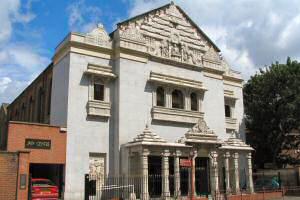
Our party of 25, from a variety of backgrounds and interests (and some from outside Leicester or Leicestershire) convened at Pilgrim House at 0930. We had a few words of welcome and introduction from Minou Cortazzi (Chair of the Council of Faiths), Cllr Manjula Sood (Deputy Lord Mayor and trustee of the Council of Faiths) and Resham Singh Sandhu (Chairman of the Sikh Welfare and Cultural Society and former Chair of the Council of Faiths). Our coach left Town Hall Square shortly before 10 o'clock. First stop was the Jain Centre, Oxford Street (pictured above), where we were joined by the Lord Mayor of Leicester and the Lady Mayoress. From there we proceeded to Shree Jalaram Prarthana Mandal, Narborough Road; then to Guru Amar Das Gurdwara, Clarendon Park Road, where we were treated to lunch (and where the Lord Mayor and Lady Mayoress had to take their leave of us). After lunch we went to the Orthodox Synagogue, Highfields Street; then to the Central Mosque, Conduit Street; and finally, St Philip's Parish Church, Evington Road. As we approached each place of worship, we handed out copies of the relevant leaflet to everyone on the coach, so they'd have a chance to read something about each faith community before each stop on the tour.

Everyone was impressed by the hospitable reception at the various places of worship. Arrangements for the day were made by Ajay Aggarwal, Co-Ordinator at Leicester Council of Faiths.

Saturday, 26 December 2009

2009'S TOP 10: 6


Launch of “Beyond Tolerance” DVD,
University of Glasgow,
Tuesday 2 June 2009

Dr Maureen Sier and her daughter Sonya (Director of Freshlight Films) launched the DVD and education pack, Beyond Tolerance, an inter faith resource for young people and adults. Young people from a variety of religious and national backgrounds were interviewed in the film and spoke at the launch about the ways in which interfaith engagement had made a positive impact on their lives.

I was invited to attend this event and I just couldn't say no. Great to see this happening in my old stomping ground, have the chance to catch up with some old friends and colleagues from the early days of my interfaith activities in Glasgow - and, hopefully, to make some new ones.

In Sonya's presentation at the launch she told the story of how this inspiring project got started (Sonya's words below are lifted wholesale from the Firstport website.
"This interfaith documentary project all started a few months before my mum, Dr Maureen Sier, left for America in August 2007. She'd received a UK/US Fulbright Interfaith Scholarship and I was very proud of her and eager to hear about everything she'd be doing. We were sitting at the dinner table late one night, mum was excitedly telling me about the amazing people she would be meeting in America; activists and scholars from around the globe who were at the forefront of interfaith learning. The plan was for the Fulbright scholars to share what they knew and explore ideas for the future. Each scholar would then go to a different grassroots project, to see what life was really like on the ground. Finally they would each return home and use their experiences to improve interfaith relations in their home country. 
"My mind was buzzing, this was really something - people who cared, who wanted to really make a positive difference. At the same time I started being plagued by the question - How were people going to hear about this? The answer came to be in a flash, literally a light bulb moment. I was convinced that if I could make a documentary about mum's journey, the people, places and organisations she met along the way it would be of interest to everyone, especially to young people who I think are the key to making real change in the world. At the same time as all this was happening I noticed whenever I watched the news, it was a doom and gloom, in fact depressing, broadcasters showed nothing but images of war, terrorism and violence, as one of the my interviewees says in the DVD 'if it bleeds it leads!' No wonder people feel hopeless!
"And so it was from this desire to make a difference, to show the world in a more positive light that Beyond Tolerance was born. I wrote a proposal and sent it to everyone I knew and sometimes people I didn't. Mum left for America and there was no sign of funding, and I was beginning to feel like perhaps it was not meant to be. Then all of a sudden some funding arrived from the Scottish Government, the Baha'i Council for Scotland, British Airways, and Scotland UnLtd. It was enough to take a small crew to America. 
"There we found wonderfully inspiring people especially youth, in fact so many people wanted to share their stories and experiences that we ended up with over thirty hours of footage. When I got home I knew the one thing that was missing was UK and Scottish voices, particularly those of young people and so another bout of filming took place and I was able to interview amazing young people from the UK. 
"The editing process was a long labour of love there was so much footage than we could ever have anticipated and I really wanted to make the most of it. Thankfully some further funding arrived from the Sikh Community and the Scottish Inter Faith Council an this allowed for the process to be completed. While the post production work was happening, work started on the education pack which could be used in schools, universities, religious groups, homes and youth centres. It had to be relevant to issues of diversity, full of activities that could be done anywhere from a small classroom to a large church hall and it had to be engaging for the participants. A tall order I hear you cry. Well, yes, but we had the assistance of many wonderful consultants from across the learning and artistic sectors. The final combination of interfaith documentary and education pack is something we're very proud of and it's already being used here in the UK."

The launch went without a hitch and the guest speakers included Dr Rose Drew, from the Glasgow University Centre for Inter-faith Studies, MSP Fergus Ewing and Haroon Ahmed, Magdalen Lambkin, Frances Hume and Dr Maureen Sier, all of whom are interviewed in the film. The atmosphere was one of hope, excitement for the future and positivity about the role interfaith can and does play in building good community relations. Many personal stories were told and MSP Fergus Ewing spoke of the continued need for education against sectarianism, bigotry and religious hatred. Dr Drew said, "This project is timely, education is vital and not just the academic level at the grassroots is really where it will make the biggest difference." There are great plans for Beyond Tolerance, already Sonya has been in discussion with Australia and New Zealand about it being used down under so it is with great expectations that we "watch this space" for further development of this inspirational project.

2009'S TOP 10: 7


“Sacred on Location”,
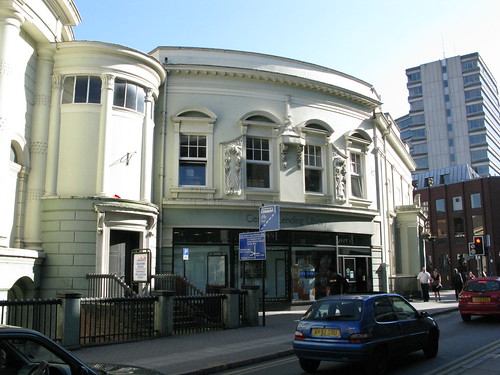
Central Lending Library, Belvoir Street, Leicester,
Friday 16 January - Friday 6 February 2009

This was a touring version of the British Library’s most successful ever exhibition (on show at the British Library’s St Pancras site, April to September 2007). It visited Leicester’s Central Lending Library for three weeks. The exhibition brought together some of the world’s most important and beautiful religious texts, exquisite and rare examples of Jewish, Christian and Muslim sacred texts from the British Library’s collections were presented in a unique and compelling modern context, which included a distinctive interactive element, enabling visitors to leaf virtually through some of the Library’s greatest treasures and even to hear extracts from the texts chanted aloud in their original languages. It also provided people with the chance to explore information about customs and rituals from the three faiths featured in the original exhibition: Judaism, Christianity and Islam.

I was commissioned to run a series of workshops on behalf of Leicester Council of Faiths, for several schools and colleges who were booked in to visit the exhibition. Unfortunately, this coincided with the worst snowfall in England for over 25 years; a fairly small amount of snow brought the country to its knees for days on end. So only two of the workshops went ahead, with Crown Hills Community College and Regent College. This was an excellent exhibition to have come to Leicester and it's a pity that more people didn't see it. Of those who did get to see it, many complained that it didn't reflect the nature of religious diversity in our city, focusing as it did only on Judaism, Christianity and Islam. But that was missing the point and there are always plenty of people who will do that, sadly. To counteract any such feelings of omission or misrepresentation, we were able to display our full series of leaflets, featuring all eight of the religions represented on Leicester Council of Faiths, in the entrance to the library. Loads of these were taken away by visitors to the library over the course of the exhibitions.

Sacred on Location launched at an event split between the The Mitchell Library and Botanic Gardens in Glasgow on 27 April 2007 before touring the UK for more than two years in all.

Thursday, 24 December 2009

2009'S TOP 10: 8


“One Leicester: Harmony & Diversity”
Secondary RE conference,
Salvation Army, Ladysmith Road, Wigston,
Monday 28 September 2009

The Salvation Army Leicester South HQ is an excellent facility and our hosts were very hospitable. The key purpose of this event was the founding of the Students' Council on RE. Being at this day was part of the ongoing process of strengthening relations between Leicester Council of Faiths and Leicester SACRE (Standing Advisory Council on Religious Education). There were around 12 schools represented out of a possible 17, with well over 100 students there. There was a good number and variety of workshops and sessions on offer, but I didn't get in to any of them. My part was to bring a small exhibition, stand by it for most of the day and ensure that staff from the various schools attending the event went away with sets of our leaflets to use as classroom resources. "They also serve who only stand and wait" as John Milton famously wrote.

Wednesday, 23 December 2009

2009'S TOP 10: 9


Andy Cooke Show,
Eava FM,
Wednesday 8 April 2009

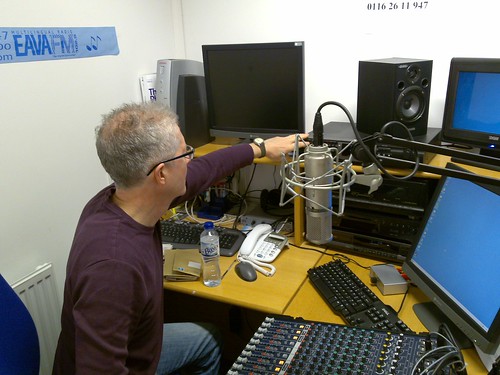
I'd met Andy a few weeks earlier, at a meeting of the short-lived Leicester Community Network which was held in the LCB Depot, Rutland Street. He'd asked me then (in principle) if I'd appear on his morning show on Eava FM, which goes out daily, live for an hour, from 0900-1000. Eava FM is a multilingual community radio station, with licence to broadcast only within Leicester. I was the only subject on this edition of Andy's show and, apart from four or five pieces of recorded music, the whole hour was given over to the two of us chatting. I got to talk about my early experiences in inter-faith work in Glasgow and what I did before taking up my current post with Leicester Council of Faiths; so I got to big up ReMit and Network for Change while talking about my teaching adults with long-term mental health issues. We covered some interesting ground on the show, such as how an organisation like Leicester Council of Faiths would relate to the increasing number of people in this city and country who describe themselves as being "spiritual" but not necessarily "religious" - those who express a genuine and lively interest in values and lifestyles that go beyond the merely material, while not aligning themselves to any religion or belief system. In this context I got to explain, live on air, how the pickling classes at Network are one of the most spiritual activities I've ever heard of! Only two people whom I know told me that they'd actually listened to the programme, since I didn't have much time to alert anyone about it.

Tuesday, 22 December 2009

2009'S TOP 10: 10


New Year Address to Leicester De Montfort Round Table,
Regency Hotel, London Road, Leicester,
Thursday 8 January 2009

At little more than 24 hours’ notice, I was asked to give the New Year address to the Leicester 500 De Montfort Round Table. I may have been filling in for someone else who had dropped out at short notice, but I’m not proud! Initially, when Ash Sheikh (their Programme Officer) phoned and asked me to speak, I declined, because I’d already accepted an invitation to attend a reception for the Cllr Manjula Sood, Lord Mayor of Leicester, which the Council of Faiths was sponsoring the same evening at the Welcome Centre. But very quickly I reconsidered, called Ash back before he could find someone else and said yes. I thought that if the Lord Mayor knew that I’d turned down the chance to speak about the Council of Faiths to such a distinguished meeting for the sake of some tea and buns with her, she’d box my ears!

The Round Table meets at the Regency Hotel, London Road. Apparently, they take their New Year address from someone involved in religious life locally; I was the first to be asked to speak from a multi-faith perspective. It was a very positive experience (for me at least); they laughed at the right bits and asked good questions. I was warned beforehand that it’s their practice not to applaud the New Year address, but most of them did anyway – even though it meant the members had to pay a fine to their Sergeant-at-Arms!

I was impressed by the Round Table’s aims and objectives and the grace that was said before dinner. I thought it would be good to include them here (starting with the grace):
May we, O Lord, adopt thy creed,
Adapt our ways to serve thy need,
And we who on thy bounty feed,
Improve in thought, in word and deed.


And the aims and objectives of the Round Table:
  1. To develop the acquaintance of young men through the medium of their various occupations;
  2. To emphasise the fact that one’s calling offers an excellent medium for service to the community;
  3. To cultivate the highest ideals in business, professional and civic traditions;
  4. To recognise the worthiness of all legitimate occupations and to dignify each his own by precept and example;
  5. To further the establishment of peace and goodwill in international relationships;
  6. To further these objects by meetings, lectures, discussions and other activities.

I was told later that the upper age for membership of the Round Table is 45; so if I fancied becoming a member, I’m too old, even if they’d have me!

2009'S TOP 10 COUNTDOWN


I've wanted to write this blog for ages, but never quite got round to it. And in that time of waiting I kept thinking how many notable events and activities were being missed out. So I'll be taking advantage of the year end to post highlights of my job in 2009 - reflections on events I've not been able to write about till now. I'll be counting down in reverse order, hopefully posting one entry each day, from now till New Year's Eve. At this time of year, lists about this that and the other are everywhere: on TV, radio, in newspapers and magazines. I'll gladly add to that pile - but at least it's not going to be my top ten of the whole decade!

Monday, 21 December 2009

VITAL STATISTICS

An hour well-spent this afternoon at Leicestershire Centre for Integrated Living, with Carolyn Pascoe, REDP's Research Officer, looking at some of the work she's been doing on the similarities, differences and variations in equality, diversity and human rights issues across the East Midlands. This is mostly for presentation at the various Involvement Meetings that REDP will be hosting all over the region early next year.

It's more challenging to get suitable information on some of the equality strands than others; we discuss some creative ways of accessing meaningful info for the harder-to-reach topics. We discuss differences between the kind of knowledge we can gain from statistics and the kind we can get "on the ground". It's the first time I've been able to work one-to-one with Carolyn since her appointment in the summer. Just from this hour together, I can certainly see the value of her contribution to the project!